Real Yield DeFi Models That Are Dominating the Market
Calibraint
Author
December 16, 2025
Alright, DeFi folks,
If you chased four-digit APYs in the last cycle, you already know how that story ends. Tokens vanished into oblivion, incentives quickly disappeared, and protocols that once seemed unstoppable simply… faded away quietly. The promised yield was impressive, but the underlying economics were actually very fragile.
That experience left a lesson that the market couldn’t ignore: hype alone doesn’t create lasting returns. Investors started asking a simple question: what actually pays?
The answer lies in protocols that generate real revenue. As 2025 wraps up, the strongest DeFi protocols aren’t promising the moon. Instead, they’re offering realistic returns backed by actual revenue. Think fees from trading, interest from borrowing, or rewards genuinely tied to participating in the network. Its value is created by real users and shared directly on-chain.
This is the real shift towards real yield decentralized finance. It’s not some brand new narrative; it’s more like a necessary correction. We’re talking about yield that comes from genuine usage, not just endless token issuance. Token models that feel like true ownership, not just marketing gimmicks.
In this guide, we’re going to dive into the real yield DeFi platforms that are truly proving their staying power.
No hype. No rehashed talking points.
Just a straightforward look at what’s genuinely paying, why it’s built to last, and how anyone serious about DeFi should be thinking about real yield.
Why did early “yield” models lose credibility?
DeFi didn’t fail because the tech was broken. It failed because the early methods it tried to generate revenue relied solely on creating new tokens, rather than actual economic activity. When your “yield” relies on constantly printing new tokens, the whole system needs endless growth to keep going. That’s not yield; that’s just diluting everyone’s share.
The market, as it always does, quickly set everyone straight on that. Protocols that weren’t actually generating revenue couldn’t sustain the incentives. Users who showed up for the ‘yield’ left just as fast as they came. The takeaway was crystal clear: no cash flow means both your governance power and token value go down the drain together.
This realization triggered the rise of real yield decentralized finance, where returns are funded by protocol revenue generated from user activity rather than token inflation. This approach mirrors how SaaS, exchanges, and infrastructure businesses mature.
Executive Summary
Real yield decentralized finance generates income solely from protocol revenue, such as trading fees, lending interest, or staking rewards, without relying on inflationary token emissions. This approach marks a mature evolution in DeFi.
Key findings reveal dominance by three models:
Liquid staking derivatives (led by Lido, with $25.8 billion in TVL and consistent 2-3% APY from Ethereum consensus rewards).
Yield-bearing stablecoins (Ethena’s sUSDe, holding $6.7 billion in TVL with current APY around 4.5%, backed by funding rates).
Lending and yield trading platforms (Aave at $32.6 billion TVL and Pendle at $3.7 billion).
Risks remain, including funding rate volatility and smart-contract vulnerabilities, yet revenue-backed distribution proves more resilient than past emission-driven farms.
“Real yield refers to income generated from actual economic activity—trading fees, lending interest, or protocol revenue—rather than token incentives.”
What ‘real yield’ in decentralized finance really means for you.
Real yield decentralized finance (DeFi) refers to projects that share the actual money they make. This income can come from various activities like trading fees, interest on loans, staking rewards, premiums from advanced financial products, or even earnings from real-world assets. The main idea is straightforward: the ‘yield’ or earnings you receive come from the project’s genuine profits, not just from minting new tokens.
Why this difference is so important: When a project’s earnings actually back the yield, it means they can clearly plan how to manage their money, reinvest, and reward people who help govern the project. People who hold the tokens act more like actual owners, not just folks hoping for a quick buck. And the teams building these products can focus on keeping users long-term, instead of just chasing temporary spikes in funds locked on the platform.
For the people running these projects, this setup makes a huge difference. Being able to clearly see the money coming in and out means they can plan for the future, understand potential risks, and position their product for lasting success.
The revenue-generating DeFi models proving durability
Not all DeFi revenue is equal. The most credible revenue-generating DeFi models share three traits. They are usage-driven, transparent on-chain, and resilient across market cycles.
Fee-based decentralized exchanges
Decentralized exchanges that generate fees from actual trading volume form the foundation of real yield decentralized finance. When users trade, fees are collected. When volume rises, revenue grows organically. Yield distribution becomes a function of platform adoption rather than incentives.
Protocols that share fees with liquidity providers or stakers align usage with reward. This model resembles exchange economics familiar to institutional leaders.
Lending and borrowing platforms
Lending protocols earn revenue through interest spreads. Borrowers pay for access to capital. Lenders receive interest. The protocol captures a portion for operations and governance.
This is one of the most intuitive sustainable APY models. When borrowing demand increases, revenue expands. When demand slows, yields compress naturally. There is no artificial floor maintained by emissions.
Liquid staking and validator economics
Liquid staking protocols earn revenue from validator rewards. These rewards originate from network security participation rather than token creation at the protocol layer. When stakers receive yield derived from consensus participation, the system reflects productive economic activity.
This category has become a pillar of real yield decentralized finance because it ties yield to infrastructure security.
Derivatives and structured products
Perpetuals, options, and structured DeFi products generate revenue through trading fees and premiums. These platforms behave similarly to traditional derivatives venues. Active traders fund yield for liquidity providers and stakers.
This model introduces sophistication and risk, but when designed correctly, it supports consistent on-chain revenue distribution.
Real-world asset protocols
Protocols tokenizing real-world yield sources such as treasury bills or private credit produce revenue independent of crypto market cycles. These platforms attract enterprises because cash flow originates from external economic activity.
For leadership teams seeking stability, this segment is shaping the next phase of real yield decentralized finance.
Sustainable APY models that survive market stress
You really find out if your returns are sustainable when the market takes a hit. The best APY models adjust themselves automatically based on actual usage, not just on how people are feeling or what the market sentiment is.
Protocols with sustainable APY models demonstrate several behaviors:
Yield fluctuates with demand rather than remaining fixed
Treasury reserves grow during high activity periods
Incentives decline gracefully without user flight
Governance decisions reflect capital efficiency
These characteristics are visible on-chain. No need to trust anyone, just inspect them yourself.
Leadership teams evaluating DeFi products should assess whether yield declines during market contractions or remains artificially elevated.
Real yield tokenomics as a governance discipline
Once revenue becomes real, tokenomics stops being a growth trick and starts becoming governance infrastructure.
In real yield decentralized finance, token design determines how value actually moves through the system. It defines how revenue is shared between users, the treasury, and reinvestment. It decides whether contributors are rewarded without dilution. It shapes how protocols fund growth without falling back on recurring emissions.
The protocols that get this right treat token holders as economic participants, not promoters. Revenue-based rewards align incentives across builders, users, and governors because everyone is tied to the same source of value: usage.
This approach creates stability. Planning becomes possible. Decisions carry weight. Over time, predictable economic behavior replaces reactive incentive cycles, which is exactly why these models are proving durable.
One of the most underappreciated strengths of real yield decentralized finance is verifiability. Revenue flows can be inspected directly on-chain. Distribution logic is encoded in contracts.
For enterprise teams, this changes due diligence. Financial transparency is not provided through quarterly reports. It is observable in real time.
On-chain revenue distribution also simplifies compliance conversations. Clear flows reduce ambiguity around value capture and reward mechanisms.
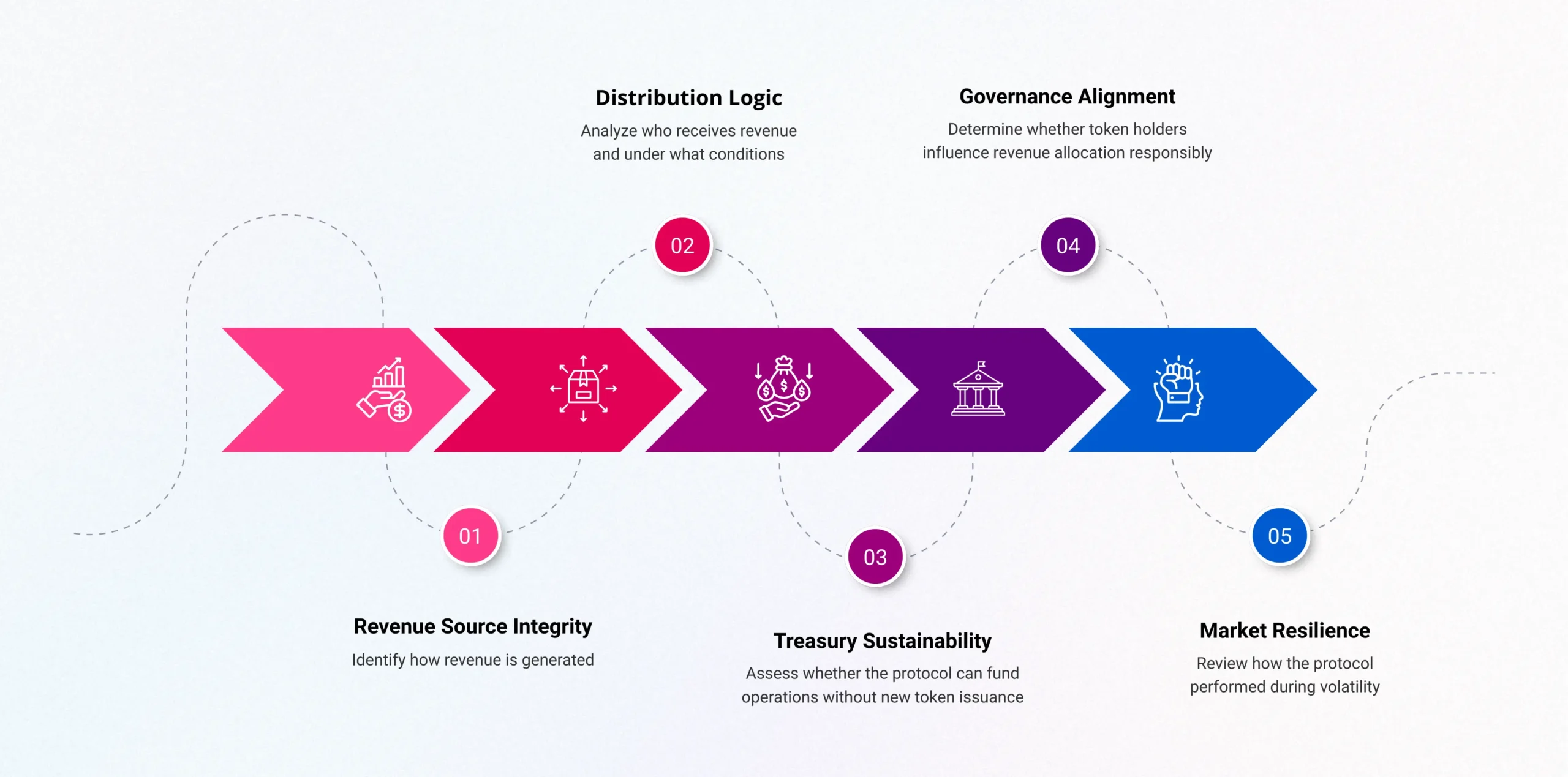
A consulting-style framework for evaluating real yield DeFi platforms
Leadership teams should not evaluate protocols based on APY alone. A repeatable framework brings clarity.
Step one: Revenue source integrity
Identify how revenue is generated. Is it driven by user behavior or token issuance?
Step two: Distribution logic
Analyze who receives revenue and under what conditions. Is the distribution automatic and enforceable?
Step three: Treasury sustainability
Assess whether the protocol can fund operations without new token issuance.
Review how the protocol performed during volatility. Did revenue persist?
This framework separates durable platforms from short-term experiments.
Business outcomes that matter to decision-makers
When implemented correctly, real yield decentralized finance delivers measurable outcomes:
Predictable cash flow models for protocol operators
Reduced dependency on external capital
Improved governance participation quality
Stronger user retention driven by ownership economics
Credibility with institutional partners
These outcomes translate into competitive advantage. Products built on revenue discipline scale more responsibly.
Why execution matters more than theory
Understanding real yield is no longer the challenge. The principles are clear: revenue-driven APYs, transparent tokenomics, and on-chain distribution can create sustainable, durable returns. The real test is execution.
Designing these systems requires more than smart contracts. It demands careful economic design, protocol architecture, and anticipation of how incentives interact with real users, capital, and governance. Many teams grasp the theory, but few can implement it in a way that actually delivers predictable revenue and aligned incentives over the long term.
This is where an experienced DeFi development company makes the difference. Teams that have built revenue-driven protocols know the pitfalls, such as fee models that collapse under pressure, governance structures that fail to scale, and incentives that quietly undermine long-term value. That expertise cannot be simulated; it is earned through real-world execution.
At Calibraint, we partner with product teams to transform real yield theory into platforms designed to last. We focus on building protocols where revenue, incentives, and governance align seamlessly, creating systems that scale responsibly without chasing fleeting APYs.
If you’re exploring how real yield decentralized finance can shape your DeFi strategy, start with a partner who understands both the theory and the execution.
FAQs
1. What is Real Yield DeFi?
Real Yield DeFi refers to decentralized finance protocols that generate returns from actual economic activity, such as trading fees, lending interest, staking rewards, or revenue from structured products. Unlike emission-driven yield models, the income comes from genuine protocol revenue, making it transparent, verifiable on-chain, and sustainable over time.
2. How do real yield DeFi protocols generate returns?
These protocols generate returns through revenue streams tied to user activity. Examples include: Fees collected from decentralized exchange trades
Interest earned on lending and borrowing platforms
Rewards from staking or validator participation
Premiums from structured products or derivatives
Returns are then shared with participants according to on-chain distribution logic, ensuring yield is linked directly to the protocol’s performance.
3. Why is real yield more sustainable than token emission-based yield?
Token emission-based yield relies on continuous minting of new tokens, which inflates supply and requires perpetual growth to maintain returns. Real yield, in contrast, is funded by actual revenue generated by the protocol. This creates predictable, usage-driven returns, aligns incentives among participants, and reduces dependency on speculative inflows, making it far more resilient during market volatility.
Calibraint
Author
December 16, 2025
Let's Start A Conversation
Manage Consent
To provide the best experiences, we use technologies like cookies to store and/or access device information. Consenting to these technologies will allow us to process data such as browsing behavior or unique IDs on this site. Not consenting or withdrawing consent, may adversely affect certain features and functions.
Functional
Always active
The technical storage or access is strictly necessary for the legitimate purpose of enabling the use of a specific service explicitly requested by the subscriber or user, or for the sole purpose of carrying out the transmission of a communication over an electronic communications network.
Preferences
The technical storage or access is necessary for the legitimate purpose of storing preferences that are not requested by the subscriber or user.
Statistics
The technical storage or access that is used exclusively for statistical purposes.The technical storage or access that is used exclusively for anonymous statistical purposes. Without a subpoena, voluntary compliance on the part of your Internet Service Provider, or additional records from a third party, information stored or retrieved for this purpose alone cannot usually be used to identify you.
Marketing
The technical storage or access is required to create user profiles to send advertising, or to track the user on a website or across several websites for similar marketing purposes.