Predictive Maintenance Revolution: How AI Prevents Equipment Failures Before They Happen
Calibraint
Author
December 20, 2025
Last updated: December 22, 2025
Unplanned equipment failure rarely announces itself, yet its impact is immediate and costly. Production halts, safety margins narrow, and operational confidence erodes. Most organizations believe they are managing this risk through scheduled inspections, alarms, and maintenance routines. In reality, these methods often respond too late or are just too broad to really help.
That’s where the “Predictive Maintenance Revolution” comes in. Our old ways simply cannot keep up with the complexity of modern equipment. Advances in AI development spot tiny signs of trouble hidden deep inside our operational data–things we could never see before! This means we’re not just waiting for things to break; we can actually step in and fix them while everything is still running smoothly.
This article explains why traditional models fail under modern complexity, how AI identifies risk before disruption, and what separates credible predictive programs from costly pilots.
Why Traditional Maintenance Models Fall Short?
For a long time, we’ve relied on two main ways to keep things running. One is ‘reactive maintenance,’ where we wait until something breaks before fixing it. The other is ‘preventive maintenance,’ where we swap out parts on a schedule, whether it’s by time or how much they’ve been used. While both seem sensible on the surface, they actually create hidden problems that only get bigger and more costly as operations grow.
Reactive maintenance accepts downtime as inevitable. It prioritizes speed over insight and often allows minor issues to escalate into systemic damage. Preventive maintenance reduces surprises but introduces waste. Parts are replaced too early. Assets are taken offline unnecessarily. Labor is consumed by routine rather than value.
The deeper problem is structural. Neither approach accounts for how modern equipment behaves under variable conditions. Assets no longer operate in isolation. They interact with upstream and downstream systems, environmental factors, and fluctuating demand.
This is the paradox leaders face. Over-maintenance inflates cost. Under maintenance increases risk. Traditional models cannot resolve this tension because they lack contextual intelligence.
What Predictive Maintenance Actually Means
Predictive maintenance is often described in technical terms that dilute its business relevance. At its core, the predictive maintenance revolution replaces assumption-driven decisions with evidence drawn from real operating behavior.
AI systems continuously evaluate asset performance using IoT predictive analysis across multiple signals, including vibration, temperature, and load patterns. Rather than reacting when a metric crosses a fixed threshold, the system examines whether behavior is shifting in ways that historically precede equipment failure.
Machine learning maintenance models deepen this understanding by learning from operational history, environmental conditions, and asset interactions. Over time, they establish a dynamic baseline for what healthy performance looks like under varying conditions.
Real-time asset monitoring AI translates these insights into prioritized actions instead of generic alerts. Maintenance teams are not overwhelmed with signals. They are guided by context, probability, and operational relevance.
The Intelligence Architecture Behind Predictive Maintenance
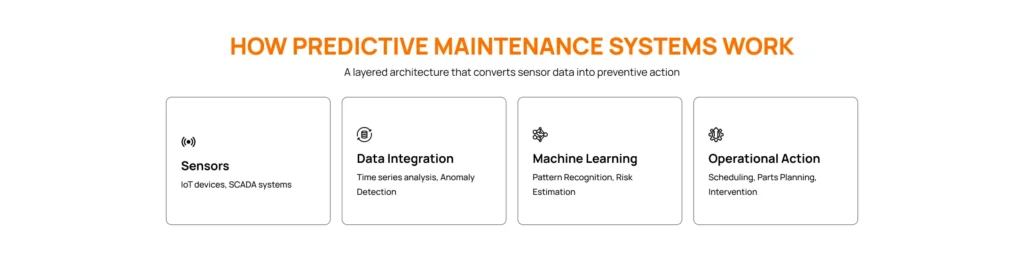
Credible predictive maintenance programs follow a layered structure designed for reliability and scale.
The data layer aggregates signals from sensors, IoT devices, and control systems. Integration with SCADA, ERP, and CMMS platforms ensures that the operational context is preserved.
The analytics layer performs time series analysis and anomaly detection. It identifies deviations in behavior rather than waiting for limits to be breached.
The machine learning maintenance layer applies supervised and unsupervised models. These models classify failure modes, recognize degradation trends, and estimate remaining useful life based on historical and real-time data.
The action layer converts insight into execution. Maintenance scheduling adjusts dynamically. Spare parts planning becomes more accurate. Interventions occur when they matter most.
How AI Identifies Risk Before Disruption
The predictive maintenance revolution focuses on how equipment degrades over time rather than attempting to predict exact failure dates. Instead of reacting to alarms or scheduled intervals, AI evaluates how assets behave during normal operations and looks for early signs of deterioration.
Modern AI systems ingest high-frequency operational data such as vibration spectra, electrical current patterns, temperature changes, and load behavior. Each signal is meaningful on its own, but true risk emerges when these signals shift together in subtle ways.
Rather than relying on fixed thresholds, AI establishes a dynamic performance baseline for every asset. This baseline adapts to operating conditions, production demand, and environmental factors, allowing the system to understand what healthy behavior looks like in context.
Small deviations are evaluated in combination. A slight vibration change may appear harmless by itself, but when it coincides with load imbalance and gradual thermal drift, it often indicates early mechanical wear.
Machine learning models compare current behavior against historical degradation and failure patterns observed across similar assets and operating environments. This allows risk to be assessed as a progression, not a sudden event.
Business Impact that Justifies Adoption
Predictive maintenance delivers outcomes that extend beyond maintenance teams.
Unplanned downtime declines as issues are addressed earlier in the failure cycle. Maintenance spending becomes more predictable as emergency repairs decrease. Asset lifespan extends through condition-based intervention rather than fixed replacement schedules.
Safety performance improves as high-risk scenarios are identified before escalation. Compliance reporting strengthens through documented condition monitoring and traceable decision logic.
These results explain why the Predictive Maintenance Revolution increasingly influences broader operational planning rather than remaining a technical initiative.
Industry Applications Without Exaggeration
In manufacturing environments, predictive maintenance identifies early wear in high-speed production equipment, reducing line stoppages and quality defects.
In energy and utilities, IoT predictive analysis detects degradation in turbines, transformers, and rotating assets where failure carries safety and regulatory consequences.
In transportation and logistics, machine learning maintenance models monitor fleet components to reduce service interruptions and extend vehicle lifespan.
In data centers and critical infrastructure, real-time asset monitoring AI protects uptime by identifying cooling, power, and mechanical risks before service degradation occurs.
Constraints That Must be Addressed
Predictive maintenance is not without challenges.
Data quality remains a common limitation. Inconsistent sensor coverage reduces model confidence. Integration with legacy systems requires careful planning.
Models must be governed to prevent drift as operating conditions evolve. Teams need time to adapt workflows and trust predictive insight.
Acknowledging these constraints early strengthens outcomes and builds long-term credibility.
Governance, Security, and Trust
As predictive systems expand, governance becomes essential.
Data ownership must be clearly defined. IoT networks require cybersecurity controls aligned with enterprise standards. Model explainability supports accountability and regulatory confidence.
Transparency into how recommendations are generated encourages adoption and sustained trust.
Over the coming decade, predictive maintenance will mature into autonomous reliability systems. Digital twins will simulate asset behavior under stress. Cross-asset intelligence will identify systemic risk patterns. Maintenance actions will increasingly be executed with minimal manual intervention.
Organizations that invest in disciplined predictive frameworks today will carry this advantage forward.
Strategic Takeaway
The predictive maintenance revolution reframes reliability as an intelligence function, not a repair task. By combining IoT predictive analysis, machine learning maintenance, and real-time asset monitoring AI, organizations can detect risk early, prevent equipment failure, and act with measurable confidence.
What matters now is not adoption, but execution. Predictive maintenance delivers value only when intelligence is translated into operational decisions across real environments.
At Calibraint, AI-driven reliability is treated as an operational discipline, not a feature set. Our AI services help transform scattered asset data into decisions that prevent failure and protect performance. If reliability is becoming a strategic priority rather than a maintenance concern, this is the moment to explore how predictive intelligence fits your operating reality.
FAQs
1. What is AI predictive maintenance?
AI predictive maintenance utilizes machine learning and asset data to continuously assess equipment condition and predict equipment failure before it occurs. It replaces time-based maintenance with decisions driven by real operating behavior and risk patterns.
2. How does AI prevent equipment failures before they happen?
AI monitors equipment using IoT predictive analysis and compares current behavior with historical performance patterns. When deviations emerge that typically lead to failure, machine learning maintenance models flag the risk early, allowing corrective action before disruption.
3. What are the benefits of AI in predictive maintenance for businesses?
AI-driven predictive maintenance reduces unplanned downtime, lowers maintenance costs, enhances asset reliability, and facilitates more informed operational planning through real-time AI asset monitoring.
Calibraint
Author
December 20, 2025
Last updated: December 22, 2025
Let's Start A Conversation
Manage Consent
To provide the best experiences, we use technologies like cookies to store and/or access device information. Consenting to these technologies will allow us to process data such as browsing behavior or unique IDs on this site. Not consenting or withdrawing consent, may adversely affect certain features and functions.
Functional
Always active
The technical storage or access is strictly necessary for the legitimate purpose of enabling the use of a specific service explicitly requested by the subscriber or user, or for the sole purpose of carrying out the transmission of a communication over an electronic communications network.
Preferences
The technical storage or access is necessary for the legitimate purpose of storing preferences that are not requested by the subscriber or user.
Statistics
The technical storage or access that is used exclusively for statistical purposes.The technical storage or access that is used exclusively for anonymous statistical purposes. Without a subpoena, voluntary compliance on the part of your Internet Service Provider, or additional records from a third party, information stored or retrieved for this purpose alone cannot usually be used to identify you.
Marketing
The technical storage or access is required to create user profiles to send advertising, or to track the user on a website or across several websites for similar marketing purposes.