Web3 Development for Autonomous AI Agents in 2026 Using Smart Contracts That Trigger On Chain AI Actions
Calibraint
Author
January 2, 2026
Web3 AI agents development in 2026 has moved beyond the experimental phase into a mission-critical enterprise requirement. For large-scale organizations in fintech and asset management, the friction of manual orchestration in AI workflows is no longer just an operational nuisance; it is a competitive liability. By leveraging specialized AI services, enterprises can resolve the inherent risks regarding data integrity and execution lag that off-chain automation carries, while also closing the significant compliance gaps created by a lack of deterministic audit trails.
As we navigate 2026, the convergence of decentralized infrastructure and machine intelligence offers a solution where trust is coded into the architecture. By shifting to a model where Web3 AI agents development in 2026 governs high-value transactions, enterprises achieve reduced operational overhead and a level of compliance-ready execution that legacy systems cannot replicate
Web3 Development company Calibraint recognizes that the shift toward on-chain autonomy is not merely a technical upgrade but a strategic necessity. For enterprises to maintain a competitive edge, the integration of deterministic logic within AI workflows is essential. As these systems scale, privacy-preserving verification becomes critical, which is why many enterprises are aligning on zero-knowledge proof–based AI validation models to ensure autonomous decisions remain auditable without exposing sensitive data. The ability to audit every autonomous decision becomes the benchmark for institutional-grade reliability.
Is This For Your Organization?
This strategic briefing is designed for enterprise leaders who are ready to move from pilot programs to production-grade autonomous systems. This is specifically for:
CTOs modernizing AI infrastructure to support decentralized, verifiable workflows.
Founders of Web3-native platforms seeking to integrate autonomous intelligence.
Product Heads designing systems where AI agents must manage financial or sensitive transactional data.
Enterprise Architects ensuring that AI deployments remain secure, scalable, and auditable.
If your organization manages high-frequency decision-making where a failure in automation directly impacts revenue, or if your AI agents must act without human intervention in a trustless environment, the transition to Web3 AI agents development in 2026 is your next logical step.
Solution Snapshot: The Value of On-Chain Autonomy
Web3 Development company Calibraint specializes in bridging the gap between static smart contracts and dynamic intelligence. By leveraging a framework where a smart contract triggers AI actions, we allow enterprises to move away from fragile API-level dependencies. In this paradigm, the smart contract acts as the ultimate source of truth, ensuring that AI on chain execution only occurs when specific, verifiable conditions are met.
This architecture eliminates the need for manual approvals in complex multi-party workflows. When you prioritize Web3 AI agents development in 2026, you are investing in faster execution cycles and lower operational risk. To further strengthen trust at scale, many enterprises now combine this approach with zero-knowledge proof–enabled AI systems, allowing autonomous agents to prove correctness and compliance without revealing proprietary logic or confidential inputs. As a leading Web3 Development company, we ensure that your AI powered decentralized agents in 2026 operate within strict guardrails, protecting your enterprise from the “black box” risks of traditional AI.
Enterprise Decision Drivers: Why Act Now?
The transition to Web3 AI agents development in 2026 is driven by five core business priorities that impact the bottom line:
Automation Without Human Intervention: Traditional AI often requires a “human-in-the-loop” for financial execution due to security concerns. In 2026, a Web3 AI agent development workflow in 2026 utilizes smart contracts to handle the trust layer, allowing for true end-to-end autonomy.
Verifiable and Auditable AI Actions: Every decision made by an agent must be traceable. By understanding how AI agents interact with smart contracts, enterprises gain a permanent, immutable record of why an action was taken.
Scalable AI Agent Orchestration: Managing a fleet of agents requires a decentralized backbone to prevent single points of failure.
Regulatory Readiness: Institutional investment platforms require deterministic outcomes. Using a smart contract triggers AI mechanism ensures that compliance logic is hardcoded into the execution layer.
Cost and Operational Predictability: Moving AI on chain execution reduces the middleman costs associated with traditional escrow and settlement services.
Enterprise Use Cases & Outcomes
The impact of Web3 AI agents development in 2026 is best observed through direct application in complex industries.
1. Autonomous Compliance and Risk Scoring
In institutional investment, manual risk assessment is too slow for 2026 market speeds.
Challenge: Lag in compliance checks leading to missed opportunities or exposure.
Approach: A smart contract triggers AI to analyze counterparty risk in real-time before releasing funds.
Outcome: 90% reduction in compliance processing time and zero-error rate in risk-gate execution.
2. Agent-Based Portfolio Rebalancing
Wealth management firms are deploying AI powered decentralized agents in 2026 to manage assets across multiple chains.
Challenge: High slippage and manual rebalancing errors in fragmented markets.
Approach: Implementation of a Web3 AI agent development workflow in 2026 that monitors liquidity and triggers trades based on on-chain sentiment analysis.
Outcome: Increased alpha through millisecond-level execution and reduced gas overhead.
3. AI-Driven Transaction Approvals
For Web3 infrastructure providers, managing node rewards and penalties requires high-fidelity oversight.
Challenge: Centralized bottlenecks in reward distribution.
Approach: Ensuring how AI agents interact with smart contracts to validate node performance and automate payouts through AI on chain execution.
Outcome: Improved network trust and lower administrative costs.
The Implementation Roadmap for 2026
Successfully executing Web3 AI agents development in 2026 requires a sophisticated AI services partner who understands both high-level architecture and low-level protocol security. The process begins with designing a Web3 AI agent development workflow in 2026 that prioritizes security-first logic.
Our approach integrates AI powered decentralized agents in 2026 by creating a multi-layered validation system. First, the smart contract defines the boundary of the agent’s authority. Second, the AI services provide the inference required for the decision. Finally, the AI on chain execution occurs only after the decentralized network verifies the agent’s signature and the contract’s conditions. This ensures that how AI agents interact with smart contracts remains secure, even if the AI model itself faces external manipulation attempts.
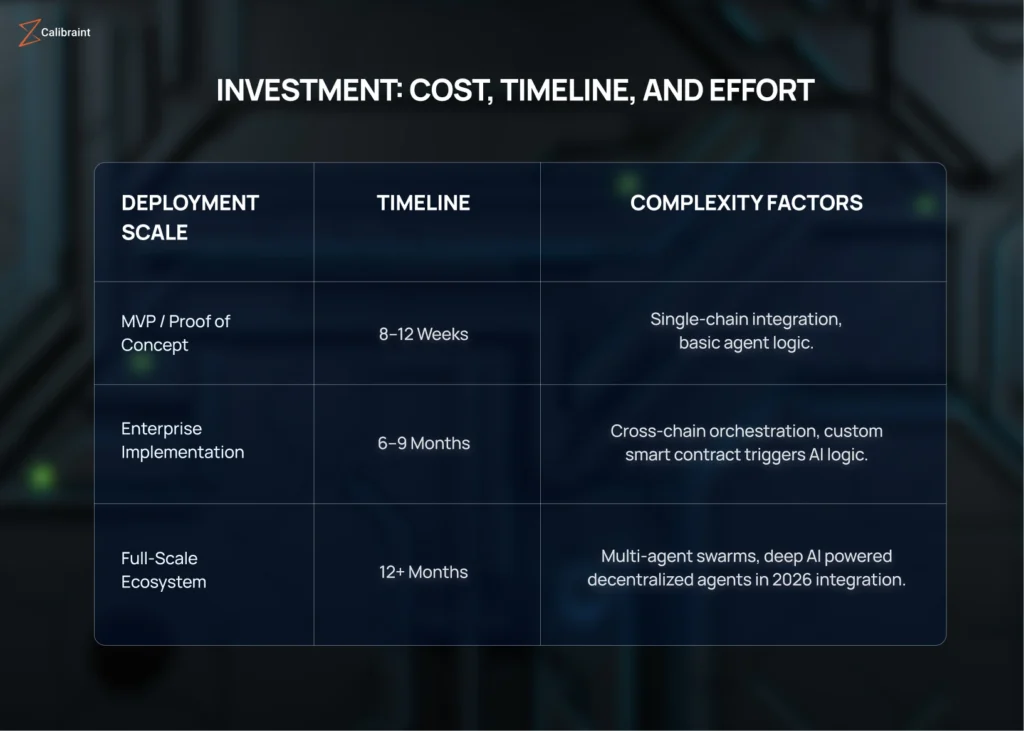
Investment: Cost, Timeline, and Effort
Transitioning to Web3 AI agents development in 2026 is a strategic investment rather than a simple software purchase.
The primary variables in cost include the depth of the Web3 AI agent development workflow in 2026 and the level of security auditing required for the smart contracts.
Critical Risks: Avoiding Enterprise Pitfalls
Without the right execution partner, Web3 AI agents development in 2026 can lead to significant technical debt or security vulnerabilities. Common pitfalls include:
Weak Agent Orchestration Logic: Failing to define exactly how AI agents interact with smart contracts leads to unpredictable “hallucination” actions on-chain.
Inflexible Architecture: Building systems that cannot adapt to the rapid evolution of Web3 AI agents development in 2026 protocols.
Security Blind Spots: Overlooking the bridge between the AI inference engine and the blockchain execution layer.
Why Calibraint is the Trusted Execution Partner
Calibraint stands at the intersection of decentralization and intelligence. We do not just build software; we architect ROI-driven ecosystems. Our deep expertise in Web3 Development company and our specialized AI Agent Architecture frameworks make us the safest choice for mid-market and large enterprises.
When you partner with us for your Web3 AI agent development workflow in 2026, you gain access to a team that understands that technology must serve the business, not the other way around. We ensure that every Web3 AI agents development in 2026 project we undertake is scalable, secure, and aligned with your long-term strategic goals.
Ready to lead the next era of autonomous enterprise operations?
1. What is the role of AI agents in Web3 development?
AI agents in Web3 development automate decentralized decision making, execute on-chain actions, and optimize smart contract workflows. They enable self-governing dApps by combining blockchain transparency with AI-driven intelligence, making Web3 systems more scalable, secure, and autonomous.
2. What are the 5 types of agents in AI?
The five types of AI agents are simple reflex agents, model-based agents, goal-based agents, utility-based agents, and learning agents. Each type differs in how it processes data, makes decisions, and adapts to its environment, with learning agents being the most advanced for autonomous AI systems.
3. How do autonomous AI agents interact with smart contracts in 2026?
In 2026, autonomous AI agents interact with smart contracts through on-chain triggers and off-chain intelligence layers. They analyze real-time data, initiate smart contract execution, and perform AI on-chain actions using oracles and decentralized compute, enabling fully autonomous Web3 AI agents.
Calibraint
Author
January 2, 2026
Let's Start A Conversation
Manage Consent
To provide the best experiences, we use technologies like cookies to store and/or access device information. Consenting to these technologies will allow us to process data such as browsing behavior or unique IDs on this site. Not consenting or withdrawing consent, may adversely affect certain features and functions.
Functional
Always active
The technical storage or access is strictly necessary for the legitimate purpose of enabling the use of a specific service explicitly requested by the subscriber or user, or for the sole purpose of carrying out the transmission of a communication over an electronic communications network.
Preferences
The technical storage or access is necessary for the legitimate purpose of storing preferences that are not requested by the subscriber or user.
Statistics
The technical storage or access that is used exclusively for statistical purposes.The technical storage or access that is used exclusively for anonymous statistical purposes. Without a subpoena, voluntary compliance on the part of your Internet Service Provider, or additional records from a third party, information stored or retrieved for this purpose alone cannot usually be used to identify you.
Marketing
The technical storage or access is required to create user profiles to send advertising, or to track the user on a website or across several websites for similar marketing purposes.