Building Flash Loan Resistant DeFi Protocols in 2026: Security Architecture That Actually Works
Calibraint
Author
January 7, 2026
Flash Loan Resistant DeFi Protocols are no longer a technical luxury; they are a fundamental requirement for institutional solvency. In 2026, the decentralized finance landscape has shifted from experimental retail playgrounds to high-stakes institutional environments, where sustainable value creation and real yield decentralized finance models are closely scrutinized by investors and regulators alike. When an exploit occurs, it is rarely viewed by stakeholders as a mere “technical bug.” Instead, these incidents are categorized as massive capital erosion events that threaten the very core of a firm’s balance sheet.
At this stage of market maturity, DeFi development is no longer about rapid feature deployment or yield innovation alone. It has become a discipline focused on economic security, attack-surface minimization, and system-level resilience. Every architectural decision, from liquidity design to oracle selection, now carries direct financial and reputational consequences for enterprises operating at scale.
For the modern enterprise, a flash loan attack represents a breakdown in three critical business pillars: governance credibility, oracle trust, and regulatory compliance. If a protocol allows an attacker to manipulate price oracles or drain liquidity pools in a single transaction block, the fallout extends far beyond lost tokens. It triggers immediate board-level intervention, platform shutdown risks, and a total collapse of investor confidence. Security architecture in 2026 must be viewed as financial risk containment. We are no longer just hardening code; we are protecting the structural integrity of financial institutions.
Who This Architecture Matters For Right Now
This strategic approach to security is specifically designed for leadership teams who carry the weight of institutional trust. If your organization operates within the following parameters, the move toward Flash Loan Resistant DeFi Protocols is a critical path item for your 2026 roadmap:
CTOs and Security Leads: Those accountable for protocol uptime and the success of rigorous third-party audits.
Founders and CEOs: Leaders who must safeguard the reputation of their brand while managing rapid TVL (Total Value Locked) growth.
Product Heads: Executives responsible for the lifecycle of lending markets, yield aggregators, or RWA (Real World Asset) tokenization platforms.
If your firm is managing institutional capital or operating in compliance-sensitive environments, you cannot afford the “move fast and break things” mentality of previous cycles. You require a DeFi protocol design that anticipates adversarial conditions and neutralizes them before they impact the bottom line.
Security Outcomes Enterprises Actually Pay For
DeFi Development at the enterprise level is judged by its ability to produce predictable economic outcomes. When you partner with a specialized engineering firm, you aren’t just buying lines of Solidity or Rust code. You are investing in controlled liquidity behavior, exploit-resistant transaction paths, and long-term alignment with real yield decentralized finance principles that institutional capital now demands.
The primary goal of building Flash Loan Resistant DeFi Protocols is capital preservation. An enterprise-grade protocol must ensure that its economic logic remains sound even when subjected to extreme, artificial volatility. By prioritizing a DeFi Security Architecture that integrates circuit breakers and multi-layered validation, organizations achieve:
Brand Credibility: Demonstrating that your protocol can withstand sophisticated arbitrage and manipulation attempts.
Audit Readiness: Reducing the time and cost of audits by utilizing pre-hardened architectural patterns.
Long-term Survivability: Ensuring the protocol remains functional during periods of high market stress or malicious activity.
What Drives Security Decisions at Enterprise Scale
In 2026, the decision to invest in advanced Smart contract security 2026 standards is driven by pragmatic business logic rather than reactive fear. Enterprise leaders prioritize the following five drivers:
Loss Prevention Over Reactive Patching: The cost of a post-exploit fix is 100x higher than the cost of secure DeFi protocol design. Prevention is the only viable ROI strategy.
Speed of Launch Without Security Debt: Enterprises need to go to market quickly but cannot inherit technical debt that leads to catastrophic failure.
Scaling TVL Under Adversarial Conditions: As liquidity grows, the “bounty” for attackers increases. Your DeFi Security Architecture must scale its defensive capabilities alongside its assets.
Audit and Compliance Readiness: Institutional users require proof of Flash Loan Attack Prevention before they commit significant capital.
Operational Continuity: Ensuring that the protocol does not require emergency pauses or manual interventions during market volatility.
How Enterprises Are Reducing Flash Loan Exposure in Production
Implementing Flash Loan Resistant DeFi Protocols requires moving beyond basic code audits. It requires specific architectural interventions. Here is how Calibraint helps enterprises secure their production environments:
Scenario A: The Lending Market & Price Manipulation
Core Protocol Risk: An attacker uses a flash loan to pump the price of a low-liquidity collateral asset, enabling them to borrow the entire pool’s liquidity.
Architectural Intervention: Implementing Time-Weighted Average Prices (TWAP) or decentralized oracle networks (like Chainlink) with outlier detection.
Business Outcome: Attack surface reduction and increased institutional confidence in collateral valuations.
Scenario B: Governance Hijacking
Core Protocol Risk: A malicious actor uses a flash loan to instantly acquire enough tokens to pass a proposal that drains the treasury.
Architectural Intervention: Implementing “Snapshot” mechanisms or “Flash-mints” restrictions that require tokens to be held for a specific duration before voting power is activated.
Business Outcome: Hardened governance that protects the treasury from flash-voting exploits.
Scenario C: Yield Aggregator Slippage Exploits
Core Protocol Risk: Forcing an imbalance in a liquidity pool to trigger excessive slippage, which the attacker then captures.
Architectural Intervention: Slippage tolerance guards and transaction sequencing that prevents “sandwich” style flash loan attacks.
Business Outcome: Predictable protocol economics and protected yields for end-users.
How Calibraint Engineers Flash Loan Resistance
Our approach to DeFi Development is rooted in a threat-model-driven delivery model. We do not treat security as an afterthought; it is the foundation of the build.
Threat-Model-Driven Architecture: We identify every potential entry point for a flash loan attack before the first line of code is written.
Oracle and Liquidity Compartmentalization: By isolating risks, we ensure that a vulnerability in one asset pool does not lead to a systemic collapse.
Deterministic Transaction Sequencing: We design protocols to be resilient against MEV (Maximal Extractable Value) and flash loan-driven reordering.
Layered Validation: Every transaction is validated against a set of invariant rules that check for abnormal liquidity shifts or price deviations.
This rigorous Smart contract security 2026 framework ensures that your protocol is not just “audited” but truly battle-hardened.
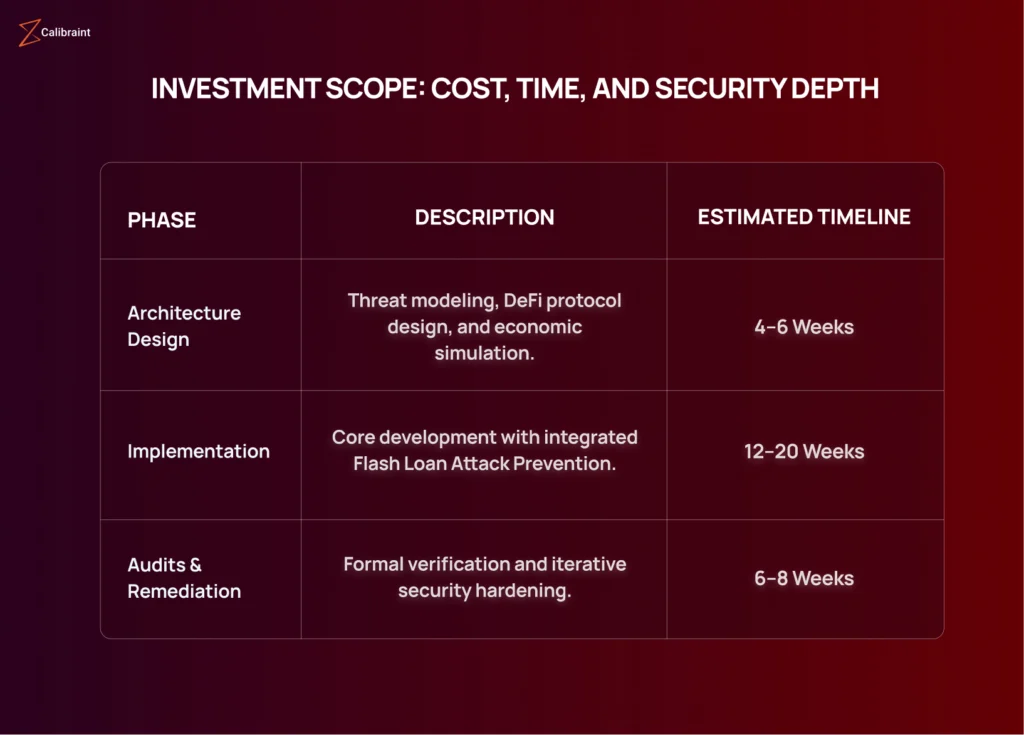
Investment Scope: Cost, Time, and Security Depth
Investing in Flash Loan Resistant DeFi Protocols requires a realistic understanding of the resources needed to achieve institutional-grade protection.
For a security-first MVP, enterprises should expect a budget range that reflects the complexity of the economic logic. Hardened, enterprise-grade systems designed to manage hundreds of millions in TVL require a deeper investment in formal verification and specialized DeFi Security Architecture.
Where Protocol Teams Fail Without a Security-Led Partner
Even the most talented internal teams can fall into common traps when they lack a dedicated security partner. Failure usually stems from:
Designing Economics Before Threat Modeling: If the financial math is sound but the technical implementation allows for flash-liquidity manipulation, the protocol will fail.
Over-reliance on External Oracles: Assuming an oracle is “safe” without implementing local circuit breakers.
Post-launch Security Retrofits: Attempting to add Flash Loan Attack Prevention after the protocol is live is often impossible without a full migration.
Incomplete Audit Readiness: Treating audits as a “rubber stamp” rather than a collaborative hardening process.
Why Enterprises Choose Calibraint for DeFi Security
At Calibraint, we position ourselves as your strategic engineering partner. We specialize in building Flash Loan Resistant DeFi Protocols that meet the rigorous demands of the modern financial sector. Our experience in Smart contract security 2026 allows us to help enterprises transition safely toward sustainable, institution-ready ecosystems aligned with real yield decentralized finance rather than fragile incentive-driven models.
Enterprise Blockchain Architecture: Specialized knowledge in Enterprise Blockchain Architecture that bridges the gap between Web2 and Web3.
Proven Smart Contract Practices: Deep expertise in Smart contract security practices that prevent common and advanced exploit vectors.
Scalability & Resilience: Engineering Web3 platform scalability that ensures your protocol remains secure as it grows.
We understand that for your organization, a secure protocol is more than just good code, it is the foundation of your future business.
1. What are flash loan attacks and why are DeFi protocols vulnerable to them?
Flash loan attacks are exploits where a malicious actor borrows massive amounts of uncollateralized capital to manipulate market variables within a single transaction block. DeFi protocols are vulnerable because they often rely on real-time price oracles and automated market makers (AMMs) that can be artificially skewed by sudden, high-volume trades. Since the loan must be repaid by the end of the transaction or it reverts, attackers face zero capital risk while exploiting logic flaws or thin liquidity to drain protocol funds.
2. What security measures make DeFi protocols resistant to flash loan attacks in 2026?
To achieve flash loan attack prevention, modern protocols integrate decentralized oracle networks like Chainlink to replace single-source spot prices with volume-weighted average prices (VWAP) and time-weighted average prices (TWAP). Advanced DeFi security architecture in 2026 also utilizes on-chain circuit breakers that pause functionality during extreme volatility, reentrancy guards to prevent multi-call drains, and mandatory time-locks for governance votes to block “flash-voting” manipulation.
3. How do you test a DeFi protocol’s resistance to flash loan attacks?
Testing involves rigorous transaction simulation and formal verification to mathematically prove that smart contract logic holds under adversarial conditions. Specialized DeFi development teams use tools to simulate “worst-case” liquidity scenarios and oracle manipulation attempts across interconnected protocols. Continuous monitoring and “dusting” counterattack simulations help developers identify zero-day vulnerabilities in the mempool before they are confirmed on-chain, ensuring the protocol’s smart contract security 2026 standards are met.
Calibraint
Author
January 7, 2026
Let's Start A Conversation
Manage Consent
To provide the best experiences, we use technologies like cookies to store and/or access device information. Consenting to these technologies will allow us to process data such as browsing behavior or unique IDs on this site. Not consenting or withdrawing consent, may adversely affect certain features and functions.
Functional
Always active
The technical storage or access is strictly necessary for the legitimate purpose of enabling the use of a specific service explicitly requested by the subscriber or user, or for the sole purpose of carrying out the transmission of a communication over an electronic communications network.
Preferences
The technical storage or access is necessary for the legitimate purpose of storing preferences that are not requested by the subscriber or user.
Statistics
The technical storage or access that is used exclusively for statistical purposes.The technical storage or access that is used exclusively for anonymous statistical purposes. Without a subpoena, voluntary compliance on the part of your Internet Service Provider, or additional records from a third party, information stored or retrieved for this purpose alone cannot usually be used to identify you.
Marketing
The technical storage or access is required to create user profiles to send advertising, or to track the user on a website or across several websites for similar marketing purposes.