Top 12 Blockchain Development Mistakes That Break Scalability Security and Upgradeability in 2026
Calibraint
Author
January 12, 2026
Blockchain adoption has matured rapidly in the past few years, moving from experimental pilots to production-grade enterprise systems. Many organizations continue to face scalability, security, and upgradeability challenges due to common blockchain development mistakes made early in design and development.
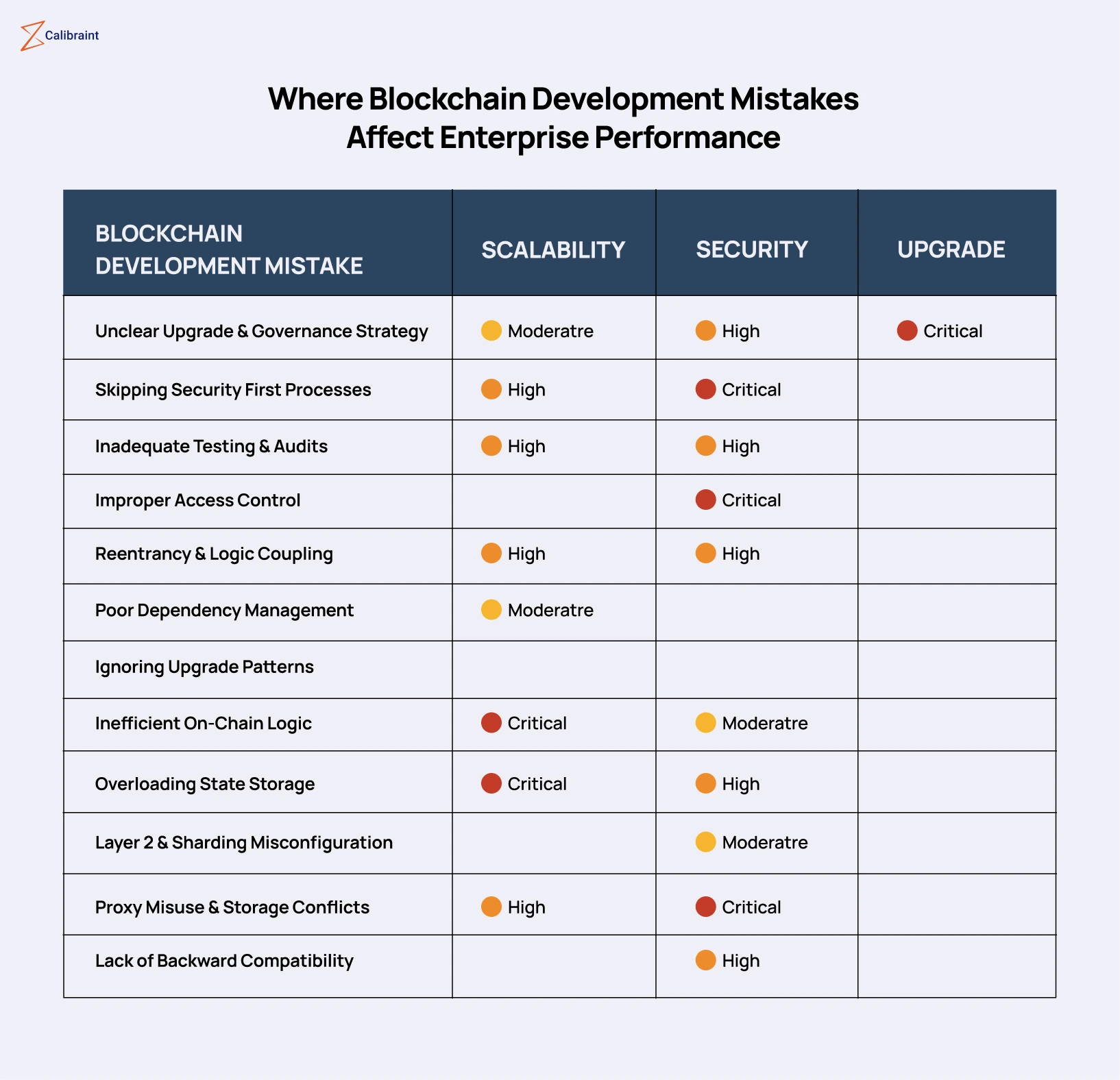
This guide identifies the top 12 blockchain development mistakes that can compromise enterprise-grade systems and explains how each mistake impacts performance, security, and long-term upgradeability.
1. Unclear Upgrade and Governance Strategy
A foundational mistake is failing to define how upgrades and governance will work from the outset. Many teams focus exclusively on initial deployment without planning for long-term maintenance.
Business impact:
Without a clear upgrade strategy, systems become brittle. Changes to smart contracts or protocols risk breaking live applications.
Governance ambiguities can slow decision-making and expose the network to centralized control or unauthorized modifications.
Mitigation:
Define upgrade procedures, access rights, and decision hierarchies before development.
Consider governance models aligned with enterprise risk management and regulatory compliance.
2. Skipping Security-First Development Processes
Security cannot be an afterthought. Ignoring blockchain security risks in early development stages is a critical mistake.
Business impact:
Vulnerabilities in smart contracts can be exploited, causing financial loss or reputational damage.
Security gaps propagate faster in distributed systems, affecting scalability and operational stability.
Mitigation:
Implement security reviews, threat modeling, and code audits as part of standard development workflows.
Integrate automated vulnerability scanners to catch common smart contract vulnerabilities early.
3. Testing Only for Correctness, Not for Scale
Many projects pass functional tests but fail under real transaction volume. This creates performance bottlenecks, inconsistent execution, and failed upgrades in production.
Blockchain scalability issues rarely appear in isolated unit tests. They emerge when contracts interact under load, when state grows, and when external dependencies are stressed.
Enterprise-grade systems require testing environments that simulate production conditions, transaction spikes, and failure scenarios long before go-live.
Access control is one of the most frequently overlooked smart contract vulnerabilities. Mistakes here allow unauthorized execution of sensitive functions.
Business impact:
Unauthorized transactions, fund theft, or system configuration changes.
Can compromise blockchain security, eroding trust among users and partners.
Mitigation:
Apply principle of least privilege, role-based access, and multi-signature approvals.
Regularly review permission structures as contracts evolve.
5. Tight Logic Coupling and Unsafe External Calls
Contracts that combine too much logic or rely on unguarded external calls introduce cascading failure risks. Reentrancy issues and state corruption are still frequent results of this design pattern.
Beyond security, tightly coupled logic reduces scalability. Every interaction becomes harder to optimize, audit, or upgrade independently.
Modular contract architecture with clear boundaries is essential for both blockchain security risk mitigation and long-term maintainability.
6. Fragile Dependency and Oracle Design
Modern blockchain systems depend heavily on oracles, bridges, and external contracts. Poor dependency management turns these integrations into single points of failure.
When external data sources fail, become expensive, or are manipulated, the entire system can degrade or halt. This directly impacts performance and reliability.
Enterprise systems treat dependencies as risk surfaces. They are audited, monitored, and backed by fallback mechanisms rather than assumed to be reliable.
7. Ignoring Upgradeability Patterns During Contract Design
Many teams still deploy immutable contracts without a clear upgrade path. While immutability is a feature, unmanaged immutability becomes a liability.
Without upgrade patterns, even minor changes require redeployment, data migration, and user coordination. This increases operational cost and disrupts scalability.
Controlled upgradeability through well-tested proxy patterns allows systems to evolve without sacrificing trust or continuity.
8. Inefficient On-Chain Computation
On-chain logic that is overly complex or poorly optimized directly limits throughput and increases transaction costs. This is one of the most visible blockchain performance optimization failures.
As usage grows, inefficient contracts turn predictable workloads into cost spikes. This affects user experience and undermines ROI.
Efficient systems minimize on-chain computation, optimize execution paths, and push non-critical processing off-chain where appropriate.
9. Excessive On-Chain State Storage
Storing too much data on-chain is a common cause of long-term blockchain scalability issues. State bloat increases latency, cost, and upgrade complexity.
Enterprises often underestimate how quickly state grows under real usage. Once bloated, it becomes difficult to prune or migrate safely.
Well-designed systems store only essential state on-chain and rely on off-chain storage for historical or auxiliary data.
10. Mis-configured Layer 2 and Scaling Architectures
Even powerful tools like Layer 2 solutions and sharding won’t help if we don’t truly understand how people actually use them. If we guess wrong about how transactions flow, all their potential is lost.
When things aren’t set up right, people experience frustrating delays, information that doesn’t add up, and payments that simply fail. This quickly breaks the trust people have in us, whether they’re our users or our business partners.
We need to build our systems to handle how our business actually works and how people truly interact with it, instead of just looking at impressive numbers in a test.
11. Proxy Misuse and Storage Conflicts
Upgradeability mechanisms introduce their own risks when implemented carelessly. Storage collisions and versioning errors can silently break production systems.
These issues often surface only after upgrades, making recovery expensive and disruptive.
Strict adherence to proven proxy standards, clear storage layout planning, and disciplined version control are non-negotiable in enterprise environments.
When a system can’t update without breaking older versions, it quickly creates a lot of extra work and headaches. It makes adding new features a nightmare, as you risk messing things up for people already using it or other connected systems. This stunts growth for everyone involved and makes things less secure because you can’t safely ditch the old, vulnerable stuff. So, making sure new versions play nice with old ones needs to be a core goal from the start. We can do this by rolling out changes little by little and having clear rules for how everything talks to each other.
Why These Mistakes Persist in 2026
These are not beginner errors. Many enterprise blockchain initiatives fail to progress beyond pilot stages due to mistakes such as unclear governance, scalability limitations, and immature smart contract implementations, as highlighted by Gartner’s research on common blockchain project pitfalls.
They occur because teams underestimate how quickly blockchain systems evolve once real value is at stake. Scalability, security, and upgradeability are not independent concerns. They reinforce or undermine each other depending on early decisions.
This is why experienced enterprise teams increasingly rely on specialized blockchain development partners rather than generic implementation approaches.
How Calibraint Helps Enterprises Avoid These Failures
At Calibraint, blockchain development is approached as a long-term system design challenge, instead of a deployment task. Our teams work with enterprises to identify common blockchain development mistakes before they reach production.
We focus on:
Security-first smart contract architecture
Scalable system design aligned with real business workloads
Upgradeable frameworks that support regulatory and operational change
Continuous audit readiness and performance optimization
This approach allows enterprises to move beyond experimentation and build blockchain systems that scale with confidence.
Final Takeaway
Blockchain technology is mature. Mistakes are no longer excusable. In 2026, the difference between successful blockchain adoption and stalled initiatives lies in disciplined architecture, security-aware development, and upgrade-ready design.
If your organization is building or scaling a blockchain system, now is the time to evaluate whether hidden blockchain development mistakes are already limiting your outcomes.
Talk to our blockchain experts to assess your architecture, identify risk early, and build systems that are secure, scalable, and ready for continuous evolution.
FAQs
1. What is the biggest problem with blockchain?
The biggest problem with blockchain is not adoption or performance, but poor system design. Many organizations underestimate governance, security, and upgrade planning, which leads to platforms that work initially but struggle under real usage. These issues often surface only after deployment, when fixes become complex and expensive.
2. What are the most common blockchain development mistakes?
The most common blockchain development mistakes include unclear upgrade strategies, weak access control, limited testing, inefficient smart contract logic, and incorrect scalability assumptions. These mistakes usually occur early in development and create long-term limitations that affect performance, security, and maintenance.
3. How do blockchain mistakes affect scalability and security?
Blockchain mistakes reduce scalability by increasing transaction latency and operational costs, making systems harder to grow. At the same time, security gaps such as poor contract permissions or unmanaged dependencies expose platforms to exploitation. Together, these risks limit enterprise adoption and long-term reliability.
4. How can enterprises avoid blockchain development failures in 2026?
Enterprises can avoid blockchain development failures by planning for governance, security, and upgrades from the start. This includes testing systems under realistic load, designing contracts for future changes, and aligning technical decisions with business risk. Working with experienced blockchain architects helps prevent structural issues before they reach production.
Calibraint
Author
January 12, 2026
Let's Start A Conversation
Manage Consent
To provide the best experiences, we use technologies like cookies to store and/or access device information. Consenting to these technologies will allow us to process data such as browsing behavior or unique IDs on this site. Not consenting or withdrawing consent, may adversely affect certain features and functions.
Functional
Always active
The technical storage or access is strictly necessary for the legitimate purpose of enabling the use of a specific service explicitly requested by the subscriber or user, or for the sole purpose of carrying out the transmission of a communication over an electronic communications network.
Preferences
The technical storage or access is necessary for the legitimate purpose of storing preferences that are not requested by the subscriber or user.
Statistics
The technical storage or access that is used exclusively for statistical purposes.The technical storage or access that is used exclusively for anonymous statistical purposes. Without a subpoena, voluntary compliance on the part of your Internet Service Provider, or additional records from a third party, information stored or retrieved for this purpose alone cannot usually be used to identify you.
Marketing
The technical storage or access is required to create user profiles to send advertising, or to track the user on a website or across several websites for similar marketing purposes.