Real Time Data Sync and Offline First Mobile Apps in 2026 Using Conflict Free Replicated Data Types
Calibraint
Author
January 16, 2026
As a leading Android App Development Company, Calibraint has navigated the shifting tides of enterprise mobility for over a decade. By 2026, the conversation among CTOs and product heads has moved beyond simple connectivity. We no longer ask if an app can connect to the internet; we ask how it behaves when it cannot.
In our experience building high-stakes platforms for fintech and real estate, we have observed a recurring failure pattern: enterprises treat real time data synchronization as a secondary feature rather than a foundational architecture. When connectivity is assumed, the system is fragile. To build a resilient offline first mobile app in 2026, the architecture must assume that the network is always “partially failed.” This shift from a “cloud-first” to a “local-first” mindset is what separates scalable enterprise systems from experimental prototypes.
The Silent Failure Most Enterprises Discover Too Late
Most enterprise apps perform flawlessly in high-bandwidth demos. However, the true test occurs when an asset manager in a basement vault or a field agent in a remote region attempts to commit a transaction. Without a robust strategy for offline mobile apps, the system typically fails in one of three ways:
The Spin of Death: The UI freezes while waiting for a server handshake that never comes.
The Overwrite War: Two users edit the same record offline; the last one to sync “wins,” silently deleting the other’s data.
The Reconciliation Debt: Conflicts surface weeks later in the backend, requiring manual intervention that scales linearly with user growth.
Many engineering teams attempt to mitigate this by looking for an offline first mobile app in 2026 GitHub repository or an offline first mobile app in 2026 download to use as a boilerplate. While these samples are excellent for understanding basic caching, they rarely account for the complex handling of data conflicts in mobile apps required by institutional-grade SaaS. At Calibraint, we have seen that “bolting on” sync logic post-launch is the most expensive technical debt an enterprise can incur.
This is also why choosing the right mobile app development partner early becomes critical. Enterprises that evaluate architecture depth before development avoid these failures altogether, as explained in our guide on choosing the right mobile app development company in 2025
Why Offline-First Is Now a Strategic Choice, Not a Feature
In 2026, the demand for real time sync for mobile apps in 2026 is driven by more than just poor signal. It is a risk management strategy. For a fintech platform or a digital banking suite, a three-second latency in data visibility can lead to double-spending or regulatory non-compliance.
An offline first mobile app in 2026 ensures that:
Operational Continuity: Business logic resides on the device, meaning the app is always “on.”
Reduced Backend Pressure: By optimizing real time data synchronization, you reduce the chatty nature of traditional APIs, lowering infrastructure costs.
User Trust: Reliability becomes the primary UX metric. When the app “just works” regardless of the 5G signal, user retention increases.
We see this pattern clearly in industries that operate across fragmented networks and multiple stakeholders. For example, enterprises investing in mobile-led supply chains rely heavily on offline-first architectures to ensure data integrity across vendors, logistics partners, and regulators. Our deep dive on supply chain transparency using mobile blockchain tracking illustrates how real time data synchronization and offline resilience directly impact trust and auditability.
How High-Growth Enterprises Solve the Conflict Problem
The primary hurdle in real time data synchronization is the “split-brain” scenario. To solve this, forward-thinking enterprises have moved away from traditional timestamp-based resolution and toward Conflict Free Replicated Data Types (CRDTs).
Rather than treating data as a static value, CRDTs treat data as a series of mathematically provable operations. This means that whether a sync happens in one second or one hour, the final state of the data is guaranteed to be identical across all devices without requiring a central coordinator to “decide” who was right.
By utilizing conflict free replicated data types, we eliminate the need for complex handling data conflicts in mobile apps. There are no “merge conflicts” because the data structure itself is designed to converge. For an enterprise, this means:
No more data loss during concurrent writes.
Zero manual reconciliation for IT teams.
Predictable system behavior across global distributed teams.
Platform Reality: Android, iOS, and Cross-Platform Constraints
The implementation of a high-performance offline first mobile app in 2026 Android environment requires a deep understanding of the background processing limitations of the OS. Android’s WorkManager and power-saving modes (Doze mode) can aggressively kill sync processes if not architected correctly.
Conversely, an offline first mobile app in 2026 iOS strategy must account for strict background execution limits and the “Data Protection” API which can lock local databases when the device is secured. At Calibraint, we balance these platform-specific constraints by:
Using Kotlin Multiplatform (KMP) to share CRDT logic across both platforms.
Implementing platform-specific “Background Fetch” and “Push-to-Sync” triggers.
Ensuring that real time sync for mobile apps in 2026 respects the device’s battery and data health.
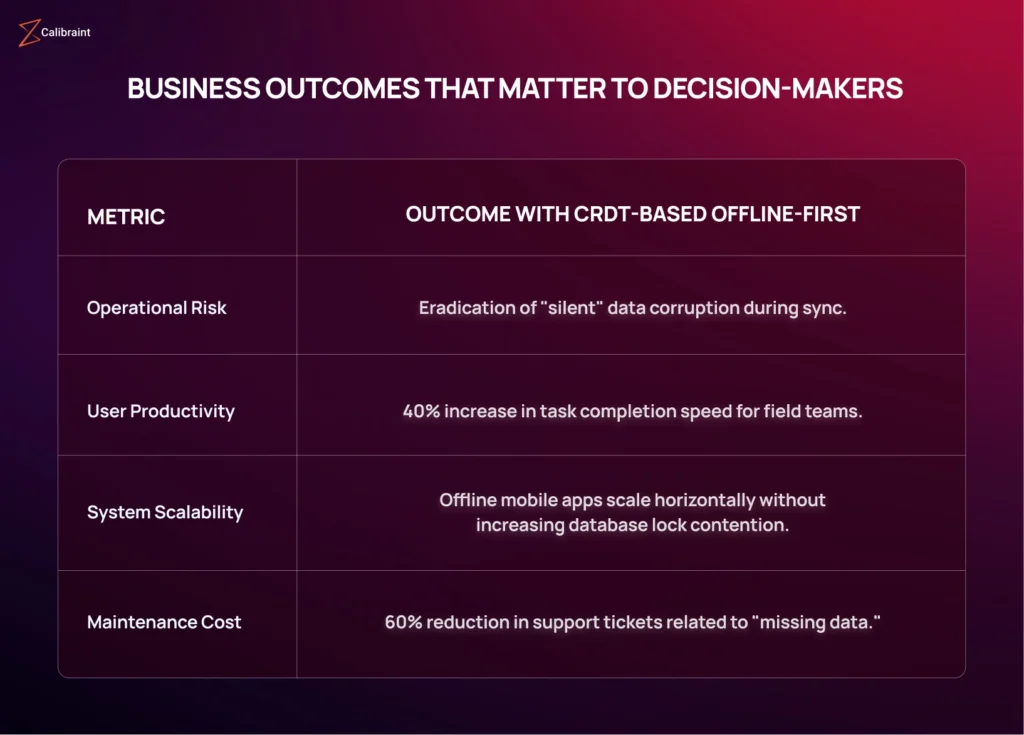
Business Outcomes That Matter to Decision-Makers
When you invest in real time data synchronization powered by CRDTs, you are not just buying a faster app. You are buying:
Check out:
How Calibraint Designs Offline-First Systems That Scale
Local-Primary Storage: We use high-performance local engines (like Realm or Room) that serve as the single source of truth for the UI.
CRDT Integration: We implement conflict free replicated data types for shared entities (e.g., a shared real estate ledger or a collaborative fintech wallet).
Intelligent Sync Orchestration: We don’t just “dump” data. We use delta-updates to ensure real time data synchronization happens with minimal payload sizes.
Cost, Timeline, and What Enterprises Usually Underestimate
A common mistake is under-scoping the “Sync Layer.” Building a best offline first mobile app in 2026 takes approximately 30% longer in the initial phase compared to a simple cloud-dependent app. However, the long-term ROI is massive because you avoid the “Success Tax”, where your system breaks precisely when you start to scale.
What enterprises underestimate:
Testing Complexity: You must simulate high-latency and high-packet-loss environments.
Migration of Legacy Data: Moving from a traditional SQL backend to a CRDT-enabled real time sync for mobile apps in 2026 requires careful schema mapping.
Security at Rest: Since data lives on the device, encryption and remote-wipe capabilities are non-negotiable.
Why Enterprises Choose Calibraint Early, Not After Failure
We are often brought in as a “rescue vendor” after a project fails its first real-world stress test. However, the most successful enterprises engage us during the discovery phase. By choosing us as your Android App Development Company early, you ensure that handling data conflicts in mobile apps is solved at the atomic level, not the application level.
We don’t just build offline mobile apps; we build distributed systems that happen to run on mobile devices.
Executive Close: The Decision Moment
In 2026, real time data synchronization is the heartbeat of the enterprise. You can either build a system that relies on the “hope” of a perfect connection, or you can build an offline first mobile app in 2026 that controls its own destiny through conflict-free replicated data types.
The decision is whether your enterprise controls data consistency or reacts to it. If you are ready to eliminate sync failures and maximize operational uptime, it is time to consult with Calibraint’s mobile architecture experts.
FAQ
1. What is an offline first mobile app?
An offline first mobile app is a mobile application designed to work fully without internet access. It stores data locally on the device and synchronizes changes automatically when connectivity is restored. In 2026, offline first apps treat the device as the primary data source, not the server.
2. What is the future of mobile app development in 2026?
The future of mobile app development in 2026 focuses on offline first architecture, real time data synchronization, and conflict-free data models. Enterprises prioritize reliability over connectivity, using local-first storage, CRDTs, AI-driven UX, and secure on-device processing to ensure apps work anywhere, anytime.
3. Can mobile apps build offline-ready apps with data sync? True or False
True. Mobile apps can be built as offline-ready systems with real time data synchronization. By using local databases, background sync mechanisms, and conflict-free technologies like CRDTs, apps can safely sync offline data without loss or overwriting when the network reconnects.
4. How do CRDTs handle data conflicts in real time apps?
CRDTs handle data conflicts by ensuring all data changes automatically converge to the same final state across devices. Instead of resolving conflicts after syncing, CRDTs prevent conflicts by design, allowing real time apps to sync offline and online data without overwrites or manual reconciliation.
5. Why are offline first apps important in 2026?
Offline first apps are important in 2026 because network connectivity cannot be guaranteed, even with 5G. They ensure uninterrupted operations, protect data integrity, improve user trust, and enable real time data synchronization across distributed teams, making them essential for enterprise and mission-critical mobile systems.
Calibraint
Author
January 16, 2026
Let's Start A Conversation
Manage Consent
To provide the best experiences, we use technologies like cookies to store and/or access device information. Consenting to these technologies will allow us to process data such as browsing behavior or unique IDs on this site. Not consenting or withdrawing consent, may adversely affect certain features and functions.
Functional
Always active
The technical storage or access is strictly necessary for the legitimate purpose of enabling the use of a specific service explicitly requested by the subscriber or user, or for the sole purpose of carrying out the transmission of a communication over an electronic communications network.
Preferences
The technical storage or access is necessary for the legitimate purpose of storing preferences that are not requested by the subscriber or user.
Statistics
The technical storage or access that is used exclusively for statistical purposes.The technical storage or access that is used exclusively for anonymous statistical purposes. Without a subpoena, voluntary compliance on the part of your Internet Service Provider, or additional records from a third party, information stored or retrieved for this purpose alone cannot usually be used to identify you.
Marketing
The technical storage or access is required to create user profiles to send advertising, or to track the user on a website or across several websites for similar marketing purposes.