Beyond the 2025 P2E Crash: Designing Sustainable Tokenomics That Keep Players Engaged in 2026
Calibraint
Author
January 19, 2026
If you are still thinking about P2E tokenomics the way it was discussed in 2021 or even 2024, your skepticism is justified. The collapse of early play to earn systems did not happen because players rejected ownership or because P2E itself was flawed. It happened because incentives were treated as a shortcut to engagement rather than a system that needed discipline.
Most teams now agree on one uncomfortable truth. P2E failed when token rewards were asked to compensate for unfinished gameplay, weak progression loops, and the absence of economic control. What collapsed in 2025 was not play to earn tokenomics as a concept, but the assumption that emissions alone could sustain participation.
The opportunity in 2026 is not to revive old reward models with better marketing. It is to redesign P2E tokenomics as a system that supports engagement, stability, and long-term value without depending on speculation. This requires treating tokenomics less like a growth hack and more like an operating system that quietly governs player behavior.
This article examines how P2E tokenomics is evolving after the reset, why sustainability starts with gameplay, and how GameFi models endure slower growth.
A Framework for P2E Tokenomics in 2026
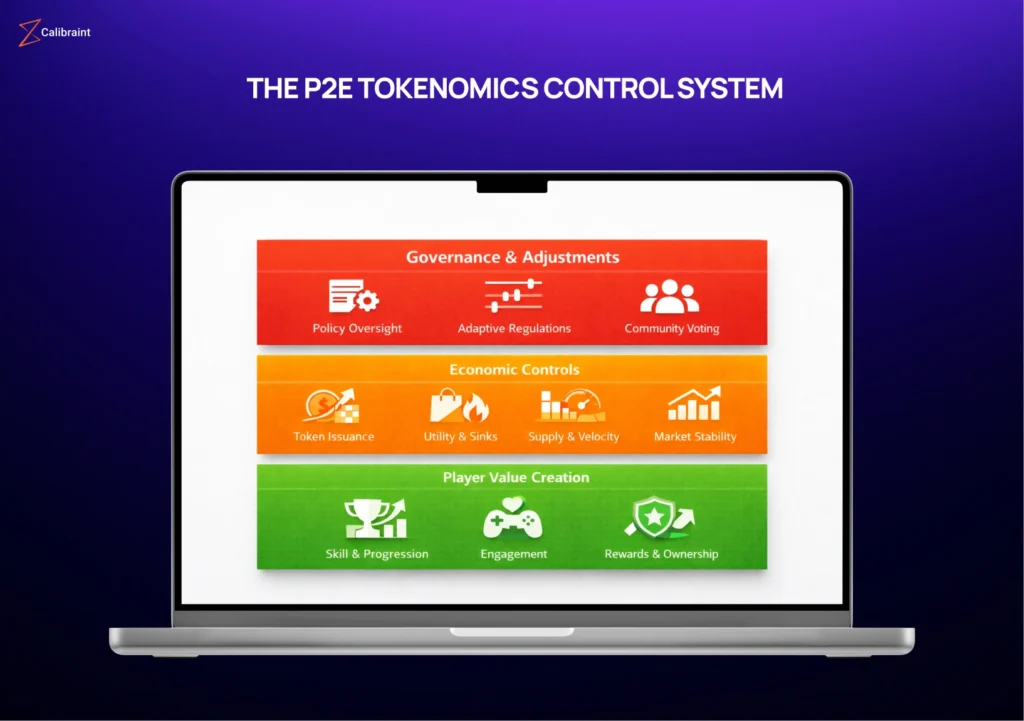
Modern P2E tokenomics is not defined by how much players earn, but by how well the system coordinates value creation, circulation, and control. The most resilient play-to-earn tokenomics models now follow a layered approach that separates player value from economic mechanics and governance decisions.
At the foundation is player value creation. This layer defines which actions genuinely improve the experience for others. Skill progression, competitive mastery, social contribution, and long-term commitment belong here. In sustainable tokenomics, value is created before it is rewarded. Tokens do not manufacture engagement. They reinforce it.
The second layer focuses on economic controls, an area where many early GameFi tokenomics models failed. Teams must design token issuance, sinks, velocity management, and market stability as interdependent systems. In well-structured blockchain game tokenomics, teams pace rewards, embed sinks into progression, and treat inflation as a risk to manage rather than a growth lever.
The final layer introduces governance and adjustment mechanisms. No P2E tokenomics system remains static. What matters is whether change is controlled, transparent, and aligned with player trust. Adaptive regulations, policy oversight, and limited community voting allow systems to evolve without destabilizing the economy.
The infographic below captures how these three layers work together as a single P2E tokenomics control system, rather than isolated features competing for attention.
Where Early Play to Earn Models Lost Control
Early Play to Earn projects did not fail for rewarding players. Designers treated P2E tokenomics as a growth lever rather than an economic system. They issued tokens faster than players created value and relied on incentives to make up for unfinished design decisions.
In many cases, play to earn tokenomics became the product itself. Gameplay loops were shallow, progression systems were thin, and long-term mastery was underdeveloped. Tokens filled the gap. As long as rewards flowed, participation followed. When emissions slowed, engagement collapsed.
This was not driven by bad intentions. It was driven by pressure. Teams prioritized onboarding numbers and daily active users, assuming refinement could come later. But P2E tokenomics do not tolerate deferred discipline. Economic systems respond immediately to incentives, even when designers hope players will behave differently.
Single-token economies made the problem worse. Without meaningful sinks or constraints, tokens accumulated with a limited purpose. Velocity increased, value leaked, and extraction became the dominant strategy. This was not a market anomaly. It was a predictable outcome of the fragile blockchain game tokenomics design.
The 2025 Reset Was Structural, Not Cyclical
By 2025, people could no longer ignore the cracks. Rewards consistently outpaced meaningful player contribution. Secondary markets began shaping in-game behavior more than the game itself. When growth slowed, there were no stabilizers in place.
What followed was often described as a “P2E crash,” but that framing misses the point. This was not a temporary downturn. It was a structural reset. Systems built without economic controls always fail once pressure increases.
This moment forced teams to confront a hard reality. Sustainable engagement cannot be purchased indefinitely. Sustainable tokenomics requires design restraint, not just better token distribution schedules. In this sense, the reset was necessary. It cleared space for GameFi tokenomics to mature beyond speculation-driven participation.
Teams that survived did so by redesigning their assumptions, not by increasing incentives. They began treating P2E tokenomics as something that must remain functional even when user growth slows or market sentiment weakens.
Redefining P2E Tokenomics as an Economic System
At its core, P2E tokenomics is a coordination system. Tokens are not simply rewards. They guide behavior, regulate access, and define progression pathways. When designed correctly, they support the game’s internal logic instead of overpowering it.
In mature play to earn tokenomics models, value enters the system through player effort, skill, creativity, or long-term participation. That value circulates through upgrades, access rights, governance roles, and social status. Only a controlled portion exists as a financial reward.
This distinction is critical for sustainable tokenomics. When too much value exits too early, the system weakens. When circulation is healthy, players remain invested even when rewards fluctuate. This is the difference between extraction and participation.
Modern blockchain game tokenomics accepts that not every action needs to be monetized. Some actions exist to deepen engagement, strengthen retention, or support social cohesion. P2E tokenomics works best when it stays in the background, reinforcing systems rather than dominating them.
Games do not retain players because of yield. They retain players because progression feels earned and mastery feels meaningful. When GameFi Tokenomics places financial rewards ahead of gameplay depth, it distorts motivation.
The strongest models in 2026 reverse this order. Gameplay establishes value first. P2E tokenomics is layered only where it strengthens effort, long-term commitment, or ecosystem contribution. This shift changes how players behave. Tokens become tools within the experience rather than the reason to participate.
From an economic perspective, this approach reduces speculative pressure. From a product perspective, it restores design authority to the game rather than the market. Sustainable tokenomics emerges by aligning them with actions that matter.
This is why many teams now reassess their incentive structures with external partners and specialists who understand both economics and product design. A thoughtful review of P2E tokenomics often reveals that fewer rewards, placed more carefully, deliver better outcomes than aggressive emission schedules.
Designing Sustainable Tokenomics Without Killing Momentum
Restraint has become a defining trait of credible P2E tokenomics in 2026. Emissions are paced. Rewards are contextual. Token sinks are designed as part of progression, not as penalties introduced after inflation becomes visible.
One effective pattern is tying rewards to skill-based milestones instead of repetitive activity. This slows unnecessary inflation while reinforcing mastery. Another pattern embeds sinks into customization, access tiers, competitive entry, and social signaling. Tokens are consumed naturally as players progress.
In sustainable tokenomics, every reward answers a simple question. What behavior does this encourage, and is that behavior valuable to the system long-term? When that question cannot be answered clearly, rewards are often the wrong tool.
Well-designed GameFi tokenomics does not assume perpetual growth. It assumes cycles. Systems built with balance in mind tend to remain functional during contraction, which is where earlier blockchain game tokenomics models failed.
One of the clearest shifts in P2E tokenomics after 2025 has been the willingness to grow slower on purpose. Several post-reset teams resisted the urge to accelerate token rewards during launch, even when market pressure pushed in that direction.
In these models, early progression relied almost entirely on non-financial achievements. Players advanced through skill, reputation, and access rather than yield. Tokens were introduced gradually and only became meaningful once players reached deeper layers of engagement.
This approach felt counterintuitive to observers accustomed to aggressive play to earn tokenomics. Growth was steadier. Speculation remained low. Yet retention outperformed comparable titles built on high initial rewards. When tokens gained value, demand emerged organically rather than being manufactured.
This is the quiet strength of sustainable tokenomics. By prioritizing system health over attention spikes, teams created economies that could stabilize instead of combust. P2E tokenomics worked because it was controlled, not because it was generous.
How Economic Discipline Changes Player Behavior
When incentives are restrained, player behavior changes in subtle but important ways. Instead of optimizing for extraction speed, participants optimize for progression and mastery. Tokens stop feeling like income streams and start functioning as tools.
In well-designed GameFi tokenomics, players hold tokens for access, upgrades, and influence rather than immediate exit. Velocity slows naturally. Demand becomes tied to engagement depth instead of hype cycles. This shift alone addresses many of the weaknesses exposed in earlier blockchain game tokenomics.
Importantly, this does not reduce motivation. It refines it. Players still earn, but earning is contextual. Rewards reflect contribution, not attendance. Over time, this alignment strengthens trust in the system and reduces adversarial behavior.
Strong P2E tokenomics does not fight player incentives. It guides them.
Governance as a Stabilizing Mechanism
Governance was often positioned as a headline feature in early P2E projects. In practice, it rarely functioned as a stabilizer. Voting power was concentrated, proposals were reactive, and changes came too late to prevent damage.
In mature play to earn tokenomics models, governance is quieter and more constrained. They limit decision-making authority. Adjustments are incremental. Transparency matters more than participation volume.
This governance layer exists to protect sustainable tokenomics, not to experiment publicly with live economies. Clear policy oversight, limited voting domains, and predictable adjustment windows help maintain confidence even when conditions change.
In this context, blockchain game tokenomics benefits from governance that feels boring. Boring systems tend to last.
Business Outcomes That Extend Beyond the Game
Well-structured P2E tokenomics delivers more than player engagement. It introduces predictability into incentive costs and reduces dependence on constant acquisition. This predictability matters when teams scale operations, partnerships, or live services.
From a business standpoint, sustainable tokenomics also simplifies compliance and governance discussions. Systems built on controlled incentives and clear utility are easier to explain, audit, and evolve. As scrutiny increases across GameFi tokenomics, this clarity becomes a competitive advantage.
Organizations evaluating long-term viability increasingly look beyond reward mechanics. They assess whether blockchain game tokenomics can remain functional under stress. Teams that design for balance rather than expansion tend to pass that test more consistently.
Why the Control System Model Matters
The P2E tokenomics control system clarifies where blockchain game economies fail and how disciplined design prevents it. By separating player value creation, economic controls, and governance, teams can see why early GameFi tokenomics collapsed and why stronger blockchain game tokenomics now endure. The takeaway is simple: P2E tokenomics is not about earning more. It is about maintaining control.
Turning that clarity into execution requires more than theory. Calibraint helps GameFi teams design sustainable P2E tokenomics that align with gameplay, incentives, and long-term system health. If you are rethinking how rewards, engagement, and value interact in your product, a focused discussion can help. It quickly reveals where adjustments are needed to build an economy that lasts.
FAQs
1. What caused the 2025 P2E crash, and what key lessons emerged for tokenomics design?
Inflationary rewards, unmanaged token velocity, and weak gameplay foundations caused the 2025 P2E crash. The key lesson is that P2E tokenomics must function as a controlled economic system, not a reward engine dependent on constant growth.
2. How can GameFi projects design sustainable tokenomics to retain players in 2026?
GameFi projects retain players in 2026 by leading with gameplay, pacing rewards, and tying incentives to meaningful contributions. Sustainable tokenomics reinforces mastery and long-term participation rather than short-term earning.
3. What are the best practices for balancing rewards and economy in post-2025 P2E games?
Best practices include skill-based rewards, embedded token sinks, controlled emissions, and transparent governance. Balanced P2E tokenomics keep value circulating longer than it exists in the system.
Calibraint
Author
January 19, 2026
Let's Start A Conversation
Manage Consent
To provide the best experiences, we use technologies like cookies to store and/or access device information. Consenting to these technologies will allow us to process data such as browsing behavior or unique IDs on this site. Not consenting or withdrawing consent, may adversely affect certain features and functions.
Functional
Always active
The technical storage or access is strictly necessary for the legitimate purpose of enabling the use of a specific service explicitly requested by the subscriber or user, or for the sole purpose of carrying out the transmission of a communication over an electronic communications network.
Preferences
The technical storage or access is necessary for the legitimate purpose of storing preferences that are not requested by the subscriber or user.
Statistics
The technical storage or access that is used exclusively for statistical purposes.The technical storage or access that is used exclusively for anonymous statistical purposes. Without a subpoena, voluntary compliance on the part of your Internet Service Provider, or additional records from a third party, information stored or retrieved for this purpose alone cannot usually be used to identify you.
Marketing
The technical storage or access is required to create user profiles to send advertising, or to track the user on a website or across several websites for similar marketing purposes.