Enterprise DApp Development: Architecture, Cost Structure, and Deployment Strategy for 2026
Calibraint
Author
January 21, 2026
Enterprise digital transformation often begins with clear budgets, evaluated platforms, and detailed implementation roadmaps. Yet even with thorough planning, organizations encounter slow cross-border settlements, fragmented workflows, and manual reconciliation that undermine operational efficiency.
Web3 development has evolved beyond experimentation into production-ready infrastructure, enabling decentralized applications that support real-time business execution across finance, supply chains, and multi-party processes. Enterprise DApp development addresses these persistent inefficiencies, creating systems that combine automation, accountability, and scalability.
In 2026, progress depends on asking the right questions, designing sound architecture, and deploying with clear business outcomes.
Why Enterprise DApp Development Requires a Different Standard
Early decentralized applications were built for open participation and rapid experimentation. Enterprise systems operate under different constraints. They must support accountability, compliance, uptime guarantees, and predictable costs. These requirements reshape every technical and strategic choice.
Enterprise DApp development succeeds when decentralized trust is applied selectively, not universally. The objective is not maximum decentralization. The objective is shared execution across parties without introducing operational fragility.
In 2026, enterprises treat DApps as a coordination infrastructure. They encode rules, record outcomes, and reduce dependency on intermediaries while preserving control where it matters. This framing shifts the conversation from innovation to systems design.
Defining Enterprise DApp Development
Enterprise DApp development refers to the design and implementation of decentralized applications that support long-term business workflows across multiple organizations or internal divisions. These applications are built to endure regulatory review, organizational change, and scale.
They differ from consumer DApps in several ways. Identity is managed through enterprise systems rather than anonymous wallets. Access is role-based. Data exposure is controlled. Governance is explicit.
This distinction is essential. Many failed initiatives attempted to adapt consumer DApp patterns to enterprise use cases. The result was complexity without accountability.
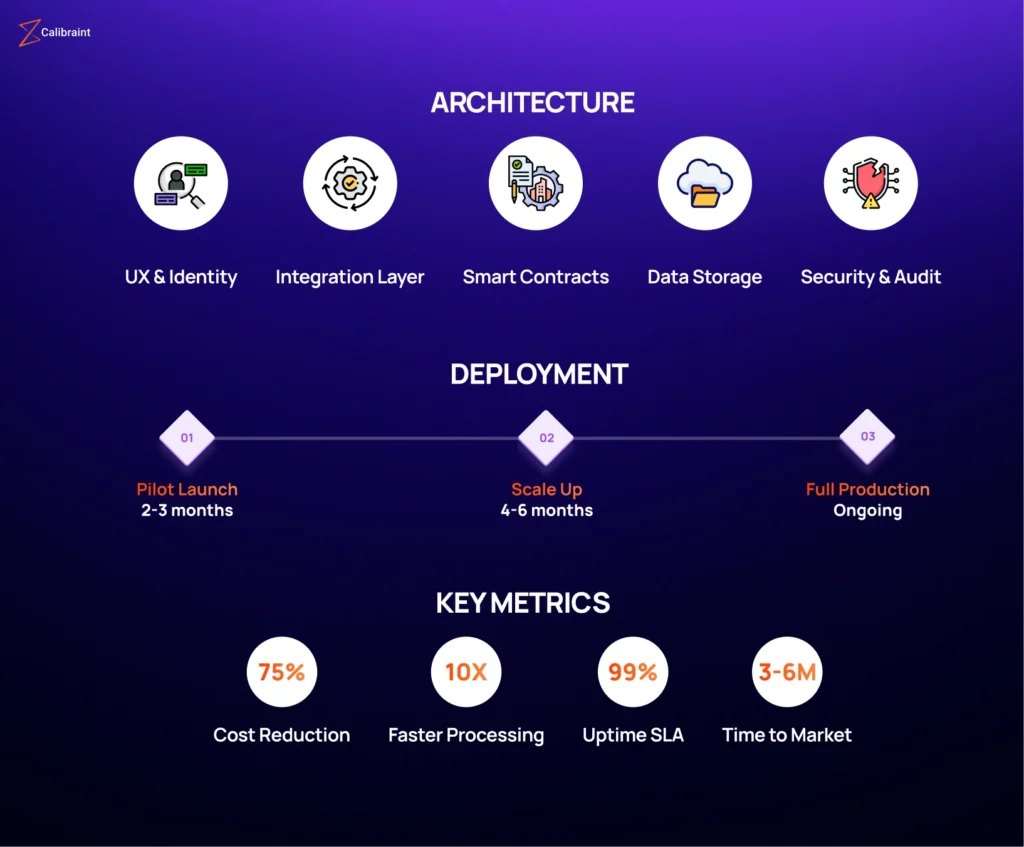
DApp Architecture Designed for Enterprise Systems
DApp architecture determines whether a decentralized application becomes a durable platform or a costly liability. Enterprise systems succeed when architecture separates responsibility across layers.
Application Layer
The application layer focuses on usability and adoption. Interfaces align with enterprise design standards and existing workflows. Authentication integrates with identity providers rather than forcing users into unfamiliar credential models.
This layer absorbs change without touching decentralized logic.
Integration and Orchestration Layer
This layer connects the DApp to enterprise systems such as finance platforms, data warehouses, and operational tools. It manages events, triggers workflows, and handles off-chain computation.
Enterprises that invest here gain visibility, reporting, and operational control. Those who skip it struggle with monitoring and reconciliation.
Smart Contract Layer
Smart contracts enforce shared rules. They are not full applications. In enterprise DApp development, contracts remain narrowly scoped, auditable, and governed.
Upgrade planning is defined at design time. Ownership is assigned. Changes follow formal processes.
This approach reduces risk and simplifies audits.
Data Layer
Not all enterprise data belongs on-chain. Sensitive information, large datasets, and operational records are stored off-chain while cryptographic references preserve integrity.
Indexing services provide analytics without compromising performance. This balance supports both compliance and efficiency.
Security and Governance Layer
Security controls are embedded, not added later. Key management relies on institutional standards such as hardware security modules and multi-party approval. Audit trails are continuous.
Governance is treated as system behavior, not policy documentation.
This layered DApp architecture supports scale without sacrificing accountability.
Architectural Tradeoffs Enterprises Must Accept
When you’re diving into enterprise DApp development, you quickly realize that you can’t have everything perfect all at once. There are always trade-offs to consider.
For instance, public networks offer great transparency, but you’ll need to be really thoughtful about your data design. Permissioned networks give you more control, yet they demand strong governance. Hybrid solutions can strike a nice balance, but only if everyone’s roles are super clear.
Then there are layer two solutions, which can cut down execution costs, but they add another layer of dependency management to think about. And while cross-chain interaction broadens your reach, it definitely ups the operational complexity.
The smartest enterprises recognize these trade-offs early on and document them. Getting your architecture clear from the start helps avoid headaches down the road and keeps costs from spiraling out of control.
Understanding the Enterprise DApp Cost Structure
Enterprise DApp cost structure is shaped less by user volume and more by design quality. Mature planning divides costs into clear categories.
Strategy and System Design
This phase defines scope, governance, compliance boundaries, and integration requirements. Business logic is mapped before implementation begins. Risk assessment is part of the process.
Decisions made here influence every downstream cost.
Engineering and Implementation
Costs include smart contract development, application engineering, integration services, and quality assurance. Complexity grows with ecosystem size rather than transaction volume.
Well-structured systems scale predictably. Poorly structured systems compound effort.
Security and Assurance
Independent reviews, audits, and testing protect the organization from systemic failure. These activities are foundational to Enterprise DApp Development.
Treating security as optional increases long-term exposure.
Infrastructure and Operations
Node management, indexing services, monitoring, and uptime support form the operational base. These costs stabilize when architecture is sound and governance is clear.
Ongoing Maintenance
Regulatory change, business expansion, and partner onboarding require updates. Systems designed with upgrade paths and governance controls cost less to maintain.
This Enterprise DApp cost structure resembles traditional enterprise platforms more than experimental software.
In enterprise DApp development, most long-term costs are locked in before the first deployment. Architectural decisions determine where business logic runs, how data is stored, and which processes require human oversight. These choices directly affect how often systems need audits, how complex compliance reporting becomes, and how much operational effort is required to keep the application stable.
When architecture is designed with clear boundaries between on-chain logic, off-chain processing, and enterprise integrations, ongoing costs remain predictable. Security reviews follow defined paths. Updates can be introduced without disrupting operations. Compliance checks rely on system behavior rather than manual intervention.
By contrast, rushed architecture concentrates logic in the wrong places. This increases audit scope, complicates upgrades, and creates recurring remediation work.
DApp Deployment Strategy Built for Enterprise Environments
DApp deployment strategy is a controlled process, not a launch event. Enterprises introduce decentralized systems gradually.
Phase One: Controlled Rollout
Initial deployment serves a limited scope. Governance processes are tested. System behavior is observed under real conditions.
Feedback informs refinement without exposing core operations.
Phase Two: Operational Expansion
The DApp supports broader workflows. Automation increases. Monitoring becomes continuous. Governance moves from theory to practice.
Integration depth increases during this phase.
Phase Three: Full-Scale Adoption
The system becomes part of daily operations. Interoperability expands. Compliance reporting is routine.
Rollback planning and upgrade coordination remain active throughout.
A disciplined DApp deployment strategy protects stability while enabling growth.
Governance and Compliance as System Design
In Enterprise DApp Development, governance is not a policy layer added after delivery. It is part of the system itself. Access control, upgrade authority, and audit visibility are designed as technical behaviors that define how the application operates over time.
Compliance requirements differ across jurisdictions, but enterprise accountability follows a consistent pattern. Systems must explain how decisions are made, who approved changes, and how exceptions are handled. When governance is embedded into DApp architecture, compliance becomes a property of system behavior rather than a manual process.
This design approach reduces friction during audits, simplifies internal reviews, and supports predictable change management across the application lifecycle.
Why Enterprise DApps Commonly Fail in Practice
When governance is treated as an afterthought, enterprise DApp development breaks down quietly. Smart contracts become overloaded with logic that should sit off-chain. Integration with enterprise systems is postponed. Upgrade paths are unclear. Monitoring remains partial.
These failures rarely appear during pilots. They surface during scale, regulatory review, or organizational change. At that point, remediation becomes expensive and disruptive.
Understanding these failure patterns clarifies why architecture, cost structure, and deployment strategy must be addressed together rather than in isolation.
A Repeatable Enterprise DApp Framework
Organizations that execute enterprise DApp development successfully follow a consistent model. They begin by mapping real business workflows before selecting platforms. They design DApp architecture around accountability boundaries rather than protocol capabilities. They define the enterprise DApp cost structure upfront, including governance, security, and long-term maintenance.
Deployment follows a phased DApp deployment strategy that allows controlled exposure, operational learning, and incremental expansion. Each phase validates assumptions before scale is introduced.
This framework aligns technical decisions with business ownership and reduces uncertainty across stakeholders.
Enterprise DApp development is not a technology bet. It is an operating model decision. Architecture, cost structure, and deployment strategy determine whether a system becomes an asset or a liability.
The organizations that succeed are the ones that ask hard questions early, design for accountability, and execute with precision. They do not chase tools. They build systems that stand up to scrutiny, scale, and regulatory review.
If you are evaluating an enterprise DApp development initiative and want clarity before committing capital, this is the moment to have that conversation.
At Calibraint, we work with enterprise teams to design and deliver production-grade DApps that align with business workflows, compliance requirements, and long-term growth objectives. Our approach is grounded in architectural discipline, transparent cost modeling, and execution that holds up beyond pilots.
1. What are the key architectural components for building a scalable enterprise DApp in 2026?
A scalable enterprise DApp relies on a layered architecture. The application layer handles enterprise UX and system integration, the smart contract layer enforces rules while remaining auditable and upgradeable, and the data and security layer ensures off-chain storage with on-chain proofs and secure key management. Continuous monitoring tracks performance, compliance, and operational integrity.
2. How much does it typically cost to develop an enterprise DApp in 2026, and what factors influence the budget?
Costs vary based on complexity, integrations, and scale. Key drivers include strategy and design for workflows and compliance, smart contract and application development, as well as ongoing security, monitoring, and maintenance. Early attention to architecture and governance reduces long-term operational expenses and risks.
3. What is the optimal deployment strategy for an enterprise DApp in 2026 to ensure security and scalability?
The most effective approach is phased. Start with a controlled rollout to test governance, workflows, and monitoring. Expand gradually to include additional systems and users, and finally move to full-scale enterprise deployment with continuous oversight to ensure security, reliability, and scalability.
Calibraint
Author
January 21, 2026
Let's Start A Conversation
Manage Consent
To provide the best experiences, we use technologies like cookies to store and/or access device information. Consenting to these technologies will allow us to process data such as browsing behavior or unique IDs on this site. Not consenting or withdrawing consent, may adversely affect certain features and functions.
Functional
Always active
The technical storage or access is strictly necessary for the legitimate purpose of enabling the use of a specific service explicitly requested by the subscriber or user, or for the sole purpose of carrying out the transmission of a communication over an electronic communications network.
Preferences
The technical storage or access is necessary for the legitimate purpose of storing preferences that are not requested by the subscriber or user.
Statistics
The technical storage or access that is used exclusively for statistical purposes.The technical storage or access that is used exclusively for anonymous statistical purposes. Without a subpoena, voluntary compliance on the part of your Internet Service Provider, or additional records from a third party, information stored or retrieved for this purpose alone cannot usually be used to identify you.
Marketing
The technical storage or access is required to create user profiles to send advertising, or to track the user on a website or across several websites for similar marketing purposes.