Blockchain Protocol Migration in 2026: Moving from Legacy Chains to Modern Infrastructure Without Downtime
Calibraint
Author
January 23, 2026
Regulation is turning blockchain programs into governed financial infrastructure. So, by 2026, blockchain protocol migration will need provable controls, clean data lineage, and continuity plans that stand up to scrutiny.
The strongest programs treat migration as an enterprise change initiative, led with operational discipline and measured with service-level objectives, not hype. The good news is that with the right blockchain development approach, you can modernize without forcing users to notice the change.
This article lays out a practical path for blockchain protocol migration with an emphasis on zero downtime blockchain migration, including parallel deployment, phased traffic shifts, and controlled cutover. It also clarifies what “modern” really means in Modern Blockchain Infrastructure, and how to plan Legacy Chain Migration without creating a second system of record you cannot govern.
Business drivers: why leadership teams are funding migration now
1) Value creation is concentrated around trust and programmable settlement
PwC’s analysis estimates blockchain could boost global GDP by US$1.76 trillion by 2030, with major value pools in provenance, payments, and identity. While this is not a direct 2026 forecast, it is a credible macro indicator executives can use to justify platform modernization roadmaps.
2) Regulatory frameworks are tightening around crypto assets and service providers
If your migration touches token issuance, custody, brokerage, or exchange-like services, the compliance burden is rising. The EU’s Markets in Crypto-Assets framework is explicitly designed to regulate crypto-asset issuance and related services in a harmonized way across the EU. That makes infrastructure choices and auditability requirements part of the business case for blockchain protocol migration.
3) AML and Travel Rule expectations are becoming operationally real
FATF’s 2024 update notes that global implementation of standards for virtual assets and VASPs is still lagging, including Travel Rule adoption and supervision. For enterprises, that translates into higher expectations for traceability, monitoring, and governance controls during legacy chain migration and afterward.
Migration rationale: what “legacy” really costs
Legacy chain migration is often triggered by a cluster of operational signals rather than one dramatic failure: limited upgrade paths, brittle tooling, expensive integrations, and rising security exposure around bridges and off-chain components. The hidden cost is that teams start compensating with manual processes and exceptions, which makes audits harder and incidents more expensive.
This is why Blockchain Protocol Migration is increasingly framed as modernization of the operating model, not only the chain. Modern blockchain infrastructure tends to reduce the number of bespoke components you maintain and increases your ability to prove correctness during incident response and regulatory review.
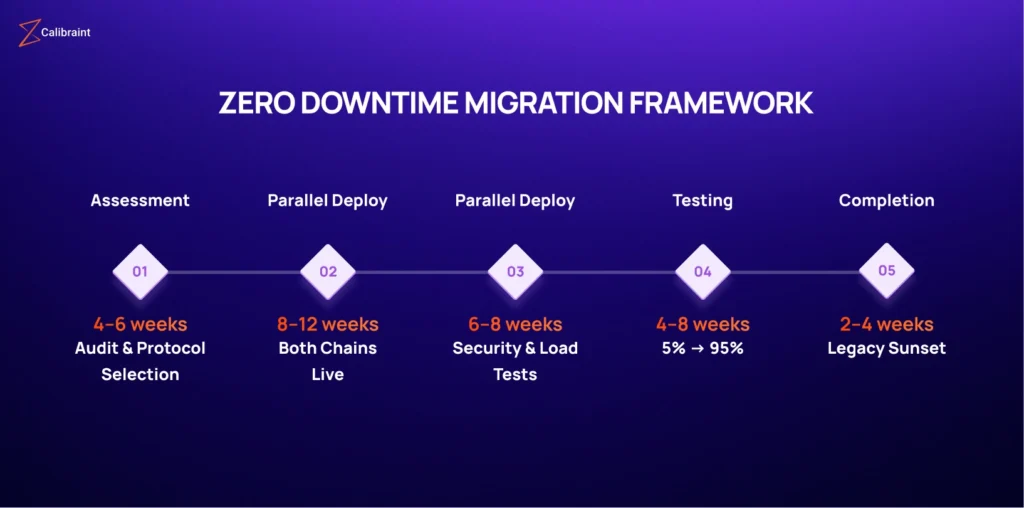
A credible blockchain migration strategy should be explainable in five phases. Each phase has measurable exit criteria that a leadership team can govern.
Phase 1: Assessment and readiness
Inventory contracts, token standards, integrations, key management, indexers, RPC dependencies, and operational workflows. Define your “non-negotiables”: finality assumptions, auditability, recovery time objectives, and regulatory constraints. This phase turns a vague blockchain protocol migration plan into a scoped delivery program.
Phase 2: Parallel deployment
Stand up the new stack in a production-like environment and run it alongside the legacy chain. Parallel deployment is the backbone of zero downtime blockchain migration because it keeps your legacy operations intact while you validate the new system under real load patterns.
Phase 3: Phased traffic shifts
Route a small, low-risk slice of traffic to the new environment. Many teams begin with a pilot cohort and then increase allocation in controlled increments. This step is where Blockchain Protocol Migration becomes a risk-managed operations exercise rather than a “big switch.”
Phase 4: Data synchronization and reconciliation
Use deterministic reconciliation methods: event replay, state proofs where applicable, and strict accounting of token balances and contract states. For zero downtime blockchain migration, executives should insist on reconciliation reports that finance and risk teams can understand.
Phase 5: Cutover and stabilization
Cutover is a controlled change window, not an improvisation. You freeze risky mutations, execute final sync, move routing to the new system, and keep the legacy chain in a monitored “read-only” posture until the organization formally decommissions it.
This five-step model should be the common language for blockchain protocol migration across product, engineering, security, compliance, and finance, and it is also the simplest way to communicate a blockchain migration strategy to the board.
Real-world case study: Polygon’s MATIC to POL upgrade signals what good looks like
Polygon’s MATIC to POL transition is one of the clearer public examples of a large-scale token and network upgrade that prioritized continuity. Polygon stated that 99% of MATIC on the Polygon network had migrated to POL, and that since September 2024, Polygon PoS transactions use POL as the native gas token.
For leaders planning Blockchain Protocol Migration, the takeaway is not tokenomics. The takeaway is that a well-managed transition can achieve high completion without forcing disruptive user actions, reinforcing the practical feasibility of zero downtime blockchain migration when incentives, tooling, and communication are aligned.
What “Modern Blockchain Infrastructure” Means in 2026
Modern blockchain infrastructure is not a single product choice. It is an architectural posture that makes upgrades safer, environments more observable, and integration surfaces more standardized.
Most enterprise-grade programs converge on these patterns during blockchain protocol migration:
Parallel environments with standardized observability and incident response controls
Contract compatibility planning, including upgrade-safe deployment patterns
Interoperability components are treated as high-risk systems with explicit governance and monitoring
Data pipelines that generate audit-ready reports, expanding beyond just developer dashboards. This is also where a blockchain migration strategy gains durability: the goal isn’t merely a “new chain” but an operational platform that your teams can confidently manage.
Risk and mitigation: what executives should demand in governance
Bridge and interoperability risk
Cross-chain components expand the attack surface. If your program requires bridging, treat it as a Tier-0 service, with separate monitoring, security reviews, and emergency procedures.
Compliance and audit risk
During Legacy Chain Migration, you can accidentally create gaps in record-keeping if data lineage is not handled deliberately. EU crypto-asset regulation frameworks and FATF standards increase the expectation that governance controls and traceability exist, not merely that the technology works.
Platform obsolescence risk
Gartner’s warning about replacement cycles in enterprise blockchain platforms supports the business argument that migrations will recur, and that the first migration should build reusable capability, not a one-off project.
Roadmap and Timeline
A typical blockchain migration strategy can be communicated as:
Readiness and design
Parallel deployment and validation
Pilot traffic shifting
Progressive ramp and reconciliation
Cutover, stabilization, decommission
This format keeps blockchain protocol migration governable and makes zero downtime blockchain migration measurable. It also helps prevent “forever dual-run” scenarios that quietly double cost and risk.
The blockchain protocol migration conversation happening in boardrooms right now isn’t about if, it’s about when and how. Legacy chain migration to modern blockchain infrastructure separates organizations that thrive in Web3 from those that fade into irrelevance.
The organizations succeeding with zero downtime blockchain migration share common traits. They plan meticulously. They test exhaustively. They communicate clearly. They partner with teams who’ve executed these migrations successfully before.
You don’t have to figure this out alone. Blockchain development expertise makes the difference between smooth transitions and costly failures.
At Calibraint, we’ve guided enterprises through complex protocol migrations while maintaining 100% uptime. Our team understands the technical architecture, the business implications, and the risk mitigation strategies that turn migration from scary to strategic.
FAQs
1. What architectural elements are crucial for a zero-downtime blockchain protocol migration in 2026?
Zero downtime blockchain migration in 2026 relies on modular architecture, parallel execution environments, and deterministic data reconciliation. Modern blockchain infrastructure should support concurrent operation across chains, secure bridge mechanisms, upgrade-safe smart contracts, and observability tools that maintain auditability throughout blockchain protocol migration.
2. How do costs break down for migrating from legacy chains without downtime in 2026?
Legacy chain migration costs typically include assessment and design, parallel infrastructure setup, smart contract compatibility work, data synchronization, security audits, and controlled cutover. For enterprise systems, blockchain protocol migration usually ranges from mid to high six figures, with long-term savings from lower transaction costs on modern blockchain infrastructure.
3. What is the best strategy for executing a seamless blockchain migration in 2026?
The most effective blockchain migration strategy uses a phased approach covering readiness assessment, parallel deployment, gradual traffic shifting, continuous reconciliation, and controlled cutover. Treating blockchain protocol migration as a governed change initiative enables zero downtime blockchain migration while preserving system stability and user trust.
Calibraint
Author
January 23, 2026
Let's Start A Conversation
Manage Consent
To provide the best experiences, we use technologies like cookies to store and/or access device information. Consenting to these technologies will allow us to process data such as browsing behavior or unique IDs on this site. Not consenting or withdrawing consent, may adversely affect certain features and functions.
Functional
Always active
The technical storage or access is strictly necessary for the legitimate purpose of enabling the use of a specific service explicitly requested by the subscriber or user, or for the sole purpose of carrying out the transmission of a communication over an electronic communications network.
Preferences
The technical storage or access is necessary for the legitimate purpose of storing preferences that are not requested by the subscriber or user.
Statistics
The technical storage or access that is used exclusively for statistical purposes.The technical storage or access that is used exclusively for anonymous statistical purposes. Without a subpoena, voluntary compliance on the part of your Internet Service Provider, or additional records from a third party, information stored or retrieved for this purpose alone cannot usually be used to identify you.
Marketing
The technical storage or access is required to create user profiles to send advertising, or to track the user on a website or across several websites for similar marketing purposes.