Scalable Mobile App Development in 2026 Using Microservices Serverless and Cloud Native Design
Calibraint
Author
January 27, 2026
When it comes to your mobile app development strategy, it probably looks bulletproof on paper. You have a talented engineering team, a decent cloud budget, and users who genuinely love your product. But here’s the real concern for CTOs, especially regarding scalable mobile app development in 2026: the moment your user base doubles, your entire system could crumble. This isn’t because your developers made mistakes, but because you built on an architecture that simply can’t scale.
This isn’t theoretical. Companies are wasting millions trying to patch monolithic systems that were never designed for modern mobile demands. Meanwhile, their competitors ship features faster, handle traffic spikes effortlessly, and sleep soundly during product launches.
The truth? Your backend architecture determines whether you scale smoothly or spend the next two years in emergency firefighting mode. Let’s talk about why microservices architecture, cloud native mobile app design, and API driven mobile development have become non-negotiable for scalable mobile app development in 2026.
The Breaking Point Most Companies Hit
You start with a solid monolithic backend. Everything lives in one codebase, one database, one deployment. For the first 10,000 users, it works beautifully. Your team moves fast, features ship weekly, and stakeholders are happy.
Then you hit 100,000 users. Deployment takes three hours instead of thirty minutes. A bug in your payment module forces you to redeploy the entire application. Your notification service needs more servers, but scaling it means scaling your entire backend. Weekend deployments become mandatory because downtime during business hours is too risky.
Netflix faced this exact problem in 2008. Their monolithic architecture worked fine until streaming exploded. They couldn’t just boost one part without messing with everything else, and honestly, every time they tried to update something, they risked the whole service crashing. So, what did they do? They completely switched over to a microservices setup – basically, breaking everything into tiny, independent pieces. Now, that’s what runs over 500 separate services, dealing with billions of requests every single day.
Uber tells a similar story. Their initial app worked for one city with a single monolithic codebase. When they expanded to 500 cities, that architecture became impossible to maintain. Different cities needed different features, different regulations, and different payment systems. The monolith couldn’t adapt fast enough.
Why Microservices Architecture Actually Solves Real Problems
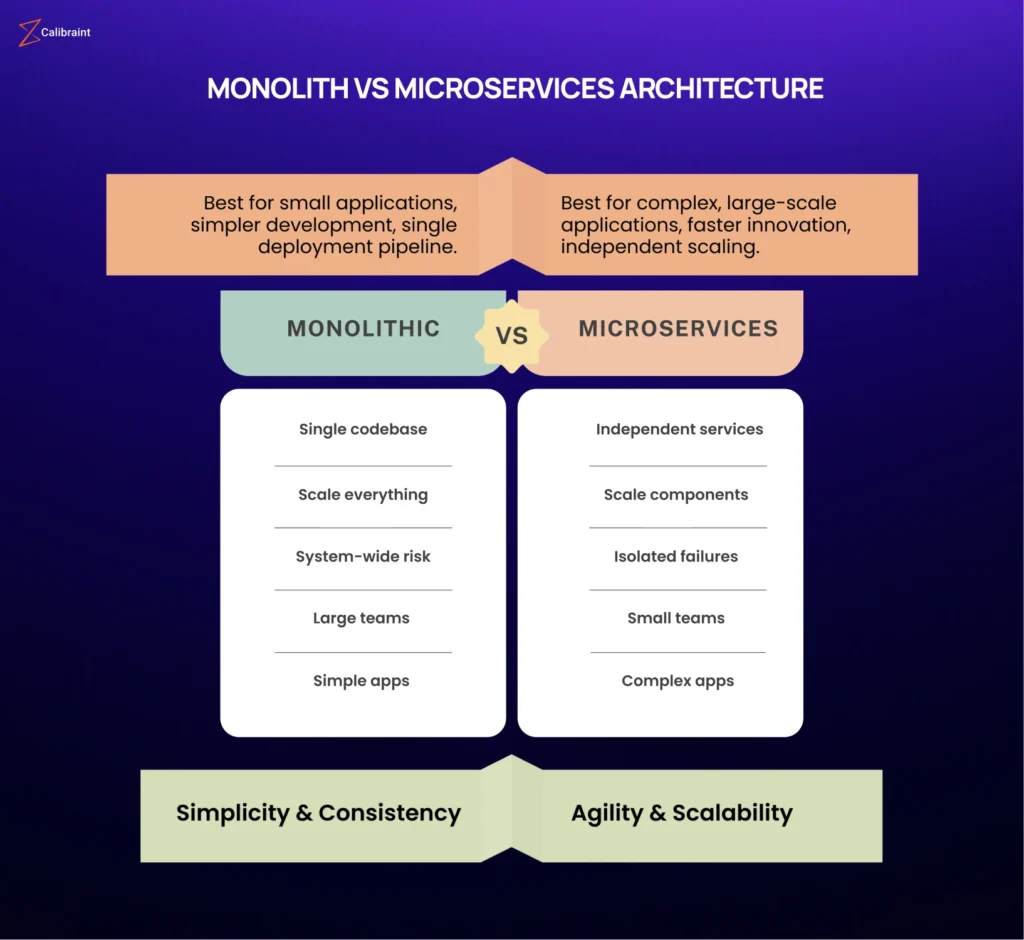
Think of microservices architecture as building blocks instead of a single massive structure. Each service handles one specific business capability: user authentication, payment processing, push notifications, content delivery, and analytics. These services communicate through APIs but otherwise operate independently.
This independence creates three critical advantages for scalable mobile app development in 2026.
First, you can scale what actually needs scaling. Your video streaming component gets hammered during peak hours? Scale just that service. Does your payment processor need extra capacity during sales events? Add resources only there. No need to duplicate your entire backend infrastructure just to handle load in one area.
Second, you ship features faster through API driven mobile development. Different teams can work on different services simultaneously without stepping on each other’s toes. Your payments team can push updates without waiting for the search team to finish their work. This alone can cut your time-to-market by 40% compared to monolithic deployments.
Third, failures stay contained. When your recommendation engine crashes, users still log in, make purchases, and receive notifications. The entire app doesn’t go dark because one component failed.
Cloud Native Architecture: The Foundation That Matters
Here’s what cloud native architecture actually means: your application is designed from day one to run in distributed cloud environments. Not just “hosted on AWS,” but also architected specifically for containerization, orchestration, and dynamic scaling—essential elements of cloud-native mobile app design.
Containers package your application code with everything it needs to run. Docker became the standard because it solves the “works on my machine” problem. Your code runs identically in development, testing, and production environments.
Kubernetes orchestrates these containers at scale. It automatically distributes your services across available servers, restarts crashed containers, and routes traffic intelligently. Companies that adopt Kubernetes report managing hundreds of services with smaller operations teams than they needed for monolithic systems.
The serverless computing market tells the adoption story clearly. It grew from $26.51 billion in 2025 to $32.59 billion in 2026, with projections reaching $91.56 billion by 2031. Organizations don’t invest at that scale unless the technology delivers measurable business value for scalable mobile app development in 2026.
Serverless: When You Need Speed Without Infrastructure Headaches
Serverless computing means you write functions that execute in response to events, and the cloud provider handles everything else. No servers to provision, no capacity planning, no patching operating systems at 2 AM.
AWS Lambda, Azure Functions, and Google Cloud Functions let you deploy code that automatically scales from zero to thousands of concurrent executions. You pay only for the compute time you actually consume, measured in milliseconds.
In mobile commerce and media-heavy applications, serverless functions often handle image processing tasks such as resizing, thumbnail generation, and metadata extraction. These workloads spike during user activity and remain idle for long periods, making them poorly suited to always-on servers.
Teams adopting serverless for these isolated workloads typically report faster deployment cycles and reduced operational overhead. The primary benefit is not cost alone, but the ability for engineering teams to focus on product delivery instead of infrastructure management.
API Driven Development: The Glue Holding Everything Together
When your backend splits into dozens of independent services, API driven mobile development becomes your contract language. Services communicate exclusively through well-defined API endpoints. This separation creates flexibility that monolithic architectures can’t match.
Your iOS app, Android app, and web dashboard all consume the same APIs. You can rebuild your entire mobile frontend without touching backend code. You can swap out your authentication service for a better alternative without affecting other components.
API gateways like Kong or AWS API Gateway sit in front of your services, handling authentication, rate limiting, request routing, and monitoring. They become your security perimeter and your observability layer.
CI/CD pipelines integrate directly with API driven architectures. Every code commit triggers automated builds, tests, and deployments. Services deploy independently, meaning your team can push updates to production dozens of times daily without coordination meetings.
Modern CI/CD pipelines incorporate security scanning, automated rollbacks, and progressive deployment strategies. You can deploy new features to 5% of users first, monitor error rates and performance metrics, then gradually expand to 100% over hours or days. If anything breaks, automated systems roll back instantly.
The Architecture Decision (When Microservices Make Sense)
Not every application needs this complexity. Microservices introduce distributed system challenges that small teams struggle to manage effectively. You need the right problem before adopting this solution.
Microservices architecture makes sense when you have distinct business domains that evolve independently, multiple teams working simultaneously, and requirements for independent scaling of different components. If your app handles payments, social features, content delivery, and real-time messaging, those boundaries suggest natural service divisions for cloud native mobile app design.
Monolithic architectures still work fine for small teams building focused applications. If you have five developers building a single-purpose app with modest traffic, adding microservices complexity probably hurts more than it helps.
The migration path matters as much as the destination. You don’t rewrite your entire backend in one dramatic cutover. The strangler pattern works better: you gradually extract services from your monolith, run hybrid architectures during transition, and move at a pace your team can sustain.
What This Means for Your Technical Roadmap
If you’re planning serious growth over the next 24 months, your architecture decisions today determine whether that growth happens smoothly or painfully. Migrating live systems under pressure costs 3-5x more than building correctly from the start.
Start by mapping your application domains. Identify the components that change frequently versus stable core functions. Look for services that need independent scaling. These become your first microservices candidates.
Invest in observability before you need it. Distributed systems require sophisticated monitoring, logging, and tracing. Tools like Prometheus for metrics, ELK stack for logs, and distributed tracing systems become essential when debugging issues across dozens of services.
Build your CI/CD pipelines early. Automated testing and deployment aren’t optional extras when implementing scalable mobile app development in 2026. Manual deployments don’t scale when you’re managing 20+ services that deploy multiple times daily.
Consider your team’s capabilities honestly. Cloud native architecture requires skills in distributed systems, container orchestration, service mesh technologies, and DevOps practices. You either build these capabilities internally or partner with teams who already have them.
Mobile competition today is shaped less by feature lists and more by delivery capability. Organizations that release frequently, recover quickly from failure, and scale without disruption tend to outperform those constrained by slower operating models.
In many markets, the gap between weekly and monthly release cycles reflects architectural choices rather than team capability. Platforms built on cloud native mobile app design allow teams to introduce changes incrementally, test them safely, and respond to user behavior without large coordinated releases.
The same principle applies to scalability. Applications designed for elastic workloads absorb demand fluctuations as a routine condition. Systems built without this assumption often experience performance degradation during promotions, regional launches, or seasonal spikes.
Enterprise investment patterns reinforce this shift. Over the past several years, cloud native and serverless architectures have moved from experimental adoption to core platform strategy, particularly in mobile-first businesses. These decisions signal a broader emphasis on speed, resilience, and operational efficiency as long-term competitive factors.
Your Next Move
You don’t need to migrate everything overnight. You do need a clear understanding of where your current architecture will break and a realistic plan for evolving before you hit those limits.
Start by assessing your scaling bottlenecks. Which components fail first under load? Where do deployment risks concentrate? What takes the longest to change when business requirements shift?
Build one pilot microservice to validate your approach. Extract a non-critical component, deploy it independently, and solve the operational challenges on something low-risk. Learn container orchestration, implement monitoring, and establish patterns your team can repeat.
This approach turns theoretical plans into practical, executable steps while minimizing risk and accelerating confidence across the organization.
This is where experienced guidance makes the difference between momentum and hesitation. Organizations that partner with teams who have already delivered scalable mobile platforms avoid costly detours and accelerate maturity. At Calibraint, mobile app development is approached as a business system, not a codebase. Architecture choices are tied directly to growth goals, operating models, and long-term product ownership, which is why scalable mobile app development in 2026 becomes practical rather than aspirational.
FAQs
1. What is scalable mobile app development in 2026?
Scalable mobile app development in 2026 is designing apps that maintain performance, reliability, and operational efficiency as user demand, features, and business complexity grow. It ensures your platform can evolve rapidly without disruption, supporting multiple clients, regions, and business initiatives.
2. How do microservices help scale mobile applications?
Microservices split an app’s backend into independent, business-focused services. This allows each service to scale, deploy, and recover independently. Teams can release updates faster, reduce deployment risk, and maintain stability even as the platform expands.
3. What are the benefits of serverless architecture in mobile app development in 2026?
Serverless architecture executes code on demand, automatically scaling with workload. It minimizes infrastructure management, reduces operational overhead, and lets engineering teams focus on building features rather than maintaining servers. This is especially effective for event-driven workloads such as notifications, background processing, or asynchronous tasks.
4. What is cloud-native mobile app design, and why is it important?
Cloud-native mobile app design leverages cloud services, automation, and containerization to build resilient, elastic, and easily maintainable platforms. It allows apps to handle global traffic, recover quickly from failures, and integrate new features or services efficiently, supporting long-term scalability.
5. How do DevOps and CI/CD improve mobile app scalability?
DevOps practices and CI/CD pipelines enable automated, repeatable build, test, and deployment processes. This allows teams to release features safely and frequently, reduces risk, improves operational visibility, and ensures that the mobile platform scales smoothly as usage and complexity grow.
Calibraint
Author
January 27, 2026
Let's Start A Conversation
Manage Consent
To provide the best experiences, we use technologies like cookies to store and/or access device information. Consenting to these technologies will allow us to process data such as browsing behavior or unique IDs on this site. Not consenting or withdrawing consent, may adversely affect certain features and functions.
Functional
Always active
The technical storage or access is strictly necessary for the legitimate purpose of enabling the use of a specific service explicitly requested by the subscriber or user, or for the sole purpose of carrying out the transmission of a communication over an electronic communications network.
Preferences
The technical storage or access is necessary for the legitimate purpose of storing preferences that are not requested by the subscriber or user.
Statistics
The technical storage or access that is used exclusively for statistical purposes.The technical storage or access that is used exclusively for anonymous statistical purposes. Without a subpoena, voluntary compliance on the part of your Internet Service Provider, or additional records from a third party, information stored or retrieved for this purpose alone cannot usually be used to identify you.
Marketing
The technical storage or access is required to create user profiles to send advertising, or to track the user on a website or across several websites for similar marketing purposes.