DeFi Lending Protocol Development 2026: Implementation Guide & Cost Breakdown
Calibraint
Author
January 28, 2026
You are not exploring DeFi lending because it sounds interesting. You are here because traditional financial infrastructure keeps showing its limits in speed, transparency, and control. In the first conversations we have with founders and product leaders, the question is rarely whether decentralized lending works. The real question is whether DeFi development can meet enterprise standards in governance, risk discipline, and long-term sustainability.
By 2026, DeFi lending protocols no longer sit at the edge of experimentation. They operate as financial systems with real capital exposure, demanding precision in architecture, compliance awareness, and operational design. This guide offers clarity. It explains how DeFi lending protocol development works today, what credible implementation looks like, and how costs form in reality rather than pitch decks.
You will leave with a grounded understanding of technical decisions, business impact, and budget planning that respects complexity instead of hiding it.
The Market Shift (Why You Build Now)
You might believe the lending market is saturated. However, that isn’t entirely accurate. The “retail” market is crowded, but the “institutional” market lacks the necessary infrastructure. In 2026, DeFi lending protocol development is about solving a specific paralysis in traditional finance: the inability to move collateral instantly.
Consider the private credit market. It’s a $1.7 trillion behemoth, still largely managed on spreadsheets. Your opportunity lies in the Lending Protocol Development 2026 trends that focus on bringing these assets on-chain. We are seeing a surge in demand for protocols that accept tokenized Treasury bills, corporate bonds, and real estate as collateral, not just volatile crypto tokens.
It’s important to understand that liquidity seeks safety. The capital you want to attract, such as family offices, corporate treasuries, and neo-banks, demands compliance baked into the smart contract. They do not want anonymity; they want “permissioned pools” where every counterparty is verified. This is where your Defi implementation guide begins: by accepting that identity is now a prerequisite for liquidity.
The protocols winning today are not the ones with the highest APY. They are the ones with the strongest legal wrappers and the most resilient code.
The “Fortress” Architecture
When you commission DeFi lending protocol development, you are essentially commissioning a bank that never sleeps. Your technical architecture must be flawless. In our DeFi protocol implementation experience, we see three non-negotiable pillars for 2026.
1. The AI Risk Engine
Old protocols relied on simple liquidation thresholds. If an asset dropped 10%, it sold. That is too crude for 2026. Your protocol needs an AI-driven risk engine that analyzes borrower wallet history and market volatility in real time. This engine predicts bad debt before it happens. It adjusts collateral requirements dynamically. This is the difference between a protocol that survives a crash and one that halts.
2. Chain Abstraction
Your users do not care which blockchain they are on. They just want yield. Successful DeFi lending protocol development now involves “Chain Abstraction.” Your user deposits USDC on Ethereum, but your protocol seamlessly lends it out on Solana or Arbitrum, where the rates are higher. You handle the bridging risks; the user sees only the result.
3. The Compliance Wrapper (ZK-Identity)
You must integrate Zero-Knowledge (ZK) identity credentials. This allows a borrower to prove they are an accredited investor or have a credit score of 800+ without revealing their name or passport on-chain. This is the holy grail of DeFi protocol implementation for institutions. It enables under-collateralized lending, the engine of real-world credit, while maintaining privacy.
DeFi Lending Cost Breakdown (The Investment)
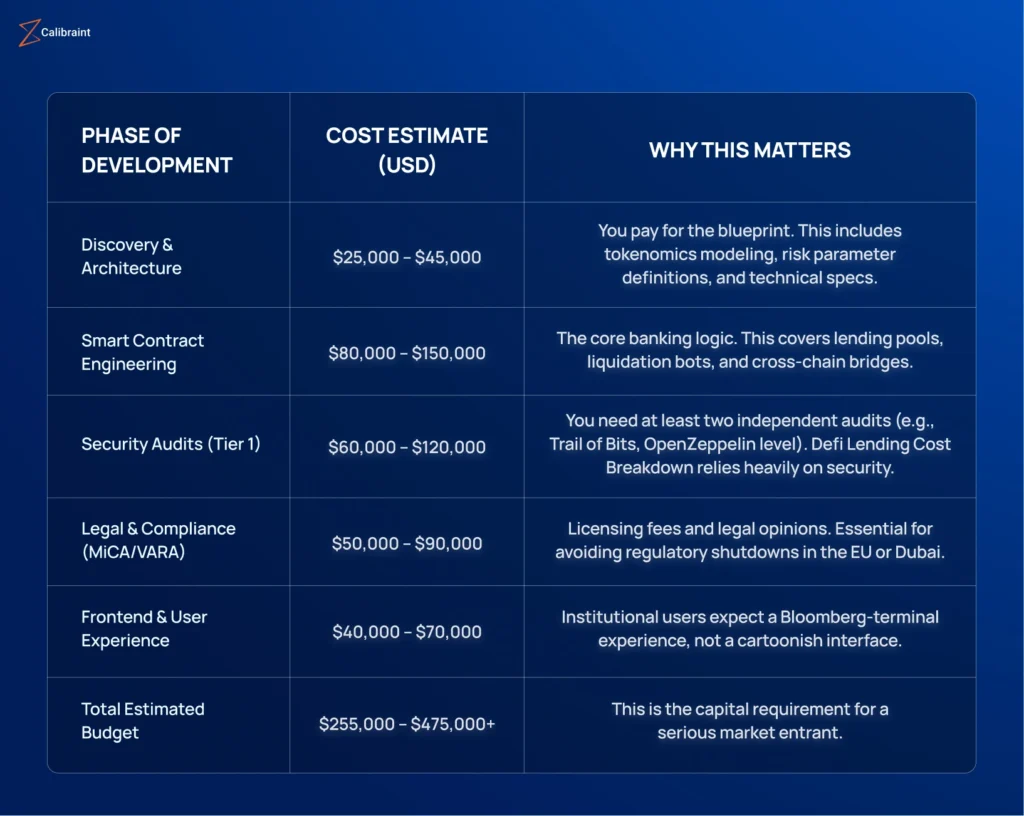
Let us be precise. Quality is expensive, but technical debt is fatal. A cheap protocol is just a bounty program for hackers. Below is a factual DeFi lending cost breakdown based on Tier-1 development standards in 2026.
These figures represent a custom institutional-grade build. They do not reflect “forking” existing code, which is a liability you cannot afford.
Note: This DeFi lending cost breakdown excludes liquidity provisioning and marketing. It is purely for the advantage of the technology itself.
Strategic Implementation Guide
How do you move from concept to capital? This Defi implementation guide follows a consulting-grade methodology we use with enterprise clients.
Phase 1: The Solvency Thesis
Before writing code, you define the asset class. Are you lending against tokenized gold? Are you offering flash loans for market makers? Your DeFi lending protocol development strategy must target a specific inefficiency in the market. Do not try to be everything. Be the best place to lend against one specific asset class.
Phase 2: The “Shadow” Deployment
You never launch to the public immediately. You launch in a “guarded” mainnet. You cap the total value locked (TVL) at $5 million. You invite white-hat hackers to attack the system. This phase of Defi protocol implementation allows you to battle-test your liquidation logic without risking a billion-dollar catastrophe.
Phase 3: The Liquidity Vortex
Once security is proven, you open the gates. But you do not just offer yield; you offer utility. You integrate with other protocols. You make your “Receipt Tokens” (the proof of deposit) usable as collateral elsewhere. Successful lending protocol development in 2026 relies on compossibility. Your token must be a LEGO brick that the rest of the financial system wants to use.
The Future of Lending Protocol Development 2026
In 2026, permissioned DeFi will play a key role in lending protocol development. Some protocols will require institutions to complete stringent identity verification and compliance checks before they can participate in lending and borrowing markets. Platforms such as Aave Arc already operate in this way, allowing approved entities to supply liquidity and borrow assets within a compliant framework.
These permissioned models provide clearer compliance controls compared with earlier, fully open protocols where anyone could participate. Many institutional teams view this as a way to engage with smart contract financing while meeting internal risk and compliance requirements.
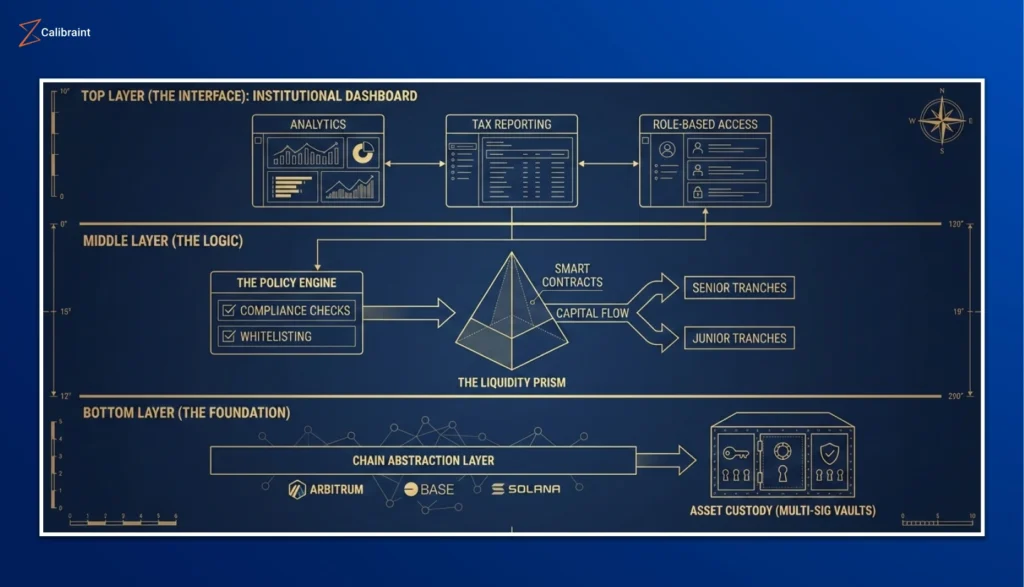
Note: The anatomy of a modern protocol. Note how DeFi lending protocol development now requires a distinct compliance layer effectively sandwiched between user and code.
Avoiding the Pitfalls
We’ve seen it happen countless times. Projects stumble because they approach DeFi lending protocol development like it’s just a coding puzzle, instead of the complex financial engineering challenge it truly is.
Mistake 1: Ignoring oracle risk. If your protocol relies on a single price feed, you will be exploited. Your DeFi protocol implementation must use decentralized oracle networks with outlier detection.
Mistake 2: Underestimating legal costs. Refer back to the DeFi lending cost breakdown. If you budget $5,000 for legal, you are preparing for a lawsuit, not a launch.
Mistake 3: Copy-pasting code. Forks inherit bugs. In lending protocol development 2026, originality is security.
You must approach DeFi lending protocol development with the mindset of an architect building a skyscraper. One weak beam collapses the whole structure. Your DeFi Implementation Guide must be rigorous.
Your Path to Market Leadership
The window for building the foundational infrastructure for 2026 is open, but it is closing. The giants, BlackRock, Fidelity, and PayPal, are already moving on-chain. They need protocols to interact with. They need the infrastructure that you are planning to build.
DeFi lending protocol development is your entry ticket to the table. By following this DeFi Implementation Guide, you ensure that your seat is secure. You are not just writing smart contracts; you are writing the future of credit.
Review the DeFi lending cost breakdown again. Secure your capital. Assemble your team. The technology is ready. The question is, do you have the vision to deploy it?
Lending Protocol Development 2026 is not about speculation. It is about utility. It is about taking the friction out of finance. When you engage in DeFi lending protocol development, you are removing the middleman and replacing him with mathematics.
Your DeFi protocol implementation strategy determines your destiny. Will you build a toy for day traders, or will you build a tool for the world economy? The choice is yours.
DeFi lending protocol development is the most potent tool for financial transformation in this decade. Do not waste it on mediocrity.
The Next Step
We understand the complexity of DeFi lending protocol development. We have navigated the regulatory maze and the architectural challenges before. We know that a DeFi lending cost breakdown is just a spreadsheet until it is executed by experts who understand the stakes.
You have the vision for a superior financial product. But in the institutional era, vision without execution is a liability. The market for lending protocol development in 2026 waits for no one, and the giants are already building.
Don’t just write code. Engineer a legacy.
AtCalibraint, we transform complex financial logic into immutable infrastructure. From tokenizing real estate equity (like our work with Reitium) to engineering seamless fintech bridges (like Mercury Cash), we don’t just experiment with DeFi, we architect it for scale.
Your liquidity engine deserves a fortress, not a playground.
FAQs
1. What are the essential steps for implementing a DeFi lending protocol in 2026?
Implementing a DeFi lending protocol in 2026 starts with defining the target market and asset scope, followed by protocol architecture design and economic modeling. Teams then develop and test smart contracts, conduct independent security audits, establish governance and compliance controls, and finally deploy with continuous monitoring and post-launch optimization.
2. How much does it cost to develop a DeFi lending protocol in 2026?
The cost to develop a DeFi lending protocol in 2026 varies based on complexity, customization, and security requirements. Key cost drivers include protocol design, smart contract development, multiple security audits, frontend experience, infrastructure setup, and ongoing governance and maintenance, rather than a fixed upfront build alone.
3. What key features should a 2026 DeFi lending protocol include for competitiveness?
A competitive DeFi lending protocol in 2026 should include transparent interest models, strong collateral and liquidation controls, reliable oracle integrations, upgradeable governance mechanisms, and security-focused architecture. Many protocols also incorporate compliance-aware access controls and clear risk disclosure to support institutional participation.
Calibraint
Author
January 28, 2026
Let's Start A Conversation
Manage Consent
To provide the best experiences, we use technologies like cookies to store and/or access device information. Consenting to these technologies will allow us to process data such as browsing behavior or unique IDs on this site. Not consenting or withdrawing consent, may adversely affect certain features and functions.
Functional
Always active
The technical storage or access is strictly necessary for the legitimate purpose of enabling the use of a specific service explicitly requested by the subscriber or user, or for the sole purpose of carrying out the transmission of a communication over an electronic communications network.
Preferences
The technical storage or access is necessary for the legitimate purpose of storing preferences that are not requested by the subscriber or user.
Statistics
The technical storage or access that is used exclusively for statistical purposes.The technical storage or access that is used exclusively for anonymous statistical purposes. Without a subpoena, voluntary compliance on the part of your Internet Service Provider, or additional records from a third party, information stored or retrieved for this purpose alone cannot usually be used to identify you.
Marketing
The technical storage or access is required to create user profiles to send advertising, or to track the user on a website or across several websites for similar marketing purposes.