From Paper Assets to Programmable Finance: How RWA Development Is Reshaping Capital Markets in 2026
Calibraint
Author
January 29, 2026
Last updated: March 2, 2026
The structural redesign of global finance is no longer a localized experiment in decentralized finance; it has become the fundamental architecture for the next era of institutional wealth. For financial institutions and asset managers, the transition from legacy paper-based systems to programmable finance represents the most significant shift since the advent of electronic trading. As a leading RWA development company, we observe that 2026 has marked a definitive turning point where the question is no longer about the viability of the technology, but the velocity of its integration. Strategic decision-makers are now prioritizing real world asset tokenization to solve chronic inefficiencies in settlement, transparency, and distribution.
This movement is not merely about digitizing assets; it is about rebuilding the plumbing of capital markets to support a more fluid, automated, and globalized economy. Institutions exploring this shift are increasingly investing in purpose-built platforms that support compliant issuance, lifecycle automation, and secondary liquidity. A closer look at how modern platforms are architected for scale and regulation can be seen in this detailed guide on RWA tokenization platform development, which breaks down the technical and compliance layers required for enterprise-grade adoption.
The Structural Limitations of Legacy Capital Markets
Traditional capital markets have long been plagued by a fragmentation that limits the potential of high-value assets. Whether dealing with private equity, commercial real estate, or sovereign debt, the reliance on manual reconciliation and siloed ledgers creates a friction-heavy environment. This friction results in “trapped” capital, where assets remain illiquid due to the high costs of administration and the complexity of fractionalizing ownership.
In 2026, the cost of maintaining these legacy systems is becoming unsustainable. Institutional leaders are grappling with settlement cycles that take days, high counterparty risks, and a lack of real-time visibility into asset performance. The traditional stack simply cannot provide the level of agility required for modern portfolio management. This is where the strategic implementation of blockchain based capital markets enters the conversation. By replacing centralized databases with distributed ledgers, the industry is finally moving toward a “golden source of truth” that eliminates the need for redundant audits and manual verification.
The drive toward liquidity improvement for RWAs is fueled by the need to democratize access to previously gatekept asset classes. When an asset is locked behind a wall of paperwork and high minimum investment thresholds, its market value is artificially suppressed. The evolution toward programmable finance allows these assets to be broken down, traded, and settled with a level of precision that was previously impossible.
Why Real World Asset Tokenization Is the New Standard
The adoption of real world asset tokenization has moved past the proof-of-concept phase because it addresses the core pain point of every Chief Financial Officer: capital efficiency. In a high-interest-rate environment, the ability to mobilize collateral instantly is a competitive advantage that cannot be ignored.
Tokenization allows for the creation of digital twins for physical or financial assets. These tokens are not just placeholders; they are containers for logic. When we discuss smart contracts for RWA tokenization, we are talking about the ability to bake compliance, dividend distribution, and voting rights directly into the asset itself. This level of automation reduces the “middleman tax” that has historically drained returns from complex investment vehicles.
Furthermore, tokenized fund infrastructure is enabling asset managers to launch products faster and at a lower cost. Instead of waiting months to set up a new fund structure, managers can utilize pre-configured blockchain environments to onboard investors and manage lifecycle events. This speed to market is essential in 2026, where market opportunities can open and close in a fraction of the time they used to.
The Role of Smart Contracts and Compliant Frameworks
One of the most significant barriers to the widespread adoption of digital assets was the perceived lack of regulatory clarity. However, in 2026, the emergence of compliant asset tokenization frameworks has provided the legal certainty necessary for large-scale institutional participation. Regulation is no longer an afterthought; it is integrated into the code.
Through smart contracts for RWA tokenization, compliance checks such as Know Your Customer (KYC) and Anti-Money Laundering (AML) are performed automatically before any transaction is validated. If a buyer does not meet the specific jurisdictional requirements for a private credit offering, the smart contract simply prevents the transfer. This “compliance-by-design” approach protects issuers and investors alike, reducing the risk of regulatory friction.
Developing a robust tokenized fund infrastructure also requires a deep understanding of how these digital instruments interact with existing legal standards. It is not enough to put an asset on a blockchain; the entire lifecycle, from issuance to secondary market trading and eventual redemption, must be legally enforceable. This is why partnering with an experienced RWA development company is critical for navigating the intersection of traditional law and distributed ledger technology.
Real-World Applications: From Real Estate to Private Credit
The impact of blockchain based capital markets is perhaps most visible in the private credit and real estate sectors. Traditionally, these markets have been opaque and slow-moving. Today, we see real estate portfolios being tokenized to allow for instant collateralization in decentralized lending markets. This creates a massive liquidity improvement for RWAs, as owners can borrow against their assets without going through a weeks-long appraisal and bank approval process.
In the world of private credit, real world asset tokenization allows for more granular risk management. Investors can choose to participate in specific tranches of a loan portfolio, with interest payments distributed automatically via smart contracts. This transparency builds trust and attracts a broader pool of capital, lowering the cost of funding for borrowers while providing diversified yields for investors.
Moreover, the use of smart contracts for RWA tokenization ensures that the underlying performance of the asset is reflected in real-time. For a renewable energy project, for instance, the energy output can be linked to the token’s value or dividend payout, providing an unprecedented level of data integrity for ESG-conscious investors.
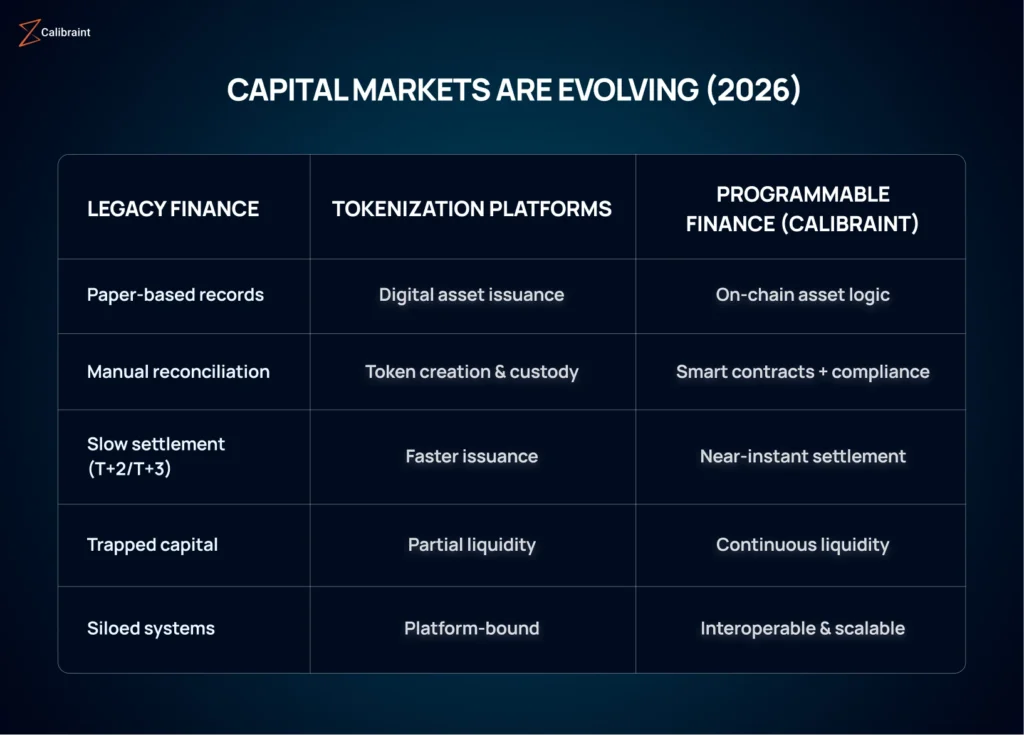
Capital Markets Are Evolving (2026)
From Paper → Platform → Programmable Finance
Evaluating Your Tokenization Strategy
For a decision-maker, the choice of technology partner and platform architecture will determine the long-term viability of a tokenization initiative. It is vital to move beyond the hype and focus on interoperability and scalability. A siloed tokenization project that cannot communicate with the broader financial ecosystem is destined for obsolescence.
When building blockchain based capital markets, firms must consider:
Interoperability: Can your tokenized assets move across different blockchains or integrate with legacy banking systems?
Scalability: Does the infrastructure support thousands of transactions per second without prohibitive costs?
Security: Are the smart contracts audited by reputable third parties to prevent exploits?
Governance: Who has the authority to pause or upgrade the contracts in the event of a market emergency?
Strategic leaders are looking for compliant asset tokenization solutions that offer a modular approach, allowing them to start with a specific use case and scale as the market matures.
The Risk of Inertia in a Programmable World
The transition to real world asset tokenization is not a trend that can be waited out. In 2026, the competitive landscape is being redefined by those who can move capital the fastest. Firms that rely on legacy processes will find themselves at a significant disadvantage, burdened by higher operational costs and unable to offer the innovative products that modern investors demand.
The liquidity improvement for RWAs is creating a “flywheel effect.” As more assets move on-chain, the depth of these markets increases, attracting more participants and further enhancing liquidity. Delaying your entry into this ecosystem means missing out on the network effects that are currently being established.
Working with an RWA development company allows institutions to mitigate these risks by leveraging proven architectures. Whether you are focused on tokenized fund infrastructure or individual asset classes, the goal is to build a foundation that is future-proof.
Building the Future of Finance
As we look toward the remainder of 2026 and beyond, the convergence of AI, IoT, and blockchain will further accelerate the evolution of compliant asset tokenization. Imagine a world where a fleet of autonomous vehicles, tracked via IoT, has its future cash flows tokenized and traded in real-time on blockchain based capital markets. This is the level of sophistication that programmable finance enables.
The success of real world asset tokenization hinges on the seamless orchestration of technology, law, and finance. By utilizing smart contracts for RWA tokenization, we are moving toward a financial system that is not only more efficient but also more equitable and transparent.
Partner with the industry leaders in RWA development to build a programmable, liquid, and compliant future for your capital.
Frequently Asked Questions
What is real world asset tokenization and why does it matter in 2026?
It is the process of converting ownership rights of a physical or financial asset into a digital token on a blockchain. In 2026, it matters because it unlocks global liquidity, reduces administrative costs, and enables the fractional ownership of high-value assets that were previously illiquid.
How does RWA development reshape capital markets?
It replaces manual, centralized processes with automated, decentralized infrastructure. This shift facilitates instant settlement, reduces counterparty risk, and creates a more transparent ecosystem where the “golden source of truth” is shared among all participants via a distributed ledger.
What are the key benefits of tokenizing real world assets?
The primary benefits include liquidity improvement for RWAs, 24/7 market access, lower entry barriers for investors, automated compliance via smart contracts, and significantly reduced operational overhead for issuers and managers.
What types of assets can be tokenized in real-world asset platforms?
Virtually any asset with value can be tokenized, including commercial real estate, private equity, venture capital funds, fine art, commodities like gold, and even cash-flow-producing assets like infrastructure projects or invoices.
How do smart contracts and blockchain enable programmable finance for RWAs?
They allow for logic to be embedded directly into the asset. This means dividends, interest payments, and compliance checks happen automatically based on pre-defined triggers, removing the need for manual intervention and ensuring the asset behaves exactly as intended throughout its lifecycle.
Conclusion: The Strategic Path Forward
The evolution of real world asset tokenization is a structural shift that demands a proactive strategy. For financial leaders, 2026 is the year to move beyond exploration and into execution. The benefits of liquidity improvement for RWAs and the efficiencies gained through tokenized fund infrastructure provide a clear ROI that justifies the transition from legacy systems.
Success in this new era requires a partner who understands the nuances of both the technology and the regulatory landscape. As a specialized RWA development company, we are committed to helping institutions navigate this transition with precision and security. The future of finance is programmable, compliant, and open. The only question remains: is your organization ready to lead?
READY TO TOKENIZE YOUR REAL WORLD ASSETS?Calibraint empowers financial innovators to build secure, scalable, and compliant RWA platforms. Let’s turn your vision into a programmable reality.
Calibraint
Author
January 29, 2026
Last updated: March 2, 2026
Let's Start A Conversation
Manage Consent
To provide the best experiences, we use technologies like cookies to store and/or access device information. Consenting to these technologies will allow us to process data such as browsing behavior or unique IDs on this site. Not consenting or withdrawing consent, may adversely affect certain features and functions.
Functional
Always active
The technical storage or access is strictly necessary for the legitimate purpose of enabling the use of a specific service explicitly requested by the subscriber or user, or for the sole purpose of carrying out the transmission of a communication over an electronic communications network.
Preferences
The technical storage or access is necessary for the legitimate purpose of storing preferences that are not requested by the subscriber or user.
Statistics
The technical storage or access that is used exclusively for statistical purposes.The technical storage or access that is used exclusively for anonymous statistical purposes. Without a subpoena, voluntary compliance on the part of your Internet Service Provider, or additional records from a third party, information stored or retrieved for this purpose alone cannot usually be used to identify you.
Marketing
The technical storage or access is required to create user profiles to send advertising, or to track the user on a website or across several websites for similar marketing purposes.