Advanced Token Standards in 2026: Functional and Expressive ERC-777, ERC-4626
Calibraint
Author
January 30, 2026
Modern finance is undergoing a silent, structural revolution where the core protocols of value exchange are being rewritten for precision and velocity. In the early days of decentralized finance, assets were often static and fragmented. Today, the focus has shifted toward programmable liquidity. This transition defines advanced token standards in 2026, where efficiency, automation, and capital precision are no longer optional.
As enterprises integrate blockchain into their core operations, the rise of NFT development has evolved from simple digital collectibles into the creation of sophisticated, programmable instruments that represent real-world utility and complex financial rights. The shift from basic token transfers to intelligent, self-executing contracts is the defining transition of this decade.
The Efficiency Gap in Legacy Digital Assets
For years, the industry relied on basic standards that required manual intervention for almost every interaction. If you wanted to move a token into a yield-generating pool, you had to approve the contract, then trigger the transfer, and finally hope the accounting on the other side remained accurate. This friction created a barrier for institutional entry. Large-scale capital requires certainty and automation. The friction of the “Approve and Transfer” model is not just a user experience flaw; it is a capital inefficiency that costs millions in lost time and potential errors.
Sophisticated market participants now look for Advanced Token Standards in 2026 to solve these structural bottlenecks. These standards provide the necessary guardrails for complex financial operations while maintaining the flexibility required for rapid innovation. The goal is to move capital with the same ease that information moves across the internet, without sacrificing the security or transparency that regulated entities demand.
ERC-777: The Engine of Expressive Transactions
The ERC-777 token standard represents a significant leap in how tokens interact with smart contracts. Unlike its predecessors, which treat tokens as passive ledger entries, the ERC-777 token standard introduces a reactive framework. Through token hooks and operators, this standard allows a contract to know exactly when it receives a payment and react to it instantly.
When a transaction occurs under this framework, the receiving contract is notified through a hook. This enables a single-transaction experience where a user can send a token to a service, and the service can immediately provide the requested utility, such as a subscription or a fractionalized asset. This efficiency is critical for DeFi composability standards, where multiple protocols must interact in a seamless sequence.
The operator model within the ERC-777 token standard also changes how we think about asset management. An operator is an address that is authorized to move tokens on behalf of another. This is a game-changer for automated portfolio rebalancing and institutional custody. A fund manager can manage a basket of assets for a client without ever taking full control of the funds, providing a layer of security and delegation that was previously difficult to achieve on-chain.
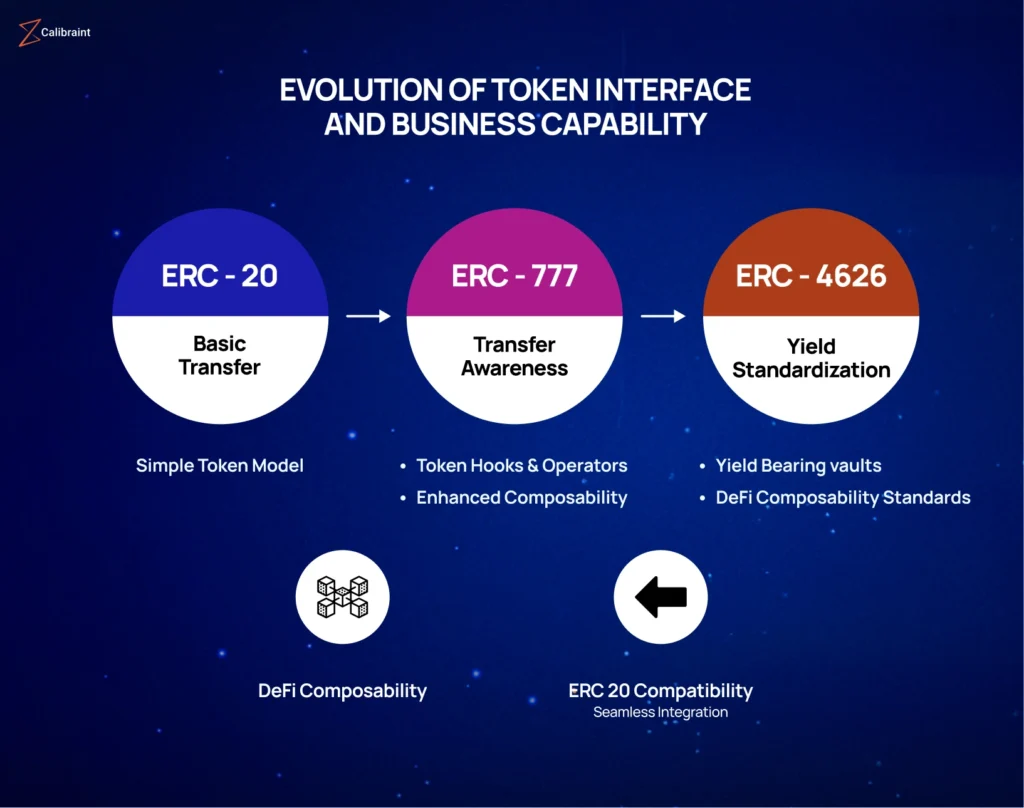
Visualizing the Evolution of Token Interfaces
At this point in the architecture shift, it is useful to visualize how token interfaces have evolved from simple transfers to expressive and yield-aware systems.
This progression illustrates how Advanced Token Standards in 2026 build incrementally rather than disruptively. ERC-20 establishes liquidity, the ERC-777 token standard introduces execution awareness, and the ERC-4626 standardizes yield behavior, all while maintaining DeFi composability standards and backward compatibility with ERC-20.
Standardizing the Yield: The ERC-4626 Revolution
If ERC-777 is about the movement of value, ERC-4626 is about the storage and growth of value. Before this standard, every yield-bearing vault had its own unique logic. Integrating a new yield strategy into a dashboard or a larger fund meant writing custom code for every single protocol. This fragmentation hindered the growth of the ecosystem and increased the risk of smart contract vulnerabilities.
ERC-4626 established the definitive yield-bearing token interfaces. It creates a standardized way for vaults to handle deposits, withdrawals, and share accounting. For a CFO or treasury manager, this means that any ERC-4626-compliant vault can be audited and integrated using the same tools. This uniformity is what allows for the massive scaling of decentralized savings accounts and institutional credit markets.
The beauty of these yield-bearing token interfaces lies in their simplicity. By standardizing how “shares” of a vault are calculated against the “total assets,” the industry has created a universal language for profit. This allows developers to build complex financial products on top of these vaults, knowing that the underlying accounting is reliable and predictable.
Bridging the Old and the New: Strategic Compatibility
A common concern for enterprise leaders is whether adopting new standards will isolate them from existing liquidity. The reality is that Advanced Token Standards in 2026 are built with a deep commitment to backward compatibility with ERC-20. Most implementations of the ERC-777 token standard function perfectly well within legacy exchanges and wallets. They essentially offer a “high-definition” experience for modern applications while remaining readable by older systems.
This bridge is vital for maintaining DeFi composability standards. It ensures that a token can benefit from the advanced features of token hooks and operators while still being tradable on every major global platform. You do not have to choose between innovation and liquidity; the architecture of 2026 allows you to have both.
The Business Impact of Smart Contract Token Interfaces
Adopting smart contract token interfaces in corporate strategy goes beyond mere technological relevance. It concerns lowering the expense associated with trust. When your token standards handle the accounting and the execution logic automatically, you reduce the need for manual reconciliation and third-party intermediaries.
Consider the impact on supply chain finance. By using advanced token standards in 2026, a company can issue tokens that represent physical goods. As these tokens move through the chain, the ERC-777 token standard triggers automatic payments to vendors via token hooks and operators. In parallel, available capital in the system can be kept in ERC-4626 vaults, ensuring every dollar earns interest up until the point it’s needed for payment. Five years ago, managing capital with this level of precision was out of reach.
How ERC-4626 Improves Capital Efficiency and Treasury Operations
At this point, the focus has shifted from whether token standards are important to how effectively they facilitate large-scale capital allocation. ERC-4626 has become the preferred structure for tokenized funds because it brings consistency to yield management across complex treasury environments.
For asset managers and finance teams, standardized vault interfaces reduce integration overhead and remove the need for custom logic with every new yield strategy. Capital moves with fewer dependencies because systems operate on shared assumptions rather than protocol-specific workarounds.
Instead of maintaining fragmented implementations, teams rely on yield-bearing token interfaces that simplify accounting, reporting, and allocation decisions. This approach improves governance and supports predictable behavior across DeFi integrations without increasing operational burden.
Backward compatibility with ERC-20 ensures these efficiencies do not compromise liquidity. Enterprises adopt advanced DeFi composability standards while maintaining full access to existing wallets, exchanges, and custody infrastructure.
Strategic Alignment and Long-Term Adoption
The adoption of ERC-777 and ERC-4626 token standards reflects a broader shift toward programmable finance. Together, they form a cohesive framework where movement, yield, and governance coexist without fragmentation.
In Advanced Token Standards in 2026, organizations no longer choose between innovation and stability. ERC-777 and ERC-4626 token standards operate within existing ecosystems while introducing expressive control and standardized yield behavior. This alignment enables scale without architectural compromise.
At Calibraint, we implement ERC-777 and ERC-4626 architectures with a clear focus on business outcomes. From institutional treasury systems to high-fidelity NFT development platforms, our work emphasizes secure design, predictable behavior, and long-term maintainability. In advanced token standards in 2026, execution discipline matters as much as technical choice.
FAQs
1. What are the ERC-777 and ERC-4626 token standards in 2026?
ERC-777 and ERC-4626 are advanced Ethereum token standards used in 2026 to support programmable and yield-aware assets. ERC-777 enables transfer-aware execution through hooks and operators, while ERC-4626 standardizes yield-bearing vaults. Together, they extend ERC-20 without breaking existing infrastructure.
2. How does ERC-777 improve upon ERC-20 in Ethereum token design?
ERC-777 improves ERC-20 by allowing smart contracts to react immediately when tokens are received. It removes repetitive approvals using operator-based permissions and enables automated execution at the token level. The design remains compatible with existing ERC-20 wallets and exchanges.
3. What benefits does the ERC-4626 vault standard bring to DeFi apps?
ERC-4626 introduces a unified interface for managing deposits, withdrawals, and yield calculations. This reduces custom integration logic and improves consistency across DeFi applications. Developers can build on standardized vault behavior with predictable accounting.
4. Why are advanced token standards important for Web3 developers?
Advanced token standards reduce operational friction by embedding logic directly into assets. They improve composability, automation, and security across decentralized systems. This enables developers to build scalable and production-ready Web3 applications.
5. How do ERC-777 and ERC-4626 enable composability in DeFi ecosystems?
ERC-777 enables composability by making token transfers execution-aware and interoperable. ERC-4626 standardizes how yield strategies expose assets and shares. Together, they allow DeFi protocols to integrate without protocol-specific adapters.
Calibraint
Author
January 30, 2026
Let's Start A Conversation
Manage Consent
To provide the best experiences, we use technologies like cookies to store and/or access device information. Consenting to these technologies will allow us to process data such as browsing behavior or unique IDs on this site. Not consenting or withdrawing consent, may adversely affect certain features and functions.
Functional
Always active
The technical storage or access is strictly necessary for the legitimate purpose of enabling the use of a specific service explicitly requested by the subscriber or user, or for the sole purpose of carrying out the transmission of a communication over an electronic communications network.
Preferences
The technical storage or access is necessary for the legitimate purpose of storing preferences that are not requested by the subscriber or user.
Statistics
The technical storage or access that is used exclusively for statistical purposes.The technical storage or access that is used exclusively for anonymous statistical purposes. Without a subpoena, voluntary compliance on the part of your Internet Service Provider, or additional records from a third party, information stored or retrieved for this purpose alone cannot usually be used to identify you.
Marketing
The technical storage or access is required to create user profiles to send advertising, or to track the user on a website or across several websites for similar marketing purposes.