TRC20 Wallet Integration for Enterprises: Complete ROI Analysis, Implementation Timeline, and Cost-Benefit Breakdown
Calibraint
Author
February 2, 2026
For the modern CFO or CTO, the friction of cross-border settlements remains a primary hurdle to global operational efficiency. Traditional banking rails are often plagued by high fees and multi-day clearing cycles that tie up essential liquidity. As enterprises seek more agile alternatives, the adoption of a USDT TRC20 wallet has transitioned from a niche fintech experiment to a strategic necessity for high-volume treasury management. Industry research on stablecoins in cross-border payments shows how blockchain-based settlement models significantly reduce transaction costs and settlement times compared to traditional banking systems.
This shift isn’t merely about following a trend; it is about leveraging sophisticated Blockchain Development to replace legacy bottlenecks with instant, low-cost stability. This analysis provides a clear roadmap for enterprise decision-makers evaluating the financial and technical feasibility of integrating Tron-based assets into their existing tech stack.
Why Enterprises Are Prioritizing USDT TRC20 Wallet Adoption
The move toward Tron-based stablecoins is driven by a fundamental need for predictable unit costs. While Ethereum remains a powerhouse, its fluctuating “gas” fees can render small to mid-sized corporate transactions economically unviable during periods of high network congestion.
The Cost-Efficiency Paradigm
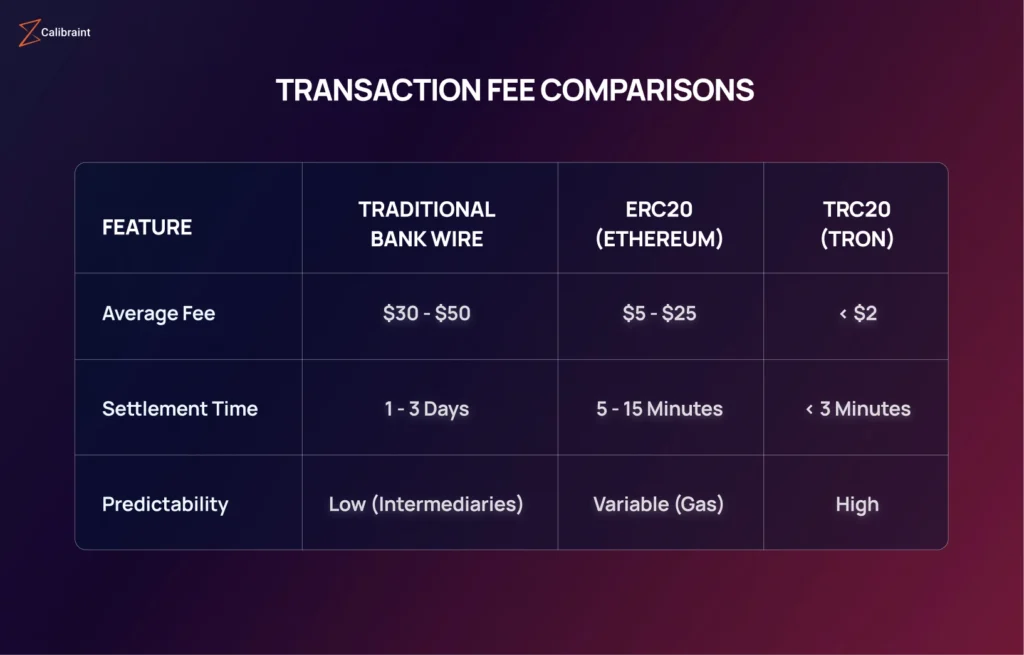
For a global enterprise processing thousands of monthly payments to vendors or contractors, the difference between a $15 transaction fee and a $1 transaction fee is substantial. A USDT TRC20 wallet allows for these high-frequency movements without the overhead of traditional wire fees or the volatility-induced costs of native network tokens. By utilizing the TRC20 standard, firms can move millions in value for a fraction of the cost associated with SWIFT or ERC20 transfers.
From a budgeting standpoint, many finance leaders first evaluate the cost to develop a USDT TRC20 wallet to understand how quickly infrastructure expenses can be offset by transaction-level savings.
Speed and Scalability
Enterprise operations require throughput. The Tron network’s delegated proof-of-stake mechanism allows for significantly higher transactions per second (TPS) compared to older chains. For a Product Head, this means the best TRC20 wallet for their platform will offer near-instant settlement, ensuring that user balances or vendor accounts reflect incoming funds in seconds, not minutes or hours.
Real-World Use Cases
Treasury Management: Moving idle capital between international subsidiaries without losing 3% to currency conversion and bank fees.
Fintech & Neobanking: Providing users with a digital dollar account that features low-cost entry and exit points.
Supply Chain Settlements: Automating payments to global suppliers through smart contracts triggered by delivery milestones.
TRC20 Wallet Integration From an Enterprise Perspective
Integrating a USDT TRC20 wallet at an enterprise level is vastly different from a consumer-grade setup. While a startup might prioritize speed to market, an enterprise must prioritize security, auditability, and compliance.
The Architecture Level
Enterprises typically require a multi-tier architecture. This includes a “hot” layer for automated payouts, a “warm” layer for secondary approvals, and a “cold” storage layer for the bulk of corporate reserves. A professional Tron Wallet Implementation ensures these layers communicate through secure APIs while keeping the private keys of the cold storage entirely offline.
Security and Custody
For a CIO, the primary concern is the custody of assets. Enterprises must choose between self-custody (building their own internal management system) or using a qualified custodian. If you are building a custom solution, the best TRC20 wallet strategy involves multi-party computation (MPC) or multi-signature (Multi-sig) workflows. This ensures that no single employee can move funds without a documented approval chain from authorized signatories.
Compliance Integration
Unlike retail wallets, enterprise versions must integrate with Know Your Transaction (KYT) and Anti-Money Laundering (AML) tools. Every incoming transfer to your USDT TRC20 wallet should be automatically screened for “tainted” funds before being credited to your ledger. This proactive stance protects the company from regulatory scrutiny and potential asset freezes.
Implementation Timeline: From Discovery to Deployment
A successful Tron Wallet Implementation follows a structured lifecycle to ensure zero downtime and maximum security.
Discovery & Requirement Gathering (2–3 Weeks): Identifying the volume of transactions, user roles, and existing software compatibility.
Architecture & Security Design (3–4 Weeks): Mapping out the key management system and firewall configurations.
Core Development (8–12 Weeks): This phase involves the actual Blockchain Development work, including smart contract writing for automated disbursements and API integration.
Deployment & Monitoring (Ongoing): Gradual rollout, starting with low-value internal transfers before full-scale client or vendor interaction.
Choosing between internal and external development is a common debate for Founders. While an internal team understands the business logic, specialized firms often have the niche security expertise required to build the best TRC20 wallet architecture that can withstand sophisticated cyber-attacks.
Complete ROI and Cost-Benefit Breakdown
Any major technical shift must be justified on the balance sheet. A comprehensive TRC20 ROI Analysis looks beyond the initial setup cost to the long-term operational savings.
Development Costs vs. Long-Term Savings
The initial investment in a custom USDT TRC20 wallet might seem significant, but the payback period is often surprisingly short. If an enterprise moves $10M monthly across 500 transactions, the savings on wire fees and exchange spreads can exceed $20,000 per month. Within a year, the system often pays for itself.
Transaction Fee Comparisons
Operational Efficiency Gains
Efficiency isn’t just about money; it’s about time. By conducting a TRC20 ROI Analysis, firms find that they reduce the “human hours” spent on reconciling failed bank transfers or investigating delayed payments. Automated Tron Wallet Implementation allows your finance team to focus on high-level strategy rather than chasing paper trails.
The Strategic Value of TRC20 ROI Analysis
Performing a formal TRC20 ROI Analysis allows a CFO to present a data-backed case to the board. It quantifies the reduction in “dead capital” money stuck in transit and shows how a USDT TRC20 wallet improves the company’s overall liquidity ratio.
Choosing the Right Wallet Strategy
Decision-makers must decide if they want to buy or build. A “white-label” solution can get you to market faster, but it may lack the specific compliance hooks your legal team requires.
Custodial vs. Non-Custodial
A non-custodial USDT TRC20 wallet gives you full control, but also full responsibility. If you lose your keys, the assets are gone. For many enterprise leaders, the next logical question after timelines is budget predictability. Understanding the cost to develop a USDT TRC20 wallet helps CFOs and CTOs align technical scope with financial planning. Development costs can vary based on security architecture, compliance integrations, custody model, and transaction volume requirements, making early cost modeling a critical step before full-scale TRC20 wallet integration.
What to Look for in a Partner
When evaluating the best TRC20 wallet developers, look for:
Experience in high-security environments.
The ability to integrate with existing ERP systems (like SAP or Oracle).
A clear understanding of the specific TRC20 Wallet Integration nuances, such as “Energy” and “Bandwidth” management on the Tron network to further reduce costs.
Frequently Asked Questions (FAQ)
What is the difference between USDT TRC20 and ERC20?
The main difference is the underlying network. USDT TRC20 runs on the Tron blockchain, while ERC20 runs on Ethereum. For a business, this translates to TRC20 having significantly lower transaction fees and faster confirmation times, making it better for high-frequency operations.
How do I send and receive USDT TRC20 without losing funds?
To ensure safety, always verify that the receiving address is a Tron (TRC20) address. These typically start with the letter “T.” Sending TRC20 tokens to an Ethereum (ERC20) address can result in a permanent loss of funds. For enterprise setups, we recommend automated address validation and small “test” transfers before moving large volumes.
What is the best TRC20 wallet for USDT in 2026?
For an individual, TronLink is widely used. However, for an enterprise, the best TRC20 wallet is a custom-built, multi-signature solution or a specialized institutional custody platform that offers audit logs, role-based access, and AML integration.
Summary of Business Value and Strategic Advantage
The transition to a USDT TRC20 wallet ecosystem is a move toward a more “borderless” and efficient financial future. By focusing on a detailed TRC20 ROI Analysis, enterprises can see the clear path from technical investment to bottom-line growth. The ability to settle transactions instantly for negligible costs provides a competitive edge that legacy-bound competitors simply cannot match.
While the technical landscape of Blockchain Development evolves rapidly, the fundamentals of the Tron network offer a stable and scalable foundation for the next decade of corporate finance. Whether your goal is to optimize treasury, launch a new fintech product, or simply reduce the cost of doing business, a professional TRC20 Wallet Integration is the bridge to that objective.
Calibraint
Author
February 2, 2026
Let's Start A Conversation
Manage Consent
To provide the best experiences, we use technologies like cookies to store and/or access device information. Consenting to these technologies will allow us to process data such as browsing behavior or unique IDs on this site. Not consenting or withdrawing consent, may adversely affect certain features and functions.
Functional
Always active
The technical storage or access is strictly necessary for the legitimate purpose of enabling the use of a specific service explicitly requested by the subscriber or user, or for the sole purpose of carrying out the transmission of a communication over an electronic communications network.
Preferences
The technical storage or access is necessary for the legitimate purpose of storing preferences that are not requested by the subscriber or user.
Statistics
The technical storage or access that is used exclusively for statistical purposes.The technical storage or access that is used exclusively for anonymous statistical purposes. Without a subpoena, voluntary compliance on the part of your Internet Service Provider, or additional records from a third party, information stored or retrieved for this purpose alone cannot usually be used to identify you.
Marketing
The technical storage or access is required to create user profiles to send advertising, or to track the user on a website or across several websites for similar marketing purposes.