Traditional vs Blockchain Gaming: The 2026 Industry Shift in Ownership and Rewards
Calibraint
Author
February 4, 2026
In 2026, the global gaming industry is undergoing a tectonic shift from traditional, closed-loop ecosystems to open-loop digital economies. This transition is defined by blockchain gaming ownership rewards 2026, where players move from being “renters” of digital licenses to “owners” of liquid assets. As enterprises pivot to capture this value, partnering with a leading Cryptocurrency wallet Development company has become the baseline requirement for building secure, scalable, and compliant player-driven economies. This shift toward blockchain gaming ownership ensures that time spent in-game translates into tangible, portable value.
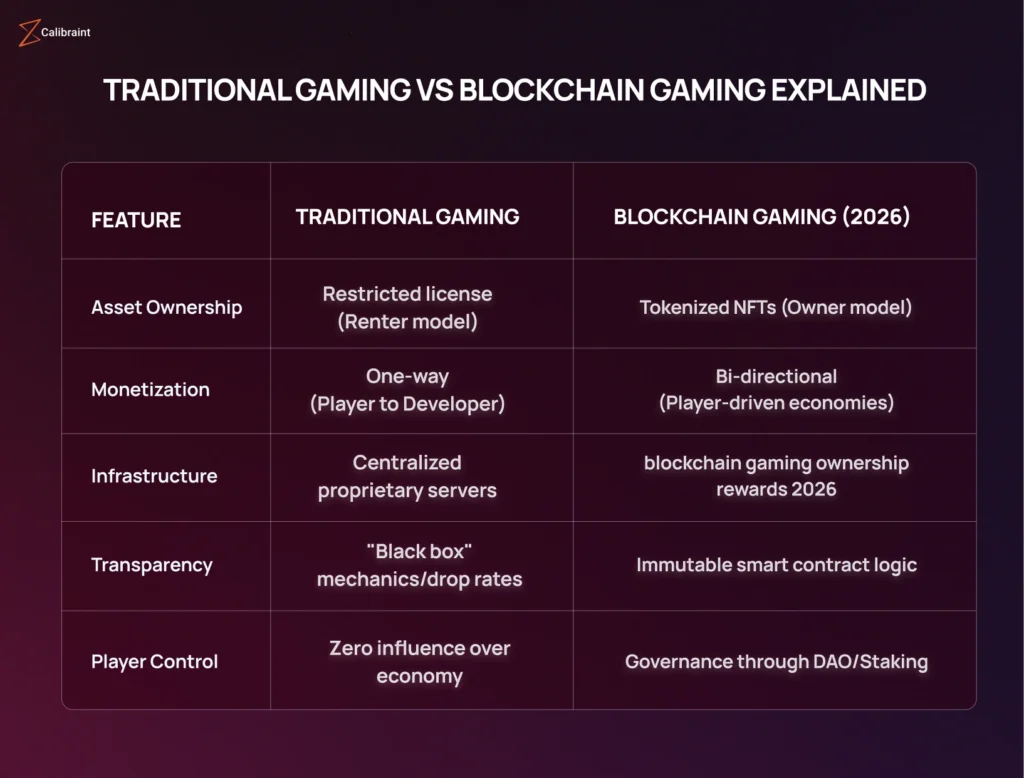
Traditional Gaming vs Blockchain Gaming Explained
Blockchain gaming differs from traditional gaming by replacing centralized databases with decentralized ledgers, ensuring that in-game assets are no longer proprietary to the developer. In 2026, this shift is characterized by “true ownership,” where assets exist independently of the game server, allowing for cross-game utility and real-world value extraction through secondary markets. This evolution of blockchain gaming ownership allows for the seamless transfer of assets across different virtual environments.
To understand how this shift is technically enabled, enterprises must look beyond surface-level NFTs and tokens. A scalable Web3 title depends on wallet architecture, smart contracts, on-chain asset standards, and interoperability layers. These key components of blockchain gaming infrastructure form the backbone that allows blockchain gaming ownership rewards 2026 to function securely across multiple chains and marketplaces.
2026 Comparison: Traditional vs Blockchain Infrastructure
How Blockchain Gaming Redefines Ownership and Rewards in 2026
In the current landscape, blockchain gaming ownership rewards 2026 represent more than just mechanics; they represent the financialization of digital entertainment. For an enterprise, this means transitioning from selling a product to managing a financial ecosystem. This new paradigm of blockchain gaming ownership requires a radical rethink of how player loyalty is cultivated and maintained.
The core of this redefinition lies in private key management. In 2026, blockchain-based assets are stored in user-controlled wallets, meaning the value persists even if the original game ceases to exist. To facilitate this, enterprises are integrating an analytics dashboard to monitor asset velocity in real-time. This data-driven approach allows developers to adjust DeFi and staking integration parameters, ensuring that nft gaming rewards remain sustainable rather than inflationary. By providing high-utility nft gaming rewards, developers can maintain economic stability.
The Rise of Multi-Chain Economies
Success in 2026 requires more than a single-chain strategy. Modern gaming ecosystems utilize DeFi and staking integration to allow players to earn yield on their idle in-game assets. By working with a professional Cryptocurrency wallet Development company, enterprises can deploy wallets that handle complex transaction signing while maintaining a seamless user experience through custom branding and UI. This infrastructure is essential for the next generation of play to earn games 2026, which demand high throughput and low latency.
The integration of blockchain gaming 2026 technology has matured to the point where “gasless” transactions are standard. By abstracting the blockchain layer, developers can offer play to earn games 2026 that feel identical to Web2 applications but retain the underlying benefits of blockchain gaming ownership.
Enterprise Infrastructure: Security and Scalability in 2026
For the enterprise buyer, the transition to blockchain gaming ownership rewards 2026 is primarily a security challenge. The stakes have moved beyond individual “hacks” to systemic institutional threats. As we navigate the complexities of 2026, the demand for “Zero Trust” architecture in gaming has become absolute.
Advanced Access Control
Modern wallets must support both non custodial and custodial options to cater to different user segments. While hardcore gamers prefer non-custodial control, casual users often opt for custodial “managed” experiences. To protect these entry points, enterprises are mandating multi factor authentication and biometric authentication to eliminate the password as a single point of failure. This is particularly vital for play to earn games 2026, where user accounts hold significant monetary value.
The use of biometric authentication ranging from facial recognition to advanced haptic patterns has drastically reduced account takeovers. When paired with multi factor authentication, the security barrier becomes high enough to deter most automated bot attacks common in early Web3 gaming iterations.
Institutional Asset Protection
Behind the scenes, private key management has evolved. Enterprises use Multi-Party Computation (MPC) to shard keys across multiple secure environments. This is often paired with custom branding and UI that masks the underlying complexity, ensuring the “crypto” remains invisible to the end-user. A dedicated analytics dashboard further assists administrators in spotting anomalous behavior. These security measures are the foundation of blockchain gaming ownership, protecting both the studio and the player.
A dedicated analytics dashboard further assists administrators in spotting anomalous behavior, such as sudden asset liquidations or suspicious cross-chain transfers. These security measures are the foundation of blockchain gaming ownership, protecting both the studio and the player. By offering both non custodial and custodial options, developers can balance user autonomy with institutional oversight.
Market Validation: The Data Behind the Shift
According to 2026 reports from SkyQuest and Token Metrics, the global blockchain gaming market is projected to reach over $1.2 trillion by 2033, with 2026 serving as the definitive inflection point. Insights from Expedite Studio suggest that high-quality nft gaming rewards are the primary driver of this growth.
Sustainability: 70% of new titles have moved toward DeFi and staking integration to lock in long-term liquidity.
Adoption: The integration of biometric authentication has reduced wallet onboarding friction by 60%, a crucial factor for play to earn games 2026.
Enterprise Spend: Institutional investment in Cryptocurrency wallet Development company services has doubled as brands seek to own their player relationship through custom branding and UI.
The focus has shifted from speculative “Play-to-Earn” models to “Play-and-Own” models. In 2026, the successful projects are those that prioritize gameplay depth while using blockchain gaming 2026 features as a backend utility.
FAQ: Navigating Enterprise Crypto Infrastructure
What is the difference between Web3 gaming and traditional gaming?
Web3 gaming differs from traditional gaming by providing players with true asset ownership. In traditional gaming, all data is stored on a publisher’s server, whereas blockchain gaming 2026 utilizes non custodial and custodial options to store assets on a public ledger, enabling blockchain gaming ownership rewards 2026.
Is Web3 gaming better than traditional gaming?
Web3 gaming is superior for players seeking financial sovereignty, as it offers blockchain gaming ownership rewards 2026. From an enterprise perspective, it is better for building loyalty via DeFi and staking integration, though it requires sophisticated private key management and security protocols like biometric authentication to protect high-value nft gaming rewards.
How does ownership work in Web3 gaming vs traditional gaming?
In traditional gaming, players buy a license; in Web3, they own the item as a tokenized NFT. This blockchain gaming ownership is managed via private key management in the player’s wallet. Enterprises track these transactions using an analytics dashboard, ensuring they can provide a curated experience through custom branding and UI.
Is UPI using blockchain?
No, the Unified Payments Interface (UPI) does not natively use blockchain technology. However, in 2026, many Web3 startups are bridging UPI with blockchain layers to allow users to purchase assets for play to earn games 2026 instantly using local fiat rails while maintaining multi factor authentication for security.
How does blockchain gaming differ from traditional gaming?
Blockchain gaming differs from traditional gaming by utilizing decentralized ledger technology to grant players absolute ownership over their in-game items as NFTs or tokens. Unlike traditional games, where assets are locked within a single company’s server, blockchain gaming 2026 platforms allow assets to be traded or used across different virtual worlds.
Conclusion: Securing Your Position in the Ownership Economy
The 2026 industry shift is clear: the future of gaming is built on the pillars of true ownership and sustainable rewards. By leveraging blockchain gaming ownership rewards 2026, enterprises can unlock new revenue streams. However, the complexity of private key management, combined with the need for a sophisticated analytics dashboard, requires a partner with deep technical pedigree.
As a premier Cryptocurrency wallet Development company, Calibraint provides the institutional-grade infrastructure from biometric authentication and multi factor authentication to DeFi and staking integration needed to launch and scale your Web3 vision. The ownership economy is here; the only question is who will own the infrastructure that powers it.
Calibraint
Author
February 4, 2026
Let's Start A Conversation
Manage Consent
To provide the best experiences, we use technologies like cookies to store and/or access device information. Consenting to these technologies will allow us to process data such as browsing behavior or unique IDs on this site. Not consenting or withdrawing consent, may adversely affect certain features and functions.
Functional
Always active
The technical storage or access is strictly necessary for the legitimate purpose of enabling the use of a specific service explicitly requested by the subscriber or user, or for the sole purpose of carrying out the transmission of a communication over an electronic communications network.
Preferences
The technical storage or access is necessary for the legitimate purpose of storing preferences that are not requested by the subscriber or user.
Statistics
The technical storage or access that is used exclusively for statistical purposes.The technical storage or access that is used exclusively for anonymous statistical purposes. Without a subpoena, voluntary compliance on the part of your Internet Service Provider, or additional records from a third party, information stored or retrieved for this purpose alone cannot usually be used to identify you.
Marketing
The technical storage or access is required to create user profiles to send advertising, or to track the user on a website or across several websites for similar marketing purposes.