From Pilots to Production: Accelerating Quantum-Resistant Blockchain Adoption and Earning Enterprise Trust in Finance and Beyond
Calibraint
Author
February 6, 2026
In the rapidly evolving digital landscape, your enterprise faces a silent but accelerating countdown. For CTOs and CISOs in the BFSI sector, the security of distributed ledgers is no longer a “set and forget” infrastructure component. As quantum computing capabilities advance, the cryptographic foundations of your current systems RSA and ECC, face an eventual, inevitable obsolescence. Transitioning from experimental pilots to full-scale quantum resistant blockchain adoption is now a strategic necessity to protect long-term asset integrity. At Calibraint, our approach to Blockchain Development prioritizes future-proofing your architecture today to ensure that the financial rails of tomorrow remain impenetrable. Waiting for a “Y2Q” moment is a risk your reputation cannot afford.
The Shift from Theoretical Risk to Enterprise Reality
For years, quantum computing was a laboratory curiosity. Today, with the emergence of Shor’s algorithm and increasing qubit counts, the threat to asymmetric encryption is a boardroom discussion. If your financial institution relies on traditional signatures for transaction validation, those signatures could eventually be forged by a sufficiently powerful quantum computer.
This is why post quantum blockchain strategies are moving out of innovation labs and into core infrastructure planning. The goal is no longer just to prove the technology works, but to ensure it can handle the throughput, compliance requirements, and latency demands of a global financial market. Enterprise leaders are recognizing that “harvest now, decrypt later” attacks mean that data encrypted today is already vulnerable to future quantum scrutiny.
Why Pilots Alone are No Longer Enough
Many organizations have dipped their toes into the water with small-scale proofs of concept. While these are valuable for learning, they often ignore the complexities of integration. A pilot typically runs in a vacuum, but quantum resistant blockchain adoption in a production environment requires integration with existing ERPs, custody solutions, and regulatory reporting engines.
Transitioning to quantum safe blockchain adoption means moving beyond isolated environments. It requires a holistic look at your cryptographic agility. If your current blockchain protocol cannot swap out its underlying hash functions or signature schemes without a total hard fork, it is a legacy system in waiting. Production readiness is defined by the ability to remain resilient as NIST (National Institute of Standards and Technology) continues to finalize new standards.
What Makes a Blockchain Quantum-Resistant Compared to Classical Cryptography?
To understand the shift, we must look at the math. Classical blockchain security relies on the difficulty of factoring large integers or solving discrete logarithm problems. Quantum computers excel at these specific tasks.
In contrast, post quantum cryptography blockchain structures utilize “quantum-hard” mathematical problems, such as lattice-based cryptography, multivariate equations, or hash-based signatures. These problems are believed to be resistant to both classical and quantum attacks. By implementing these at the protocol layer, enterprises ensure that even if a quantum adversary emerges, the fundamental ledger remains immutable.
Is Post-Quantum Cryptography Already Standardized for Enterprise Use?
The short answer is: we are getting there. NIST has already identified several candidate algorithms for standardization, such as CRYSTALS-Kyber for encryption and CRYSTALS-Dilithium for digital signatures.
For the C-suite, this means the “wait and see” period is over. Quantum resistant blockchain adoption can now be mapped against these emerging standards. Leading enterprise tech leaders are already building “cryptographically agile” layers that allow them to implement these algorithms as they become industry-standard, ensuring they aren’t locked into a dead-end technology.
High-Stakes Challenges: Security, Compliance, and Auditability
In the BFSI sector, security is only one part of the equation. You also face the challenge of regulatory alignment. Regulators are beginning to ask how firms plan to protect consumer data and systemic stability against future technological shocks.
Cryptographic Agility: The ability to update algorithms without disrupting service.
Performance Overheads: Quantum-resistant keys and signatures are often larger than their classical counterparts. This impacts storage and bandwidth.
Audit Trails: Maintaining a clear, tamper-proof history during the transition from classical to post quantum cryptography blockchain frameworks is essential for compliance.
Successfully navigating these hurdles requires a partner who understands both the theoretical math and the practical rigors of Blockchain Development.
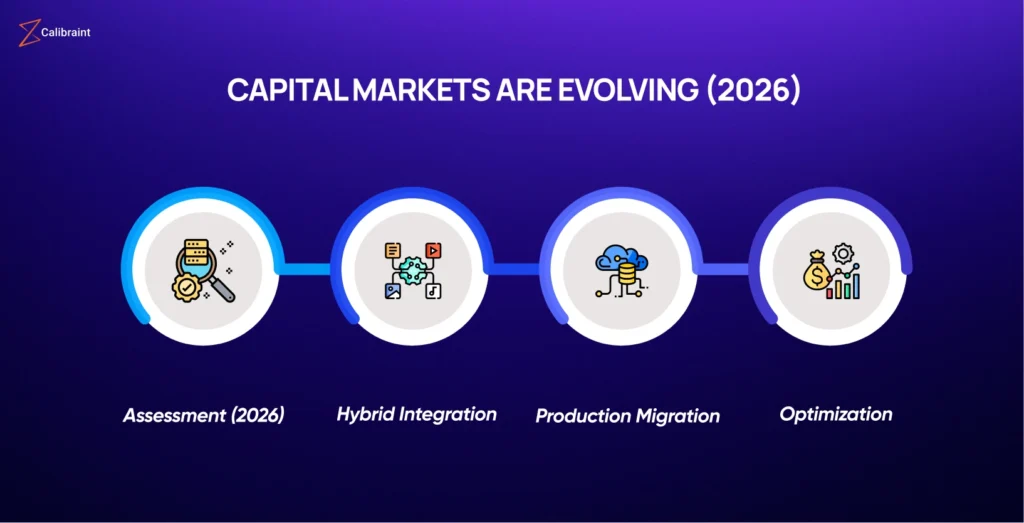
Verify “Cryptographic Agility” to swap algorithms without downtime.
Phase 3: Production Migration
Scale quantum resistant blockchain adoption across core financial rails.
Re-encrypt legacy data to prevent “Harvest Now, Decrypt Later” risks.
Phase 4: Optimization
Align with finalized NIST standards for post quantum cryptography blockchain.
Audit for quantum safe blockchain adoption compliance and ROI.
Can Financial Institutions Upgrade Existing Blockchains to be Quantum-Safe?
One of the most frequent questions we hear is whether a total rebuild is necessary. Fortunately, the answer is often no, but it requires a sophisticated migration path. Upgrading to a quantum safe blockchain adoption model can involve “hybrid” signatures.
In a hybrid model, a transaction is signed with both a classical signature (for current compatibility) and a post-quantum signature. This allows for a graceful transition. As the industry matures, the classical requirement can be sunsetted. This path minimizes downtime and allows for quantum resistant blockchain adoption to happen in phases rather than one risky “big bang” migration.
ROI and Risk Mitigation: The Business Case for Early Adoption
Investing in quantum resistant cryptographic finance is not just about avoiding a catastrophe; it is about building a premium brand centered on trust. In an era where data breaches cost millions and erode customer confidence, being a “first mover” in quantum readiness is a powerful market signal.
Risk Mitigation: Protecting against the “Harvest Now, Decrypt Later” threat.
Regulatory Confidence: Demonstrating proactive risk management to central banks and financial authorities.
Future-Proofing: Avoiding the massive costs of emergency, last-minute infrastructure overhauls.
By prioritizing quantum resistant blockchain adoption, you ensure that your platform remains the “gold standard” for institutional investors who prioritize long-term stability over short-term hype.
How Do Regulators View Quantum Readiness in Financial Infrastructure?
Regulators are increasingly viewing quantum threats as a matter of national and economic security. We are seeing a shift from “encouraging research” to “expecting readiness.” For institutions involved in cross-border payments or large-scale asset tokenization, quantum resistant cryptographic finance is becoming a checkbox in high-level risk assessments.
Documentation and transparency are key. When you can show that your post quantum blockchain strategy is aligned with international standards, you reduce your regulatory friction. This proactive stance simplifies audits and can even lead to lower insurance premiums as you demonstrate a lower risk profile compared to peers.
What are the Biggest Risks of Delaying Quantum-Safe Blockchain Adoption?
The danger of delay is two-fold: technical debt and loss of trust. If you continue to build on top of classical architectures, the cost of eventually migrating those systems grows exponentially. Furthermore, if a competitor announces a fully quantum safe blockchain adoption milestone, your institution may be perceived as laggard or, worse, unsafe.
In the world of quantum resistant cryptographic finance, the “wait and watch” approach is a gamble where the house eventually wins. The time to establish your roadmap for quantum resistant blockchain adoption is while the market is still in the transition phase, not when the crisis has arrived.
FAQ: Navigating the Quantum Transition
What is quantum-resistant blockchain and why do enterprises need it now?
It is a distributed ledger that utilizes cryptographic algorithms specifically designed to be secure against the processing power of quantum computers. Enterprises need it now because data stored on current blockchains can be intercepted today and decrypted once quantum computers become sufficiently powerful.
When will quantum computers break current blockchains, and what’s the timeline for adoption in finance?
Estimates vary, but many experts point to a 5 to 10-year window. However, for financial institutions with long-term data retention requirements, the timeline for quantum resistant blockchain adoption is immediate. The transition of core infrastructure can take years, meaning the work must begin today.
How can enterprises accelerate from quantum-resistant blockchain pilots to production and build trust?
Success lies in moving toward cryptographic agility and hybrid signature models. By integrating post quantum blockchain features into existing workflows and focusing on interoperability, enterprises can prove resilience without disrupting current operations, thereby earning the trust of stakeholders and regulators alike.
Conclusion: Securing the Future of Finance
The journey toward quantum resistant blockchain adoption is a marathon, not a sprint, but the starting gun has already fired. For leaders in finance and enterprise technology, the priority must shift from “if” to “how.” Transitioning to a post quantum blockchain environment is the only way to ensure that the digital assets and sensitive data you manage today remain secure for decades to come.
As you look to evolve your infrastructure, remember that true resilience is built on a foundation of consultative expertise and technical precision. Whether you are refining a current project or starting from scratch, our team’s deep experience in Blockchain Development ensures that your transition to a quantum safe blockchain adoption model is seamless, compliant, and above all, secure.
The institutions that lead the charge in quantum resistant blockchain adoption will be those that define the standards of trust in the next era of global finance. By acting now, you are not just solving a technical problem; you are securing your organization’s legacy in the quantum age.
Calibraint
Author
February 6, 2026
Let's Start A Conversation
Manage Consent
To provide the best experiences, we use technologies like cookies to store and/or access device information. Consenting to these technologies will allow us to process data such as browsing behavior or unique IDs on this site. Not consenting or withdrawing consent, may adversely affect certain features and functions.
Functional
Always active
The technical storage or access is strictly necessary for the legitimate purpose of enabling the use of a specific service explicitly requested by the subscriber or user, or for the sole purpose of carrying out the transmission of a communication over an electronic communications network.
Preferences
The technical storage or access is necessary for the legitimate purpose of storing preferences that are not requested by the subscriber or user.
Statistics
The technical storage or access that is used exclusively for statistical purposes.The technical storage or access that is used exclusively for anonymous statistical purposes. Without a subpoena, voluntary compliance on the part of your Internet Service Provider, or additional records from a third party, information stored or retrieved for this purpose alone cannot usually be used to identify you.
Marketing
The technical storage or access is required to create user profiles to send advertising, or to track the user on a website or across several websites for similar marketing purposes.