Zero Knowledge Proof Implementation for Enterprises: Selecting ZK-SNARKs or ZK-STARKs for Live Production Systems
Calibraint
Author
February 9, 2026
Enterprise technology is shifting beneath our feet. Privacy now sits at the center of every boardroom discussion. Data moves across partners, systems, and regions, yet trust rarely keeps pace. Leaders working closely with blockchain development understand this tension well. Modern organizations need verification without exposure, proof without revealing the data behind it, and systems that protect value while still enabling collaboration.
This is where Zero Knowledge Proof Implementation for Enterprises becomes a strategic conversation, not just a technical one.
Most teams aren’t searching for theory. What matters is clarity on what works in production: whether ZK-SNARKs or ZK-STARKs align with specific business needs, compliance models, and long-term security postures. This guide walks through how Zero Knowledge Proof Implementation for Enterprises supports live systems, how production-ready ZKP systems take shape, and how to make the right architectural call with confidence.
The Shift Toward Verifiable Privacy
Enterprises collect and process sensitive data at scale. Financial institutions validate transactions. Healthcare providers manage confidential patient records. Supply chains track product authenticity across borders. In each case, data must be verified by multiple parties. Yet exposure creates risk.
Zero Knowledge Proof Implementation for Enterprises changes how trust forms between organizations. Teams can confirm that a transaction is valid without revealing its value. Identity credentials can be verified without exposing personal data. Compliance can be proven without opening internal records.
This approach supports privacy-preserving blockchain protocols that allow businesses to prove integrity while keeping critical information protected. Leaders see this not as an experiment but as a foundation for secure collaboration.
When systems operate in regulated environments, this form of validation matters deeply. It reduces risk, supports transparency, and builds confidence across partners who depend on accurate verification. Production ready ZKP systems make this possible without forcing organizations to choose between privacy and proof.
The Leadership Problem You Are Trying to Solve
Data sharing creates a deep tension inside enterprise systems. Partners expect proof that processes meet defined standards. Regulators look for confirmation that frameworks are followed. Auditors require evidence that controls function as intended. Every validation request increases the risk of exposing information that should remain protected.
This is where Zero Knowledge Proof Implementation for Enterprises becomes a serious strategic consideration. The goal is not secrecy. The goal is verification without exposure.
Traditional verification models create a difficult trade-off. Organizations either share internal data and increase risk, or restrict access and slow collaboration. Over time, this friction begins to affect partnership speed, compliance cycles, and operational efficiency.
Zero Knowledge Proof Implementation for Enterprises resolves this tension. One party can prove a statement is true without revealing the underlying data. Financial institutions can confirm transaction integrity without exposing account information. Healthcare platforms can validate eligibility without sharing sensitive records. Supply chain participants can prove authenticity without disclosing supplier relationships.
What once lived inside academic cryptography now supports real enterprise operations. Production ready ZKP systems already support identity validation, confidential financial workflows, and secure verification processes.
Why the Conversation Is Happening Now
Enterprise systems have become deeply interconnected. Data flows across partners, platforms, regions, and regulatory environments. Each integration increases the need for verification. Each verification introduces new privacy concerns.
Zero Knowledge Proof Implementation for Enterprises sits at the center of this shift. Outcomes must be confirmed without exposing inputs. Compliance must be demonstrated without revealing internal structures. Collaboration must happen without weakening data protection.
Enterprise zero knowledge proof solutions address these pressures directly. Proof generation satisfies verification requirements while protecting sensitive information. This supports privacy preserving blockchain protocols that enable trusted collaboration across distributed environments.
This transition isn’t about increasing complexity; it’s focused on building trust in digital interactions. Organizations that adopt this model create systems where validation happens without compromise.
Understanding ZK-SNARKs and ZK-STARKs in a Business Context
When evaluating Zero Knowledge Proof Implementation for Enterprises, the decision between ZK-SNARKs and ZK-STARKs shapes system architecture and long-term security posture.
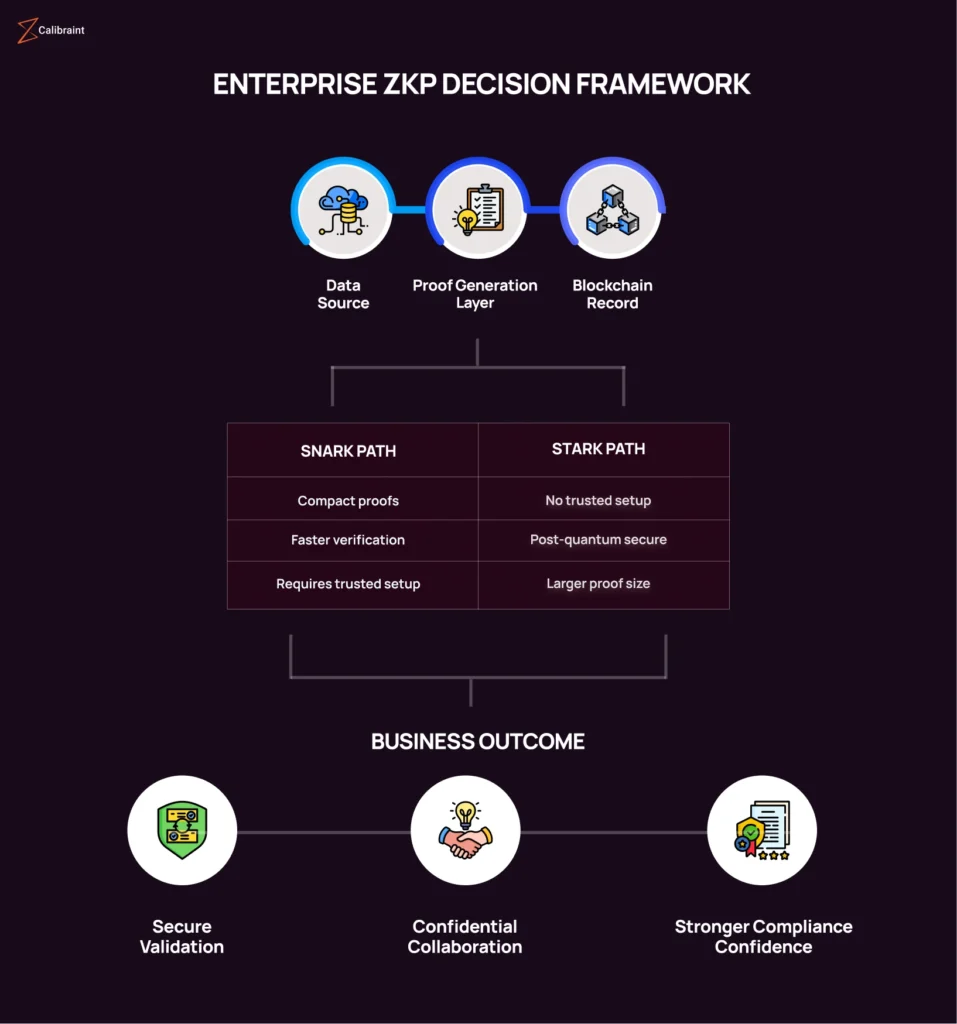
ZK-SNARKs produce compact proofs and support efficient verification. Many production ready ZKP systems rely on them because they fit well into environments where performance and bandwidth efficiency matter. However, SNARK-based models require a trusted setup phase. This step demands careful governance and secure handling of initialization parameters.
ZK-STARKs follow a different path. They do not depend on a trusted setup. They rely on transparent cryptographic assumptions and public randomness. Many post quantum secure ZKP frameworks consider STARK-based approaches suitable for long-term security planning. The trade-off appears in proof size and generation complexity, which can affect performance planning.
This decision is not purely technical. It involves security leadership, compliance teams, and infrastructure planners. Organizations planning long operational lifecycles often consider STARKs for their future-oriented security model. Companies focused on current performance efficiency often prefer SNARKs due to their compact nature.
Zero Knowledge Proof Implementation for Enterprises becomes a strategic conversation at this stage. The choice defines how systems will manage privacy, governance, and verification over time.
What Makes a System Truly Production Ready
Not every cryptographic model works in a live enterprise environment. Production ready ZKP systems must operate under real conditions. They must handle transaction volumes, maintain performance, and integrate with existing workflows.
ZKP scalability and performance optimization play a central role here. Proof generation should align with your system’s operational pace. Verification must remain efficient as adoption grows. Infrastructure should support continuous operation without disruption.
Organizations that succeed with Zero Knowledge Proof Implementation for Enterprises treat it as part of their architecture rather than an isolated feature. They align proof systems with business processes. They design governance structures for setup and updates. They build environments that support growth without slowing down core operations.
When done right, enterprise zero knowledge proof solutions become a stable layer that strengthens trust and reduces exposure risk.
How Privacy Becomes a Competitive Advantage
Privacy has moved beyond compliance. It now shapes how organizations build credibility with partners and customers.
Privacy preserving blockchain protocols allow verification without exposing internal data. This opens new collaboration models. Compliance can be confirmed without sharing records. Transactions can be validated without revealing values. Identity attributes can be proven without exposing personal details.
Enterprise zero knowledge proof solutions support this structure by separating proof from data. Knowledge of information can be demonstrated without transmitting the information itself. This creates a secure foundation for cooperation across organizations that must work together but cannot fully share internal systems.
The advantage appears in operational flexibility. Partnerships form faster. Compliance becomes more efficient. Integrations move forward without increasing exposure risk.
Zero Knowledge Proof Implementation for Enterprises supports systems that encourage trust while protecting what matters most.
A Practical Example From Enterprise Operations
Consider a network where multiple financial institutions process shared transactions. Each participant needs assurance that rules are followed. At the same time, no institution wants to expose sensitive transaction data.
Zero Knowledge Proof Implementation for Enterprises makes this possible. Each institution generates proofs that confirm rule compliance. Other participants verify those proofs without accessing the underlying transaction details.
This model works because proof generation and verification are separated. The system creates evidence that a process was followed correctly. Verification confirms the validity of that evidence. Production ready ZKP systems make this process efficient enough for real operational use.
Organizations that focus on ZKP scalability and performance optimization start with targeted deployments. They measure system behavior. They refine circuit design. They expand as they gain confidence in performance and integration stability.
The choice depends on what matters most to your organization.
If you prioritize efficiency, compact data transfer, and faster integration into existing systems, SNARK-based implementations often align well. They support many production ready ZKP systems and work effectively in environments where performance and bandwidth are key concerns.
If your focus is long-term security, transparency, and alignment with post quantum secure ZKP frameworks, STARK-based approaches may feel more appropriate. They remove the need for trusted setup and support stronger future-oriented security thinking.
Infrastructure also influences the decision. STARK-based systems may require more computational resources during proof generation. Organizations with strong infrastructure capacity and long planning horizons can support this model comfortably.
Zero Knowledge Proof Implementation for Enterprises requires this evaluation at the architecture level. The decision affects performance, governance, infrastructure planning, and security posture. When you align the choice with your business goals, the system becomes a long-term asset rather than a short-term experiment.
Conclusion
Zero Knowledge Proofs are quickly moving from theory to enterprise reality. The right implementation strengthens privacy, improves compliance readiness, and builds verifiable trust across digital ecosystems without exposing sensitive data.
Turning this into a production-ready system, however, requires deep blockchain expertise, secure architecture design, and seamless integration with existing infrastructure. That’s where Calibraint adds measurable value.
Our focus is on translating advanced cryptographic systems into production environments that perform in real conditions. We help enterprises move from concept to live deployment with confidence.
Ready to implement enterprise-grade ZKP solutions?
Partner with us to design, build, and scale secure blockchain systems tailored for real business impact.
FAQs
1. How do enterprises decide between ZK-SNARK and ZK-STARK architectures for production blockchain systems?
Enterprises typically compare proof size, verification speed, setup requirements, and long-term security. SNARKs offer smaller proofs and faster verification, while STARKs provide stronger transparency and post-quantum resilience.
2. What performance trade-offs should enterprises evaluate when deploying zero knowledge proof infrastructure at scale?
Key trade-offs include proof generation time, computational cost, storage overhead, and network latency. Faster verification often comes with heavier proof generation demands.
3. How do zero knowledge proofs improve compliance and data privacy in enterprise blockchain ecosystems?
ZKPs allow validation of transactions or identities without revealing underlying data, supporting regulatory compliance while protecting sensitive business and customer information.
4. What infrastructure requirements are needed to implement production-grade ZKP verification pipelines?
Enterprises need high-performance compute environments, optimized cryptographic libraries, scalable nodes, secure key management, and integration with existing backend systems.
5. How do Layer-2 scaling solutions integrate ZKP frameworks for high-throughput enterprise applications?
Layer-2 platforms use ZKPs to bundle and verify multiple transactions off-chain, then submit compact proofs on-chain. This improves throughput, reduces costs, and maintains security guarantees.
Calibraint
Author
February 9, 2026
Let's Start A Conversation
Manage Consent
To provide the best experiences, we use technologies like cookies to store and/or access device information. Consenting to these technologies will allow us to process data such as browsing behavior or unique IDs on this site. Not consenting or withdrawing consent, may adversely affect certain features and functions.
Functional
Always active
The technical storage or access is strictly necessary for the legitimate purpose of enabling the use of a specific service explicitly requested by the subscriber or user, or for the sole purpose of carrying out the transmission of a communication over an electronic communications network.
Preferences
The technical storage or access is necessary for the legitimate purpose of storing preferences that are not requested by the subscriber or user.
Statistics
The technical storage or access that is used exclusively for statistical purposes.The technical storage or access that is used exclusively for anonymous statistical purposes. Without a subpoena, voluntary compliance on the part of your Internet Service Provider, or additional records from a third party, information stored or retrieved for this purpose alone cannot usually be used to identify you.
Marketing
The technical storage or access is required to create user profiles to send advertising, or to track the user on a website or across several websites for similar marketing purposes.