Account Abstraction (ERC-4337) Blockchain Development Guide: Smart Wallets Without Private Keys
Calibraint
Author
February 12, 2026
You already know that wallet friction remains one of the biggest blockers to Web3 adoption. Private keys, seed phrases, and irreversible mistakes create hesitation for users and risk for enterprises. This concern surfaces repeatedly in boardrooms where product leaders discuss Blockchain development at scale. ERC-4337 changes how wallets behave without changing Ethereum itself. It introduces a programmable account model that aligns security, usability, and operational control in a way earlier designs never could.
This guide explains how ERC-4337 Account Abstraction Development works in practice, why it matters for real businesses, and how smart wallets now operate without placing the full burden of key management on users. You will also see where the model fits today, where it still shows limits, and how serious teams design around it.
Why Enterprise Adoption Stalls at the Wallet
Across enterprise blockchain programs, momentum often holds through early technical validation. Friction appears when wallet custody, key management, and user accountability shift from concept into operational reality.
Traditional Ethereum accounts, known as Externally Owned Accounts, give a single private key complete control over funds. They have no spending limits, approval workflows, or mechanisms to freeze a compromised account. This creates a governance gap that enterprise risk teams cannot accept.
ERC‑4337 addresses this limitation, and adoption reflects its practical value. Since its introduction to mainnet in March 2023, over 40 million smart accounts have been deployed across Ethereum and compatible networks, including Base, Polygon, and Optimism. Nearly 20 million of those appeared in 2024 alone, demonstrating rapid uptake among builders and users.
This scale marks a shift from experimental deployments to production systems with active users. Enterprise teams are taking note: ERC‑4337 is not a theoretical standard. It is live infrastructure being integrated into major platforms and user experiences.
What Account Abstraction Actually Means
In traditional Ethereum architecture, there are two clear account types. Externally owned accounts hold ether and initiate transactions using private key signatures. Smart contracts contain executable code but cannot initiate transactions on their own. This separation made sense in early blockchain designs, but it creates real friction today.
Account abstraction removes this constraint by allowing smart contracts to initiate and pay for their own transactions using programmable logic you define. With this model, you could build wallets that enforce multi-executive approval for high-value transfers. You could design automated monthly disbursements without constant signature prompts. You could embed social recovery where trusted stakeholders help restore access after a lost device.
Critically, ERC-4337 smart wallets make these capabilities possible without modifying Ethereum’s core protocol. Previous account abstraction proposals required major consensus changes and long coordination cycles. The design choice behind ERC-4337 was to implement a higher-layer standard that works with existing Ethereum infrastructure and existing smart wallet tooling.
The result is an account abstraction blockchain infrastructure that supports a wide range of wallet behaviors, matching business policy rather than forcing business processes to conform to primitive cryptographic constraints.
How the ERC-4337 System Functions
A reliable mental model of ERC-4337 helps leaders evaluate whether this technology fits their use cases. The system has several key components:
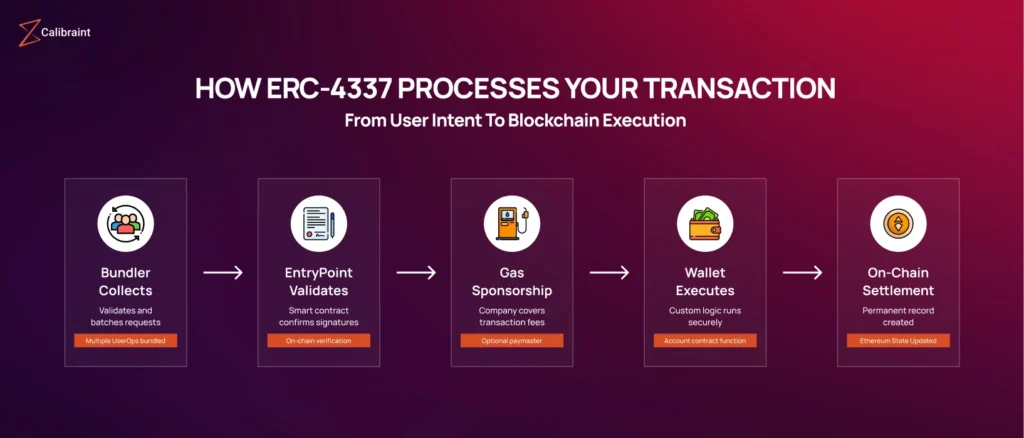
User operations: Instead of sending standard transactions, users sign an intent describing the action they want to perform. This abstraction separates authorization from execution, allowing richer business logic to be enforced by the wallet contract.
Bundlers: These services collect user operations, validate them, and submit them to the blockchain as normal transactions. Anyone can run a bundler, and competition among bundlers helps ensure reliability and performance.
Entry point contract: A shared smart contract deployed at a common address across networks. Entry point coordinates validation and execution. It calls validation logic on each account contract and ensures operations meet defined criteria.
Paymasters: Optional smart contracts that sponsor gas costs on behalf of users. Applications can run paymasters to offer gasless experiences for verified users. This mechanism is central to gasless transactions in blockchain experiences.
Account contracts: These encapsulate validation logic and business rules. After a user operation is validated, the entry point invokes the execution logic to transfer funds, update state, or trigger on-chain processes, exactly as programmed.
Together, these elements enable wallets that behave like familiar software applications. Users can authenticate through familiar patterns such as biometric authentication or session approvals, while your infrastructure handles bundling, execution, and gas coordination.
Working Implementations in Production
Theory matters, but running systems matter more.
Coinbase Smart Wallet
Coinbase deployed its Smart Wallet on the Base network with user experiences that require no seed phrases or manual gas management. By leveraging session keys and paymasters that sponsor transaction costs for everyday actions, the wallet aligns Web3 interactions with expectations shaped by consumer technology ecosystems.
Safe (formerly Gnosis Safe)
Safe has served enterprise users with multi-signature smart wallets for years. In early 2024, Safe expanded its stack to support ERC-4337 smart wallets. Their configurations illustrate how account abstraction supports complex control models where multiple authorized actors must approve high-value transactions, a requirement that traditional EOAs cannot satisfy.
Developer-Focused Infrastructure
Platforms like Biconomy provide SDKs that handle bundler communication, gas sponsorship, and account deployment. This lets development teams embed sophisticated smart wallet behavior without reinventing core logic. Applications such as blockchain games use these frameworks to ensure users never interact with raw wallets or transaction confirmations.
These implementations show that Web3 smart wallet infrastructure is not limited to research prototypes. Real platforms are using account abstraction today to improve usability, governance, and risk control in live environments.
What Implementation Requires
Building on ERC-4337 Account Abstraction Development requires thoughtful technical and operational decisions.
Choose an account contract. Established frameworks like Safe offer battle-tested patterns for multi-signature and enterprise control. Minimalist reference implementations from the Ethereum Foundation provide a starting point for bespoke logic.
Audit smart contracts. Account contracts hold assets and enforce business validations. Security reviews from reputable firms such as OpenZeppelin or Trail of Bits should be part of any deployment plan.
Manage bundlers. Running your own bundlers gives maximum control but also creates operational overhead. Third-party bundler services simplify deployment at the cost of reliance on external infrastructure.
Design gas sponsorship logic. Paymasters define which transactions your organization sponsors and under what conditions. Simple models might cover all verified user operations. Sophisticated paymasters check metadata, transaction types, or external service conditions.
Plan recovery pathways. Traditional financial systems can restore access after identity verification. Smart wallets can embed recovery structures such as social recovery or time-locked backup access to support enterprise continuity.
Test end-to-end. Your QA process must verify both on-chain execution and off-chain bundler behavior. ERC-4337 test suites from community tooling help validate compatibility before production rollout.
Economic Realities and Risk Factors
Account abstraction introduces a new cost model. Traditional transactions have straightforward economics: users pay gas directly to validators. With ERC-4337, bundlers add a processing fee on top of base gas costs. Organizations sponsoring gas must maintain a balance of native tokens to cover fees and operational overhead.
Adoption data shows ERC-4337 infrastructure supports high volumes of operations, underscoring practical viability. The standard has enabled over 100 million UserOperations by late 2024, a more than tenfold increase from the early stages of adoption. Most of these operations are sponsored through paymasters, enabling users to interact without holding native tokens for gas.
Paymaster economics require careful modeling. If your organization sponsors all operations unconditionally, it creates a security risk where malicious actors could drain resources with high-cost operations. Production paymasters mitigate this by implementing rate limits, operation whitelisting, or user verification checks.
Smart contract risk also demands attention. Validation logic now lives inside programmable contracts rather than being enforced at the protocol level. Bugs in validation or execution logic can lead to unauthorized access or loss of funds. Thorough audits and conservative design patterns reduce this exposure.
Bundler concentration remains a systemic concern. If only a few operators control a large share of bundling activity, they could influence which operations get prioritized on the chain. Community discussions and incentive alignment mechanisms targeting decentralization are underway to address this.
The broader Ethereum roadmap includes proposals for native account abstractionat the protocol level. While these changes remain in development, they would reduce complexity by embedding support into consensus rules rather than relying on higher-layer standards.
Cross-chain identity and abstraction is another frontier. Users increasingly seek a single wallet identity that works seamlessly across Ethereum, Base, Polygon, Arbitrum, and other networks. Emerging work on coordinated account states across chains points toward this future.
Programmability also opens doors for advanced automation. Integrations with artificial intelligence could enable dynamic spending policies, gas optimization strategies, and behavioral wallet adaptation according to real-time conditions
Conclusion
ERC‑4337 represents a turning point for enterprise blockchain adoption. Traditional wallet limitations no longer need to stall innovation. Account abstraction blockchain technology allows organizations to enforce governance, manage risk, and simplify user interactions while maintaining the security and transparency inherent to Ethereum.
Enterprises that adopt ERC-4337 smart wallets can create programmable, policy-driven accounts that align with internal controls and operational requirements. This approach transforms blockchain wallets from static tools into strategic infrastructure that supports compliance, operational efficiency, and user experience.
For organizations evaluating how to modernize wallet management and deploy secure, scalable solutions, Calibraint provides end-to-end expertise. From designing account abstraction logic to deploying Web3 smart wallet infrastructure, we help translate technical innovation into measurable business impact.
FAQs
1. How does ERC-4337 enable programmable authentication without modifying Ethereum consensus?
ERC-4337 introduces a higher-layer standard that uses UserOperations, EntryPoint contracts, and account contracts. Users sign intents instead of traditional transactions, allowing wallets to enforce custom authentication rules without changing Ethereum’s core protocol or consensus.
2. What security advantages does account abstraction provide over traditional EOA wallets?
Account abstraction allows multi-signature approvals, spending limits, and social recovery mechanisms, reducing single-point-of-failure risks. Unlike EOAs, compromised keys don’t automatically give full control, aligning blockchain security with enterprise governance requirements.
3. How do bundlers and paymasters improve scalability and user onboarding in ERC-4337?
Bundlers batch multiple UserOperations into single transactions, improving throughput and reducing gas costs. Paymasters can sponsor transaction fees, enabling gasless onboarding and a smoother user experience without requiring users to hold native tokens.
Calibraint
Author
February 12, 2026
Let's Start A Conversation
Manage Consent
To provide the best experiences, we use technologies like cookies to store and/or access device information. Consenting to these technologies will allow us to process data such as browsing behavior or unique IDs on this site. Not consenting or withdrawing consent, may adversely affect certain features and functions.
Functional
Always active
The technical storage or access is strictly necessary for the legitimate purpose of enabling the use of a specific service explicitly requested by the subscriber or user, or for the sole purpose of carrying out the transmission of a communication over an electronic communications network.
Preferences
The technical storage or access is necessary for the legitimate purpose of storing preferences that are not requested by the subscriber or user.
Statistics
The technical storage or access that is used exclusively for statistical purposes.The technical storage or access that is used exclusively for anonymous statistical purposes. Without a subpoena, voluntary compliance on the part of your Internet Service Provider, or additional records from a third party, information stored or retrieved for this purpose alone cannot usually be used to identify you.
Marketing
The technical storage or access is required to create user profiles to send advertising, or to track the user on a website or across several websites for similar marketing purposes.