Unlocking Institutional RWA Potential: Overcoming Usability and Interoperability Barriers with Custom Web3 Integrations
Calibraint
Author
February 18, 2026
As an institutional decision-maker, you face mounting pressure to integrate real-world assets into your portfolios through tokenization. Yet, institutional RWA interoperability barriers often stand in the way, creating fragmented chains that complicate seamless operations. Your compliance teams struggle with poor user experiences that hinder efficient workflows, while integration friction with legacy systems adds unnecessary delays and risks.
At Calibraint, we have guided numerous asset managers and fintech leaders through these challenges, delivering practical solutions that drive real results. By addressing these issues head-on with custom integrations, you can unlock your institution’s full potential in this space. Explore Calibraint’s RWA Development services to see how we make this achievable for organizations like yours.
Why Interoperability is the Real Bottleneck for Institutional RWA Adoption
Institutions exploring tokenization quickly discover that institutional RWA interoperability barriers are not just technical hurdles but strategic roadblocks. When assets are tokenized across multiple chains, the lack of smooth communication between them leads to isolated silos. This fragmentation means your teams cannot easily transfer or manage assets without manual interventions, increasing operational risks.
Consider a scenario where an asset manager tokenizes real estate on one blockchain and securities on another. Without proper bridges, reconciling these assets for portfolio reporting becomes a nightmare. RWA interoperability challenges exacerbate this, as differing protocols fail to align, forcing reliance on third-party oracles that introduce latency and potential points of failure.
Moreover, institutional RWA tokenization barriers arise when governance models clash across chains. Your CIO might prioritize scalability, but without interoperability, expanding to new networks means rebuilding compliance frameworks from scratch. This bottleneck slows adoption, as decision-makers weigh the benefits against the complexity of managing disparate systems.
In practice, we have seen fintech founders pivot away from promising RWA projects due to these issues. Cross-chain RWA usability for institutions demands more than basic connectivity; it requires robust standards that ensure data integrity and transaction finality across ecosystems.
Ultimately, overlooking institutional RWA interoperability barriers can stall your institution’s competitive edge in a market where speed and efficiency define success.
To understand how leading institutions are addressing these challenges in practice, explore Best Blockchain Interoperability Tools to Connect Multiple Networks. The article breaks down real-world integration patterns, usability fixes, and cross-chain strategies that help institutions move from fragmented pilots to production-ready RWA ecosystems.
How Usability Failures Slow Compliance, Reporting, and Operations
Usability issues compound the problems tied to institutional RWA interoperability barriers. Compliance heads know all too well how clunky interfaces delay audits and reporting. When tokenization platforms lack intuitive designs, teams spend hours navigating wallets or verifying transactions, pulling focus from core duties.
For instance, a CTO implementing RWA tokenization might encounter wallets that do not support bulk operations or easy integration with existing CRM systems. This leads to errors in data entry and prolonged reconciliation processes. RWA interoperability challenges play a role here, as switching between chains often requires multiple logins and verifications, eroding efficiency.
Institutional RWA tokenization barriers extend to operations, where poor usability hampers real-time monitoring. Imagine a scenario where a compliance team cannot quickly query asset provenance across chains due to inconsistent user interfaces. This not only slows decision-making but also heightens exposure to regulatory scrutiny.
Web3 product leaders piloting RWAs often report that these usability gaps force reliance on spreadsheets or manual logs, defeating the purpose of tokenization. Overcoming RWA interoperability barriers starts with addressing these pain points, ensuring that tools align with institutional workflows.
In our experience, institutions that ignore cross-chain RWA usability for institutions end up with fragmented teams and delayed deployments, ultimately affecting bottom-line performance.
Off-the-shelf Web3 tools promise quick wins but frequently fall short for institutions due to institutional RWA interoperability barriers. These solutions are designed for general use, lacking the customization needed for complex regulatory environments. Asset managers find that predefined bridges do not handle the nuances of cross-jurisdictional compliance, leading to gaps in audit trails.
RWA interoperability challenges become evident when these tools cannot scale to institutional volumes. A fintech founder might adopt a popular platform only to discover it struggles with high-throughput transactions across chains, causing bottlenecks during peak periods.
Furthermore, institutional RWA tokenization barriers manifest in the inability to integrate with legacy systems like ERP or risk management software. Off-the-shelf options rarely offer flexible APIs, forcing costly workarounds that compromise security.
We have observed CIOs abandon these solutions after pilots reveal hidden vulnerabilities, such as inadequate support for multi-signature custody models. Overcoming RWA interoperability barriers requires more than plug-and-play; it demands tailored architectures that prioritize governance and scalability.
Cross-chain RWA usability for institutions suffers most here, as generic UX does not cater to decision-makers who need dashboard-level insights without technical deep dives. Institutions deserve better than one-size-fits-all approaches that overlook their unique needs.
The Hidden Cost of Fragmented RWA Infrastructure
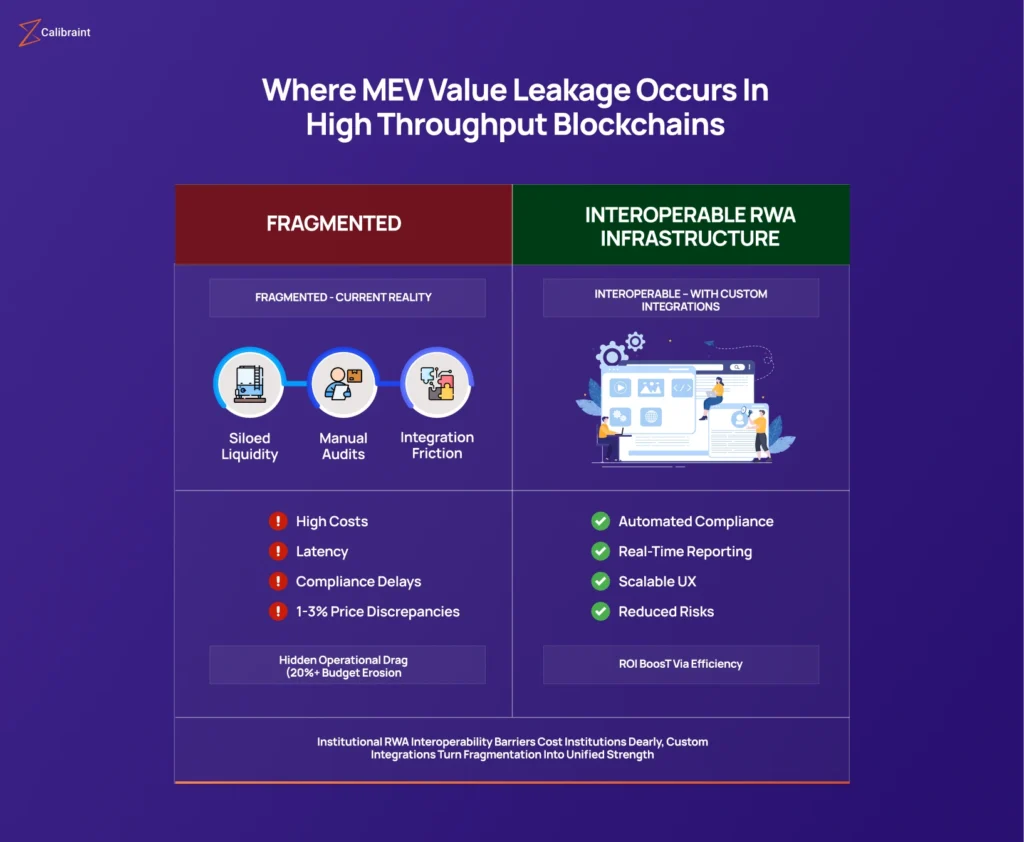
Fragmented infrastructure tied to institutional RWA interoperability barriers carries steep hidden costs. Beyond initial setup expenses, ongoing maintenance drains resources as teams juggle incompatible tools. Compliance heads face escalated audit fees when data silos require manual aggregation, inflating operational budgets.
Consider the ROI impact: A Web3 product leader might calculate tokenization savings, but RWA interoperability challenges erode them through downtime and failed transactions. Lost opportunities arise when institutions cannot swiftly capitalize on market shifts due to chain-specific limitations.
Institutional RWA tokenization barriers also manifest in talent retention, as skilled staff grow frustrated with inefficient systems. Training costs soar when usability is poor, and errors lead to reputational risks that can deter partnerships.
In quantifiable terms, we have helped clients uncover savings by quantifying these costs often exceeding 20% of projected RWA budgets. Overcoming RWA interoperability barriers is essential to avoid these pitfalls, ensuring that your infrastructure supports long-term growth.
Cross-chain RWA usability for institutions directly influences these economics, as seamless systems reduce friction and enable faster scaling. Ignoring fragmentation invites compounding expenses that undermine your institution’s strategic goals.
How Custom Web3 Integrations Solve Key Institutional Challenges
Custom Web3 integrations offer a proven path to overcoming RWA interoperability barriers, transforming potential roadblocks into operational strengths. By designing bridges tailored to your ecosystem, these solutions eliminate cross-chain fragmentation, allowing assets to move fluidly without compromising security.
For asset managers, this means unified views of tokenized portfolios, regardless of the underlying chain. We start by mapping your existing infrastructure, identifying pain points in RWA interoperability challenges, and building modular components that scale with your needs.
Custody and compliance workflows benefit immensely from these integrations. Custom tools embed regulatory checks directly into transaction flows, automating KYC and reporting. This addresses institutional RWA tokenization barriers by ensuring every asset transfer aligns with governance standards, reducing manual oversight.
A practical example: A CIO we worked with integrated custom oracles to verify off-chain data in real time, streamlining audits and cutting compliance time by half. Such integrations prioritize risk management, delivering measurable ROI through efficiency gains.
Legacy system integration is another area where customs shine. By creating APIs that connect Web3 protocols to your core banking or ERP platforms, we resolve friction points that off-the-shelf tools ignore. This enables seamless data flows, enhancing decision-making without overhauls.
Scalable institutional UX is the final piece. Custom dashboards provide intuitive interfaces for compliance teams and executives, focusing on key metrics like asset liquidity and chain performance. Overcoming RWA interoperability barriers through these means ensures your teams operate with confidence.
Cross-chain RWA usability for institutions improves dramatically, as personalized designs accommodate high-volume users without complexity. We have seen fintech founders accelerate pilots by 30% after implementing such integrations, proving their value in real-world scenarios.
In addressing institutional RWA interoperability barriers, customs also future-proof your setup. As new chains emerge, modular designs allow easy expansions, safeguarding your investments against evolving landscapes.
RWA interoperability challenges no longer need to hinder progress; with targeted integrations, institutions achieve interoperability that supports ambitious goals.
Building Confidence in Your RWA Strategy
As you evaluate next steps, remember that institutional RWA interoperability barriers are surmountable with the right approach. Custom integrations not only resolve current frictions but also position your institution for sustained success in tokenization.
Overcoming RWA interoperability barriers leads to streamlined operations, where compliance is automated and reporting is effortless. Your teams gain tools that enhance productivity, directly impacting scalability and governance.
Cross-chain RWA usability for institutions becomes a strength, enabling agile responses to market dynamics. We encourage you to consider how these solutions align with your ROI objectives.
Institutional RWA tokenization barriers fade when usability and interoperability are prioritized, unlocking new revenue streams from tokenized assets.
Conclusion: Securing Institutional Success in RWAs
In the end, interoperability and usability determine whether your institution thrives in RWA tokenization. By tackling institutional RWA interoperability barriers head-on, you achieve outcomes like reduced operational risks, faster compliance cycles, and enhanced portfolio agility. These are not abstract benefits but tangible results that drive ROI and competitive positioning.
RWA interoperability challenges, once resolved, open doors to efficient cross-chain management and scalable growth. Institutions that invest in custom solutions see quicker adoption and stronger governance, turning potential liabilities into assets.
Overcoming RWA interoperability barriers equips your teams with the confidence to innovate without constraints. Cross-chain RWA usability for institutions ensures that every decision-maker, from CTOs to compliance heads, operates from a unified platform.
We invite you to explore Calibraint’s RWA development services for a deeper dive into how we can support your journey. Summarizing the path forward, expect streamlined workflows, cost savings, and strategic advantages that position your institution as a leader.
To get started, reach out to Calibraint for a conversation about your specific needs. Our team is ready to guide you toward solution confidence, helping you navigate these challenges with expertise and precision. Let’s discuss how we can make this a reality for your organization.
FAQ:
1. What are the main institutional RWA interoperability barriers in 2026?
The main institutional RWA interoperability barriers in 2026 include fragmented blockchains, lack of standardized token frameworks, regulatory uncertainty, limited cross-chain liquidity, and poor integration with legacy financial systems.
2. How can custom Web3 integrations overcome RWA usability and interoperability challenges for institutions?
Custom Web3 integrations solve RWA usability and interoperability challenges by enabling seamless cross-chain connectivity, regulatory-compliant smart contracts, secure data oracles, and direct integration with existing enterprise and banking systems.
3. Why is overcoming interoperability barriers key to unlocking institutional RWA potential?
Overcoming interoperability barriers is critical to unlocking institutional RWA potential because it enables scalable adoption, efficient cross-chain asset transfers, improved liquidity, regulatory compliance, and real-world enterprise integration.
Calibraint
Author
February 18, 2026
Let's Start A Conversation
Manage Consent
To provide the best experiences, we use technologies like cookies to store and/or access device information. Consenting to these technologies will allow us to process data such as browsing behavior or unique IDs on this site. Not consenting or withdrawing consent, may adversely affect certain features and functions.
Functional
Always active
The technical storage or access is strictly necessary for the legitimate purpose of enabling the use of a specific service explicitly requested by the subscriber or user, or for the sole purpose of carrying out the transmission of a communication over an electronic communications network.
Preferences
The technical storage or access is necessary for the legitimate purpose of storing preferences that are not requested by the subscriber or user.
Statistics
The technical storage or access that is used exclusively for statistical purposes.The technical storage or access that is used exclusively for anonymous statistical purposes. Without a subpoena, voluntary compliance on the part of your Internet Service Provider, or additional records from a third party, information stored or retrieved for this purpose alone cannot usually be used to identify you.
Marketing
The technical storage or access is required to create user profiles to send advertising, or to track the user on a website or across several websites for similar marketing purposes.