DeFi-Powered Trade Credit Systems: Building Compliant Token Ecosystems for Deferred Payments and Supply Chain Finance
Calibraint
Author
February 26, 2026
Global trade is moving faster than traditional finance can support. Enterprises today face delayed payments, frozen working capital, and rising credit risk across supply chains. This is exactly where Tokenized invoice financing DeFi is changing the game. By combining programmable liquidity with institutional-grade controls, modern platforms are unlocking faster, safer trade credit. Forward-looking CFOs and CTOs are already exploring Defi Development strategies to digitize receivables, reduce financing friction, and create new revenue efficiency layers. The core belief is simple: trade finance must become real-time, transparent, and compliant by design. Organizations that act early are not just optimizing cash flow, they are building structural competitive advantage in global commerce.
The Growing Problem in Trade Finance
Trade finance remains one of the most paper-heavy, risk-sensitive areas in enterprise finance. Despite digital transformation across industries, many companies still rely on slow banking intermediaries and fragmented credit processes.
Common pain points include:
Payment cycles stretching to 60–120 days
Limited credit access for SMEs
High factoring fees
Poor visibility across supplier networks
Manual reconciliation and compliance overhead
These inefficiencies create trapped liquidity across global supply chains. Even large enterprises struggle to optimize working capital when receivables remain illiquid.
This is why Tokenized invoice financing DeFi is gaining attention among fintech leaders. Instead of waiting for invoices to clear through legacy rails, companies can convert receivables into programmable digital assets. Many enterprises are already exploring how decentralized lending models unlock liquidity faster, as explained in this deep dive on how DeFi lending and loan apps generate revenue and why these mechanisms are becoming foundational to modern onchain credit systems.
At the same time, Onchain trade credit systems are emerging to provide transparent credit flows between buyers, suppliers, and liquidity providers. When combined with RWA supply chain tokenization, physical trade activity can finally be reflected in real-time financial infrastructure.
The shift is no longer experimental, it is becoming economically necessary.
How DeFi-Powered Trade Credit Works
At its core, Tokenized invoice financing DeFi converts approved invoices into programmable, blockchain-backed financial assets that can be funded almost instantly by qualified liquidity providers. Instead of waiting weeks for traditional factoring or bank approvals, enterprises can unlock working capital in near real time while maintaining strong risk controls.
Below is the enterprise-grade workflow that leading organizations are adopting.
1. Invoice Tokenization
The process begins once an invoice is validated within the enterprise finance or ERP system. Through RWA supply chain tokenization, verified receivables are transformed into secure digital tokens that represent legally enforceable payment obligations.
This step typically includes:
Invoice authenticity verification
Buyer credit assessment
Legal structuring of receivable rights
Token minting with embedded metadata
By digitizing receivables at the source, companies create a liquid, trackable asset that can move efficiently across modern financing rails.
2. Risk & Compliance Layer
Institutional adoption depends heavily on trust and regulatory alignment. Enterprise platforms therefore embed KYC, AML, sanctions screening, and jurisdictional logic directly into compliant Defi token ecosystems.
This compliance layer ensures:
Permissioned participant access
Real-time regulatory checks
Audit-grade transaction records
Policy-driven risk controls
Rather than treating compliance as an afterthought, leading architectures make it native to the protocol, a critical requirement for CFOs and risk teams evaluating blockchain-based finance.
3. Liquidity Access
Once tokenized and validated, receivables become available for funding through Onchain trade credit systems. Institutional investors, credit funds, or liquidity pools can review risk parameters and fund invoices at competitive rates.
Key advantages at this stage include:
Broader capital participation
Dynamic pricing based on risk
Faster funding cycles
Transparent funding visibility
This is where Tokenized invoice financing DeFi begins to materially outperform legacy factoring models, especially in multi-tier supply chains.
4. Deferred Settlement
Importantly, buyer relationships remain intact. Under deferred payments blockchain finance structures, buyers continue to operate on agreed payment terms while suppliers receive early liquidity.
This dual benefit is powerful for enterprise ecosystems because it:
Protects buyer cash flow strategies
Strengthens supplier stability
Reduces supply chain friction
Improves procurement resilience
The financing becomes invisible to the underlying commercial relationship — a major reason adoption is accelerating among large enterprises.
5. Automated Repayment
When the invoice reaches maturity, smart contracts automatically trigger settlement flows. Funds are routed to liquidity providers according to predefined logic, eliminating manual reconciliation.
Automation typically delivers:
Reduced operational overhead
Near-zero settlement errors
Real-time status tracking
Improved audit readiness
By the end of the cycle, Tokenized invoice financing DeFi compresses what traditionally took weeks into a streamlined, programmable liquidity event.
Key Benefits for Enterprises
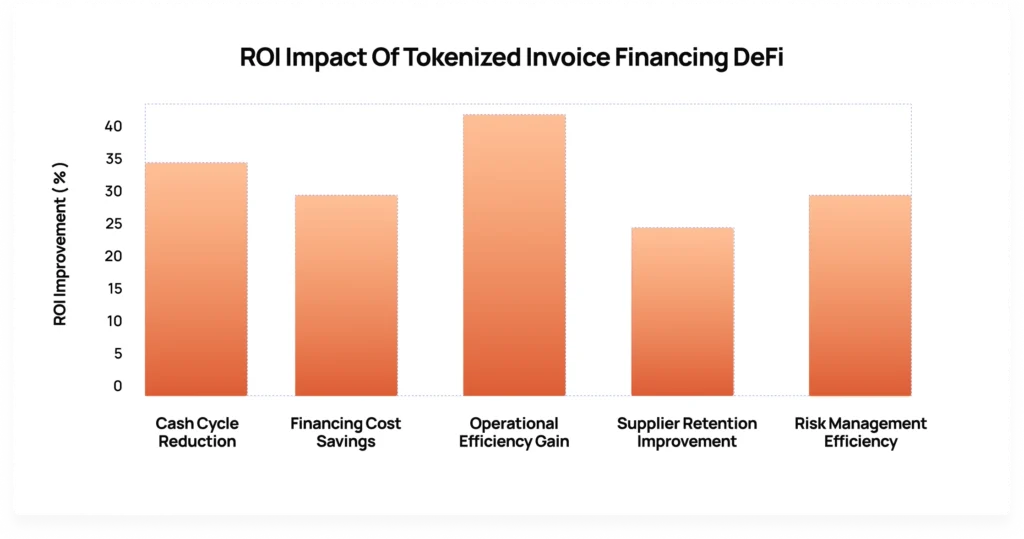
Enterprises evaluating Tokenized invoice financing DeFi typically focus on measurable financial outcomes. The advantages are increasingly hard to ignore.
Improved Working Capital Velocity
By leveraging Onchain trade credit systems, companies can unlock receivables without traditional factoring delays.
Impact:
Faster cash conversion cycles
Reduced dependency on bank credit lines
Stronger supplier relationships
Lower Financing Costs
Because compliant Defi token ecosystems enable broader liquidity participation, pricing often becomes more competitive than legacy factoring.
Impact:
Reduced discounting pressure
Better yield optimization
More predictable financing terms
Programmable Risk Controls
Modern platforms embed policy logic directly into deferred payments blockchain finance workflows.
Impact:
Automated credit limits
Real-time exposure tracking
Reduced manual oversight
Enhanced Transparency
Through RWA supply chain tokenization, every financed invoice carries an immutable audit trail.
Impact:
Stronger audit readiness
Improved lender confidence
Better fraud prevention
For CFOs, the appeal of Tokenized invoice financing DeFi is clear: faster liquidity with tighter risk management.
Real-World Use Cases in Supply Chain Finance
The adoption curve is accelerating across multiple sectors where payment delays create operational drag.
Manufacturing Networks
Large manufacturers are using Tokenized invoice financing DeFi to stabilize supplier ecosystems. Tier-2 and Tier-3 vendors gain faster access to capital without renegotiating buyer terms.
Typical outcome:
Stronger supplier resilience
Fewer production disruptions
Improved procurement leverage
Global Trade Corridors
Cross-border trade benefits significantly from Onchain trade credit systems, which remove banking bottlenecks and FX delays.
When paired with deferred payents blockchain finance, exporters can offer flexible payment windows without harming liquidity.
Enterprise Procurement Platforms
Digital procurement marketplaces are embedding RWA supply chain tokenization to create built-in financing rails for vendors.
This allows marketplaces to evolve from simple matching platforms into full financial ecosystems powered by compliant Defi token ecosystems.
SME Financing Networks
Perhaps the biggest impact of Tokenized invoice financing DeFi is democratized credit access for smaller suppliers that traditional banks often overlook.
Forward-thinking enterprises are already moving pilot programs into production environments.
Why Compliance-First Token Ecosystems Matter
Speed without compliance creates risk. This is where many early DeFi experiments failed to meet enterprise standards.
Institutional adoption requires compliant Defi token ecosystems that embed regulatory, legal, and audit controls from day one. With regulators like the SEC and CFTC increasing scrutiny on onchain financial products, enterprises must align architecture with evolving compliance expectations. This is why understandingDeFi regulatory compliance across SEC and CFTC frameworks in 2025 is critical before deploying tokenized trade credit or deferred payments blockchain finance solutions.
Regulatory Alignment
Enterprises must ensure Tokenized invoice financing DeFi platforms support:
KYC/AML enforcement
Jurisdiction-aware controls
Permissioned access layers
Audit-grade reporting
Risk Containment
Well-architected Onchain trade credit systems include exposure caps, counterparty scoring, and programmable safeguards.
Without these, deferred payments blockchain finance can introduce unmanaged credit risk.
Investor Confidence
Liquidity providers increasingly demand RWA supply chain tokenization frameworks that provide verifiable linkage between physical trade and digital assets.
This is why compliance-first architecture is no longer optional, it is foundational.
Organizations that treat compliance as infrastructure, not overhead, are seeing faster institutional adoption.
Why Choose Calibraint
Building production-grade Tokenized invoice financing DeFi platforms requires more than smart contracts. It demands deep expertise across fintech architecture, regulatory design, and enterprise integration.
Calibraint brings a structured, enterprise-ready approach.
What Sets Calibraint Apart
Domain Depth Our teams understand both financial workflows and blockchain infrastructure, enabling scalable compliant Defi token ecosystems.
Enterprise Architecture We design Onchain trade credit systems that integrate cleanly with ERP, treasury, and procurement stacks.
Compliance by Design From day one, we embed controls required for deferred payments blockchain finance at institutional scale.
RWA Expertise Our frameworks for RWA supply chain tokenization ensure verifiable asset linkage and audit readiness.
Organizations exploring Defi Development with Calibraint gain a partner focused on measurable business outcomes, not experimental pilots.
Conclusion
Trade finance is entering a structural transformation phase. Companies that continue relying solely on legacy credit rails will face increasing working capital pressure and supplier fragility. In contrast, enterprises adopting Tokenized invoice financing DeFi are building faster, more transparent financial ecosystems that scale with global commerce.
The real opportunity lies in combining automation, compliance, and liquidity into a single programmable layer. With mature Onchain trade credit systems, robust compliant Defi token ecosystems, and proven RWA supply chain tokenization frameworks, deferred finance no longer has to mean delayed growth.
If your organization is evaluating the next evolution of Defi Development, now is the time to move from exploration to execution. Calibraint works closely with enterprise leaders to design secure, compliant, and production-ready token finance platforms that deliver measurable ROI.
Start the conversation with Calibraint and unlock the next generation of trade finance.
FAQ
What is tokenized invoice financing in DeFi?
Tokenized invoice financing DeFi is a blockchain-based model where approved invoices are converted into digital tokens that can be funded by liquidity providers. It allows suppliers to access early payments while maintaining existing buyer payment terms, improving working capital efficiency.
How does tokenized invoice financing DeFi improve supply chain finance?
Tokenized invoice financing DeFi improves supply chain finance by accelerating liquidity access, reducing financing costs, and increasing transparency. By using onchain settlement and programmable credit logic, enterprises can shorten cash cycles while maintaining stronger control over risk exposure.
Is tokenized invoice financing in DeFi compliant and safe for businesses?
Yes, when built on properly compliant Defi token ecosystems with embedded KYC, AML, and audit controls. Enterprise-grade platforms combine regulatory safeguards with smart contract automation, making the model increasingly viable for institutional adoption.
Calibraint
Author
February 26, 2026
Let's Start A Conversation
Manage Consent
To provide the best experiences, we use technologies like cookies to store and/or access device information. Consenting to these technologies will allow us to process data such as browsing behavior or unique IDs on this site. Not consenting or withdrawing consent, may adversely affect certain features and functions.
Functional
Always active
The technical storage or access is strictly necessary for the legitimate purpose of enabling the use of a specific service explicitly requested by the subscriber or user, or for the sole purpose of carrying out the transmission of a communication over an electronic communications network.
Preferences
The technical storage or access is necessary for the legitimate purpose of storing preferences that are not requested by the subscriber or user.
Statistics
The technical storage or access that is used exclusively for statistical purposes.The technical storage or access that is used exclusively for anonymous statistical purposes. Without a subpoena, voluntary compliance on the part of your Internet Service Provider, or additional records from a third party, information stored or retrieved for this purpose alone cannot usually be used to identify you.
Marketing
The technical storage or access is required to create user profiles to send advertising, or to track the user on a website or across several websites for similar marketing purposes.