AI in Healthcare: 7 Proven Ways Hospitals Reduce Costs and Improve Patient Care
Calibraint
Author
March 2, 2026
Hospitals today are operating in a pressure cooker. Margins are tightening, staffing gaps are widening, and patient expectations continue to climb. Leadership teams know incremental fixes won’t solve structural inefficiencies. The uncomfortable truth is this: organizations that delay adopting AI in healthcare strategically will keep absorbing avoidable costs while more agile competitors pull ahead. Many forward-looking systems are already working with a specialized AI Development Company to modernize operations, reduce administrative drag, and improve care delivery. If you’re evaluating AI vendors right now, the question isn’t whether transformation will happen, it’s whether your hospital will lead it or struggle to catch up.
The Rising Cost Crisis in Healthcare
Across the industry, the financial warning signs are hard to ignore. Labor expenses continue to rise, manual processes remain deeply embedded, and fragmented systems slow decision-making. This is exactly why AI in healthcare has moved from innovation labs to boardroom agendas.
Hospitals adopting modern Healthcare AI solutions are not chasing hype, they are targeting very specific cost centers. From discharge delays to call center overload, the opportunity for AI for patient care improvement is increasingly measurable. At the same time, smart Healthcare workflow automation is helping operations leaders remove friction from everyday processes.
One of the biggest relief valves has been AI medical administration automation, which is quietly eliminating thousands of hours of repetitive back-office work. Taken together, these capabilities are shaping the future of AI in healthcare, where efficiency and care quality improve simultaneously rather than competing for budget.
Many healthcare leaders begin their transformation journey by studying real-world implementations rather than theory. If you’re looking to understand where AI is already delivering measurable impact across hospitals, this breakdown of AI use cases in healthcare highlights practical applications across diagnostics, operations, patient engagement, and administrative automation.
7 Proven Ways Hospitals Use AI to Reduce Costs and Improve Care
1. Intelligent Patient Triage and Routing
Emergency departments are often where inefficiency becomes most visible. Long wait times, manual prioritization, and inconsistent triage decisions create both financial waste and patient frustration. Hospitals deploying AI in healthcare platforms are using predictive analytics in healthcare to identify high-risk patients the moment they enter the system.
This shift enables faster clinical prioritization and supports meaningful AI for patient care improvement without adding headcount. Many systems are embedding this capability into broader Healthcare AI solutions so triage standards remain consistent across facilities.
For hospitals looking to implement scalable transformation, this use case strongly reflects the future of AI in healthcare, where care pathways adjust dynamically instead of relying on static protocols.
2. Automated Clinical Documentation
Ask any physician where time disappears, and documentation will be near the top of the list. Manual charting is expensive, error-prone, and a major contributor to burnout. With AI medical administration automation, hospitals are dramatically reducing the documentation burden.
When paired with Healthcare workflow automation, clinical summaries, coding suggestions, and discharge notes can be generated in near real time. The downstream effect on AI for patient care improvement is significant because clinicians reclaim time for direct patient interaction.
Executives investing in AI in healthcare often see documentation automation as a fast-return initiative, especially when implemented through enterprise-ready Healthcare AI solutions platforms that integrate cleanly with existing EHR environments.
3. Predictive Capacity and Bed Management
Bed utilization remains one of the most overlooked financial levers in hospital operations. Poor visibility into admissions and discharge timing creates avoidable bottlenecks. Using predictive analytics in healthcare, leading hospitals are forecasting patient flow days in advance.
Integrated Healthcare workflow automation then helps operations teams adjust staffing and bed allocation proactively. This directly contributes to AI for patient care improvement by reducing emergency department boarding and delayed transfers.
More importantly, this is where many executives begin to see the tangible future of AI in healthcare. Systems that once relied on manual bed boards are evolving into predictive command centers powered by AI in healthcare intelligence.
4. AI-Powered Remote Patient Monitoring
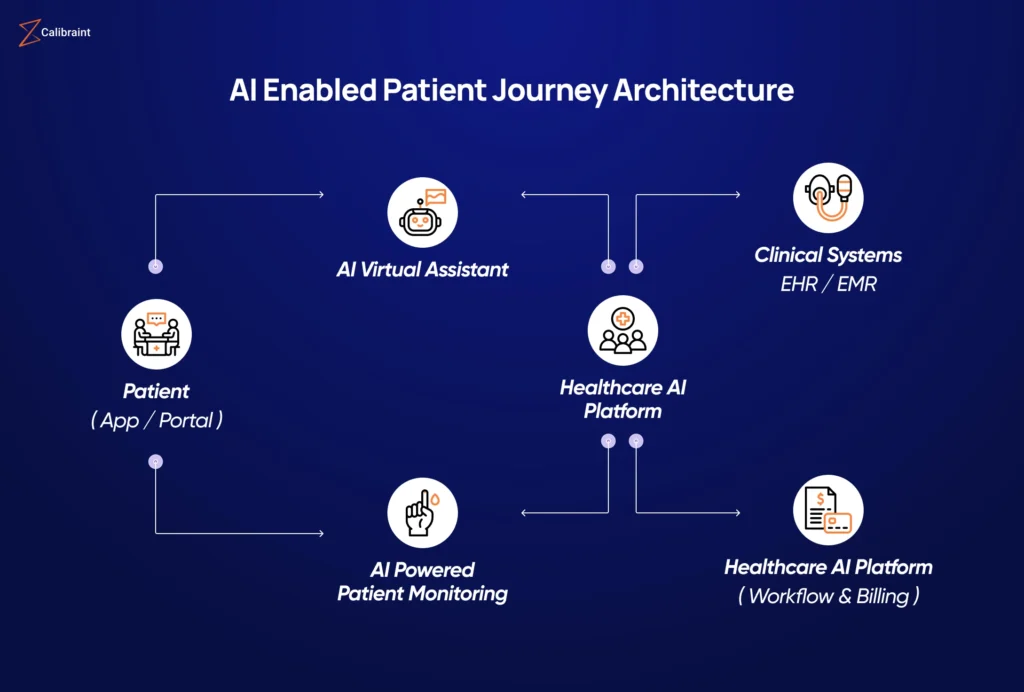
Chronic care management is expensive largely because deterioration is often detected too late. With AI powered patient monitoring, hospitals can track patient vitals continuously and flag early warning signs.
This approach strengthens AI for patient care improvement by enabling care teams to intervene before conditions escalate. When deployed through scalable Healthcare AI solutions, remote monitoring becomes a population health asset rather than a pilot program.
From a financial standpoint, AI in healthcare initiatives in this area consistently reduce readmissions and unnecessary visits. Not surprisingly, many leaders view this as a cornerstone of the future of AI in healthcare operating models.
5. Smart Revenue Cycle Optimization
Revenue cycle inefficiencies quietly drain millions from hospital systems every year. Coding errors, missed documentation, and claim denials create avoidable leakage. With AI medical administration automation, finance teams are now automating large portions of the billing workflow.
By layering in predictive analytics in healthcare, organizations can identify high-risk claims before submission. This level of Healthcare workflow automation improves clean claim rates and accelerates reimbursement cycles.
For CFOs evaluating AI in healthcare, revenue cycle transformation often delivers one of the clearest business cases, particularly when powered by mature Healthcare AI solutions designed for enterprise complexity.
6. Workforce and Staff Scheduling Intelligence
Labor remains the single largest line item on most hospital P&Ls. Traditional scheduling methods struggle to match staffing levels with real patient demand. Using predictive analytics in healthcare, advanced workforce platforms forecast staffing needs by unit and shift.
This enables more precise Healthcare workflow automation, reducing overtime and agency spend. It also supports better AI for patient care improvement by ensuring appropriate clinical coverage at peak times.
Many organizations now view workforce optimization as part of the future of AI in healthcare, and it has become a core pillar in successful AI in healthcare transformation programs.
7. Virtual Assistants and Patient Engagement
Patient access teams are under constant strain. Call volumes are rising, while staffing remains tight. Virtual assistants powered by AI in healthcare are now handling appointment scheduling, reminders, and common patient questions at scale.
When connected with AI powered patient monitoring, these systems create a continuous engagement loop that keeps patients informed between visits. Meanwhile, AI medical administration automation reduces pressure on front-office teams.
Hospitals deploying these capabilities through enterprise Healthcare AI solutions frequently report measurable AI for patient care improvement, particularly in satisfaction and access metrics. This engagement layer is quickly becoming embedded in the future of AI in healthcare experience strategy.
ROI & Business Impact: What Decision-Makers Should Expect
If you’re evaluating AI vendors, the conversation should center on measurable outcomes, not pilots that never scale. Well-executed AI in healthcare programs typically produce impact in three areas.
First, administrative cost reduction improves through disciplined Healthcare workflow automation, often lowering overhead by double-digit percentages. Second, revenue protection strengthens when predictive analytics in healthcare identifies risks earlier in the billing cycle. Third, clinical quality improves with AI powered patient monitoring, reducing avoidable complications.
Equally important is how AI medical administration automation and enterprise-grade Healthcare AI solutions are architected. Systems that scale cleanly across departments consistently outperform fragmented deployments.
Organizations that move decisively today are positioning themselves at the center of the future of AI in healthcare, while hesitant adopters risk widening performance gaps.
Why Choosing the Right AI Partner Matters
Technology selection is only half the equation. Execution maturity is what separates successful programs from stalled pilots. Hospitals often underestimate the complexity of deploying AI in healthcare across clinical, operational, and financial domains simultaneously.
When selecting a partner, leadership teams should look closely at real healthcare experience, data governance rigor, and proven Healthcare workflow automation frameworks. The ability to deploy AI powered patient monitoring securely at scale is another critical differentiator.
Most importantly, hospitals should engage an experienced AI Development Company that understands interoperability, compliance requirements, and enterprise architecture patterns.
For hospitals looking to implement sustainable transformation, the partner you choose will directly influence how quickly you realize value in the future of AI in the healthcare landscape.
Conclusion: Turning AI Strategy Into Measurable Hospital Outcomes
The hospitals pulling ahead financially are not experimenting at the edges, they are executing with focus. Strategic adoption of AI in healthcare is already helping leading systems reduce operational drag, strengthen margins, and deliver more responsive care experiences.
If your organization is moving from exploration to implementation, this is the moment to act. Working with the right AI Development Company ensures your initiatives are scalable, compliant, and aligned with enterprise ROI expectations.
Calibraint is a trusted enterprise partner helping hospitals design, deploy, and scale production-grade AI platforms. From intelligent automation to advanced analytics, Calibraint builds secure architectures that deliver measurable outcomes, not just pilots.
👉 Connect with Calibraint’s healthcare AI experts and start your transformation journey today.
FAQ
1. How does AI reduce costs in hospitals?
AI in healthcare reduces hospital costs by automating labor-intensive administrative tasks, optimizing staff scheduling, improving revenue cycle accuracy, and predicting patient flow. Technologies like clinical documentation automation, predictive analytics, and intelligent billing systems help hospitals eliminate inefficiencies, reduce claim denials, lower overtime expenses, and improve bed utilization. Over time, this leads to measurable reductions in operational overhead without compromising care quality.
2. Can AI improve patient care in healthcare settings?
Yes, AI in healthcare significantly improves patient care by enabling faster diagnoses, personalized treatment plans, continuous remote monitoring, and proactive intervention. AI-driven tools help clinicians identify high-risk patients earlier, reduce medical errors, and spend more time on direct patient interaction. This results in better outcomes, higher patient satisfaction, and more consistent care delivery across departments.
3. What are the best examples of AI in healthcare today?
Some of the most effective examples of AI in healthcare include intelligent patient triage systems, automated clinical documentation, predictive bed and capacity management, AI-powered remote patient monitoring, revenue cycle optimization, workforce scheduling intelligence, and virtual assistants for patient engagement. These solutions are already delivering measurable cost savings and care improvements in hospitals worldwide.
4. What are the biggest challenges of implementing AI in healthcare?
The biggest challenges of adopting AI in healthcare include data quality and interoperability issues, regulatory and compliance requirements, integration with existing EHR systems, change management, and ensuring clinical trust in AI-driven insights. Hospitals also face challenges in scaling AI beyond pilot programs. Working with an experienced AI development partner helps address these risks and ensures enterprise-ready deployment.
5. How is AI transforming hospital operations and clinical decision making?
AI in healthcare is transforming hospital operations by shifting decision making from reactive to predictive. Operational teams use AI to forecast demand, optimize staffing, and manage capacity more efficiently, while clinicians benefit from data-driven insights that support faster and more accurate decisions. This transformation improves coordination across departments, reduces delays, and aligns operational efficiency with better clinical outcomes.
Calibraint
Author
March 2, 2026
Let's Start A Conversation
Manage Consent
To provide the best experiences, we use technologies like cookies to store and/or access device information. Consenting to these technologies will allow us to process data such as browsing behavior or unique IDs on this site. Not consenting or withdrawing consent, may adversely affect certain features and functions.
Functional
Always active
The technical storage or access is strictly necessary for the legitimate purpose of enabling the use of a specific service explicitly requested by the subscriber or user, or for the sole purpose of carrying out the transmission of a communication over an electronic communications network.
Preferences
The technical storage or access is necessary for the legitimate purpose of storing preferences that are not requested by the subscriber or user.
Statistics
The technical storage or access that is used exclusively for statistical purposes.The technical storage or access that is used exclusively for anonymous statistical purposes. Without a subpoena, voluntary compliance on the part of your Internet Service Provider, or additional records from a third party, information stored or retrieved for this purpose alone cannot usually be used to identify you.
Marketing
The technical storage or access is required to create user profiles to send advertising, or to track the user on a website or across several websites for similar marketing purposes.