Enterprise AI Change Management: Overcoming Resistance, Upskilling Teams and Driving Adoption Org Wide
Calibraint
Author
March 19, 2026
Enterprise AI has consumed billions of dollars. The most common outcome is a dashboard that nobody opens.
That is not a pessimistic view. It is simply what happens when technology moves faster than the people using it. Enterprise AI change management exists to close that gap. The organizations taking it seriously are pulling ahead fast. McKinsey’s State of AI 2024 research proves why. 65 percent of organizations now use generative AI in at least one business function. Yet over 80 percent report no measurable impact on their bottom line. The spend is real. The results are not.
That gap does not live in the technology. It lives in everything around it. Most AI development strategies focus on the model, the platform, and the deployment plan. Very few focus on the people. Thousands of employees are expected to change how they work. They are expected to change what they trust. They are expected to rethink their own value inside the organization. Without addressing that, even the best platforms stall. The investment stays at the surface level. It never reaches the actual work.
This guide is written to answer the fundamental question: what does it truly require to transform an organization, beyond merely updating its tools?
The Anatomy of Resistance
Before any organization can drive enterprise AI change management at scale, it needs an honest diagnosis of why resistance exists. And it is almost never laziness or technophobia.
The resistance is rarely about laziness or fear of technology. It runs much deeper than that. IBM’s Institute for Business Value surveyed 3,000 CEOs across 30 countries and found that 64 percent say succeeding with generative AI depends more on people’s adoption than on the technology itself. Yet most organizations spend 90 percent of their energy on the technology and almost nothing on the people side. That imbalance is where resistance is born.
Overcoming employee resistance to AI adoption becomes far easier once you understand where it actually comes from. It operates at three levels.
The first is informational. Employees simply do not know what AI will do to their jobs, daily workflows, or their roles within the organization. When there is no clear answer, people fill the silence with worst-case assumptions. This is a communication failure, not a people failure.
The second is emotional. Even employees who understand AI well can feel a quiet loss of professional identity. A procurement analyst who has spent ten years building sharp judgment does not automatically celebrate a tool that can replicate parts of that judgment. That feeling should not be dismissed and deserves acknowledgment.
The third is structural. People resist when expectations change while processes remain the same. Asking a team to use an AI assistant without redesigning the workflows around it creates friction on every side. The tool feels like an additional workload, rather than a relief.
Organizations that get past resistance the fastest all share one common trait. Instead of managing it away, they view resistance as valuable information.
Building the Right Upskilling Architecture
Most enterprise AI upskilling programs struggle for one reason. The same training goes to everyone.
Rolling out a single AI literacy course across an entire organization feels efficient. In practice, it builds very little real capability. A customer success manager and a software engineer have completely different needs. One needs to know how AI can surface account health signals and write follow-up messages.
The other needs to know how AI coding assistants fit into version-controlled workflows and where they introduce risk. Putting both in the same room, with the same content, wastes time for both of them. It also quietly damages trust in the program itself.
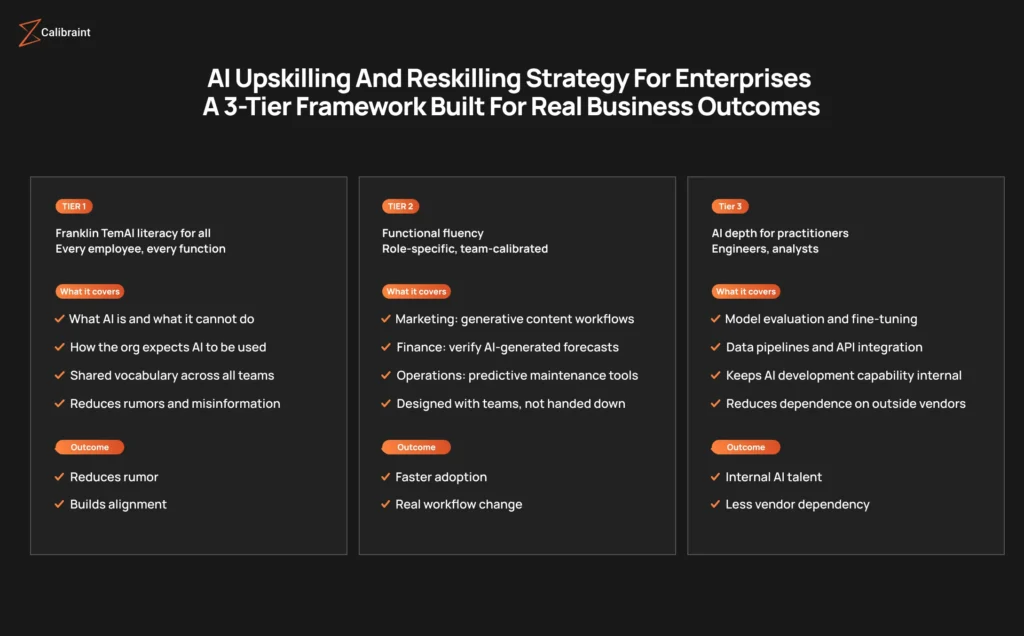
AI upskilling and reskilling strategies for enterprises work when they are built around roles. The most effective approach runs across three clear tiers.
The first tier covers everyone. Every employee needs a simple, honest baseline. What AI does. What it cannot do. How the organization expects people to use it. Think of this as an alignment exercise rather than a technical one. It clears up confusion, builds shared vocabulary, and sets expectations that everyone can work from.
The second tier goes deeper by team. Each business unit gets training built around its actual daily work. Marketing teams learn to work with generative content tools. Finance teams learn to question and verify AI-generated forecasts. Operations teams get comfortable with predictive maintenance interfaces. This training is designed alongside the teams it serves.
The third tier builds serious capability for technical practitioners. Engineers, data analysts, and product managers need hands-on depth. Evaluating models, understanding fine-tuning, managing data pipelines, and working with APIs. This is the internal layer that keeps AI development capability inside the organization and reduces dependence on outside vendors.
Success across every tier comes down to one thing. How visibly behavior changed in the 60 to 90 days after training. Completion rates tell you nothing. Behavioral change tells you everything.
What an AI-Ready Workforce Culture Actually Looks Like
Building an AI-ready workforce culture is perhaps the most misrepresented goal in enterprise AI strategy. Organizations frame it as a communication campaign. In practice, it is a governance and incentive redesign.
Culture is what people do when no one is measuring them. And in most organizations, the incentive structures that govern performance, promotion, and recognition were designed before AI existed. They reward individual expertise, speed, and output. They rarely reward the kind of experimental, collaborative, error-tolerant behavior that AI adoption actually requires.
An AI-ready workforce culture has three observable characteristics:
Psychological safety around failure. Employees must believe that testing an AI tool and finding it inadequate is a contribution, not an embarrassment. Organizations that build internal sharing mechanisms, such as AI use-case registries or monthly learning sessions, create the peer learning loops that formal training cannot replicate.
Leadership modeling. This is the one that most organizations underestimate. A genuine AI adoption is signaled when senior leaders are seen using AI tools, talk about their learning experiences, and explain how AI has reshaped their decision-making. Mandating AI use from a distance communicates the opposite.
Early win architecture. Building an AI-ready workforce culture requires deliberate sequencing of where AI gets deployed first. The initial use cases should be high-frequency, low-risk, and fast to produce visible results. The reason isn’t their strategic value, but their ability to create compelling evidence that turns doubters into participants. Announcements don’t build trust; evidence does.
The Shadow AI Problem Nobody Wants to Talk About
Right now, employees across your organization are using AI tools you have never approved. Most of them are doing it to get their work done faster. And most of them have no idea it could be a problem.
Managing shadow AI in the enterprise workplace has become one of the most serious and least addressed challenges in corporate technology today. Gartner found that 69 percent of organizations already suspect or have confirmed that employees are using prohibited public generative AI tools.
The tools showing up are consumer AI platforms, free browser extensions, and third-party SaaS integrations. Employees reach for them because the approved alternatives are too slow, too limited, or simply do not exist yet. There is no malice in it. There is just a gap between what people need and what the organization has provided.
The real risk sits in the data. When an employee pastes a client contract into an unapproved AI tool to get a quick summary, that data has left the organization. Depending on the vendor’s policy, it may be used to train their models. In regulated industries, it may already be a compliance violation.
Banning these tools outright has been tried. It rarely works. Employees find other ways or simply stop reporting what they use. That silence is far more dangerous than the original behavior.
Managing shadow AI in the enterprise workplace calls for a response built on three clear tracks.
Rapid Policy Formation
The first is faster policy formation. Most AI acceptable use policies were written in 2022 or 2023 and have not been touched since. The market has moved dramatically. Policies need a regular review cycle tied to how fast the tools are changing, not the annual legal calendar.
A sanctioned tool pathway
The second is a proper, sanctioned tool pathway. Employees turn to shadow AI when the approved options fall short. Organizations that keep an updated, actively managed list of approved tools, with a clear process for requesting new ones, remove the main reason shadow AI spreads in the first place.
Feedback-based governance
The third is feedback-driven governance. When a group of employees in the same team are all independently finding and using the same unapproved tool, that is useful information. It points to an unmet need inside the organization. Treating it as a signal rather than a violation builds the kind of trust that brings shadow AI into the open, where it can actually be managed.
Enterprise AI change management is not a soft discipline. It is the variable that determines whether AI investment generates returns or generates write-offs.
The organizations that treat change management as an afterthought tend to follow a familiar pattern. Initial adoption metrics look acceptable. Six months in, usage has plateaued. Twelve months in, the tools are technically deployed but operationally marginal. The AI is present. The transformation is not.
The organizations that build resistance diagnosis, tiered upskilling, cultural conditions, and shadow AI governance into their deployment design from the start operate differently. Adoption curves are steeper. Behavioral change is measurable. Each phase of adoption builds the organizational muscle for the next one.
The next five years of AI development will separate organizations not by which ones bought the best models, but by which ones built the best capacity to absorb, apply, and grow with them. That capacity is entirely human. It lives in how well an organization manages change.
The question worth sitting with is not whether your organization has an AI strategy. It is whether your organization has the human infrastructure to actually execute it.
Every organization we have worked with started the same way. The technology was ready. The strategy looked solid on paper. What they needed was someone who understood the human side well enough to make it actually work. The resistance, the skills gaps, the shadow AI quietly spreading through teams nobody was watching.
The gap between AI deployment and real adoption has never been a technology problem. If your organization is sitting somewhere in that gap right now, that is exactly where the real work begins.
Calibraint, works alongside enterprise teams to turn AI investment into adoption that actually holds. Book a discovery call, and we will spend 45 minutes looking honestly at where your AI adoption stands, where the real friction lives, and what a clear path forward looks like for your specific context. No generic frameworks. Just a focused conversation that gives you something useful, whether you work with us or not.
FAQs
1. What is enterprise AI change management, and why is it critical in 2026?
Enterprise AI change management is the structured process of preparing people, processes, and culture to adopt AI tools effectively across an organization. In 2026, it is critical because most enterprises have already deployed AI but are seeing little measurable impact. The technology is live. The people are not ready. Change management is what closes that gap.
2. Why do employees resist AI adoption and how can enterprises overcome it?
Resistance comes from three places. Employees fear job loss, feel uncertain about their skills, and distrust tools they had no say in choosing. Enterprises overcome it by communicating clearly about how AI affects each role, involving employees in the process early, and building upskilling programs that are role-specific rather than generic. Resistance treated as useful feedback moves faster than resistance treated as a problem.
3. How do enterprises build an effective AI upskilling program for non-technical staff?
Start with the work, then the technology. Map the daily tasks of non-technical teams first, then identify where AI can genuinely help. Build training around those specific workflows rather than broad AI concepts. Keep sessions short, practical, and immediately applicable. Non-technical staff adopt AI faster when they can see it solving a real problem they already have.
4. What role does leadership play in driving enterprise-wide AI adoption?
Leadership is the single biggest signal the rest of the organization watches. When senior people visibly use AI tools, talk openly about their own learning curve, and tie AI adoption to business goals rather than just IT mandates, adoption accelerates across every level. When leadership is absent from the process, even the best programs stall. Employees follow behavior, not announcements.
5. How do you measure the success of an enterprise AI change management program?
Completion rates on training courses tell you very little. The real measures are behavioral. Are employees using the tools in their daily workflows 60 to 90 days after training? Has productivity shifted in the teams where AI was deployed? Has shadow AI usage decreased as sanctioned tools improved? Those are the indicators that tell you whether change management is working or just running.
Calibraint
Author
March 19, 2026
Let's Start A Conversation
Manage Consent
To provide the best experiences, we use technologies like cookies to store and/or access device information. Consenting to these technologies will allow us to process data such as browsing behavior or unique IDs on this site. Not consenting or withdrawing consent, may adversely affect certain features and functions.
Functional
Always active
The technical storage or access is strictly necessary for the legitimate purpose of enabling the use of a specific service explicitly requested by the subscriber or user, or for the sole purpose of carrying out the transmission of a communication over an electronic communications network.
Preferences
The technical storage or access is necessary for the legitimate purpose of storing preferences that are not requested by the subscriber or user.
Statistics
The technical storage or access that is used exclusively for statistical purposes.The technical storage or access that is used exclusively for anonymous statistical purposes. Without a subpoena, voluntary compliance on the part of your Internet Service Provider, or additional records from a third party, information stored or retrieved for this purpose alone cannot usually be used to identify you.
Marketing
The technical storage or access is required to create user profiles to send advertising, or to track the user on a website or across several websites for similar marketing purposes.