Customer Experience Driving Users Away? How LLM Powered Conversational Systems Transform Enterprise Support
Calibraint
Author
March 24, 2026
Every minute a customer waits on hold, navigates a broken chatbot, or repeats their issue to a third agent, your business is quietly hemorrhaging revenue. Enterprises today are sitting on a customer experience time bomb and poor support is the fuse. The data is unforgiving: customers who experience one bad interaction are four times more likely to switch to a competitor. The solution is no longer optional. Conversational AI for customer support is rapidly becoming the defining line between enterprises that retain customers and those that lose them to faster, smarter rivals. Companies that invest in an LLM development service now are not just cutting costs, they are engineering loyalty, scale, and competitive advantage that compounds over time.
The Hidden Cost of Poor Customer Experience
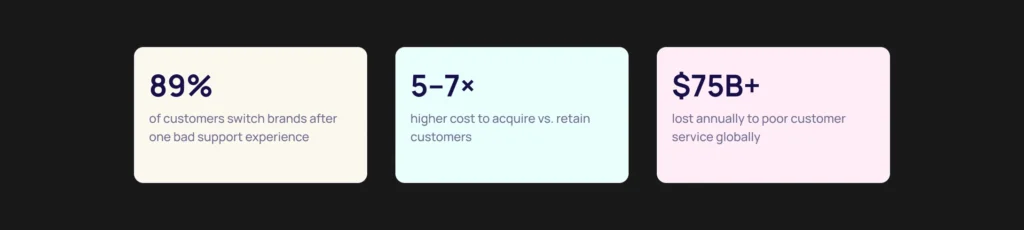
Poor customer experience does not announce itself as a crisis. It accumulates quietly, one missed SLA here, one frustrated ticket there until you look at your churn report and the numbers shock you. Research consistently shows that businesses lose over $75 billion annually due to poor customer service. Yet most enterprise leaders still treat support as a cost center rather than a revenue-critical function.
Think about what that looks like in practice. A customer in Singapore submits a billing dispute on a Friday evening. Your agents are offline. The automated response triggers a scripted reply that addresses the wrong issue entirely. By Monday, that customer has already posted a negative review, escalated to a chargeback, and begun evaluating your competitor. You never got a second chance.
The compounding damage of poor CX extends beyond individual churn. Brand reputation erodes. Net Promoter Scores fall. Sales teams find prospects who’ve “heard things.” The economics are brutal: acquiring a new customer costs five to seven times more than retaining an existing one. And yet enterprises continue to under-invest in the support infrastructure that determines whether customers stay.
The irony? The technology to fix this exists, right now. Conversational AI for customer support is not a future promise; it is a present-day operational lever that forward-thinking enterprises are already pulling. Businesses exploring this shift are increasingly investing in advanced AI capabilities through solutions likeLLM development services in 2026 to build scalable, intelligent support systems that evolve with customer expectations.
What Are LLM Powered Conversational Systems?
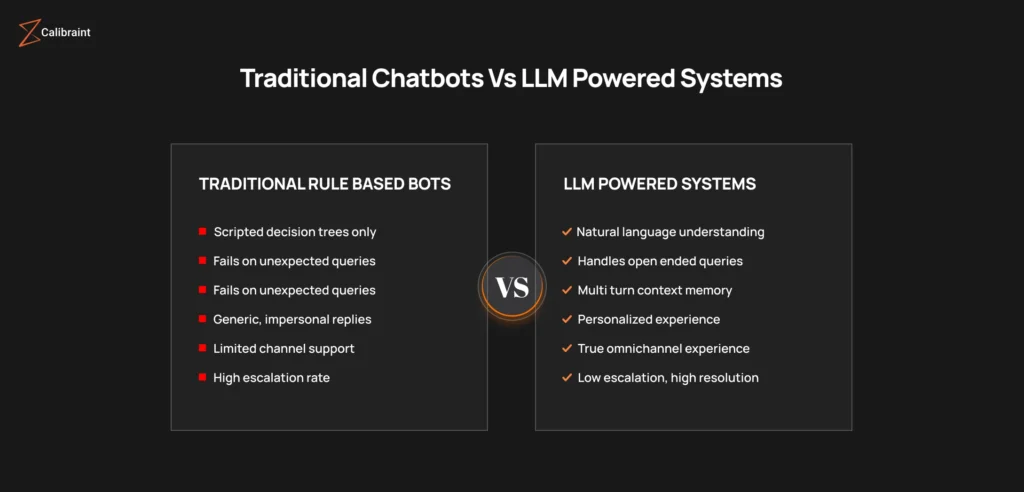
Let’s cut through the jargon. LLM powered customer support systems are AI-driven platforms built on Large Language Models, the same foundational technology behind tools like ChatGPT but purpose-engineered for enterprise support workflows. Unlike the rule-based chatbots of the 2010s that could only respond to pre-defined scripts, these systems understand natural language, context, intent, and nuance.
Traditional AI chatbots for customer service were brittle. Ask them something slightly outside their decision tree, and they’d loop you back to “I didn’t understand that.” LLM-powered systems are fundamentally different. They process open-ended questions, interpret ambiguous requests, maintain multi-turn conversation context, and generate responses that feel genuinely human. They learn from your enterprise knowledge base, your historical ticket data, your product documentation, and your brand voice then operationalize all of it at scale.
The result: a support layer that doesn’t just answer questions, but resolves issues. There’s a significant difference between the two.
How Conversational AI Transforms Enterprise Support
Speed That Matches Customer Expectations
Today’s customers expect answers in seconds, not hours. Conversational AI for customer support eliminates the latency that kills customer satisfaction. With instant response times across chat, email, and voice channels, enterprise support teams can handle thousands of simultaneous queries without a single second of queue time. Average handle time drops. First-contact resolution rates climb.
Personalization at Machine Scale
One of the most powerful capabilities of LLM powered customer support systems is contextual personalization. These systems integrate with your CRM, order management, and billing platforms, so when a customer reaches out, the AI already knows their history, preferences, and account status. Every interaction feels tailored, not templated.
Scalability Without Headcount Growth
Product launch. Flash sale. Seasonal spike. These moments used to mean emergency hiring, agent burnout, and degraded service quality. Customer support automation powered by LLMs scales elastically handling 10× normal volume with no degradation in response quality or speed. Your infrastructure grows with demand, not ahead of it.
True Omnichannel Experience
Enterprise customers engage across email, live chat, mobile apps, social media, and voice. Conversational AI for customer support delivers a unified, context-aware experience across every channel so a customer who starts a conversation on chat and continues via email never has to repeat themselves. The AI carries context seamlessly.
Key Benefits for Enterprises
The business case for conversational AI for customer support is compelling across every dimension that matters to enterprise decision-makers:
Reduce customer support costs using AI: Enterprises that deploy LLM-powered systems consistently report a 40–70% reduction in cost-per-ticket. Fewer escalations, faster resolution, and automated tier-1 handling translate directly into operational savings. The ability to reduce customer support costs using AI is among the strongest ROI drivers in enterprise technology today.
Improved CSAT & NPS: When customers get accurate, instant, personalized answers, satisfaction scores rise. AI-powered support consistently outperforms human-only support on resolution speed, the #1 driver of CSAT.
24/7 Support Availability: Unlike human agents, AI chatbots for customer service never sleep. Your customers in every timezone get the same quality experience at 3 AM as at 3 PM.
Operational Efficiency: Human agents are freed from repetitive, low-value queries and can focus on complex, high-stakes interactions where empathy and judgment are genuinely required. Agent morale improves. Turnover drops.
Compliance & Consistency: Every response follows policy, every time. Enterprises in regulated industries banking, healthcare, insurance, find that conversational AI reduces compliance risk by eliminating agent variability.
Real Enterprise Use Cases Across Industries
E-Commerce
Order tracking, returns, and product queries account for 60–70% of all e-commerce support volume. Customer support automation handles these end-to-end from initiation to resolution without human involvement, cutting fulfillment support costs dramatically while improving post-purchase experience.
SaaS & Technology
SaaS companies use LLM powered customer support systems to provide intelligent, documentation-aware troubleshooting. The AI understands product context, guides users through workflows, and escalates only genuine edge cases reducing ticket volume by up to 60%.
Banking & Fintech
In regulated environments, conversational AI for customer support manages account inquiries, fraud alerts, and loan status updates with policy-compliant accuracy. Banks using AI-powered support report significant improvements in call deflection rates and regulatory audit readiness.
Healthcare
Healthcare providers deploy AI chatbots for customer service to handle appointment scheduling, insurance verification, and post-care follow-ups reducing administrative burden on clinical staff while ensuring patients receive accurate, timely information 24/7.
Why Are Enterprises Adopting This Technology So Rapidly?
The timing of this AI shift isn’t accidental, it’s the convergence of three forces happening simultaneously.
First, AI maturity. Large Language Models have crossed a quality threshold where they’re genuinely capable of handling complex, nuanced enterprise conversations. Two years ago, hallucination rates and context limitations made enterprise deployment risky. Today, with proper grounding and guardrails, the reliability is enterprise-grade.
Second, competitive pressure. When your competitor deploys conversational AI for customer support and starts responding to customer inquiries in 10 seconds instead of 10 hours, the market notices. Conversational AI is no longer a differentiator, it is rapidly becoming the baseline expectation.
Third, economic pressure. In a challenging macroeconomic environment, the imperative to reduce customer support costs using AI while simultaneously improving service quality is irresistible to CFOs and CXOs alike. There are very few enterprise investments that simultaneously cut operating costs and improve revenue-driving metrics like retention. This is one of them.
This is exactly why organizations are accelerating their AI roadmap by partnering with experts offeringLLM development services in 2026 to fast-track deployment, reduce risk, and achieve measurable ROI in customer support transformation.
Customer support automation is no longer a ‘future roadmap’ item. Enterprises that delay adoption are already conceding ground to those that don’t.
Why Choose Calibraint as Your LLM Development Partner?
Building an LLM-powered support system that actually works at enterprise scale requires more than plugging in an API. It demands deep AI engineering expertise, enterprise integration experience, compliance awareness, and a partner who understands the nuances of your specific industry and use case.
Calibraint is not a software reseller or a no-code platform with AI bolted on. We are a technology consulting firm that specializes in building custom, enterprise-grade AI systems from the ground up. Our LLM development service is designed specifically for organizations that need conversational AI architectures that integrate deeply with existing CRM, ERP, and ticketing systems, not generic deployments that look good in demos but fail in production.
Our team has architected conversational AI for customer support across industries including fintech, healthcare, SaaS, and logistics. We bring proven frameworks for intent classification, knowledge base integration, multi-channel deployment, and continuous model improvement. We also build with compliance in mind, so enterprises in regulated industries can deploy with confidence, not anxiety.
What sets Calibraint apart is outcome orientation. We don’t measure success by deployment. We measure it by the metrics that matter to your business: reduce customer support costs using AI, improve CSAT, increase first-contact resolution, and reduce time-to-resolution. Our LLM development service includes post-deployment optimization, so your system continues improving with every interaction.
Conclusion: The Window to Act Is Now
The enterprise customer experience landscape is shifting faster than most organizations can keep pace with. Customer tolerance for slow, impersonal, broken support is at an all-time low and competitor investment in AI is at an all-time high. The question is no longer whether to adopt conversational AI for customer support. It is whether you move fast enough to matter.
LLM powered customer support systems represent the most significant leap in enterprise support capability in a generation. They are not just tools for cost reduction, they are strategic assets that build customer loyalty, protect revenue, and give your team the infrastructure to grow without proportionally growing your support headcount.
AI chatbots for customer service, enterprise-grade conversational AI, intelligent customer support automation are the pillars of the modern enterprise support stack. Companies that build on them today will define the CX standard their competitors will scramble to meet tomorrow.
Calibraint is ready to build that future with you. Whether you’re evaluating AI for the first time or looking to scale an existing deployment, our team brings the strategic clarity and technical depth to deliver real outcomes, not just implementations.
How do LLM powered conversational systems improve customer experience?
LLM powered customer support systems improve customer experience by delivering instant, accurate, and contextually personalized responses across every channel 24/7. Unlike rule-based bots, they understand natural language and conversation context, resolve issues in one interaction, and reduce the frustration of repeated escalations directly improving CSAT and retention rates.
Why are enterprises adopting conversational AI for customer support?
Enterprises are adopting conversational AI for customer support to simultaneously reduce operating costs and improve service quality, a rare combination in enterprise technology. Driven by rising customer expectations, competitive pressure, and proven AI maturity, LLM-powered support systems deliver measurable ROI through cost reduction, faster resolution, and improved customer retention.
Can conversational AI reduce customer churn in enterprise support?
Yes. Conversational AI for customer support directly reduces churn by eliminating the top drivers of customer defection: long wait times, unresolved issues, and impersonal interactions. Enterprises deploying LLM-powered support systems report meaningful improvements in first-contact resolution rates and CSAT scores, two of the strongest predictors of long-term customer retention.
Calibraint
Author
March 24, 2026
Let's Start A Conversation
Manage Consent
To provide the best experiences, we use technologies like cookies to store and/or access device information. Consenting to these technologies will allow us to process data such as browsing behavior or unique IDs on this site. Not consenting or withdrawing consent, may adversely affect certain features and functions.
Functional
Always active
The technical storage or access is strictly necessary for the legitimate purpose of enabling the use of a specific service explicitly requested by the subscriber or user, or for the sole purpose of carrying out the transmission of a communication over an electronic communications network.
Preferences
The technical storage or access is necessary for the legitimate purpose of storing preferences that are not requested by the subscriber or user.
Statistics
The technical storage or access that is used exclusively for statistical purposes.The technical storage or access that is used exclusively for anonymous statistical purposes. Without a subpoena, voluntary compliance on the part of your Internet Service Provider, or additional records from a third party, information stored or retrieved for this purpose alone cannot usually be used to identify you.
Marketing
The technical storage or access is required to create user profiles to send advertising, or to track the user on a website or across several websites for similar marketing purposes.