The Agentic AI Imperative: Why Enterprises Need AI-Native Fullstack Developers to Build Autonomous Systems
Calibraint
Author
March 25, 2026
Enterprises are investing heavily in AI tools and setting up the right committees, yet a common frustration persists. Teams watch a few proofs-of-concept shine in demos, only to see real progress stall when they face operational complexity. The tools work, the ambition is strong, but the organization as a whole simply does not move. This is why the conversation around AI development needs to become far more precise and far more honest.
Enterprises are not short of AI enthusiasm. What they are short of is the engineering capability to turn that enthusiasm into autonomous AI systems for enterprise that run, reason, and adapt without a human hand-holding every decision.
According to McKinsey’s 2024 State of AI report, 72% of organizations have adopted AI in at least one business function. Yet scaling these implementations is identified as the main hurdle by the majority. It’s not the model that’s causing the bottleneck. It is the architecture around it.
This piece is not about what agentic AI is. It addresses the necessary qualifications and highlights the distinct advantages an AI-native fullstack developer possesses over other engineering specialists.
Most enterprise AI deployments today sit in one of two categories: assistive tools that augment human workflows, or automation scripts that handle narrow, rule-based tasks. Both have genuine value. Neither is what the market is now asking for.
Agentic AI systems operate differently. They perceive context, form plans, call external tools, manage memory across interactions, and course-correct based on feedback, all without waiting for a human to press a button at each step. An autonomous AI system for an enterprise does not just complete a task. It manages a workflow, coordinates with other agents, and reports outcomes. In this case, the difference is not incremental but architectural.
The divide between deploying AI tools and creating autonomous AI systems isn’t a technical challenge; rather, it’s a matter of talent structure.
Because of this change, choosing an AI-native fullstack developer has become one of the most important hiring choices an organization can make. While familiarity with frameworks like React and Node.js remains important, these skills alone are no longer enough.
True value lies in developers who can architect agent loops, integrate RAG with live data, and deploy multi-agent coordination on cloud infrastructure. It is this combination of abilities that transforms early prototypes into operational AI systems capable of driving measurable business outcomes.
Why Traditional Engineering Teams Hit a Ceiling
This is not a critique of engineering talent. It is a structural observation about what enterprise agentic AI development actually requires. Teams pursuing agentic systems without the right engineering profile consistently hit the same wall. Early demos impress, but production systems remain fragile and progress stalls.
The Limits of Traditional Fullstack Thinking
Traditional fullstack development assumes a human is on the other side of every interaction. Systems receive input, process it, and return a response. The loop ends there. Agentic systems break that assumption. In these systems, the loop itself is the product. An agent must reason about the next step, select the correct tool, retrieve memory, execute an action, evaluate results, and decide whether to continue, retry, or escalate.
Building this requires a rare combination of capabilities. The agentic AI software engineer skills that matter most include:
Deep familiarity with large language model behavior
Expertise in prompt architecture to ensure the system interprets and executes tasks correctly,
The ability to design feedback loops that prevent runaway agent behavior, and
Experience with vector databases and semantic retrieval to access and act on relevant information efficiently.
An AI-native fullstack developer also brings competence in API orchestration across heterogeneous systems and the judgment to know when an autonomous system should defer to a human. Developing these agentic AI software engineer skills requires production-level experience rather than short experimentation cycles.
Enterprises seeking this profile want someone who has applied these agentic AI software engineer skills under real business constraints, such as compliance boundaries, latency requirements, cost ceilings, and audit expectations. This combination separates an AI-native fullstack developer from a developer who has only experimented with an LLM API.
The right developer does more than implement systems. They enable enterprise agentic AI development to move from concept to fully autonomous operation.
What an AI-Native Full stack Developer Actually Builds
The term AI-native fullstack developer is precise. It describes a developer whose mental model of software begins with the agent, not the interface. Where a traditional developer asks, “What does the user need to click?” an AI-native fullstack developer asks, “What does the agent need to know, and what should it do with that knowledge?” The agentic AI software engineer skills are embedded in this mindset, context management, tool selection logic, and memory architecture. These are the foundations of every autonomous system worth building.
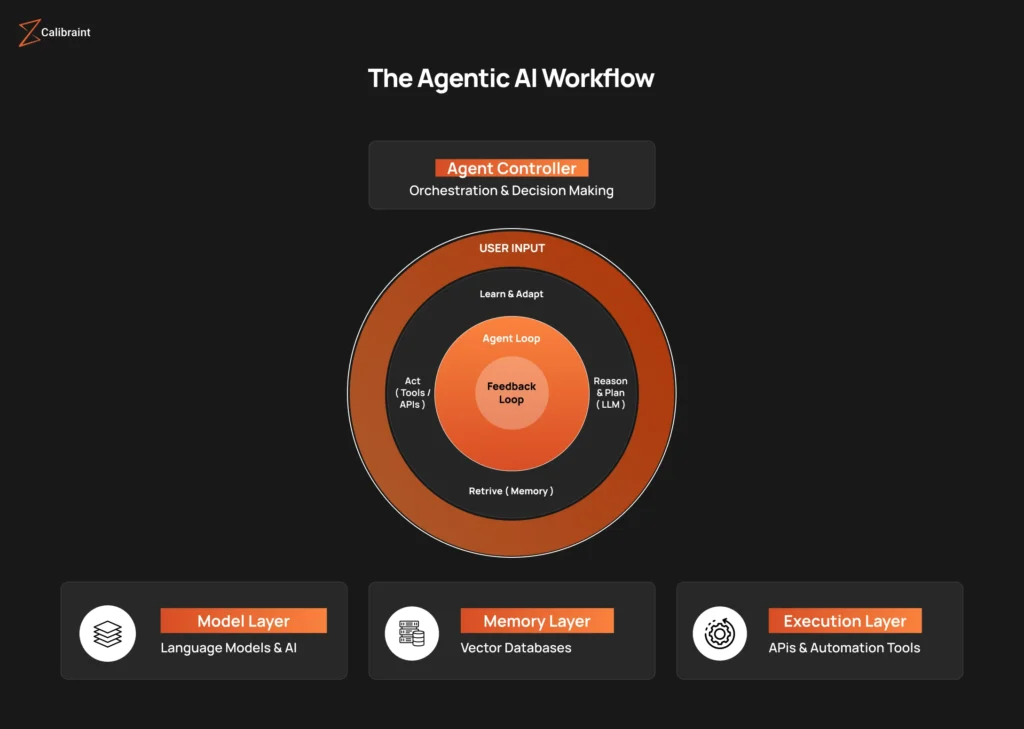
In practice, this means building systems across three distinct layers. At the model layer, the developer selects and orchestrates the language model, manages context windows, and designs prompting strategies that produce reliable, structured outputs.
At the memory layer, the developer implements vector databases and retrieval logic that give agents access to relevant information without overwhelming the model’s context.
At the execution layer, the developer connects agents to APIs, tools, and data pipelines, ensuring that autonomous actions are logged, auditable, and reversible where required.
The visual below maps this architecture precisely. It is worth studying before proceeding.
What makes enterprise agentic AI development uniquely challenging is not any single layer but the integration between them. A memory layer that returns irrelevant context breaks the reasoning loop. A model that hallucinates tool calls breaks the execution layer. An AI-native fullstack developer understands how failures propagate across the stack and designs with that in mind from the start.
The Multi-Agent Advantage at Enterprise Scale
Single-agent systems have limits. When the task is complex or when it spans multiple domains simultaneously, a single agent becomes a bottleneck. This is why multi-agent AI systems enterprise development has moved from theoretical to operational in the span of eighteen months. The demand for multi-agent AI systems enterprise development is now a defining signal of where serious enterprise engineering investment is going.
The logic is straightforward. In a financial services firm, document parsing, regulatory compliance checks, risk scoring, and customer communication do not need to be managed sequentially by one agent. It needs four specialized agents operating in parallel, each optimized for its domain, with an orchestration layer coordinating their outputs into a single decision. This is not complexity for its own sake. It is how intelligent automation scales.
Organizations implementing multi-agent architectures report measurable gains in processing speed and decision consistency. The architectural pattern also introduces resilience: if one agent fails or produces uncertain output, the orchestration layer can route the task differently rather than halting the entire workflow.
Four Signals of a Genuine AI-Native FullStack Developer
Not every developer who has worked with an LLM API qualifies as an AI-native fullstack developer. Evaluating this talent requires a sharper lens than a resume scan. Here is a framework that enterprise teams have found genuinely useful.
Systems-First Thinking: The candidate designs the agent loop before writing a single line of code. They can articulate how context flows from input to output across all three layers, and where each failure mode lives.
Model-Layer Fluency: They understand how different LLMs behave under different prompting conditions. They have opinions about when to use retrieval versus in-context learning, and why.
Deployment Realism: They have shipped something autonomous to production. They can speak to latency, cost, and monitoring strategies. The strongest agentic AI software engineer skills are always proven in production, not on whiteboards.
Business Context Awareness: They understand that an autonomous AI system for enterprise operations lives within an organization, subject to compliance requirements, audit expectations, and human escalation paths. They design for those constraints.
Where Enterprise Agentic AI Development Is Heading
The next twelve to twenty-four months will see several architectural patterns mature from experimental to standard. Agent-to-agent communication protocols are already being standardized, allowing enterprises to compose agent networks the way they currently compose microservices. Self-evaluating agents that monitor their own output quality and trigger retraining pipelines are moving from research to production.
For enterprises, the strategic implication is clear. Teams investing in multi-agent AI systems for enterprise development today will gain a structural advantage over those that do not. Building a production-grade autonomous AI system demands more than good intentions or a cloud budget. It requires an AI-native fullstack developer who has successfully navigated these challenges.
This hire is not niche. They turn enterprise agentic AI development from theory into reality. Organizations that grasp this early will spend the next decade explaining to competitors how they achieved such a rapid, sustained advantage.
1. What is an AI-native fullstack developer, and how are they different from a traditional fullstack developer?
A traditional fullstack developer builds systems where a human drives every interaction. An AI-native fullstack developer builds systems where the AI drives the workflow autonomously, reasoning, retrieving information, executing actions, and self-correcting without waiting for human input at each step. The difference is not the tech stack. It is the entire mental model of how software behaves.
2. Why do enterprises need agentic AI developers in 2026?
Because AI tools alone do not create operational advantage. Autonomous systems do. In 2026, enterprises that only use AI as an assistant are already behind the ones running multi-agent systems that handle complex workflows end to end. The demand is no longer experimental. It is a production-level business requirement, and the talent to build it is still scarce.
3. What skills does an AI-native fullstack developer need to build autonomous systems?
The core skills are LLM orchestration, prompt architecture, vector database management, retrieval-augmented generation, API chaining, multi-agent coordination, and feedback loop design. Beyond the technical layer, the developer must understand how to build systems that are auditable, cost-efficient, and safe to deploy inside a real enterprise environment.
4. Will AI replace fullstack developers or make them more valuable?
It will replace developers who only execute instructions. It will make the developers who understand how to architect, supervise, and improve AI systems. The AI-native full stack developer is not threatened by AI. They are the person who makes AI useful at scale. That profile is becoming one of the most sought-after in enterprise engineering.
5. How do enterprises start building agentic AI systems? What is the first step?
Start with one high-friction workflow that currently requires too much human coordination, such as approvals, exception handling, document processing, or compliance checks. Map the decision logic, identify where autonomous action is safe, and scope a single-agent prototype around that use case. The goal of the first step is not to build the whole system. It is to prove the loop works in your environment, with your data, under your constraints.
Calibraint
Author
March 25, 2026
Let's Start A Conversation
Manage Consent
To provide the best experiences, we use technologies like cookies to store and/or access device information. Consenting to these technologies will allow us to process data such as browsing behavior or unique IDs on this site. Not consenting or withdrawing consent, may adversely affect certain features and functions.
Functional
Always active
The technical storage or access is strictly necessary for the legitimate purpose of enabling the use of a specific service explicitly requested by the subscriber or user, or for the sole purpose of carrying out the transmission of a communication over an electronic communications network.
Preferences
The technical storage or access is necessary for the legitimate purpose of storing preferences that are not requested by the subscriber or user.
Statistics
The technical storage or access that is used exclusively for statistical purposes.The technical storage or access that is used exclusively for anonymous statistical purposes. Without a subpoena, voluntary compliance on the part of your Internet Service Provider, or additional records from a third party, information stored or retrieved for this purpose alone cannot usually be used to identify you.
Marketing
The technical storage or access is required to create user profiles to send advertising, or to track the user on a website or across several websites for similar marketing purposes.