Enterprise AI in Healthcare: A Data-Backed Guide to 25% Cost Reduction and Better Outcomes
Calibraint
Author
March 31, 2026
What If the Biggest Problem in Healthcare Has Nothing to Do With Medicine?
Here is something worth sitting with for a moment.
A hospital runs out of surgical gloves on a Tuesday morning. A billing team corrects the same coding error for the sixth time this month. A night shift supervisor calls agency staff at midnight because nobody saw the census spike coming.
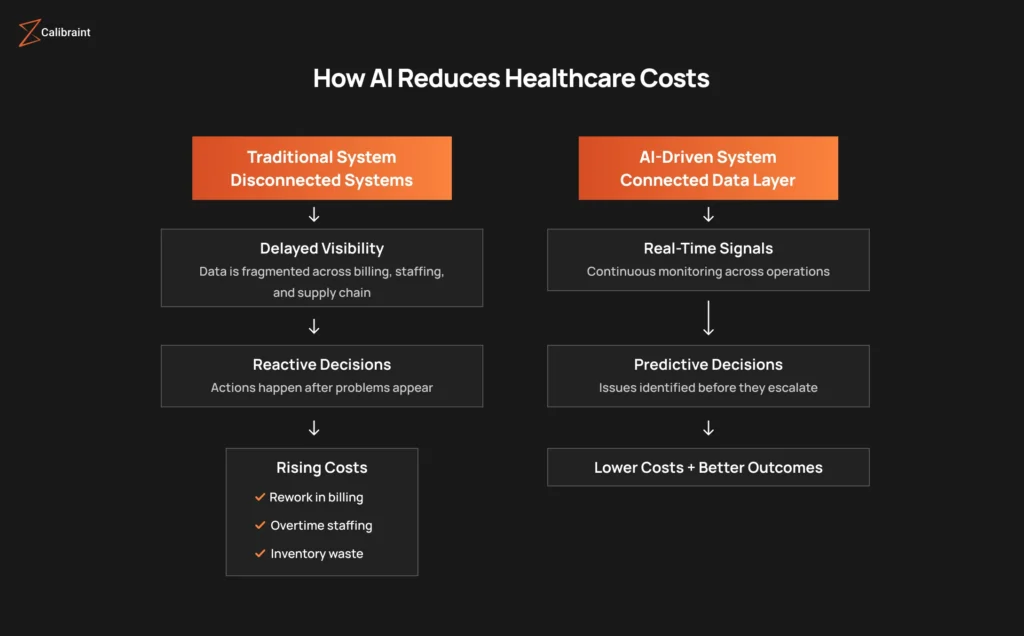
None of these is a clinical failure. But all of them cost real money. All of them burn out real people. And all of them happen because the systems running in the background were never designed to get ahead of problems. They were designed to record them after they happened.
That is where AI in healthcare cost reduction becomes more than a technology conversation. It becomes an operational one.
The role of AI development in this shift is not about replacing clinicians or adding complexity. It is about changing when decisions happen. Instead of reacting after the loss is visible, systems begin to detect patterns as they form.
This is the layer most organizations overlook. Not the clinical breakthroughs. The operational intelligence. The place where costs quietly accumulate long before they appear in reports.
📌 Key Insight You Should Notice
Area You Manage
What Is Actually Happening
Billing
Repeated claim corrections before approval
Staffing
Reactive scheduling instead of predictive planning
Supply chain
Late detection of demand shifts
The Cost Problem Is Not What Most People Think
Most leaders can tell you their cost numbers. Labor. Supplies. Denials.
But knowing the number is not the same as understanding where it is created.
A large portion of healthcare spending is not clinically necessary. It exists because of operational delay. A claim gets denied because of a simple coding issue that was never caught early. Inventory expires because the system is still using outdated consumption data. Overtime builds because staffing models cannot see demand forming in real time.
AI in healthcare cost reduction changes this dynamic.
Instead of waiting for a report that explains what went wrong, systems begin to signal when something is starting to drift. Not weeks later. As it happens.
That shift from reaction to anticipation is where enterprise AI healthcare solutions begin to show real value.
How AI Changes the Way You Operate
When implemented correctly, AI in healthcare cost reduction does not remove people from the process. It changes when they act.
💡 What Actually Changes for You
Function You Run
Before AI
With AI
Billing
Fix errors after submission
Prevent errors before submission
Staffing
Schedule based on past averages
Plan using real-time demand
Supply chain
React to shortages
Predict shortages early
The real value is not automation. It is visibility.
Where You See Results First: Revenue Cycle
For most health systems, the swiftest and most measurable impact from AI is undeniably realized within the billing department. Before a single claim is even submitted, AI algorithms meticulously review submissions, proactively flagging potential errors that might otherwise lead to rejections, ensuring issues are caught early.
This smart oversight ensures that complex cases are automatically directed to the correct human experts for quick resolution, helping to avoid bottlenecks and delays. The direct consequence of such precision is a significant drop in claim denials, which in turn dramatically accelerates reimbursement cycles, bolstering the organization’s financial health.
It is precisely through these tangible operational improvements, the visible decline in denials, and the quicker receipt of funds that the positive AI healthcare ROI statistics of 2026 begin to materialize.
Not just as abstract figures in reports, but as concrete gains felt across daily operations.
📌 Key Insight for You You typically begin to see measurable impact in revenue cycle performance within 90 to 120 days.
Staffing: The Cost You Feel Every Day
In healthcare, it’s a well-known reality that labor constitutes your largest expense, but the underlying issue is rarely the total headcount; it’s almost always about precise timing. Most traditional staffing systems, relying heavily on historical patterns, are inherently reactive, unable to detect a surge in patient volume that is already forming, leaving teams stretched thin and resources misaligned.
In this case, Enterprise AI Healthcare Solutions steps in and makes big changes to staffing using real-time signals. You can make sure the right staff is in the right place at the right time by planning based on admissions, discharges, and patient flow patterns. By making changes based on predictions in real-time, we improve operational efficiency, patient care, and staff well-being.
Supply Chain: The Waste You Do Not See Early Enough
Inventory systems often react after the problem appears.
AI in Healthcare Cost Reduction enables you to detect shifts in consumption before they become shortages or surpluses.
Issue You Face
What AI Helps You Do
Stockouts
Predict them early
Over-ordering
Reduce unnecessary spending
Vendor pricing drift
Detect inconsistencies
Enterprise AI healthcare solutions quietly protect margins here without the need for manual audits.
📌 Why this matters Most supply chain waste becomes visible only after it becomes a financial loss.
Why Some Deployments Work and Others Do Not
Not every implementation of AI in healthcare cost reduction delivers results.
The difference usually comes down to three factors.
1. Data Quality
Inconsistent data leads to unreliable outputs. Strong enterprise AI healthcare solutions are built on clean, connected systems.
2. Team Adoption
If people do not trust the system, they will override it. And if they override it, the value disappears.
3. Governance
Models need continuous monitoring. Without it, performance declines over time.
📌 Operational reality check AI performance is not static. It reflects the system around it.
What You Actually Achieve When It Works
When properly implemented, AI in healthcare cost reduction creates a layered impact.
📊 What You Typically See
Area
Expected Improvement
Operating costs
15 to 25 percent reduction
Claims processing
Faster turnaround
Staffing efficiency
Reduced overtime
Inventory accuracy
Better demand prediction
These are not isolated gains. They compound over time.
This is how AI healthcare ROI statistics 2026 are being shaped across leading health systems.
How This Impacts Patient Outcomes
Operational efficiency and clinical quality are not separate.
When systems improve, outcomes follow.
Readmissions decrease
Medication errors are prevented earlier
Deterioration is detected sooner
This is where enterprise AI healthcare outcomes connect cost and care directly.
What a Real Implementation Looks Like
Successful adoption of AI in healthcare cost reduction typically follows three phases.
Phase 1: Build the Data Foundation
Systems are connected. Data becomes usable. Governance is defined.
Phase 2: Focus on High-Impact Areas
Revenue cycle and supply chain often deliver early AI healthcare ROI statistics in 2026.
Phase 3: Expand Across the Organization
Capabilities extend into staffing, clinical support, and financial planning.
📌 Note: AI becomes powerful only when your systems are connected enough to support it.
Conclusion
Health systems that are moving on this now are not doing it because the technology is new and exciting. They are doing it because the operational pain is real, and they have seen enough evidence to act.
If you are at that point, or getting close to it, Calibraint works with healthcare organizations to design and implement AI in healthcare cost reduction in a way that fits how your operations actually run, not just how they look on a slide.
1. How much can AI actually reduce healthcare costs in a hospital?
Most healthcare organizations see 15–25% cost reduction potential when AI is applied across revenue cycle, staffing, and supply chain operations. The actual impact depends on data quality, integration depth, and adoption across teams.
2. What are the biggest benefits of enterprise AI in healthcare?
The key benefits include reduced operational costs, faster decision-making, improved staffing efficiency, fewer billing errors, and better resource utilization. It also improves coordination across clinical, financial, and administrative systems.
3. Is AI in healthcare HIPAA compliant and safe for patient data?
Yes, when properly designed. Enterprise AI systems can be built to meet HIPAA and other healthcare data privacy standards through encryption, access controls, audit trails, and secure infrastructure. Compliance depends on implementation, not just the technology itself.
4. How long does it take to see ROI from AI in healthcare?
Most organizations begin to see early ROI in 90 to 120 days, especially in revenue cycle and billing improvements. Broader enterprise-wide ROI typically becomes visible within 6 to 12 months as systems mature and scale.
5. What are the real-world examples of enterprise AI in healthcare?
Common use cases include predictive staffing models, automated claims processing, supply chain demand forecasting, patient risk scoring, and real-time operational dashboards that connect financial and clinical data for better decision-making.
Calibraint
Author
March 31, 2026
Let's Start A Conversation
Manage Consent
To provide the best experiences, we use technologies like cookies to store and/or access device information. Consenting to these technologies will allow us to process data such as browsing behavior or unique IDs on this site. Not consenting or withdrawing consent, may adversely affect certain features and functions.
Functional
Always active
The technical storage or access is strictly necessary for the legitimate purpose of enabling the use of a specific service explicitly requested by the subscriber or user, or for the sole purpose of carrying out the transmission of a communication over an electronic communications network.
Preferences
The technical storage or access is necessary for the legitimate purpose of storing preferences that are not requested by the subscriber or user.
Statistics
The technical storage or access that is used exclusively for statistical purposes.The technical storage or access that is used exclusively for anonymous statistical purposes. Without a subpoena, voluntary compliance on the part of your Internet Service Provider, or additional records from a third party, information stored or retrieved for this purpose alone cannot usually be used to identify you.
Marketing
The technical storage or access is required to create user profiles to send advertising, or to track the user on a website or across several websites for similar marketing purposes.