Smart Contracts vs Traditional Contracts — Which One Is Right for Your Business?
Calibraint
Author
April 15, 2026
Introduction
Every enterprise runs on agreements. But if your contracts still rely on paper trails, legal intermediaries, and weeks of back-and-forth approvals, you’re losing time, money, and competitive ground. Today, forward-thinking business leaders are turning to smart contract development services to replace slow, expensive, and error-prone traditional workflows. As a trusted Smart Contract Development Company, Calibraint has seen firsthand how businesses transform their operations when they make this shift. The core belief here is simple: the way your business executes agreements is either accelerating growth or silently draining it. So, let’s cut through the noise and help you decide which contract model actually serves your enterprise.
The Business Problem with Traditional Contracts
Let’s be direct: traditional contracts were built for a different era. In today’s fast-moving business environment, their friction points are glaring.
Consider a typical enterprise procurement cycle. A vendor agreement goes through legal review, multiple stakeholder approvals, physical signatures, and manual processing often taking 3 to 6 weeks. During that time, business opportunities slip away. And that’s before your account for the costs: law firms charge anywhere from $500 to $3,000 per hour for contract drafting and negotiation. For enterprises executing hundreds of agreements per year, this compounds into millions of dollars in operational overhead.
Then there’s enforcement risk. Traditional contracts depend entirely on the goodwill of the parties involved and the speed of the legal system when things go wrong. Court-based dispute resolution in the U.S. averages 18 to 24 months and that’s for relatively straightforward commercial cases. Cross-border contracts introduce even more complexity: conflicting jurisdictions, different enforcement standards, and currency risk all eat into enterprise margins.
The inefficiencies aren’t just financial. They create bottlenecks in supply chains, delay revenue recognition, and introduce compliance exposure that CFOs and CIOs are increasingly anxious about. The question isn’t whether traditional contracts have problems, it’s whether your business can afford to keep ignoring them.
What Are Smart Contracts? (Simple but Powerful)
A smart contract is a self-executing digital agreement written in code and deployed on a blockchain network. Think of it as a contract that enforces itself. Instead of relying on a lawyer or court to ensure compliance, the agreement is baked into software logic: if this condition is met, then this action executes automatically, instantly, and without human intervention.
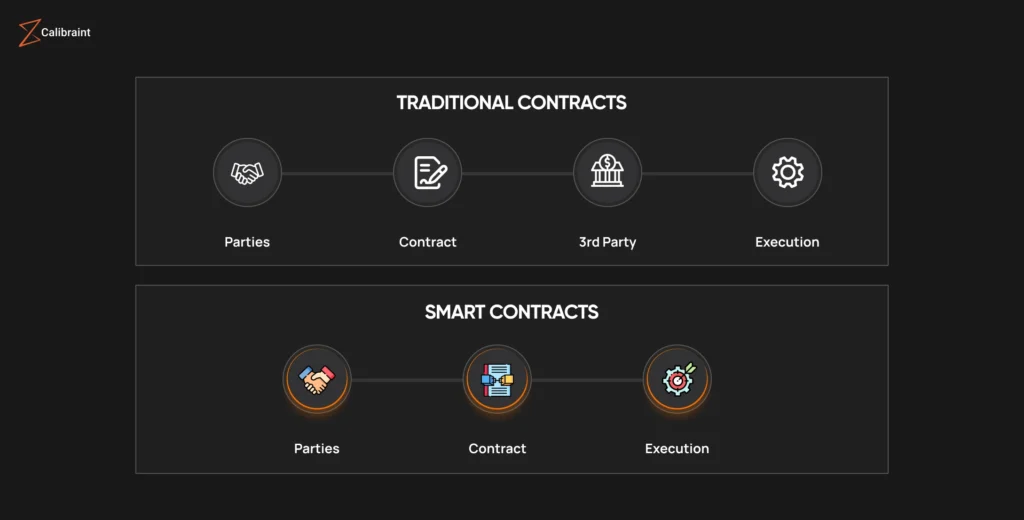
Here’s a practical illustration. Suppose your company pays a supplier upon confirmed delivery. With a traditional contract, that involves invoice submission, AP processing, bank transfers, and sometimes weeks of reconciliation. With smart contract solutions for business, the moment a verified delivery confirmation hits the system, payment releases automatically. No chasing invoices. No payment disputes. No delays.
Smart contracts run on blockchain networks like Ethereum, Hyperledger, or Polygon, making them tamper-proof and fully transparent. Every transaction is permanently recorded, auditable by all parties, and cryptographically secured. This is the foundation of blockchain contract automation services replacing human-dependent enforcement with code-dependent precision.
Smart Contracts vs Traditional Contracts: Head-to-Head
Understanding smart contracts vs traditional contracts means looking at five dimensions that matter most to enterprise decision-makers: speed, cost, transparency, trust, and enforcement.
Speed: Traditional contracts move at human speed days, weeks, sometimes months. Smart contracts execute in seconds once conditions are met. For time-sensitive industries like finance, logistics, and insurance, this isn’t a convenience; it’s a competitive necessity.
Cost: Traditional contracts carry layered costs legal fees, notary costs, administrative overhead, and dispute resolution expenses. Smart contract development services require an upfront investment in development and auditing, but eliminate the recurring operational costs that slowly bleed enterprise budgets. Studies from Deloitte and Accenture indicate that blockchain-based contract automation can reduce administrative costs by 30% to 50% in high-volume contract environments.
Transparency: With traditional contracts, each party holds their version, and disputes often arise from interpretation differences. Smart contracts exist on a shared ledger both parties see the same code, the same conditions, and the same execution history. There’s no version mismatch.
Trust: Traditional contracts rely on institutional trust. You trust the other party, their lawyers, and ultimately the court system. Smart contracts shift trust from institutions to technology. The code is the law. Neither party can manipulate outcomes once the contract is deployed.
Enforcement: Traditional contract enforcement requires active intervention legal notices, arbitration, litigation. Smart contract enforcement is automatic and unconditional. If the condition triggers, the action happens. Period.
The verdict? Smart contracts vs traditional contracts isn’t a binary winner-takes-all debate, it’s about understanding which model fits each use case. But for high-volume, rules-based, cross-border transactions, smart contracts win decisively on nearly every metric.
Why Businesses Are Adopting Smart Contracts
Why businesses are adapting blockchain contracts isn’t hard to understand when you look at the ROI. Across sectors from trade finance to real estate to healthcare enterprises are discovering that smart contract solutions for business solve three core problems simultaneously: automation, compliance, and cost reduction.
In supply chain management, companies like Walmart and Maersk have deployed blockchain-based contract systems to automatically trigger payments upon shipment milestones. What previously required weeks of manual reconciliation now happens in real time. In financial services, blockchain contract automation services power DeFi platforms, automated loan disbursements, and insurance payouts reducing claims processing time from weeks to hours. In real estate, tokenized property agreements using smart contract development services are cutting transaction costs by up to 80% by removing escrow intermediaries.
From a compliance standpoint, smart contracts can be programmed to automatically enforce regulatory conditions, KYC checks, audit trails, jurisdiction-specific rules without adding manual overhead. For CIOs managing complex regulatory environments, this is a transformative capability.
The market is responding accordingly. The global smart contract market is projected to surpass $8 billion by 2030, with enterprise adoption accelerating as blockchain infrastructure matures and regulatory clarity improves.
Key Benefits for Enterprise Leaders
When CTOs and CIOs evaluate smart contract solutions for business, four benefits consistently rise to the top:
Cost Savings at Scale: Every manual touchpoint in contract management has a cost attached. Eliminate the intermediaries lawyers for routine agreements, banks for payment processing, notaries for verification and those savings compound across thousands of transactions annually. Enterprises running high-volume vendor contracts or customer agreements often recover their smart contract development services investment within the first fiscal year.
Faster Time-to-Execution: Speed is money. In procurement, a 30-day contract cycle means a 30-day delay in getting goods, services, or partnerships activated. Smart contracts compress that timeline dramatically. For businesses operating in competitive or time-sensitive markets, this speed advantage is real and measurable.
Reduced Disputes: Most contract disputes arise from ambiguity between two parties interpreting the same clause differently. Smart contracts eliminate interpretive ambiguity entirely. The conditions are in code. Either they’re met or they’re not. This dramatically reduces the volume of disputes and the legal costs they generate.
Full Automation of Recurring Workflows: Milestone-based payments, subscription billing, royalty distributions, multi-party escrow all of these are prime candidates for blockchain contract automation services. Once deployed, they run on their own, with full auditability and zero manual intervention required.
👉 To understand the critical role of security in this transformation, explore the detailed guide onsmart contract security benefits a must-read before deploying any production-grade solution.
When Traditional Contracts Still Make Sense
A credible analysis acknowledges the limits of smart contracts and there are genuine scenarios where traditional agreements remain the right tool.
Complex, bespoke negotiations involving M&A activity, strategic partnerships, or multi-layered service agreements require the kind of nuanced language and interpretive flexibility that code cannot replicate. These agreements often evolve throughout negotiation and may need amendment after execution something traditional contracts handle naturally.
Employment relationships involve performance expectations, behavioral standards, and subjective judgments that don’t translate cleanly into programmatic conditions. A sales rep’s “reasonable best efforts” clause means something to a judge; it means nothing to a blockchain.
Regulated industries like government contracting, healthcare procurement, and defense often have legal requirements mandating specific contract formats, oversight procedures, and human sign-off. In these environments, why businesses are adapting blockchain contracts often centers on hybrid models rather than full replacement.
Jurisdictional uncertainty also matters. While legal recognition of smart contracts is advancing with states like Wyoming, Arizona, and Tennessee having passed blockchain-friendly legislation, global legal clarity is still evolving. For contracts spanning multiple jurisdictions with conflicting legal frameworks, traditional contracts with clear governing law provisions offer more predictable enforcement.
The smart move isn’t to choose one approach religiously. It’s to understand where each excels and deploy accordingly.
Choosing the Right Approach for Your Business
A practical decision framework for enterprise leaders evaluating smart contracts vs traditional contracts:
Choose smart contracts when:
Transactions are high-volume and rules-based (payments, deliveries, milestones)
Speed of execution is a competitive differentiator
Counterparties span multiple geographies and you need trustless enforcement
Compliance conditions can be clearly coded into logic
You’re operating in digital-native environments (DeFi, tokenized assets, digital supply chains)
Choose traditional contracts when:
The agreement involves complex negotiation and customization
Performance is subjective or requires human judgment
Regulatory requirements mandate specific legal formats
The relationship requires ongoing flexibility and amendment
Legal recognition in the relevant jurisdiction is uncertain
Consider a hybrid model when:
You need legal enforceability alongside automated execution
The agreement has both static conditions (suitable for code) and variable terms (suitable for legal language)
Your organization is transitioning from traditional workflows and needs a bridge
This isn’t a permanent either/or decision. Many enterprises begin with smart contract solutions for business for a specific use case supplier payments, for example and expand as they see ROI. The key is starting with a clear-eyed assessment of where automation delivers the most value.
Why Partnering with the Right Company Matters
Here’s a reality that doesn’t get discussed enough: deploying smart contracts poorly is worse than not deploying them at all. A poorly audited contract with a code vulnerability can be exploited and unlike traditional contracts, you can’t simply call your lawyer to stop the damage. The DAO hack of 2016, which resulted in $60 million in losses, stands as a permanent reminder that smart contract security is non-negotiable.
This is why the partner you choose for smart contract development services matters enormously. You need a team that brings not just technical depth in Solidity or Rust, but also robust security auditing practices, deep knowledge of enterprise integration patterns, and the ability to translate your business logic into airtight code.
A credible smart contract development company doesn’t just write code, it stress-tests it, audits it, and designs the deployment architecture to minimize risk while maximizing performance. They understand the difference between a proof-of-concept and a production-grade enterprise system. And they stay current with the rapidly evolving legal and regulatory landscape around blockchain contract automation services, so your implementation remains compliant as standards develop.
Why businesses are adapting blockchain contracts at scale comes down to trust in their technology partners as much as trust in the technology itself.
Conclusion: The Future Belongs to Automated, Intelligent Agreements
The shift from traditional contracts to blockchain-powered smart agreements isn’t a trend, it’s a structural change in how business gets done. Enterprises that continue relying solely on manual, intermediary-dependent contracts are carrying an operational cost and speed disadvantage that will only widen as their competitors automate.
The good news? You don’t have to make this transition blindly or all at once. Start with your highest-volume, most rules-based workflows. Measure the impact. Scale from there.
Calibraint is the Smart Contract Development Company enterprises trust when the stakes are real. With a proven track record in enterprise blockchain deployments, a security-first development methodology, and architecture built for scale, Calibraint helps you move from contract management overhead to intelligent automation that delivers measurable ROI. Whether you need end-to-end smart contract development services, a targeted automation pilot, or a full blockchain transformation roadmap, Calibraint’s team of experts is ready to build it with you.
Don’t let outdated contracts be the ceiling on your growth. Partner with Calibraint and turn your agreements into a competitive advantage.
👉 Contact Calibraint Today — Your First Consultation Is Free →
Frequently Asked Questions
Why are businesses switching from traditional contracts to smart contracts?
Businesses are making the switch primarily for three reasons: speed, cost, and reliability. Traditional contracts require manual execution, legal intermediaries, and often weeks to enforce. Smart contract solutions for business automate execution the moment predefined conditions are met eliminating delays, reducing administrative costs by up to 50%, and removing the risk of non-compliance. For enterprises handling high volumes of supplier agreements, payments, or compliance workflows, the operational ROI becomes evident quickly. This is the core reason why businesses are adapting blockchain contracts at an accelerating pace.
What are the main disadvantages of traditional contracts in business?
The most significant disadvantages are speed, cost, and enforcement dependency. Traditional contracts are slow to draft, execute, and enforce. They rely on legal professionals at every stage, creating cost layers that compound across large contract volumes. Dispute resolution through traditional legal channels can take 18 to 24 months and cost tens of thousands of dollars. They also carry interpretation risk courts may read the same clause differently than either party intended. For enterprises operating in fast-moving markets, these disadvantages represent real competitive exposure. Blockchain contract automation services directly address each of these friction points.
How do smart contracts save time and money for businesses?
Smart contract development services eliminate the manual touchpoints that drive cost and delay in traditional contract management. By encoding agreement terms in self-executing code, businesses remove the need for lawyers in routine contract execution, banks in payment processing, and administrators in compliance tracking. Payments release automatically upon milestone completion. Deliveries trigger instant settlements. Compliance conditions enforce themselves. Research from major consulting firms suggests enterprises can reduce contract-related administrative costs by 30% to 50% and compress execution timelines from weeks to minutes. The savings are both direct (eliminated fees) and indirect (faster revenue recognition, fewer disputes).
Are smart contracts legally binding and enforceable?
Yes, in many jurisdictions, with important nuances. Several U.S. states, including Wyoming, Arizona, and Tennessee, have enacted legislation recognizing smart contracts as legally enforceable agreements. The European Union is actively developing regulatory frameworks under MiCA that address blockchain-based contracts. The key legal requirement is the same as for traditional contracts: mutual agreement, lawful purpose, and consideration. Where smart contracts vs traditional contracts get more complex is in jurisdictions that haven’t yet passed specific enabling legislation in those cases, the underlying legal agreement may still need to exist in traditional form, with the smart contract serving as the automated execution mechanism. Always consult legal counsel for jurisdiction-specific guidance.
How much does it cost to develop a smart contract for a business?
The cost varies significantly based on complexity, blockchain platform, and security requirements. Simple smart contracts for straightforward payment automation may range from $5,000 to $20,000. Complex enterprise deployments involving multi-party logic, integration with existing ERP or CRM systems, and rigorous security auditing can range from $50,000 to $250,000 or more. Working with a reputable smart contract development company like Calibraint ensures you receive a detailed scope, transparent pricing, and critically proper security auditing that protects your investment. The more relevant question for enterprise buyers isn’t the development cost in isolation; it’s the ROI relative to the ongoing operational costs your current contract processes carry.
.
Calibraint
Author
April 15, 2026
Let's Start A Conversation
Manage Consent
To provide the best experiences, we use technologies like cookies to store and/or access device information. Consenting to these technologies will allow us to process data such as browsing behavior or unique IDs on this site. Not consenting or withdrawing consent, may adversely affect certain features and functions.
Functional
Always active
The technical storage or access is strictly necessary for the legitimate purpose of enabling the use of a specific service explicitly requested by the subscriber or user, or for the sole purpose of carrying out the transmission of a communication over an electronic communications network.
Preferences
The technical storage or access is necessary for the legitimate purpose of storing preferences that are not requested by the subscriber or user.
Statistics
The technical storage or access that is used exclusively for statistical purposes.The technical storage or access that is used exclusively for anonymous statistical purposes. Without a subpoena, voluntary compliance on the part of your Internet Service Provider, or additional records from a third party, information stored or retrieved for this purpose alone cannot usually be used to identify you.
Marketing
The technical storage or access is required to create user profiles to send advertising, or to track the user on a website or across several websites for similar marketing purposes.