Real-World Asset Tokenization: Unlocking Liquidity in Real Estate, Finance, and Beyond
Calibraint
Author
April 16, 2026
How blockchain is reshaping the economics of ownership, and what it means for real estate, private credit, and the businesses building for what comes next.
The Problem With How We Have Always Owned Things
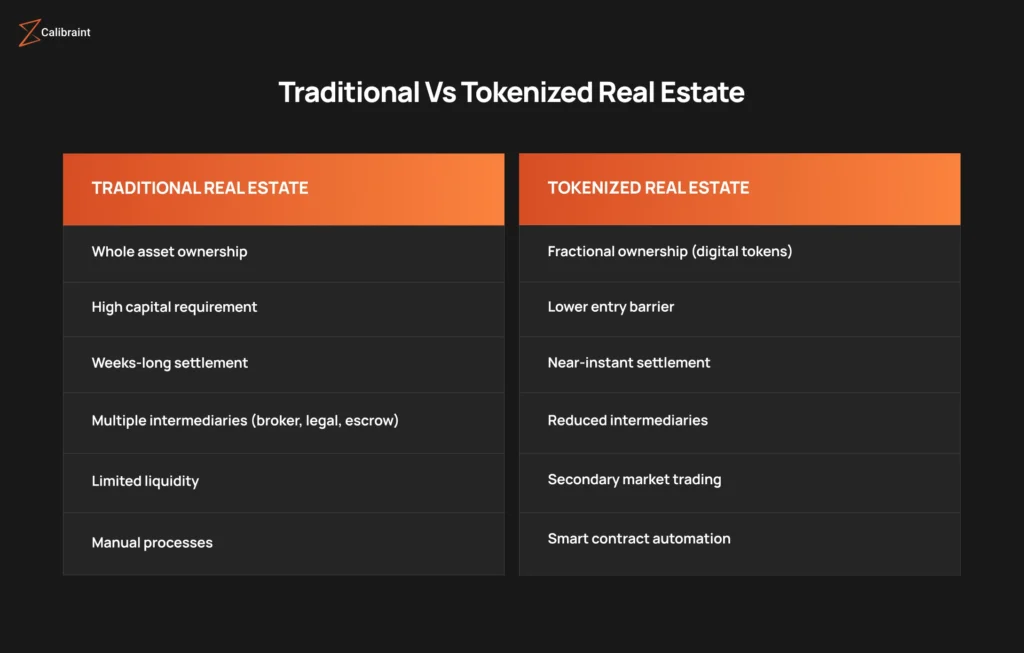
Real estate has always been one of the most reliable stores of wealth. It is also one of the most illiquid. A commercial property worth tens of millions of dollars cannot be sold in pieces. It cannot change hands in hours. Settlement takes weeks, sometimes months. Transaction costs consume a significant portion of value. And access, for most investors, remains gated by geography, capital minimums, and layers of intermediaries that add friction without adding proportionate value.
Tokenized real estate investment changes that equation. By converting ownership rights into digital tokens recorded on a blockchain, asset owners can offer fractional stakes in high-value properties to a broader pool of investors, without liquidating the entire asset or restructuring existing arrangements. Smart contract development sits at the core of this shift, encoding compliance logic, ownership transfers, and income distributions directly into the token structure.
This is not a niche experiment playing out on the fringes of finance. The numbers confirm it is a structural shift with serious institutional weight behind it.
What the Market Data Actually Says
According to the Deloitte Center for Financial Services, the tokenized real estate market stood at under $300 billion in 2024 and is projected to reach $4 trillion by 2035, growing at a compound annual rate of 27%. Of that $4 trillion, $2.39 trillion is expected to come from tokenized loan securitizations and $1 trillion from tokenized private real estate funds.
Institutional investors are not watching from the sidelines. Market data from 2024 shows that nearly 70% of deployed capital in tokenized assets came from large institutional players seeking improved efficiency and access to alternative yield. Private credit, historically one of the most relationship-dependent asset classes, made up over 58% of tokenized real-world asset flows in the first half of 2025.
These figures come from organizations with research budgets and reputational stakes in accuracy. They are not projections built on optimism. They reflect where institutional capital is already moving.
Three Problems Tokenization Actually Solves
Strip away the technical language, and tokenized real estate investment addresses three problems that have defined this asset class for decades.
Illiquidity is structural in real estate. Large assets cannot be divided and traded like equities. Tokenization breaks a property or a portfolio into programmable digital units. Each token represents a provable ownership stake. Investors can enter and exit positions on secondary markets without requiring the underlying asset to change hands. A settlement that traditionally takes weeks can happen in minutes.
Accessibility has historically favored the well-capitalized. Minimum investment thresholds and accreditation requirements locked most mid-market and retail investors out of commercial real estate entirely. Fractional ownership via tokenization lowers those minimums substantially, opening the asset class to a wider and more geographically distributed investor base.
Operational cost is where smart contract development delivers the most immediate, measurable value. Contracts that once required legal teams, escrow agents, and weeks of reconciliation can be encoded as self-executing logic on the blockchain. Compliance checks, dividend distributions, and ownership transfers become automated, auditable, and tamper-resistant from day one.
What This Looks Like in Practice
In December 2024, T-RIZE Group announced a $300 million deal to tokenize Project Champfleury, a 960-unit residential development in Montreal, Canada. The deal was structured to offer accredited investors globally a first tranche of the project through Texture Capital, a SEC-registered Alternative Trading System. This is institutional-grade tokenization infrastructure deployed at real scale.
An earlier and frequently cited case is the tokenization of the St. Regis Aspen Resort. Asset management firm Elevated Returns tokenized nearly 19% of the property’s equity, with tokens trading on tZERO’s regulated ATS platform. According to ScienceSoft’s research, the token value grew 3.3x between 2022 and 2024, trading through a period of significant market uncertainty.
These are not isolated proof-of-concept projects. They are early chapters of what Deloitte describes as a structural transformation in how real estate is financed, owned, and traded.
Finance Is Following the Same Path
Real estate is the most visible use case for tokenized real estate investment, but private credit and structured finance are moving just as deliberately. Tokenized US Treasury and money-market fund assets reached $7.4 billion in 2025, an 80% increase year-to-date, according to CoinLaw’s 2025 asset tokenization data.
Private credit, historically opaque and access-restricted, is being restructured through tokenization into programmable instruments with transparent repayment records and secondary market access. These instruments bring the efficiency and visibility of public markets to an asset class that has long resisted both.
The business case here is not theoretical. It is the documented experience of funds that have made the transition and are now operating with faster settlement, lower counterparty risk, and full auditability built into the infrastructure from the ground up.
Building a Tokenization Program That Holds
Most organizations that struggle with tokenization do not fail because of the technology. They fail because they begin without a clear framework for what they are tokenizing, who their investors are, and what regulatory environment governs their issuance.
A credible tokenized real estate investment program starts with asset selection. Not every property is a strong candidate. High-value, income-generating assets with clear title, stable occupancy, and a defined investment horizon tend to perform best as tokenized instruments. The economics need to work for both issuer and investor before the token structure is designed.
Compliance architecture comes next. Jurisdictional variation in securities law means that a token structure acceptable in one market may need significant redesign in another. Smart contract logic needs to encode investor eligibility checks, transfer restrictions, and reporting requirements as foundational layers, not afterthoughts.
Secondary market access is the piece most issuers underestimate. A token with no liquid secondary market is a digital representation of the same illiquidity problem that tokenization is supposed to solve. Access to a credible tokenized real estate exchange with genuine trading depth is not optional. It is the difference between a tokenization program and a tokenization announcement.
The Business Case: What Organizations Are Gaining
Liquidity in real estate investment is the most cited benefit, and rightly so. But the operational gains from a well-designed tokenization program extend further.
Capital formation timelines improve substantially. A traditional private placement can take three to six months to close. A tokenized offering with KYC and AML logic embedded in the smart contract layer can reach its first close faster. For development projects with time-sensitive funding windows, that difference is commercially meaningful.
Investor reporting, which in traditional structures requires manual reconciliation and periodic disclosure, becomes a continuous and automated function. Every on-chain transaction is timestamped, attributable, and accessible to authorized parties. Audit costs fall. Investor confidence rises. Both matter to organizations building long-term capital relationships.
Where This Is Heading
Gartner, in its 2024 Hype Cycle for Web3 and Blockchain, classified tokenization as a maturing technology and predicted mainstream adoption within two to five years. That timeline is compressing. The infrastructure exists. Institutional capital is moving. Regulatory frameworks in the US, EU, and across Asia are taking shape.
Cross-border tokenized real estate investment is an emerging frontier that the current infrastructure is already beginning to support. Tokenized exchanges operating across jurisdictions allow investors in one country to hold fractional stakes in assets located in another, with on-chain compliance logic handling the jurisdictional complexity. A Dubai villa offering, as reported by Brevitas, sold out in under five minutes to 169 investors from 40 different nationalities, each holding a blockchain-verified fractional stake.
The organizations building their tokenization capabilities now are not simply early adopters. They are the issuers, platforms, and exchanges that will define what credible tokenized real estate investment looks like for the decade ahead.
The Right Partner Changes the Outcome
Tokenization is not a product you buy off a shelf. It is an infrastructure decision that touches legal structure, technology architecture, investor relations, and long-term business strategy at the same time. In the context of real-world asset tokenization, getting this right requires more than just technical execution. It demands a deep understanding of how assets, compliance, and market dynamics come together on-chain.
The teams building serious tokenization programs are not looking for vendors. They are looking for partners who understand the full stack, from blockchain architecture to the business logic that makes a tokenization model scalable and trusted across markets.
At Calibraint, we design and build end-to-end tokenization infrastructure that goes from concept to compliant, production-ready systems. If you are planning a real-world asset tokenization initiative, we can help you define the architecture, compliance framework, and go-to-market strategy.
Let’s build a tokenization model that is scalable, regulated, and investor-ready.
FAQs
1. How does tokenization improve liquidity in real estate investment?
Tokenization converts real estate into fractional digital tokens that can be traded more easily. This allows investors to buy or sell smaller portions without waiting for a full property sale. It reduces lock-in periods and improves market access for smaller investors.
2. What are tokenized real estate exchanges?
Tokenized real estate exchanges are digital platforms where property-backed tokens are listed and traded. They function like stock exchanges but focus on fractional ownership of real-world assets. These platforms enable faster, more transparent property investment transactions.
3. What is the ROI on tokenized real estate?
ROI varies based on property type, location, rental yield, and market demand. Tokenization itself does not guarantee higher returns but can improve portfolio efficiency and access. Investors may benefit from rental income plus potential asset appreciation.
4. What are the risks of tokenized real estate investment?
Risks include regulatory uncertainty as laws around tokenized assets are still evolving. There may also be platform risks like security breaches or smart contract vulnerabilities. Liquidity risk exists if there are not enough buyers in the token market.
Calibraint
Author
April 16, 2026
Let's Start A Conversation
Manage Consent
To provide the best experiences, we use technologies like cookies to store and/or access device information. Consenting to these technologies will allow us to process data such as browsing behavior or unique IDs on this site. Not consenting or withdrawing consent, may adversely affect certain features and functions.
Functional
Always active
The technical storage or access is strictly necessary for the legitimate purpose of enabling the use of a specific service explicitly requested by the subscriber or user, or for the sole purpose of carrying out the transmission of a communication over an electronic communications network.
Preferences
The technical storage or access is necessary for the legitimate purpose of storing preferences that are not requested by the subscriber or user.
Statistics
The technical storage or access that is used exclusively for statistical purposes.The technical storage or access that is used exclusively for anonymous statistical purposes. Without a subpoena, voluntary compliance on the part of your Internet Service Provider, or additional records from a third party, information stored or retrieved for this purpose alone cannot usually be used to identify you.
Marketing
The technical storage or access is required to create user profiles to send advertising, or to track the user on a website or across several websites for similar marketing purposes.