How Autonomous AI Agents Are Reducing Operational Costs for Enterprises
Calibraint
Author
April 9, 2026
There is a quiet, expensive crisis happening in the modern back office. Despite two decades of “digital transformation,” the ratio of operational overhead to revenue has remained stubbornly stagnant for the Fortune 500. We’ve spent billions on software that was supposed to save us time, yet we’ve ended up hiring more people just to manage that software. This is the “Efficiency Paradox,” and it is currently the single greatest drain on enterprise value.
The friction isn’t the technology; it’s the intervention. Every time a process stops because it needs a human to “check the data” or “validate the exception,” your margins take a hit.
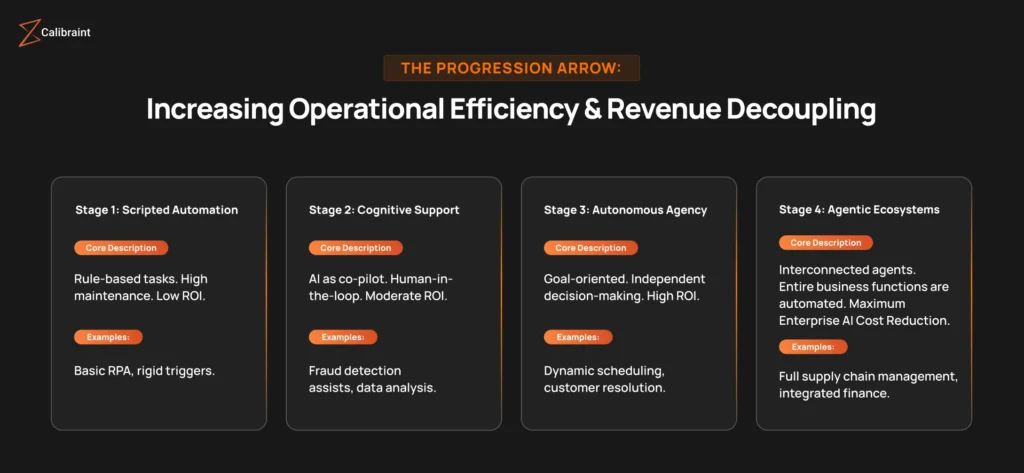
The shift to autonomous agency is the first real solution to this stagnation. We are moving past the era of tools and into the era of specialized digital workers. By embedding high-tier AI development services directly into the logic of the business, organizations are finally decoupling their ability to scale from their need to hire. This isn’t about a better dashboard; it’s about AI agents for operational cost reduction that possess the cognitive sovereignty to close a ticket, resolve a shipment error, or reconcile a ledger without asking for permission.
For the strategic thinker, the goal isn’t just “automation”, that’s a 2010s mindset. The goal is Enterprise AI cost reduction through a self-correcting infrastructure. When you deploy AI automation for enterprise cost savings, you aren’t just buying software; you are installing a permanent, appreciating asset that drives AI agents for operational efficiency at a marginal cost that trends toward zero.
The following breakdown isn’t a speculative look at what might happen. It is a clinical analysis of the “Autonomy Dividend” and how the most aggressive players are already using it to hollow out their competitors’ cost structures.
The Economics of Intellectual Labor: Taxing the Routine
The primary friction in any large-scale operation is not a lack of effort but the sheer cost of decision-making. Every time a human must intervene to validate data or approve a routine deviation, the enterprise incurs a hidden “Cognitive Tax.” AI agents for operational cost reduction target these specific friction points. Unlike previous generations of software that merely moved data, these agents use reasoning to interpret it.
This intelligence allows for a radical restructuring of labor costs. Instead of scaling headcount to match growth, which is a linear and expensive path, enterprises utilize AI automation for enterprise cost savings to maintain a lean, strategic core while expanding output. The objective is clear: decouple revenue growth from headcount. When the marginal cost of processing an additional unit of work approaches zero, you achieve a level of scalability that was previously impossible.
Mapping the Efficiency Gain: The Digital Nervous System
To understand the impact, one must look at the structural changes in how departments function. AI agents for operational efficiency are currently transforming three key areas:
Data Synthesis: Ingesting vast amounts of unstructured information and turning messy inputs into actionable insights in real time.
Autonomous Resolution: In customer service and internal help desks, agents resolve issues from end to end rather than just routing tickets to an already overwhelmed human.
Dynamic Scheduling: In logistics, agents optimize routes and inventory levels based on shifting variables like weather or port delays without waiting for a manual override.
These are not hypothetical applications. High-performing organizations are already realizing enterprise AI cost reduction through the deployment of specialized agentic workflows that act as a digital nervous system for the firm.
The Shift from Tools to Teammates
The most significant realization in the current market is that agents are functional entities rather than static tools. An agentic system designed for AI agents for operational efficiency can manage a budget, negotiate with vendor APIs, and adjust project timelines. This level of agency reduces the need for middle management oversight in routine processes, allowing human talent to focus on high-stakes creative and emotional intelligence tasks.
When we analyze enterprise AI cost reduction, we see that the highest ROI comes from agents that bridge silos. An agent that can communicate with the CRM, the ERP, and the project management tool simultaneously eliminates the need for manual data entry. This connectivity is the hallmark of sophisticated AI agents for operational cost reduction.
Strategic Implementation: Beyond the Generalist
The path to a successful deployment requires more than just capital; it requires a modular approach to architecture. Successful AI cost-saving strategies for enterprises focus on high-volume, high-complexity tasks that previously required specialized, expensive knowledge. For instance, in the legal and compliance sectors, agents can now scan thousands of contracts to identify specific risk parameters in minutes. This is a task that would traditionally take human teams weeks of billable hours to complete.
This is where the precision of AI development services becomes critical. A generic, off-the-shelf solution rarely yields the specialized logic needed to handle enterprise-grade complexity. Custom agents must be grounded in the specific data and the unique regulatory environment of your business. When built with this level of specificity, AI automation for enterprise cost savings moves from a speculative IT project to a core component of the balance sheet.
Precision as a Financial Strategy: The Trust Architecture
While the first hurdle is strategy, the second is trust. The transition to an agentic enterprise often meets resistance regarding accuracy. However, the methodology behind AI agents for operational efficiency has matured through multi-agent orchestration. This is a system where specialized agents act as “checkers” for one another. This self-correcting mechanism is vital to AI automation, enabling enterprise cost savings in high-stakes sectors like finance and healthcare.
Consider the long-term impact of the “Autonomy Dividend.” Unlike outsourced labor or seasonal contractors, an agent trained via expert AI development services does not suffer from turnover, fatigue, or a loss of institutional memory. It becomes a permanent, appreciating asset that improves as it ingests more internal data. By focusing on AI cost saving strategies for enterprises, leadership is installing a system that maintains a level of precision and scale that no human team could realistically match. The result is a more resilient, predictable, and ultimately more profitable operational model.
The Future of the Self-Optimizing Enterprise
We are entering an era where the enterprise becomes a self-optimizing entity. In this future, AI agents for operational cost reduction will not just execute tasks but also suggest ways to improve them. They will identify bottlenecks in real time and reallocate digital resources to clear them. This is the ultimate expression of AI automation for enterprise cost savings.
For organizations looking to maintain a competitive edge, the question is no longer whether to adopt these systems but how quickly they can be integrated into the core architecture. The most successful AI cost saving strategies for enterprises are those that view AI as a foundational shift in the cost of doing business.
Engineering the Autonomy Dividend with Calibraint
The hardest part of this transition is the execution. Generic models lack the nuance of your specific business logic. At Calibraint, we specialize in moving beyond the pilot phase to build custom, agentic ecosystems that deliver measurable enterprise AI cost reduction.
We do not just build software; we architect the digital workforce that allows your business to scale without the weight of traditional overhead. Whether you are looking to refine your AI agents for operational efficiency or deploy a full-scale autonomous workflow, our team provides the strategic precision required for high-stakes enterprise environments.
FAQs
1. Why are enterprises adopting autonomous AI agents now?
The primary driver is the “Productivity Paradox.” Despite years of digital investment, operational costs have remained stagnant because traditional software still requires human oversight to handle exceptions. In 2026, market volatility and data velocity have outpaced human manual processing. AI agents for operational efficiency allow businesses to move from reactive automation to proactive agency, enabling them to scale output without a corresponding increase in headcount.
2. How do autonomous AI agents differ from traditional AI tools?
Traditional AI tools are reactive; they follow fixed rules and wait for a human prompt to deliver a prediction or classification. In contrast, autonomous agents are goal-oriented. They possess the “cognitive sovereignty” to plan multi-step workflows, access necessary APIs, and resolve deviations independently. While traditional tools provide data, AI agents for operational cost reduction provide completed outcomes.
3. Are there any risks in implementing autonomous AI agents?
The transition introduces challenges related to “Agentic Sprawl” and observability. Without a structured framework, autonomous systems can create “shadow pipelines” of data that circumvent traditional governance. Risks include logic drift—where an agent’s decision-making deviates from business intent over time—and integration complexity. Mitigating these risks requires specialized AI development services to build robust “guardrail” architectures and multi-agent validation loops.
4. Are autonomous AI agents secure for enterprise use?
Yes, provided they are built on an enterprise-grade stack rather than consumer-grade models. Security in 2026 focuses on the “Agentic Security Gap,” ensuring that every API call and data access point an agent touches is encrypted and permissioned. High-quality AI automation for enterprise cost savings utilizes short-lived credentials and “least-privilege” access, ensuring that agents only see the data they need to execute their specific goals.
Calibraint
Author
April 9, 2026
Let's Start A Conversation
Manage Consent
To provide the best experiences, we use technologies like cookies to store and/or access device information. Consenting to these technologies will allow us to process data such as browsing behavior or unique IDs on this site. Not consenting or withdrawing consent, may adversely affect certain features and functions.
Functional
Always active
The technical storage or access is strictly necessary for the legitimate purpose of enabling the use of a specific service explicitly requested by the subscriber or user, or for the sole purpose of carrying out the transmission of a communication over an electronic communications network.
Preferences
The technical storage or access is necessary for the legitimate purpose of storing preferences that are not requested by the subscriber or user.
Statistics
The technical storage or access that is used exclusively for statistical purposes.The technical storage or access that is used exclusively for anonymous statistical purposes. Without a subpoena, voluntary compliance on the part of your Internet Service Provider, or additional records from a third party, information stored or retrieved for this purpose alone cannot usually be used to identify you.
Marketing
The technical storage or access is required to create user profiles to send advertising, or to track the user on a website or across several websites for similar marketing purposes.