AI Driven Smart Contract Auditing: Using LLMs to Detect Vulnerabilities on Blockchain
Calibraint
Author
February 25, 2026
Smart contract failures rarely begin with careless engineering. They tend to surface when a protocol grows beyond the security processes designed to protect it. As features accumulate, governance layers expand, and upgrade logic becomes more intricate, even well-structured codebases become harder to reason about at production speed.
Every team that deploys a vulnerable contract intends to ship a secure one. The difference between intent and outcome is due to coverage rather than effort. As systems scale, the surface area requiring review grows faster than traditional audit cycles can reasonably support.
This pressure is increasingly visible as blockchain development matures into an enterprise discipline. Composability, cross-chain interactions, and on-chain governance introduce layers of logic that earlier audit models were never built to evaluate in full. Human auditors remain indispensable, yet operating alone, they face practical limits in consistency, depth, and velocity.
AI driven smart contract auditing emerged to address this imbalance. It broadens review coverage, connects logic across large codebases, and surfaces risk earlier in the lifecycle.
This guide examines how AI driven smart contract auditing works in practice, where it delivers measurable security value, and where its limits still require human oversight.
When “audited” still isn’t safe: lessons from real breaches
The industry has already seen what happens when review processes fail under pressure. The Ronin Network breach associated with Axie Infinity led to losses widely reported as $600M+. The Wormhole bridge exploit involved about $320M worth of ETH in a major cross-chain incident.
These events are useful to mention because they highlight a pattern that keeps repeating. Code can look clean and still fail in production. Attackers exploit timing, edge conditions, governance gaps, and economic pressure. A security program has to assume those pressures will appear.
The challenge comes from scale. Codebases expand. Integrations multiply. Product cycles compress. A deep manual review takes time, and time is often constrained near launch.
AI Driven Smart Contract Auditing changes the workflow. It surfaces likely failure points before the audit window begins. Senior security engineers then focus on business logic and exploit paths that require expert judgment.
What LLM Smart Contract Auditing Actually Does
Large language models trained on code behave differently from traditional static analysis tools. Tools like Slither and Mythril follow rule-based detection. They are fast, useful, and well-established. They also have a hard ceiling: they can only find what their rules were written to find.
LLM smart contract auditing goes further. A model trained across thousands of real audit reports, bug bounty disclosures, and historical exploit patterns does not just pattern-match against a known list. It reasons about code behavior in context. It identifies logic that, while syntactically valid, creates exploitable conditions that no rule set anticipated.
In practical terms, LLM smart contract auditing surfaces vulnerabilities in categories including reentrancy, integer overflow and underflow, access control failures, improper input validation, front-running exposure, and flash loan attack vectors. More importantly, it does so with natural language explanations of why each finding is risky, not just a flagged line of code. This changes the conversation from triage to understanding.
The distinction matters enormously for a product leader or CTO. Your team does not just receive a list of red flags. They receive a reasoned analysis of the business risk attached to each finding, ranked by severity, with remediation context already in place.
The Capabilities That Change the Security Equation
AI code analysis for smart contracts operates across several dimensions that traditional tools handle separately, if at all.
Pattern intelligence across multi-chain environments: AI code analysis for smart contracts now covers EVM-compatible chains, Solana, and Cosmos-based architectures. A team building cross-chain infrastructure can run consistent AI detection of smart contract vulnerabilities across their entire codebase, not just the primary deployment chain.
Continuous post-deployment monitoring: Most security conversations stop at deployment. Automated contract security scanning extends into production, flagging anomalous transaction behavior, unusual gas consumption patterns, and interaction sequences that suggest an active exploit attempt. This closes the gap between audit and ongoing operation, which is where most losses actually occur.
Explainability for non-technical stakeholders: AI auditing tools for blockchain generate reports that translate technical risk into business language. A CPO can understand why a specific finding affects user funds. A legal team can understand the regulatory exposure. This accelerates internal decision-making without requiring every stakeholder to be a security engineer.
Speed that changes commercial timelines: An initial AI driven smart contract auditing scan that takes minutes rather than weeks does not replace a human audit. It means your human auditors begin their review with the highest-priority findings already surfaced, ranked, and contextualized. The audit becomes more precise, more thorough, and more time-efficient at the same time.
What This Looks Like in Practice
Consider a DeFi lending protocol preparing for mainnet launch on an EVM-compatible chain. The team has written approximately 4,000 lines of Solidity. Two senior engineers have reviewed the code internally. A third-party audit is scheduled, but the audit firm has a six-week lead time, and the commercial launch window is closing.
Running AI driven smart contract auditing as a first pass takes under two hours. The scan returns a structured report with findings categorized across critical, high, medium, and low severity tiers. Three high-severity findings are surfaced: a reentrancy condition in the withdrawal logic, an access control gap in the administrator functions, and an edge case in the interest rate calculation that could be exploited during extreme market conditions.
The development team remediates all three before the external audit begins. When the human auditors arrive, they confirm the fixes and focus their time on deeper business logic review and protocol-specific edge cases. The audit is completed in three weeks instead of six. The protocol launches with higher confidence, a cleaner audit report, and a faster path to the market.
This is not a hypothetical sequence. It is the operational pattern that teams adopting AI auditing tools for blockchain are running today, and the commercial advantage it creates is real.
A Repeatable Framework for Smart Contract Security
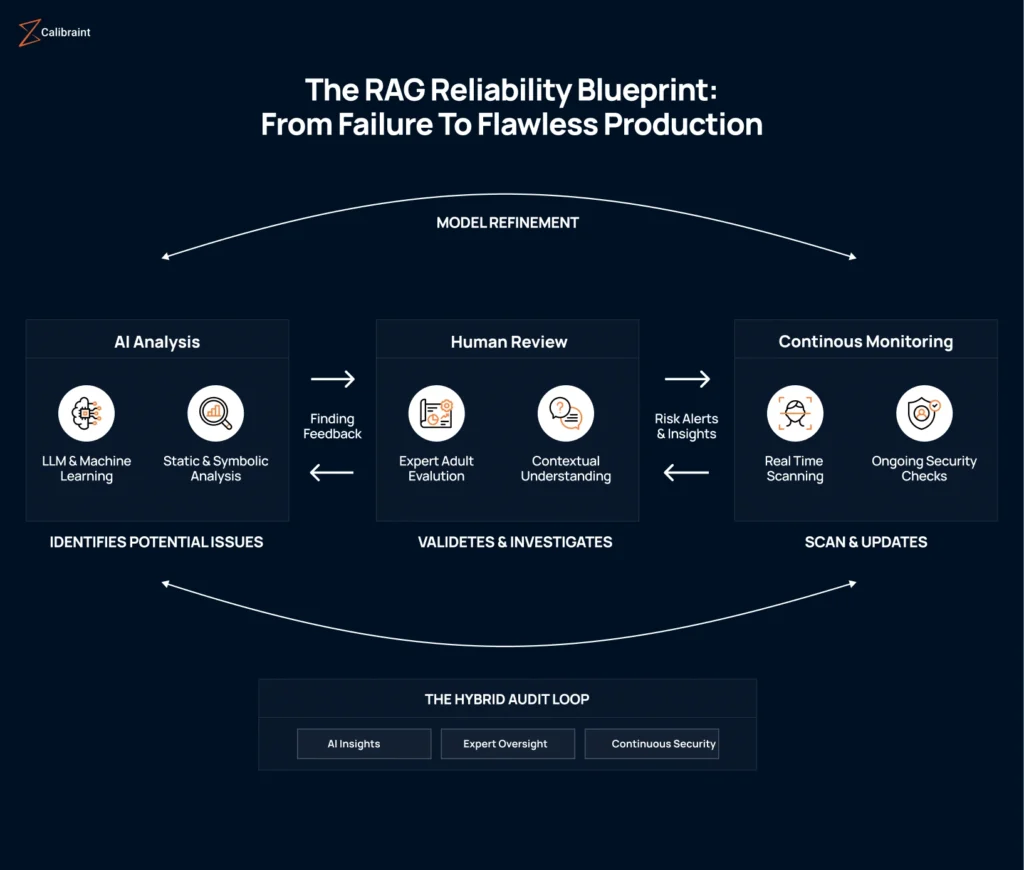
For teams that want to institutionalize AI driven smart contract auditing rather than treat it as a one-time event, a four-phase model provides a structure that scales.
Phase 1: Pre-Audit Code Profiling. Automated contract security scanning runs across the full codebase before any human review begins. This produces a baseline risk profile and prioritizes areas of highest complexity.
Phase 2: LLM-Powered Vulnerability Detection.LLM smart contract auditing executes a deep analysis pass, surfacing findings across all known vulnerability categories and flagging novel logic patterns that warrant expert review.
Phase 3: Risk Classification and Reporting. AI detection of smart contract vulnerabilities produces a structured severity report with business-language explanations, remediation guidance, and a ranked action list.
Phase 4: Human Expert Validation. Qualified security engineers review the AI findings, validate remediations, conduct business logic analysis, and issue a final audit certificate. The human layer works with higher context and spends zero time on findings that the AI has already resolved.
This framework compresses the overall audit cycle without reducing rigor. It also creates a repeatable security posture that applies to every future contract update, not just the initial deployment.
The Business Case for AI-Enabled Smart Contract Auditing
Security in Web3 influences capital access, partnership approvals, and market credibility. Projects with documented, AI-assisted audit trails strengthen their position during due diligence, as investors, exchanges, and insurers increasingly require structured security evidence.
Automated contract analysis reduces review cycles and accelerates remediation. In competitive protocol markets, faster deployment directly impacts liquidity capture and ecosystem traction.
Continuous post-deployment monitoring improves operational resilience by detecting anomalies early and limiting financial exposure.
As regulatory oversight expands, structured audit records also support governance reporting and internal risk controls.
AI-enabled smart contract auditing, therefore, supports credibility, speed, and resilience, positioning security as a strategic advantage rather than an isolated engineering function.
The Security Standard Your Protocol Deserves
Every serious on-chain product deserves a security process that matches its ambition. AI driven smart contract auditing is not a shortcut. It is a more intelligent approach to a problem that has cost the industry billions and damaged the credibility of protocols that deserved better.
At Calibraint, we work with blockchain teams who are building products that matter and who understand that security is not a final step. It is a foundational one. Our approach combines the intelligence of trained LLM models with the judgment of experienced security engineers, giving your protocol the kind of audit coverage that holds up under real-world conditions.
1. How does AI detect vulnerabilities in smart contracts?
Through automated scanning and behavioral analysis, AI identifies risky code patterns, known exploits, and unusual contract behavior. This makes vulnerability detection faster and more reliable than traditional manual audits.
2. Why is AI-driven smart contract auditing important for blockchain security?
AI-driven smart contract auditing improves blockchain security by detecting vulnerabilities early, preventing potential hacks and financial losses. It enables scalable, accurate, and continuous monitoring of contracts on decentralized networks.
Calibraint
Author
February 25, 2026
Let's Start A Conversation
Manage Consent
To provide the best experiences, we use technologies like cookies to store and/or access device information. Consenting to these technologies will allow us to process data such as browsing behavior or unique IDs on this site. Not consenting or withdrawing consent, may adversely affect certain features and functions.
Functional
Always active
The technical storage or access is strictly necessary for the legitimate purpose of enabling the use of a specific service explicitly requested by the subscriber or user, or for the sole purpose of carrying out the transmission of a communication over an electronic communications network.
Preferences
The technical storage or access is necessary for the legitimate purpose of storing preferences that are not requested by the subscriber or user.
Statistics
The technical storage or access that is used exclusively for statistical purposes.The technical storage or access that is used exclusively for anonymous statistical purposes. Without a subpoena, voluntary compliance on the part of your Internet Service Provider, or additional records from a third party, information stored or retrieved for this purpose alone cannot usually be used to identify you.
Marketing
The technical storage or access is required to create user profiles to send advertising, or to track the user on a website or across several websites for similar marketing purposes.