AI in Education: How Smart Learning Platforms Improve Student Engagement and Outcomes
Calibraint
Author
March 26, 2026
Education today faces a critical challenge: students are disengaged, overwhelmed, and often lost in one-size-fits-all systems. Traditional models struggle to adapt to diverse learning needs, leaving both educators and institutions searching for scalable solutions. This is where AI in Education is no longer optional, it’s transformational. Forward-thinking institutions are now partnering with an AI Development company to build intelligent systems that go beyond digitization and actually improve outcomes. The promise is clear: adaptive, personalized, and data-driven learning that keeps students engaged while delivering measurable results. If you’re evaluating the future of learning, this shift isn’t coming, it’s already here.
How is AI used in education?
At its core, AI in education refers to the application of machine learning, natural language processing, computer vision, and predictive analytics to teaching and learning environments. This spans everything from intelligent tutoring systems that identify knowledge gaps in real time, to automated grading tools that free teachers from administrative burden, to recommendation engines that serve the right content at the right moment.
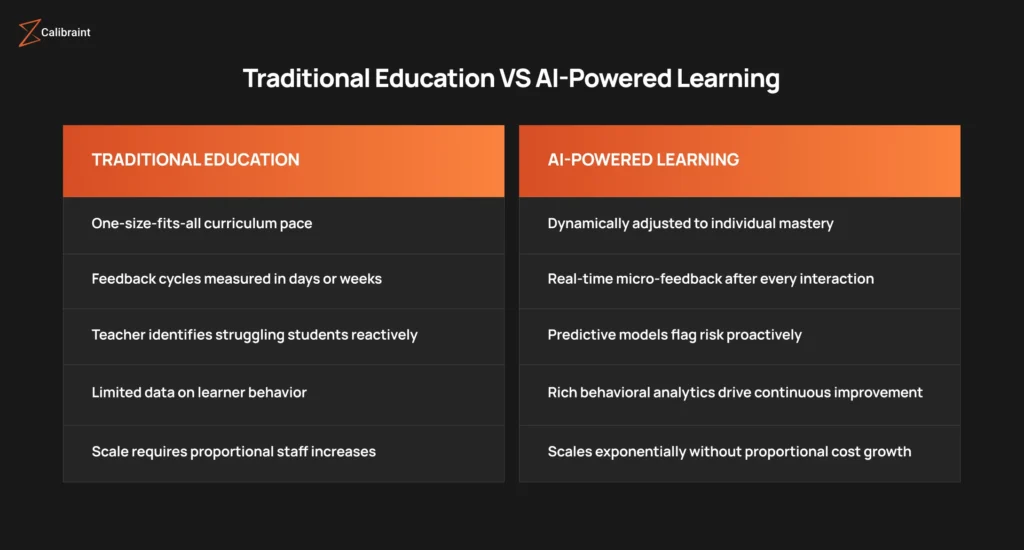
In practice, AI functions as a silent co-teacher, one who never sleeps, never loses patience, and processes data at a scale no human instructor could match. Smart learning platforms for students use behavioral data time-on-task, answer patterns, click sequences to continuously recalibrate the difficulty and style of content. When a student struggles with fractions, the system doesn’t wait for a teacher to notice; it pivots instantly, serving visual explanations, worked examples, or peer-reviewed analogies based on that specific learner’s history.
To understand the real-world impact and practical applications, explore these detailed use cases and benefits of AI in education that highlight how institutions are already driving measurable outcomes using AI.
When a student struggles with fractions, the system doesn’t wait for a teacher to notice; it pivots instantly, serving visual explanations, worked examples, or peer-reviewed analogies based on that specific learner’s history.
Key Uses of AI in Education
Adaptive Learning Pathways:
AI dynamically adjusts content sequencing based on mastery, learning pace, and preferred modality.
Intelligent Tutoring Systems (ITS):
One-on-one guidance at scale these systems replicate the coaching quality of human tutors for thousands of simultaneous learners.
Automated Assessment & Feedback:
From multiple-choice grading to nuanced essay evaluation using NLP, AI compresses the feedback loop from days to seconds.
Predictive Analytics for At-Risk Students:
Early identification of disengagement, learning difficulties, or dropout risk enabling counselors to intervene before a crisis forms.
Natural Language Processing in Chatbots:
24/7 academic support, answering curriculum questions and guiding learners without requiring a human on standby.
Administrative Automation:
Scheduling, compliance reporting, and resource allocation freeing educators to focus on high-value human interactions.
The breadth of these applications means the benefits of AI in education are felt at every layer — from the individual learner’s daily experience to the institutional KPIs that matter to board members and investors.
Pros and Cons of AI in Education
No technology deserves uncritical enthusiasm least of all one operating in as sensitive a domain as learning. Here’s a grounded view:
Cons: Data privacy obligations, algorithmic bias risk, dependency on quality training data, and the irreplaceable value of human mentorship. The best implementations of AI in eLearning platforms treat AI as an amplifier of human teaching not a replacement. Schools that adopt AI without a governance framework for data ethics risk undermining trust with both students and parents.
Popular AI Applications in Education
Several platforms have become benchmarks for what’s possible when AI in eLearning platforms is executed with intention:
Duolingo:
Uses spaced repetition algorithms and predictive modeling to optimize lesson timing for each individual learner, driving one of the highest daily active user rates of any educational app.
Khan Academy’s Khanmigo:
A generative AI tutor that engages students through Socratic dialogue rather than answer-giving a deliberate design choice rooted in learning science.
Carnegie Learning:
An ITS used in thousands of US schools, proven to improve math outcomes by adapting problem sets to each student’s demonstrated ability.
Coursera’s AI features:
Personalized course recommendations, automated grading on peer-reviewed assignments, and learner success predictions shared with enterprise L&D teams.
Knewton (now part of Wiley):
One of the earliest adaptive learning engines, demonstrating how personalized learning using AI can operate at institutional scale.
These aren’t experimental pilots, they’re production-grade systems serving millions of learners, generating the longitudinal data that proves personalized learning using AI delivers measurable academic gains.
Three Paradigms of AIEd
Researchers at UCL’s Knowledge Lab among others have proposed a useful framework for understanding how AI and learners can relate to each other. Rather than treating AI as a monolithic tool, they describe three paradigms that reflect fundamentally different philosophies:
PARADIGM 1
AI-Directed — Learner as Recipient
The AI is in control. It decides what to teach, when, and how. Adaptive drill systems, automated tutors delivering scripted content. Powerful for foundational skill acquisition and remediation, but limited for higher-order thinking. Example: a math app that serves next problem sets based purely on accuracy scores.
PARADIGM 2
AI-Supported — Learner as Collaborator
AI and learners work together. The system surfaces insights, flags patterns, and makes suggestions but the learner retains agency over decisions. Closest to augmented intelligence. Example: a writing platform that identifies weak argumentation and prompts the student to reconsider without rewriting the essay for them.
AI-Empowered — Learner as Leader
PARADIGM 3
The learner drives. AI acts as infrastructure handling logistics, providing on-demand resources, tracking progress while the learner directs their own inquiry. Ideal for project-based, self-directed learning in higher education and professional development. Example: a graduate researcher using AI to synthesize literature while forming their own original hypotheses.
For EdTech product leaders, this framework is strategic gold. The paradigm you design for determines your content architecture, data model, and market positioning. AI based smart learning platforms for schools serving K-8 learners lean heavily toward Paradigm 1. University platforms and corporate L&D solutions increasingly operate in Paradigm 3 territory.
How AI Is Used in Schools Today
Walk into a progressive school district today, and the use of AI in education is less “future concept” and more operational reality. Georgia’s Fulton County School System uses AI-driven dashboards to track learning progression across 100,000+ students, allowing curriculum coaches to reallocate resources based on real-time achievement data. In the UK, third-sector organizations are piloting AI reading assistants in under-resourced primary schools extending personalized reading support to children who might otherwise share a teaching assistant between thirty peers.
AI based smart learning platforms for schools are also transforming special education. Students with dyslexia, dyscalculia, or attention difficulties can now receive micro-adjusted content pacing that would be impossible to deliver manually at classroom scale. Speech-to-text tools powered by AI are removing writing barriers for students with motor difficulties, and sentiment analysis tools are beginning to surface emotional disengagement before it becomes behavioral disruption.
At the administrative level, AI scheduling tools in districts like New York City’s DOE have reduced timetabling conflicts and optimized teacher utilization savings that translate directly into classroom contact time. The ROI is real, and the data to prove it is growing year over year.
Using AI in Schools With Purpose and Intention
Technology deployed without strategy creates expensive noise. The institutions achieving the strongest outcomes from smart learning platforms for students share one characteristic: they began with learning outcomes, not features. Before procuring any AI system, high-performing schools define what success looks like improved literacy rates, reduced dropout frequency, higher teacher satisfaction scores and then evaluate AI tools against those specific metrics.
Intentional implementation also means investing in teacher training. AI doesn’t replace the pedagogical expertise of educators; it needs that expertise to be configured correctly. When teachers understand how to interpret AI-generated learner analytics, they become dramatically more effective at targeted intervention.
Equity is the third pillar. Personalized learning using AI examples from well-resourced suburban districts don’t automatically translate to under-resourced urban schools with infrastructure limitations. EdTech founders building for scale need to design AI systems that function gracefully under connectivity constraints progressive web apps, offline-capable content delivery, and lightweight ML models that don’t require expensive hardware.
Benefits of AI in Education
The benefits of AI in education extend well beyond novelty. They represent a structural shift in what’s possible at scale:
Hyper-Personalization at Scale: Every learner gets a curriculum tailored to their pace, style, and knowledge gaps, something that was economically impossible in traditional models.
Dramatically Improved Retention: Spaced repetition and adaptive review cycles, driven by AI, have been shown in peer-reviewed studies to improve long-term retention by 20-40% compared to static curricula.
Early Intervention: Predictive models identify at-risk students weeks earlier than human observation alone, converting potential dropouts into success stories.
Reduced Administrative Overhead: Automated grading, scheduling, and compliance reporting free teachers for the high-value human interactions that AI cannot replicate.
Measurable ROI for Institutions: Improved completion rates, higher standardized assessment performance, and reduced remediation costs produce financial returns that justify investment.
Scalable Content Delivery: Smart learning platforms for students built on AI infrastructure can serve ten million learners as effectively as ten thousand, a multiplier that changes the economics of education entirely.
The benefits of AI in education compound over time. As platforms accumulate learner data, their models improve, their predictions sharpen, and their personalization becomes increasingly precise. The institutions that invest early build a proprietary data moat that latecomers cannot replicate overnight.
If you’re evaluating the long-term impact, theseuse cases and benefits of AI in education provide deeper insights into how AI delivers measurable ROI, improved retention, and scalable learning outcomes across institutions.
Challenges of AI in Education
Honest evaluation demands acknowledging the real obstacles. Data privacy remains the most operationally complex challenge particularly for AI based smart learning platforms for schools operating across jurisdictions with different FERPA, GDPR, or COPPA requirements. Every interaction logged by an AI system is a data point that must be stored, protected, and governed responsibly.
Algorithmic bias is a subtler but equally serious concern. If training data reflects historical inequities in educational achievement as most legacy datasets do, AI models risk encoding and amplifying those inequities rather than correcting them. Responsible development requires deliberate bias auditing, diverse training datasets, and ongoing model monitoring post-deployment.
Infrastructure disparity means that personalized learning using AI examples showcased at well-funded private institutions may be inaccessible to the schools that need AI most urgently. Solving for equity requires product decisions, offline functionality, low-bandwidth optimization, device agnosticism that many commercial platforms still haven’t prioritized.
Finally, teacher buy-in is not automatic. Educators who perceive AI as a threat to their professional identity will find ways to work around it. The platforms that succeed treat teachers as co-designers of the AI experience not passive recipients of a vendor’s algorithm.
The Future of AI in Education
The trajectory of AI in education points toward greater contextual intelligence, deeper personalization, and seamless integration between formal and informal learning. Generative AI is moving from novelty to infrastructure. Large language models are being embedded into every stage of the learning lifecycle, from curriculum design to student assessment to teacher professional development.
Multimodal AI systems that understand text, voice, video, and behavioral signals simultaneously will enable AI in eLearning platforms to respond to how a student sounds, not just what they type. The convergence of AI with augmented reality and immersive simulation will create learning environments that are impossible to distinguish from real-world professional contexts.
Personalized learning using AI will extend beyond academics into career guidance, skill credentialing, and lifelong learning portfolios that follow individuals from school to workplace and back. For decision-makers evaluating platforms today, the strategic question is not whether to adopt AI that debate is settled. The question is whether to build or buy, and whether your chosen partner has the technical depth to deliver systems that survive contact with real learners at scale.
Conclusion: The Window for Competitive Advantage Is Now
The evidence is no longer theoretical. AI in education is delivering measurable improvements in engagement, retention, and learning outcomes across institutions of every size and geography. The platforms winning market share aren’t the ones with the most features, they’re the ones whose AI systems genuinely understand learners and adapt at the individual level.
For EdTech founders, school administrators, and product leaders, the stakes are clear. The institutions and platforms that move decisively now will build data advantages, learner trust, and platform stickiness that will be extraordinarily difficult for competitors to replicate in three years’ time.
Calibraint is a proven AI Development company that has helped EdTech companies and educational institutions design and build the custom AI systems that make this transformation real not in a pitch deck, but in live classrooms and production platforms serving real learners. From adaptive content engines to predictive analytics dashboards to full-scale AI in eLearning platforms, we build for scale, for equity, and for the outcomes that matter to your stakeholders
FAQ
How is AI used in education today?
AI in education is deployed across four primary areas: adaptive learning (adjusting content difficulty and sequencing to each student’s demonstrated mastery), intelligent tutoring systems (providing one-on-one coaching at scale), predictive analytics (identifying at-risk students before disengagement becomes dropout), and administrative automation (handling grading, scheduling, and reporting). Leading platforms like Khan Academy, Duolingo, and Carnegie Learning have demonstrated these applications at scale, achieving measurable improvements in learning outcomes
How do AI-powered learning platforms improve student engagement?
Smart learning platforms for students improve engagement by eliminating the mismatch between content difficulty and learner ability, the primary driver of both frustration and boredom. AI continuously recalibrates challenge level, serves content in preferred modalities, and provides immediate feedback that reinforces progress. Platforms also use sentiment analysis and behavioral signals to detect disengagement early and adapt the learning experience before a student mentally checks out.
What are the benefits of AI in education for students?
The core benefits of AI in education for students include: personalized learning pathways that adapt to individual pace and learning style; instant, actionable feedback after every interaction; equitable access to high-quality tutoring regardless of socioeconomic background; early identification of learning difficulties enabling timely intervention; and improved long-term knowledge retention through AI-optimized spaced repetition and review cycles. Students in AI-enhanced learning environments consistently demonstrate higher completion rates and stronger performance on standardized assessments.
Calibraint
Author
March 26, 2026
Let's Start A Conversation
Manage Consent
To provide the best experiences, we use technologies like cookies to store and/or access device information. Consenting to these technologies will allow us to process data such as browsing behavior or unique IDs on this site. Not consenting or withdrawing consent, may adversely affect certain features and functions.
Functional
Always active
The technical storage or access is strictly necessary for the legitimate purpose of enabling the use of a specific service explicitly requested by the subscriber or user, or for the sole purpose of carrying out the transmission of a communication over an electronic communications network.
Preferences
The technical storage or access is necessary for the legitimate purpose of storing preferences that are not requested by the subscriber or user.
Statistics
The technical storage or access that is used exclusively for statistical purposes.The technical storage or access that is used exclusively for anonymous statistical purposes. Without a subpoena, voluntary compliance on the part of your Internet Service Provider, or additional records from a third party, information stored or retrieved for this purpose alone cannot usually be used to identify you.
Marketing
The technical storage or access is required to create user profiles to send advertising, or to track the user on a website or across several websites for similar marketing purposes.