The Future of NFT Marketplace Development: AI Integration Strategies and Solutions
Calibraint
Author
December 18, 2025
AI in NFT marketplace development is currently at the forefront of the Web3 evolution. The digital asset landscape is no longer just about static art; it is evolving into a complex ecosystem of utility, gaming, and enterprise-grade identity. The future of NFT marketplace development is being reshaped by AI-driven intelligence, automation, personalization, and security enhancements, transitioning from simple transactional hubs to sophisticated, self-governing platforms. For instance, modern NFT marketplace solutions now employ AI-based recommendation engines to improve NFT discovery, ensuring users find assets tailored to their behavioral patterns rather than scrolling through cluttered listings.
As we look toward 2026 and beyond, the convergence of Generative AI and Web3 is creating a new paradigm for “Intelligent Assets.” Industry research suggests that the sector is shifting toward NFT marketplaces 2026 trends and future innovations where assets serve as ownership verification for real-world identity and luxury goods. However, this evolution is not without friction. For enterprise leaders and Web3 founders, the challenge lies in moving past the “hype” and building a sustainable, secure, and scalable AI NFT platform. This requires a deep understanding of how machine learning and specialized AI services can solve the structural weaknesses that have plagued the first generation of digital asset exchanges.
The Critical Pain Points of Traditional NFT Ecosystems
Despite the rapid growth of the decentralized economy, several high-level industry pain points continue to hinder mainstream enterprise adoption:
Fake NFTs and Copyright Violations: Plagiarism and “lazy minting” of protected IP remain a deterrent for serious creators and luxury brands.
Low User Trust: Inconsistent valuations and the lack of transparent historical data make new investors hesitant.
Marketplace Fraud and Wash Trading: AI-powered NFT marketplaces are now detecting wash trading where users trade with themselves to pump volumes identifying patterns that humans and basic scripts might miss.
Poor NFT Discoverability: Without intelligent curation, high-quality projects get buried under a mountain of low-effort derivative works.
Scalability and Performance Issues: Inefficient moderation and manual compliance workflows create bottlenecks that prevent platforms from handling millions of concurrent users.
To overcome these hurdles, the industry is shifting toward a robust and intelligent NFT platform development model that prioritizes data-driven security and automated user experiences.
Core AI Capabilities Defining the Future of NFT Marketplace Development
To build a competitive AI NFT platform, decision-makers must look beyond the blockchain layer and focus on the intelligence layer. Here are the core AI-driven components defining the next generation of the market.
The most critical barrier to mainstream adoption is the prevalence of “copy-minting.” AI integration in NFT ecosystems allows for real-time vision and text recognition technologies to screen every new mint against existing databases.
Impact on Trust: By identifying duplicates or trademark infringements before they reach the secondary market, platforms build immense trust and transparency. This is a non-negotiable requirement for enterprise-grade NFT marketplace solutions handling high-value intellectual property.
2. Smart Recommendation Engines
Traditional search filters (price, date, category) are static and often lead to high bounce rates. AI analyzes a user’s wallet history, browsing time, and social engagement to curate a “Discovery Feed” unique to every individual.
Impact: This boosts user engagement and creator retention. When an AI NFT platform can surface a niche artist to a collector who specifically likes that aesthetic, it creates a more efficient market
Industry Insight: Before diving into advanced AI features, it is vital to understand the foundational steps of the launch. For a comprehensive roadmap, check out this step-by-step guide to launch an NFT marketplace, which covers the essential trends and development phases.
3. Predictive Analytics & Dynamic Pricing
The volatility of the NFT marketplace development is often its Achilles’ heel. AI models can ingest vast amounts of off-chain data including social sentiment, news cycles, and cross-chain volume to provide “fair value” estimates.
Impact: Predictive insights enhance long-term viability, helping buyers make data-backed decisions and stabilizing the platform’s internal economy.
4. Automated Moderation & Compliance
As global regulations tighten, manual moderation is no longer feasible. AI-driven systems can automatically flag content that violates local laws or community guidelines, ensuring the platform remains compliant without slowing down the minting process.
Impact on Scalability: This automation allows for scalable NFT platform development, where the infrastructure grows seamlessly regardless of the volume of content being uploaded.
Enterprise Decision-Making Framework for NFT Marketplace Platforms
Strategic leaders must move beyond the “if it works, it’s good” mentality. A professional NFT platform development strategy requires a structured framework to evaluate the depth of automation and the quality of the tech stack.
1. AI Readiness and Automation Depth
When evaluating NFT marketplace solutions, ask: Can the system learn from user behavior? Is fraud detection reactive or proactive? A future-ready platform uses “active learning” models that become more accurate with every transaction.
2. Multi-Standard Support and Interoperability
An AI NFT platform should not be siloed. It must support various token standards (ERC-721, ERC-1155, and beyond) while using AI to bridge the metadata gaps between different blockchains. This ensures that your AI integration in NFT efforts are not limited to a single ecosystem.
3. The Balance of Decentralization and Governance
While Web3 prizes decentralization, enterprises require governance. The framework should include AI-managed “guardrails” that protect the brand while allowing the community to thrive. This influence is critical for operational efficiency and cost optimization.
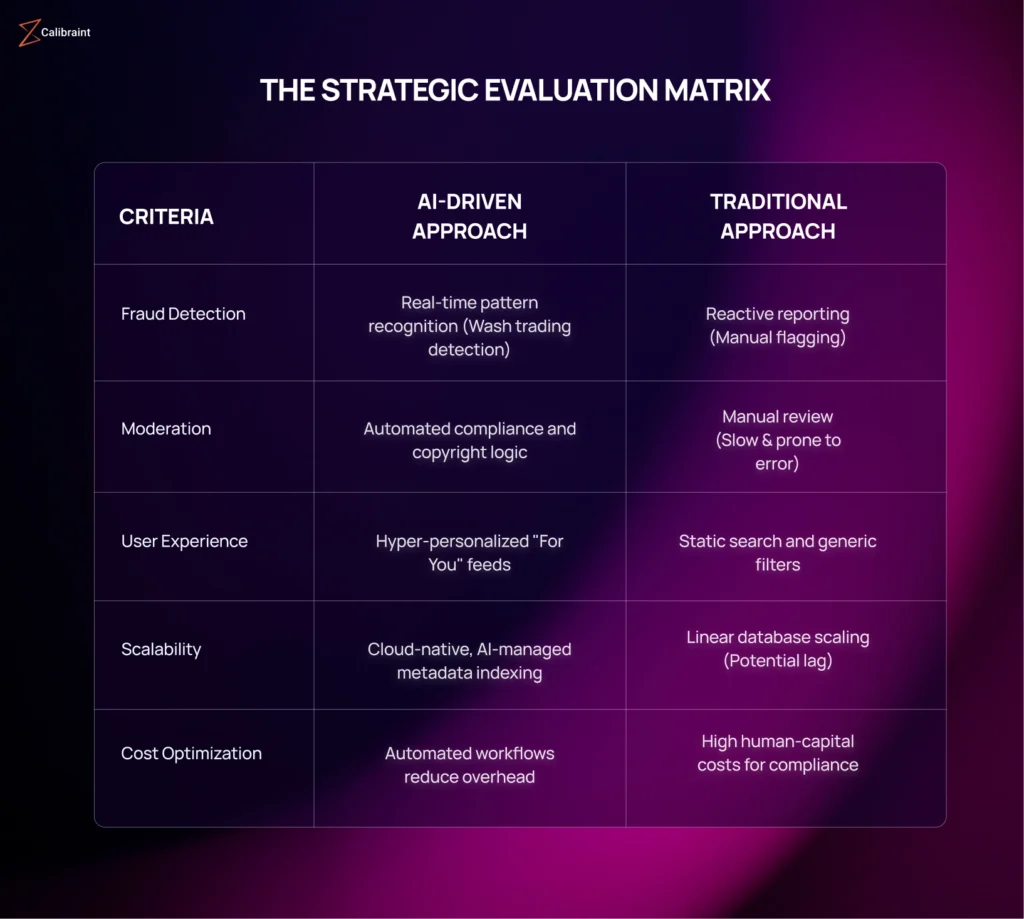
The Strategic Evaluation Matrix
Integrating AI integration in NFT layers ensures that as your AI NFT platform grows, your operational efficiency doesn’t degrade. This choice directly influences user trust and your ability to pivot as Web3 standards evolve.
Business Benefits of AI in NFT Marketplace Development
Why should a CTO or Product Manager prioritize AI integration in NFT platforms? The business case is built on three pillars: Risk Mitigation, Revenue Optimization, and Operational Excellence.
Smarter Content Moderation: AI reduces the risk of hosting illegal or offensive content, ensuring compliance-ready infrastructure.
Enhanced NFT Discovery: By matching the right buyer with the right asset, platforms see higher conversion rates and increased transaction volume.
Personalized Buyer Journeys: Automation allows for tailored notifications and marketing, fostering a loyal community.
Scalable NFT Platform Development: AI handles the “heavy lifting” of data analysis, allowing your core team to focus on partnership and brand growth.
Short & Impactful Industry Use Cases
Gaming & Metaverse: AI agents can manage in-game NFT economies, adjusting asset rarity or utility based on player behavior.
Music & Creator Economies: AI ensures that complex royalty structures are honored across different platforms, protecting the creator’s revenue.
Brand Loyalty: Enterprises use AI to analyze customer data and drop “surprise and delight” NFTs that match a user’s specific purchase history.
The right AI-driven architecture defines the future of NFT marketplace development, expanding mainstream adoption by removing the “Wild West” risks typically associated with digital assets.
Risks of Choosing the Wrong NFT Marketplace Architecture
Choosing a rigid or “dumb” architecture is a recipe for platform obsolescence. Risks include:
Weak AI Moderation: Leading to copyright lawsuits and loss of high-value creators.
Poor Fraud Detection: Allowing wash trading to artificially inflate volume, which eventually leads to market crashes and loss of user faith.
Scalability Failures: Without robust AI integration in NFT systems, the platform may crash during high-traffic “hype” drops.
Compliance Gaps: Failure to integrate automated KYC/AML checks can lead to regulatory shutdowns.
To avoid these, businesses must prioritize an intelligent NFT marketplace solutions provider that understands both the blockchain and the AI layer.
Recommended Architecture Blueprint for Modern NFT Marketplaces
An enterprise-grade AI NFT platform should be built on a modular, multi-layer architecture:
Data Intelligence Layer: AI fraud detection engines and smart recommendation systems.
Blockchain Execution Layer: Smart contracts for automated royalty enforcement and minting.
Validation Layer: Automated moderation workflows and NFT authenticity validation.
User Interface Layer: Analytics and reporting dashboards for both administrators and collectors.
Governance Layer: Compliance protocols and secure, scalable infrastructure.
Conclusion: Lead the Web3 Evolution with Calibraint
The shift toward a more intelligent, AI-driven NFT marketplace is inevitable. As digital assets move from the periphery to the center of enterprise strategy, the role of AI integration in NFT ecosystems will be the primary differentiator between market leaders and those who fade away.
At Calibraint, we specialize in bridge-building connecting the decentralized power of Web3 with the predictive intelligence of AI. Our expertise in AI-powered NFT marketplace development ensures that your platform is not just functional, but future-proof. Whether you are looking for intelligent NFT platform development, scalable NFT marketplace solutions, or a custom AI NFT platform architecture, our end-to-end AI services are designed to help you scale with confidence.
Don’t just launch another NFT marketplace; build an ecosystem that learns, protects, and grows.
FAQ
1. What is an AI-powered NFT marketplace?
An AI-powered NFT marketplace is a next-generation decentralized platform that integrates machine learning (ML) and artificial intelligence to enhance the trading, discovery, and creation of digital collectibles. Unlike traditional marketplaces, these platforms use AI-driven discovery engines to provide personalized recommendations based on user behavior and offer automated pricing algorithms that analyze market trends in real-time. By leveraging big data, these marketplaces help collectors find undervalued assets and assist creators in optimizing their NFT minting strategies for better engagement.
2. How does AI improve security and fraud detection in NFT platforms?
AI significantly bolsters blockchain security by using pattern recognition and anomaly detection to identify suspicious activity before it impacts users. Machine learning models scan millions of transactions to flag wash trading, a common market manipulation tactic, and detect counterfeit NFTs by comparing image hashes against existing collections. Additionally, AI-enhanced smart contract auditing tools can automatically find vulnerabilities in code, while biometric identity verification and behavioral analysis protect crypto wallets from unauthorized access and phishing scams.
3. Can AI create dynamic or generative NFTs?
Yes, AI is the primary engine behind generative art and dynamic NFTs (dNFTs). Through Generative Adversarial Networks (GANs) and large-scale transformers, AI can produce unique visual assets from simple text prompts, allowing for massive collections of one-of-a-kind digital art. Beyond static images, AI enables dynamic NFTs that evolve or change their metadata in response to real-world data or user interactions. These “intelligent NFTs” can learn from conversations, react to environmental triggers, or level up in gaming environments, offering a more immersive experience than traditional tokens.
Calibraint
Author
December 18, 2025
Let's Start A Conversation
Manage Consent
To provide the best experiences, we use technologies like cookies to store and/or access device information. Consenting to these technologies will allow us to process data such as browsing behavior or unique IDs on this site. Not consenting or withdrawing consent, may adversely affect certain features and functions.
Functional
Always active
The technical storage or access is strictly necessary for the legitimate purpose of enabling the use of a specific service explicitly requested by the subscriber or user, or for the sole purpose of carrying out the transmission of a communication over an electronic communications network.
Preferences
The technical storage or access is necessary for the legitimate purpose of storing preferences that are not requested by the subscriber or user.
Statistics
The technical storage or access that is used exclusively for statistical purposes.The technical storage or access that is used exclusively for anonymous statistical purposes. Without a subpoena, voluntary compliance on the part of your Internet Service Provider, or additional records from a third party, information stored or retrieved for this purpose alone cannot usually be used to identify you.
Marketing
The technical storage or access is required to create user profiles to send advertising, or to track the user on a website or across several websites for similar marketing purposes.