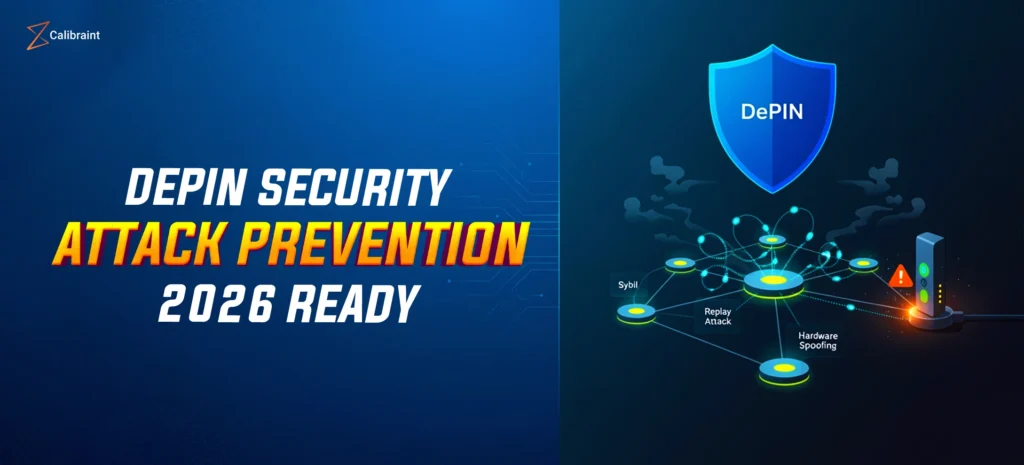
DePIN Development Security Checklist 2026: Building Institutional-Grade Decentralized Infrastructure
Calibraint
Author
February 5, 2026
Infrastructure remains the backbone of the global economy. As we approach 2026, the shift from centralized provider models to decentralized physical infrastructure networks (DePIN) represents one of the most significant capital transitions of this decade. For enterprises entering this space, successful DePIN development requires far more than connecting hardware to a blockchain ledger.
You are building a system where trust must exist without central oversight. This reality demands a rigorous, security-first mindset. Without it, network value erodes through increasingly sophisticated digital and physical exploits.
Today’s market makes one signal clear: investors and enterprise users prioritize reliability over token incentives. If your network cannot reliably distinguish between a genuine hardware node and a simulated bot, its economic foundation will collapse.
This DePIN Development Security Checklist for 2026 provides a strategic, executive-level framework to secure decentralized infrastructure against the most pressing threats of the coming year.
The Business Imperative of Hardware Integrity
When you use traditional cloud services, your security basically relies on how trustworthy that one big company is. But with a DePIN model, the actual physical work is spread out among lots of different people. While this democratic approach helps things grow really big, it also creates a huge number of places where security could be attacked.
The core challenge is deceptively simple: verifying that a node exists in the physical world and performs the work it claims to perform.
When physical reality is ignored, networks become vulnerable to Sybil attacks, where a single actor spins up thousands of fake identities to drain rewards and influence governance. Without a clear DePIN development security strategy, these synthetic nodes can quietly dominate the network, destroying both trust and utility.
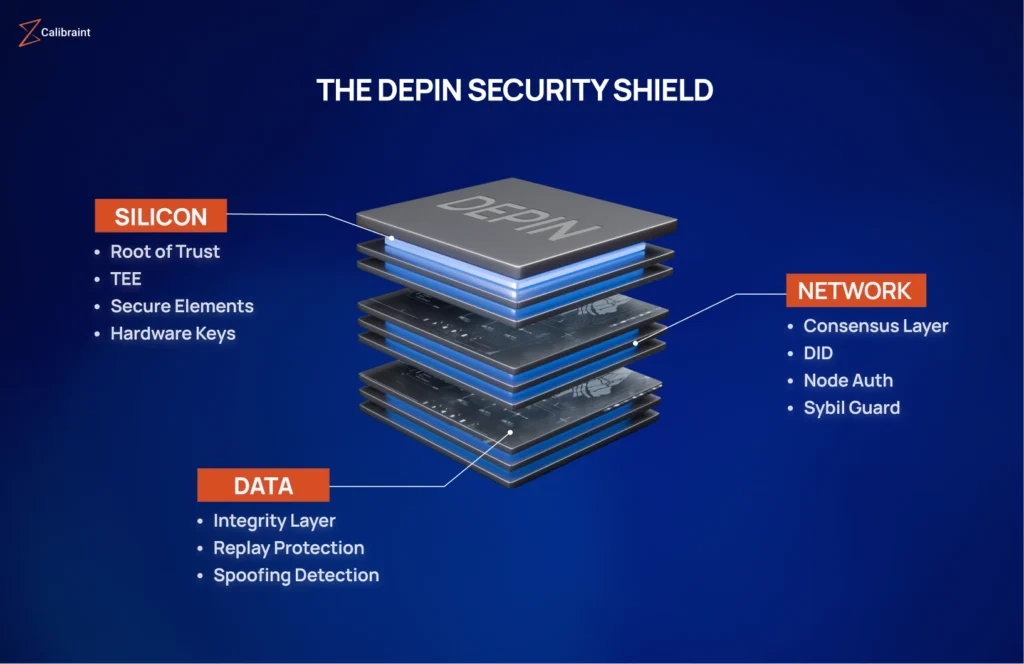
To secure distributed hardware against emerging threats, DePIN developers must implement a series of strategic safeguards. The first of these focuses on ensuring hardware integrity at the silicon level. Trusted execution environments (TEEs) in DePIN create a secure enclave within the processor, isolating sensitive code and data from the rest of the system.
By using TEE-based attestation, networks can verify that node data reflects genuine sensor output, free from operating system or user-level tampering. By 2026, this capability will no longer be a premium feature reserved for experimental projects. It is increasingly becoming a baseline expectation for serious DePIN networks.
Whether implemented via Intel SGX or ARM TrustZone, TEEs enable remote attestation of both hardware authenticity and runtime integrity. Even the node owner cannot manipulate protected data before it reaches the blockchain.
This establishes a verifiable chain of trust, from physical silicon to smart contract, while reducing reliance on expensive consensus mechanisms. Leading DePIN projects already use TEE-backed computation to secure decentralized AI workloads, mapping data, and private analytics. In practice, TEEs form the first line of defense against large-scale data manipulation.
Strategic Pillar 2: Sybil Attack Prevention
A Sybil attack is one of the most damaging and least visible threats to decentralized infrastructure. When identities are cheap to create, attackers can claim disproportionate rewards and quietly undermine governance.
Effective Sybil attack prevention in DePIN requires a layered approach that extends far beyond wallet or email verification. Hardware-bound staking is a foundational mechanism, requiring participants to lock value to a verified physical device rather than a disposable identity.
Advanced Sybil resistance strategies also rely on behavioral analysis. Nodes that operate in perfect synchronization or exhibit unnatural uptime patterns often signal scripted activity rather than genuine physical deployment. Integrating these heuristics into the DePIN development roadmap allows malicious clusters to be identified and pruned early.
Ultimately, robust Sybil attack prevention in DePIN ensures that the cost of an attack exceeds its potential reward, preserving both token economics and long-term network credibility.
Strategic Pillar 3: Hardware Spoofing Detection
Hardware spoofing occurs when software emulates physical equipment, tricking the network into paying rewards for work that never happened. Common examples include virtual machines simulating GPUs, sensors, or location-based devices.
Effective hardware spoofing detection on blockchain systems relies on proof-of-physical-work mechanisms. These require outputs that are difficult to fabricate but easy to verify, such as sensor readings signed with secure timestamps or cryptographic device keys.
Challenge–response protocols further strengthen spoofing resistance. By issuing unpredictable computational challenges and measuring response characteristics, networks can detect emulators that fail to match real hardware performance profiles.
By 2026, machine-learning–assisted hardware fingerprinting is expected to play a growing role, identifying deviations from known physical signatures and automatically disqualifying suspicious nodes from reward pools.
Strategic Pillar 4: Blockchain Identity Verification for Nodes
Every node in a DePIN network requires a unique, immutable identity tied to both hardware and ownership. Unlike social identities, these identifiers must be cryptographically verifiable and resistant to duplication.
Blockchain identity verification for nodes is best implemented using decentralized identifiers (DIDs). This model allows nodes to prove credentials without exposing sensitive operator data, creating accountability without sacrificing privacy.
DID-based identity systems also enable network-wide blacklisting of malicious actors and support reputation-based task allocation. Nodes with a long history of honest behavior can be trusted with higher-value workloads, reinforcing reliability through incentives.
Traditional login credentials are insufficient for physical infrastructure networks. Effective DePIN node authentication mechanisms combine what the node possesses (a hardware-bound key) with what it produces (verifiable physical output).
Periodic re-authentication is critical. Nodes should continuously prove identity throughout operation, preventing session hijacking and unauthorized access.
Advanced implementations also account for physical relocation or theft. If a node deviates from its registered operational parameters, authentication systems can trigger automatic lockouts. Emerging zero-knowledge proof models further allow nodes to verify authorization without revealing exact locations or private keys, an important consideration for enterprise adoption.
Strategic Pillar 6: Replay Attack Protection
Replay attacks occur when valid data is captured and resent to fraudulently claim multiple rewards. Without replay-attack protection in blockchain systems, network data quickly becomes unreliable.
Core defenses include nonces, timestamps, and sequential message validation. Each data packet must be unique and time-bound. More advanced protection chains sensor outputs together, making it cryptographically infeasible to insert old data into a live stream.
Low-latency verification layers are essential. By detecting replay attempts at the edge, before data reaches permanent storage, networks prevent ledger bloat and protect downstream consumers from corrupted datasets.
Hardware Attestation: Integrate TEEs or secure elements for cryptographic proof of node authenticity.
Anti-Spoofing Sensors: Cross-verify primary data using secondary inputs such as network clocks and GPS time.
Tiered Rewards: Require new nodes to establish trust before accessing full economic incentives.
Zero-Knowledge Proofs: Verify work and location without exposing sensitive operator information.
Firmware Audits: Conduct quarterly reviews of node firmware to eliminate backdoors.
Economic Penalties: Implement slashing mechanisms for provably malicious behavior.
Real-Time Monitoring: Use AI-driven analytics to detect Sybil patterns and replay attempts.
Operationalizing DePIN Security at Enterprise Scale
Security frameworks only create value when they are operationalized across real-world infrastructure. As DePIN networks move beyond pilot deployments, execution discipline becomes the differentiator between theoretical security and production-grade resilience.
Enterprise-scale DePIN development requires clearly defined security ownership across hardware provisioning, firmware lifecycle management, on-chain identity governance, and real-time monitoring. Fragmented responsibility often creates invisible gaps where spoofing, replay attacks, or identity abuse can emerge undetected.
A mature operating model treats security controls as continuously evolving systems. Hardware attestation policies must adapt to new silicon releases. Identity credentials require periodic rotation. Authentication thresholds should evolve based on node behavior, reputation, and historical integrity. These controls cannot remain static in a network designed to operate autonomously.
Equally critical is incident readiness. Decentralized infrastructure must support rapid isolation of compromised nodes without halting network operations. Automated slashing, credential revocation, and workload redistribution allow networks to respond to threats in minutes rather than days, preserving service continuity for enterprise consumers.
Build DePIN Infrastructure That Institutions Can Trust
As decentralized physical infrastructure matures, security will define which networks scale and which quietly fail. Enterprises entering DePIN cannot afford experimental architectures or retrofitted controls. Security must be embedded from silicon to smart contract from day one.
Calibraint partners with enterprises and Web3 innovators to design and deploy institutional-grade DePIN architectures, combining hardware attestation, identity systems, cryptographic verification, and blockchain-native security models. Our approach ensures a decentralized infrastructure that is resilient, auditable, and trusted by regulators, investors, and enterprise users alike.
If you are building or scaling a DePIN network in 2026, engage with us to design secure, future-proof decentralized infrastructure built for real-world scale.
FAQs
1. What technology forms the backbone for trust in DePINs?
Trust in DePINs is anchored in hardware-level verification, primarily through trusted execution environments (TEEs), cryptographic device identities, and on-chain attestation. These technologies create a verifiable link between physical hardware and blockchain records, ensuring that reported work reflects real-world activity.
2. How can enterprises secure DePIN networks against Sybil, replay, and hardware spoofing attacks in 2026?
Enterprises must apply a layered security model that combines hardware-bound staking, continuous node authentication, challenge–response protocols, and replay-attack protections such as nonces and time-bound data validation. Real-time behavioral monitoring further enables early detection and isolation of coordinated or simulated nodes.
3. What security layers should be included in a DePIN development checklist before launching decentralized infrastructure networks?
A robust DePIN development checklist should include hardware attestation, spoofing detection mechanisms, decentralized identity systems, secure node authentication, replay-attack protection, and real-time monitoring with economic penalties. Together, these layers ensure infrastructure integrity from physical hardware to smart contracts.
4. Which authentication and identity verification methods are most effective for protecting DePIN nodes from fake device participation?
The most effective methods combine hardware-bound cryptographic keys, decentralized identifiers (DIDs), periodic re-authentication, and behavior-based reputation scoring. This approach ensures each node maintains a unique, verifiable identity while preventing simulated or duplicated devices from participating in the network.
Calibraint
Author
February 5, 2026
Let's Start A Conversation
Manage Consent
To provide the best experiences, we use technologies like cookies to store and/or access device information. Consenting to these technologies will allow us to process data such as browsing behavior or unique IDs on this site. Not consenting or withdrawing consent, may adversely affect certain features and functions.
Functional
Always active
The technical storage or access is strictly necessary for the legitimate purpose of enabling the use of a specific service explicitly requested by the subscriber or user, or for the sole purpose of carrying out the transmission of a communication over an electronic communications network.
Preferences
The technical storage or access is necessary for the legitimate purpose of storing preferences that are not requested by the subscriber or user.
Statistics
The technical storage or access that is used exclusively for statistical purposes.The technical storage or access that is used exclusively for anonymous statistical purposes. Without a subpoena, voluntary compliance on the part of your Internet Service Provider, or additional records from a third party, information stored or retrieved for this purpose alone cannot usually be used to identify you.
Marketing
The technical storage or access is required to create user profiles to send advertising, or to track the user on a website or across several websites for similar marketing purposes.