DePIN vs. Centralized Infrastructure: Unlocking Potential in Smart Cities, Energy, and Industrial IoT
Calibraint
Author
March 23, 2026
The internet runs on trust. Trust that servers stay online. Trust that data remains intact. Trust that a vendor’s roadmap will still align with business priorities five years from now. For a long time, that trust was enough.
Then the physical world became intelligent, and the pressure began to show.
Smart cities now operate through thousands of simultaneous data streams. Industrial environments generate more sensor data in a single hour than legacy systems, which once processed in months. Energy grids are expected to respond in real time, adjusting to demand and supply within milliseconds. The centralized architecture that supported the last generation of enterprise infrastructure was not designed for this level of scale, speed, or complexity.
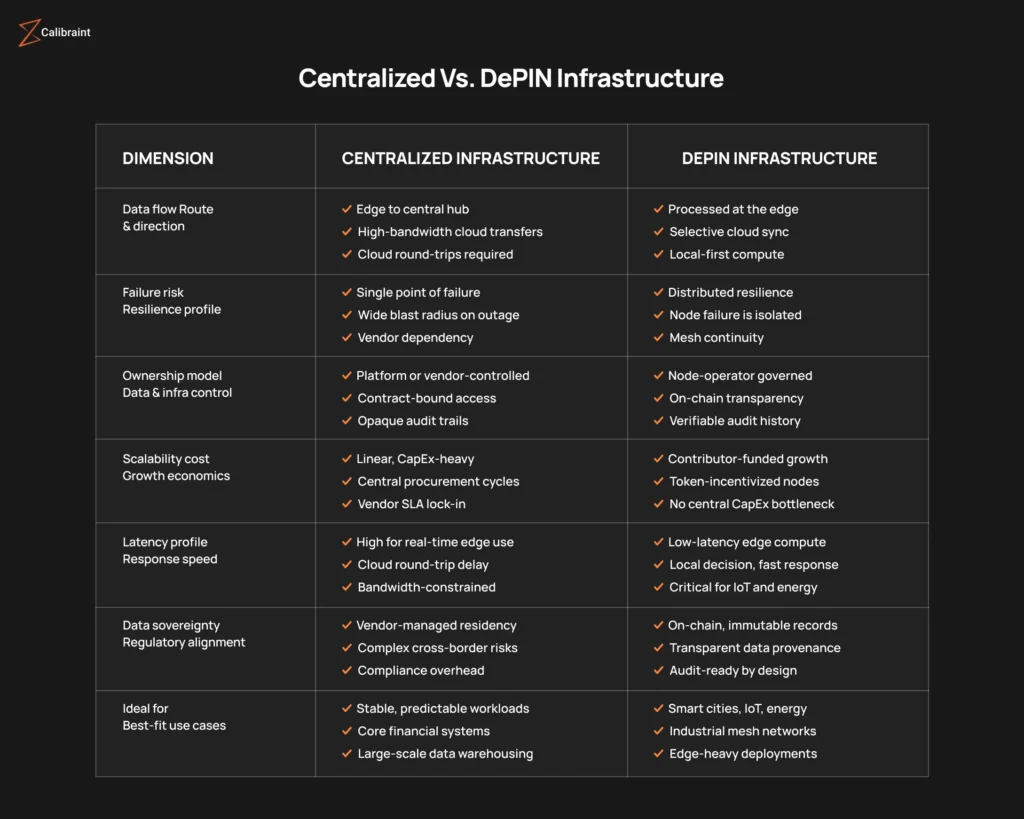
This is where DePIN development begins to take shape, not as a passing trend, but as a structural shift in how infrastructure is built, owned, and operated. When examining DePIN vs centralized infrastructure, the difference is not just technical. It is architectural, economic, and strategic.
Decentralized physical infrastructure networks redistribute compute, connectivity, and storage functions that were once concentrated in centralized cloud systems. What once lived in theory is now visible in active deployments across industries.
This blog explores where centralized infrastructure still fits and where DePIN infrastructure for smart cities and industrial systems delivers clear advantages over cloud models.
The Structural Weakness: Centralized Infrastructure Built In
Centralized cloud and infrastructure models were engineered for a different era of data volume, device density, and geographic distribution. They consolidated computing and storage into regional centers, a logical move when data production was limited and steady.
Smart cities generate data from thousands of concurrent sources: traffic sensors, air quality monitors, surveillance systems, utility meters, and emergency response nodes. Industrial IoT environments add machine telemetry, predictive maintenance signals, and supply chain tracking to that load. The result is a data architecture that centralized systems were simply not designed to handle at the edge, in real time, and at an acceptable cost.
The problems that surface are structural, not operational. When a centralized node fails, the ripple effect is wide. When data must travel from a city’s edge sensor to a distant cloud server and back before triggering a local response, the latency becomes a liability. In energy grid management, that latency is not just inefficient; it can be dangerous.
Understanding DePIN vs centralized infrastructure starts here. Centralized systems also create concentrated data ownership, which is increasingly incompatible with regulatory frameworks around data residency, privacy, and sovereignty. Blockchain infrastructure and smart city data ownership requirements are pulling in the opposite direction, toward distributed control and transparent audit trails.
What DePIN Actually Offers, Technically and Economically
DePIN infrastructure for smart cities is built on a different logic. Instead of routing everything through a central hub, it distributes the compute, storage, and connectivity functions across a network of physical nodes, many of them owned and operated by independent participants.
The economic model is unusual by enterprise standards. Infrastructure contributors earn token-based rewards for providing network capacity, which reduces the capital burden on the primary operator. The Helium Network built the world’s largest LoRaWAN network, powered entirely by individually owned hotspots, without deploying a single unit of hardware itself. The network’s coverage was built by individual operators motivated by token economics.
For industrial IoT decentralization, the benefits are more operational than economic. A decentralized sensor mesh can continue functioning even when individual nodes fail, because there is no single point of failure.
Data can be processed at the edge, reducing the bandwidth load on central servers and improving response time for time-sensitive applications. When the logic of “process here, report there” replaces “send everything, process centrally,” industrial operations become more resilient by design.
DePIN energy grid management Web3 applications take this further. Decentralized energy grids allow prosumers, those who both produce and consume energy, to transact peer-to-peer, feed surplus back to the grid, and participate in demand-response programs without intermediary overhead. Grid operators gain real-time visibility into load distribution without the capital cost of building centralized monitoring infrastructure.
Smart Cities and the Data Ownership Question
When a city deploys thousands of sensors across transit, utilities, and public services, who owns that data? Under centralized models, the answer is often the vendor. The city pays for infrastructure deployment, signs a long-term contract, and in effect transfers data custody to a third party.
Blockchain infrastructure and smart city data ownership frameworks change this arrangement. With on-chain data recording, every data point has a verifiable origin, a timestamp, and an immutable access history. City administrators can audit exactly what data was collected, when, and who accessed it. That level of transparency is increasingly a procurement requirement, not a bonus feature.
Barcelona’s DECODE project was funded by the European Union’s Horizon 2020 Programme. The initiative piloted decentralized blockchain infrastructure across Barcelona and Amsterdam between 2017 and 2019. Its core aim was to give citizens direct control over how their personal data was collected, accessed, and shared.
The lesson from both cities is consistent: the governance model matters as much as the technical architecture. Decentralization without clear governance creates different problems than centralization. DePIN networks that combine on-chain transparency with defined governance protocols offer a more durable path.
Industrial IoT and the Case for Decentralization
Manufacturing, logistics, and energy production environments have distinct requirements that most cloud-first IoT strategies underserve. Real-time machine monitoring, predictive maintenance, and supply chain visibility all depend on low-latency, high-reliability data flows.
The debate around DePIN vs centralized infrastructure becomes most tangible here. Industrial IoT decentralization addresses a problem that cloud platforms have consistently struggled with: the last-mile reliability gap. In a factory floor or an offshore energy installation, connectivity to a central cloud server is not guaranteed. When it fails, a centralized IoT architecture fails with it. A decentralized mesh network, with local compute nodes, continues operating in isolation and syncs when connectivity returns.
The energy sector is one of the most consequential testing grounds for DePIN vs centralized infrastructure. The traditional grid model was built for predictable, one-directional power flow, with centralized generation pushing outward through transmission and distribution networks. Renewable energy integration has made that model increasingly difficult to manage.
Solar and wind generation is intermittent and geographically distributed. Batteries and electric vehicles add bidirectional complexity. The grid needs to become intelligent and adaptive, not just larger.
DePIN energy grid management Web3 models address this by enabling decentralized coordination. Smart contracts can automatically balance supply and demand across thousands of nodes. Prosumers, those who both produce and consume energy, can sell surplus directly to neighbors without utility intermediaries. Blockchain records every transaction on an immutable ledger, making energy flows transparent and auditable in real time.
Decentralized systems using smart contracts can share excess solar energy with the grid automatically, reducing administrative overhead and eliminating manual settlement. This is not a theoretical model. Active deployments across energy networks already show that tokenized incentives and on-chain coordination can replace the centralized overhead traditional grid management depends on.
Making the Strategic Decision
The question enterprises and city planners face is not whether to adopt DePIN development but where it creates disproportionate value relative to existing infrastructure. The real conversation is about DePIN vs centralized infrastructure at the use-case level.
Centralized infrastructure continues to make sense for workloads that are predictable, compliance-heavy in traditional ways, and do not require real-time edge processing. Core financial systems, large-scale data warehousing, and applications where latency is not critical remain well-served by cloud platforms.
DePIN infrastructure for smart cities, energy networks, and industrial IoT earns its place where scale is uncertain, where edge processing matters, where data sovereignty is a priority, and where contributor economics can reduce capital requirements. The decision is not either/or. Most mature implementations run hybrid architectures with centralized governance and decentralized execution.
The organizations that move thoughtfully now will have infrastructure that scales with device density and data volume without proportional cost increases. Those who delay will face increasingly expensive retrofitting as regulatory requirements around data sovereignty tighten.
If your organization is evaluating where decentralized infrastructure fits within your current or planned architecture, Calibraint brings the technical depth and strategic clarity to help you build the right model. Explore your use case today!
FAQs
1. What is DePIN, and how does it work in smart cities?
DePIN stands for Decentralized Physical Infrastructure Networks. Instead of routing city data through a central server, it distributes compute, storage, and connectivity across independent physical nodes. In smart cities, this means sensors, traffic systems, and utility meters process data locally and sync selectively, reducing latency and returning data ownership to the municipality.
2. Is DePIN better than centralized cloud infrastructure for energy grids?
For modern energy grids managing renewable inputs and bidirectional power flows, DePIN performs better. Smart contracts automate supply and demand balancing across nodes in real time. Centralized cloud infrastructure introduces latency and single points of failure that distributed energy environments cannot afford.
3. What are the risks of decentralized infrastructure in industrial IoT?
The primary risks are governance gaps, token volatility affecting node operator participation, and integration complexity with legacy systems. Without defined governance protocols, decentralization can introduce coordination failures. Security across a distributed node network also requires more rigorous design than a centralized architecture.
4. Which DePIN projects are used in real-world energy management?
The Helium Network demonstrated large-scale contributor-funded connectivity infrastructure. The EU-funded DECODE project piloted decentralized data governance across Barcelona and Amsterdam. Several blockchain-based energy platforms have demonstrated peer-to-peer energy trading at the community scale across multiple countries.
5. How does DePIN reduce infrastructure costs for municipalities?
DePIN shifts the capital burden from the municipality to network node operators who are incentivized through token rewards. Cities avoid large upfront hardware procurement, vendor lock-in, and long-term cloud contracts. Costs scale with actual usage rather than pre-committed capacity.
Calibraint
Author
March 23, 2026
Let's Start A Conversation
Manage Consent
To provide the best experiences, we use technologies like cookies to store and/or access device information. Consenting to these technologies will allow us to process data such as browsing behavior or unique IDs on this site. Not consenting or withdrawing consent, may adversely affect certain features and functions.
Functional
Always active
The technical storage or access is strictly necessary for the legitimate purpose of enabling the use of a specific service explicitly requested by the subscriber or user, or for the sole purpose of carrying out the transmission of a communication over an electronic communications network.
Preferences
The technical storage or access is necessary for the legitimate purpose of storing preferences that are not requested by the subscriber or user.
Statistics
The technical storage or access that is used exclusively for statistical purposes.The technical storage or access that is used exclusively for anonymous statistical purposes. Without a subpoena, voluntary compliance on the part of your Internet Service Provider, or additional records from a third party, information stored or retrieved for this purpose alone cannot usually be used to identify you.
Marketing
The technical storage or access is required to create user profiles to send advertising, or to track the user on a website or across several websites for similar marketing purposes.