In the rapidly maturing landscape of digital finance, deciding on DEX vs CEX for enterprises is no longer a peripheral IT choice but a foundational governance decision. For example, a global fintech might opt for a CEX to leverage “plug-and-play” KYC and the deep, institutional order books of high liquidity crypto exchanges to ensure rapid fiat-to-crypto on-ramps. Conversely, a sophisticated Web3 treasury or an asset-management firm might engage a specialized DEX Development Company to build a bespoke protocol, specifically to eliminate the “honeypot” risks and counterparty vulnerabilities inherent in third-party custody.
This strategic choice is driven by urgent boardroom priorities: managing custodial asset exposure, navigating shifting global regulations, and mitigating the constant threat of infrastructure breaches. As we move through 2025, enterprises must balance the operational convenience of centralized systems against the sovereign resilience of decentralization to ensure their digital asset strategy is both scalable and secure.
1. Core Differences Between DEX and CEX Architectures
Understanding the underlying “DNA” of these platforms is the first step in determining which model aligns with your business goals. The DEX vs CEX for enterprises debate centers on the tension between control and convenience.
Custody and Security Posture
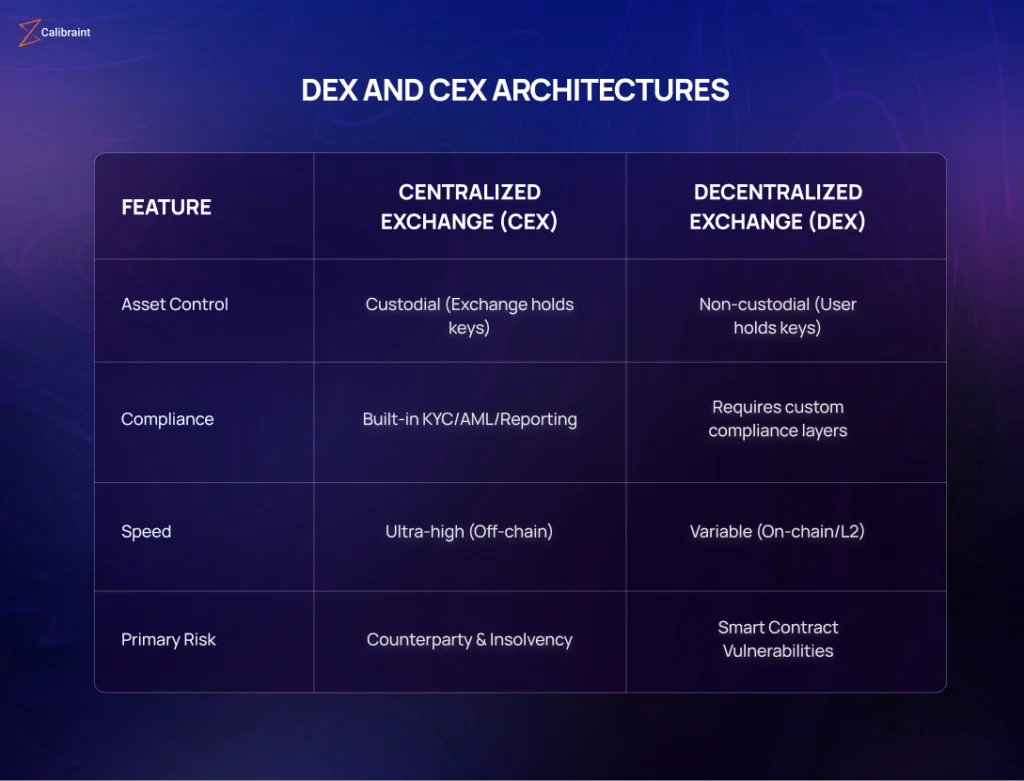
In a centralized exchange infrastructure, the platform acts as a digital bailee. They manage the private keys and pool assets in a mix of hot and cold storage. While this offers “Web2-style” convenience such as password recovery and institutional insurance, it creates a single point of failure. If the exchange is compromised or becomes insolvent, your assets are at risk.
In contrast, non custodial trading platforms (DEXs) leverage decentralized exchange development to ensure the enterprise keeps 100% ownership of its private keys. Assets move only when pre-authenticated smart contracts are triggered. This “trustless” model radically shrinks the attack surface and prevents your holdings from being commingled with the exchange’s own liabilities.
Execution Mechanisms and Liquidity
CEXs utilize off-chain matching engines that provide the sub-millisecond latency required for high-frequency trading. They are the traditional choice for high liquidity crypto exchanges, aggregating massive volumes from global retail and institutional market makers to ensure tight spreads.
DEXs settle every transaction directly on the blockchain. While older models were slower, modern decentralized exchange development utilizes Layer-2 scaling and concentrated liquidity protocols (like Uniswap V4) to rival traditional speeds. However, liquidity can remain siloed across different chains unless your architecture includes sophisticated cross-chain aggregation.
Comparison Overview
Looking to build a secure and scalable exchange? Explore our enterprise-ready DEX development solutions.
2. Enterprise Decision-Making Framework: DEX vs CEX
When evaluating DEX vs CEX for enterprises, decision-makers must look beyond the “crypto-native” hype and focus on institutional-grade requirements.
The Five-Pillar Evaluation Matrix
Regulatory & KYC Readiness: If your jurisdiction demands strict “Travel Rule” compliance and identity verification for every swap, a CEX offers a shorter path to market. However, with modern decentralized exchange development, you can now integrate permissioned pools that only allow KYC-verified wallets to interact.
Liquidity Expectations: For large-block trades, high liquidity crypto exchanges are essential to minimize slippage. CEXs lead here, but enterprises can bridge the gap by developing DEX aggregators that pull liquidity from multiple on-chain sources.
Security Responsibility: Are you prepared to manage your own private keys (MPC, hardware modules)? If yes, non custodial trading platforms offer the highest level of security. If you prefer to outsource that risk to a regulated entity with insurance, a centralized exchange infrastructure is the standard.
Operational Overhead: CEXs require massive teams for customer support and manual compliance. A DEX automates these functions through code, potentially lowering long-term OpEx. To ensure success, follow enterprise DEX development best practices to maintain operational efficiency.
Integration & Interoperability: Consider how the exchange fits into your existing ERP or banking software. CEXs offer polished APIs, while DEXs offer “composability”—the ability to plug directly into other DeFi protocols for lending, staking, or hedging.
3. Business Benefits of Choosing the Right Model
Aligning your architecture with your business goals unlocks specific competitive advantages:
Reduced Counterparty Risk: By utilizing a DEX, enterprises are immune to the “insolvency contagion” that has historically plagued centralized platforms. Your assets remain in your wallet, not on an exchange’s balance sheet.
Operational Resilience: A DEX has no central server to go down. The exchange lives on the blockchain, ensuring 24/7 uptime and global accessibility without geographical restrictions.
Enhanced Transparency: For audited entities, a DEX provides a verifiable, immutable ledger of every trade. This “on-chain proof” simplifies reporting and builds trust with stakeholders.
Access to New Markets: CEXs are often limited to specific jurisdictions. A DEX allows enterprises to tap into the global DeFi ecosystem, accessing niche tokens and yield-generating protocols that aren’t available on centralized rails.
4. Industry Use Cases Across Enterprise Segments
The choice of DEX vs CEX for enterprises manifests differently across sectors:
Financial Institutions: Banks often prefer a “Hybrid” model using centralized exchange infrastructure for front-end customer interaction while utilizing non custodial trading platforms for back-end settlement to reduce their own balance sheet risk.
Web3 Foundations: These organizations almost exclusively use DEXs for treasury management and token buy-backs to remain philosophically aligned with decentralization and avoid custodial lock-in.
Supply Chain & Tokenized Assets: Companies dealing in Real-World Assets (RWA) use DEXs to allow peer-to-peer trading of tokenized property or commodities, ensuring that the “asset” and the “payment” swap simultaneously without a middleman.
5. Risks of Choosing the Wrong Architecture
A mismatch between your business needs and your exchange model can lead to catastrophic failure:
Inadequate Decentralized Exchange Development: Poorly written smart contracts are the #1 cause of DEX exploits. Without rigorous audits, your “secure” DEX could be drained in minutes.
Weak Centralized Exchange Infrastructure: Relying on a CEX with opaque reserves or poor internal controls exposes you to total asset loss if the operator goes bankrupt.
Liquidity Shortages: If you build a DEX without a strategy for high liquidity crypto exchanges, your users will suffer from massive slippage, making the platform unusable for institutional-sized orders.
Regulatory Non-Compliance: Launching a non-custodial platform in a highly regulated market without “Permissioned” features can lead to immediate legal cease-and-desist orders.
6. Recommended Enterprise Architecture Blueprint
For enterprises looking to build for the future, we recommend a “Compliance-First” decentralized architecture. This blueprint combines the security of a DEX with the rigors of corporate governance:
The Identity Layer: A KYC/AML “gate” that whitelists only approved institutional participants before they can interact with liquidity pools.
The Smart Contract Core: Audited, upgradable contracts using industry standards (like OpenZeppelin) to ensure long-term agility.
Liquidity Aggregation: Integration with multi-chain aggregators to ensure deep order books and “Best Execution” for users.
Key Management: Implementation of MPC (Multi-Party Computation) or multi-sig wallets to secure keys internally while maintaining a non-custodial stance.
Interoperability Layer: Cross-chain bridges to allow seamless asset movement across Ethereum, Layer-2s, and private subnets.
Strategic Conclusion: Why the Decision Matters
Ultimately, the debate over DEX vs CEX for enterprises isn’t about which technology is “better”, it’s about which risk profile your organization is prepared to manage. A CEX offers a familiar, regulated environment at the cost of asset control. A DEX offers absolute sovereignty and transparency but demands higher technical responsibility.
At Calibraint, we specialize in bridging this gap. As a leading DEX Development Company, we don’t just write code; we architect strategic financial ecosystems. Whether you need enterprise-grade decentralized exchange development, a robust non custodial trading platform, or a custom integration for high liquidity crypto exchanges, we deliver solutions that are secure, compliant, and ready for the future of finance.
Would you like me to create a technical comparison table for your team to help evaluate specific DEX protocols against CEX APIs?
FAQ
1. What is the difference between a DEX and a CEX?
The main difference is ownership. On a Centralized Exchange (CEX) like Binance or Coinbase, the company holds your funds and manages your “private keys.” It feels like using a banking app. On a Decentralized Exchange (DEX) like Uniswap or Raydium, there is no middleman. You trade directly from your own digital wallet using smart contracts on the blockchain.
2. Which is more secure: DEX or CEX?
A DEX is generally more secure against massive platform failures. Since you hold your own keys, your funds cannot be frozen or lost if the exchange goes bankrupt (the “Not your keys, not your coins” rule). However, you are responsible for your own wallet security.
A CEX is safer for beginners who might lose their passwords, as they offer customer support and account recovery. However, CEXs are “centralized targets” for hackers and carry the risk of internal mismanagement.
3. Which is better for liquidity: DEX or CEX?
CEXs are superior for liquidity. Because they aggregate millions of users and professional market makers into a single order book, you can execute large trades instantly with almost no “slippage” (price change).
While DEX liquidity has grown significantly in 2025, especially on networks like Solana and Layer-2s trading large amounts of niche or rare tokens on a DEX can still result in higher costs and volatile price swings.
Calibraint
Author
December 17, 2025
Last updated: December 18, 2025
Let's Start A Conversation
Manage Consent
To provide the best experiences, we use technologies like cookies to store and/or access device information. Consenting to these technologies will allow us to process data such as browsing behavior or unique IDs on this site. Not consenting or withdrawing consent, may adversely affect certain features and functions.
Functional
Always active
The technical storage or access is strictly necessary for the legitimate purpose of enabling the use of a specific service explicitly requested by the subscriber or user, or for the sole purpose of carrying out the transmission of a communication over an electronic communications network.
Preferences
The technical storage or access is necessary for the legitimate purpose of storing preferences that are not requested by the subscriber or user.
Statistics
The technical storage or access that is used exclusively for statistical purposes.The technical storage or access that is used exclusively for anonymous statistical purposes. Without a subpoena, voluntary compliance on the part of your Internet Service Provider, or additional records from a third party, information stored or retrieved for this purpose alone cannot usually be used to identify you.
Marketing
The technical storage or access is required to create user profiles to send advertising, or to track the user on a website or across several websites for similar marketing purposes.