Struggling with Legacy Systems? How AI Enables Modern Digital Transformation
Calibraint
Author
March 30, 2026
Introduction
CTOs and CIOs across enterprise organizations share a frustratingly familiar story: legacy systems are slowly strangling organizational growth. Aging infrastructure consumes 60-80% of IT budgets year after year, while business velocity remains stuck in neutral. The cruel irony? Ripping out these systems feels like corporate suicide too risky, too expensive, too disruptive.
Here’s the reality: digital transformation with AI isn’t a trendy buzzword anymore. It’s literally how modern enterprises survive. The companies winning in their markets have figured out something critical: digital transformation with AI isn’t just about modernizing code, it’s about becoming fundamentally different competitors. Right now, forward-thinking enterprises are turning to AI service solutions that intelligently bridge the gap between yesterday’s infrastructure and tomorrow’s capabilities.
The real question isn’t whether to modernize. It’s how to do it without disrupting operations or destroying what already works.
The Legacy System Trap: Why Your Enterprise Is Stuck
Legacy systems feel like quicksand. The longer organizations stay in them, the harder they pull down.
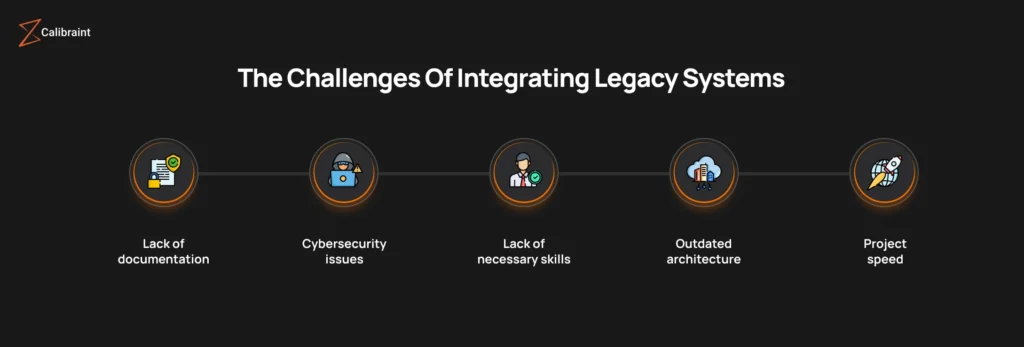
Enterprise infrastructure often runs on systems someone built 10, 15, maybe 20 years ago. The original architects have long departed. Documentation is fragmented at best, nonexistent at worst. Patches have been piled on patches, and now a feature that should take weeks takes quarters. Scaling to new markets becomes impossible, infrastructure wasn’t designed for it. Security holes appear faster than teams can seal them, creating genuine risk.
The real cost of legacy systems goes way beyond maintenance bills. Consider what’s actually happening in organizations across industries:
Operational Drag: Development teams are stuck in slow-motion. Monolithic systems lock everyone into endless release cycles. A simple feature request becomes a months-long odyssey. The best engineers get frustrated and leave. Organizations end up hiring juniors who don’t know better, trying to maintain systems that shouldn’t exist anymore.
Scalability Nightmares: Peak demand hits, and infrastructure chokes. Systems can’t scale because they weren’t designed for it. Expanding internationally means rebuilding half the core infrastructure. It’s a nightmare nobody wants to face.
Security Debt Piling Up: Legacy stacks can’t integrate with modern security frameworks. Compliance audits turn into exercises in creative explanation. Organizations are living on borrowed time until a breach happens and it will.
Talent Exodus: Engineers don’t want careers buried in 20-year-old code. The talented ones leave. Organizations end up recruiting people who don’t have better options. Team morale tanks. Productivity suffers.
Hidden Costs Nobody Talks About: Workarounds. Custom integrations. Band-aid solutions stacked on top of each other. Every month, money gets spent on infrastructure that shouldn’t exist, temporary fixes that become permanent, tech debt that compounds relentlessly.
The painful truth? Organizations already know these systems are anchoring them down. The idea of migrating legacy systems using AI used to seem impossible. But it’s not anymore.
The Role of AI in Digital Transformation: Your Transformation Engine
Digital transformation with AI changes the modernization equation entirely. Instead of rip-and-replace, AI becomes your strategic bridge.
Here’s what makes this different:
Intelligent Data Migration: AI-powered tools analyze your legacy systems in ways humans can’t. They identify data dependencies, flag corruption, and plan migration paths that minimize risk. Instead of months of manual analysis, you get days.
Automated Workflow Optimization: AI doesn’t just move old code to new infrastructure, it learns how you actually operate. AI in digital transformation reveals inefficiencies invisible to human analysis. It suggests process redesigns, identifies automation opportunities, and recommends system reconfigurations based on real usage patterns.
Seamless Legacy Integration: You don’t have to choose between old and new. Digital transformation with AI enables hybrid architectures where legacy systems work alongside modern cloud infrastructure. AI acts as the intelligent translator, managing data flow and API integration automatically.
Predictive Risk Management: Machine learning models predict where modernization will create bottlenecks. You can allocate resources strategically instead of firefighting problems as they emerge.
Real-Time Decision Support:
AI surfaces actionable insights about system performance, usage patterns, and infrastructure strain enabling your team to make informed modernization decisions backed by data, not guesswork.
This isn’t about replacing human judgment. It’s about augmenting it. Your architects and engineers are freed from manual grunt work and can focus on strategy.
Why Enterprises Are Turning to AI for Legacy Modernization
Organizations running digital transformation at major enterprises face a brutal squeeze: innovate faster, reduce operational risk, control costs. Legacy systems make all three impossible simultaneously.
But the business case for AI-driven transformation? It’s actually compelling:
Speed to Market: How AI helps modernize legacy systems by compressing modernization timelines from years to months. Companies report 40-60% faster deployment when leveraging AI for system analysis and migration planning.
Cost Control: Traditional legacy system modernization can consume 15-25% of annual IT budgets. Digital transformation with AI reduces this by automating the most expensive phase discovery and planning.
Competitive Pressure: Your competitors aren’t waiting. Every quarter you delay, they gain ground. Cloud-native competitors move 3-5x faster than enterprises still bound to legacy infrastructure.
Scalability Without Chaos: AI for business automation means you can expand into new markets, new products, and new customer segments without rebuilding your entire technology foundation from scratch.
Risk Mitigation: Real examples of AI in digital transformation show that companies using AI-guided migration strategies experience 70% fewer post-migration incidents than traditional approaches.
The narrative has shifted. It’s no longer ‘Should we modernize?’ It’s ‘Can we afford not to?’
AI Workflow Automation: From Legacy Processes to Intelligent Operations
AI in digital transformation doesn’t stop at migration. It fundamentally changes how your organization operates.
Process Automation Layers:
The first layer is simple automation replacing manual data entry, scheduling, and routine tasks. AI tools learn your process rules and execute them at scale. Document processing, invoice handling, customer onboarding all become self-executing.
The second layer is intelligent optimization. AI doesn’t just follow your current processes; it rewires them. It identifies where you have unnecessary steps, redundant approvals, and inefficient handoffs. It suggests better sequences and flags exceptions that need human judgment.
The third layer is continuous improvement. Legacy systems become static. AI systems evolve. Machine learning models improve as they process more data. Your operations become smarter automatically every month, every quarter.
Integration with Legacy Infrastructure: The beauty of migrating legacy systems using AI is that you don’t need to choose between stability and innovation. AI middleware connects legacy databases with modern applications. It translates between incompatible systems. It handles the messy reality of enterprise environments where old and new coexist.
This is how global banks modernize without shutting down. How insurance companies scale without replacing core platforms that process trillions in transactions annually.
Real Examples of AI in Digital Transformation Across Industries
The business case becomes real when you see what’s actually possible.
Financial Services: A Fortune 100 bank faced a seven-year modernization project for core transaction processing. Seven years. That’s a generation in tech. With AI-guided modernization, they finished in three years. The AI analyzed codebases, identified refactoring opportunities, and automated massive work volumes. Result? 65% less manual work. But here’s the business impact—they launched new products 18 months earlier than planned. In banking, being first to market with new services matters. They captured market share competitors completely missed.
Healthcare Systems: A major health network had 47 fragmented legacy systems. Patient records over here, supply chain over there, billing elsewhere. Data was trapped in silos. Patients couldn’t get integrated care because information wasn’t accessible across networks. Traditional data mapping and ETL processes would have taken years. With AI-powered automation for data mapping and ETL, they completed it in 8 months. Now data flows across the entire network. Patient care improved measurably because doctors actually have access to complete information.
Retail & E-Commerce: An enterprise retailer had separate legacy systems for inventory, pricing, and customer data. Responding to market changes quickly was impossible. Competitors dropped prices? By the time inventory was analyzed and pricing adjusted, the moment was gone. Digital transformation with AI gave them real-time inventory visibility and dynamic pricing. Within 12 months, margins increased by 2.3% and overstock reduced by 40%. That’s real money.
Manufacturing: A global manufacturer with 30-year-old production management systems couldn’t track quality or efficiency across facilities. Factories on three continents had fragmented data. How AI helps modernize legacy systems means deploying ML models that analyze production data in real-time across all facilities. Now bottlenecks appear immediately. Result: 25% reduction in defect rates and $12M in annual waste elimination.
These aren’t theoretical success stories. They’re happening right now. Real examples of AI in digital transformation prove that modernization with AI isn’t riskier, it’s smarter.
The Business Benefits: ROI-Driven Outcomes Your Board Will Approve
Enterprise decision-makers care about outcomes, not technologies. Here’s what digital transformation with AI actually delivers:
Financial Impact:
30-40% reduction in IT operational costs within 18 months50-70% faster feature deployment reducing time-to-revenue2-3 year faster ROI compared to traditional modernization approaches
Operational Excellence:
60-80% reduction in system downtime and incidents90%+ automation of routine administrative tasksImproved system performance and scalability supporting 10x growth
Strategic Advantages:
Ability to pivot rapidly as market conditions changeData-driven decision-making replacing historical guessworkTalent retention—engineers want to work on modern systemsCompliance and security posture that actually keeps pace with threats
These benefits compound. Year one you get faster deployments. Year two you have cost savings to invest in innovation. Year three you’re competing in ways your legacy-bound competitors can’t match.
Conclusion: Your Transformation Starts Now
Legacy systems are no longer a technical problem to solve ‘someday.’ They’re a strategic threat you must address now. Every quarter you delay costs you millions in opportunity cost and competitive ground.
Digital transformation with AI is the proven path forward. It’s not theoretical anymore enterprises across every industry are successfully modernizing while maintaining stability, controlling risk, and dramatically improving speed.
The executives who move first will own their markets. The ones who wait will struggle to catch up.
At Calibraint, we’ve guided enterprise teams through complex digital transformation journeys. We understand the specific challenges CTOs and CIOs face—the pressure to innovate while maintaining stability, the need to control costs while upgrading infrastructure, the requirement to move fast while managing risk.
We partner with your team to build a transformation roadmap that’s tailored to your business, your constraints, and your strategic priorities. We’ve helped organizations reduce modernization timelines by 50%, cut costs by 40%, and achieve measurable business impact within 12 months.
Your legacy systems don’t have to define your future. Let’s build your path to modern, scalable, intelligent infrastructure.
What are legacy systems and why are they a problem?
Legacy systems are older, outdated software applications and infrastructure that organizations continue to rely on despite their age. They’re problematic because they consume disproportionate IT resources, limit scalability, create security vulnerabilities, make it difficult to integrate new technologies, and prevent rapid innovation. Digital transformation requires addressing these systems head-on rather than continuously patching them.
How does AI help modernize legacy systems?
AI accelerates every phase of modernization discovery, planning, migration, and optimization. Machine learning algorithms analyze code complexity, identify data dependencies, predict migration risks, automate code refactoring, and optimize workflow processes. Instead of manual analysis taking months, AI provides insights in days. This reduces both the cost and timeline of digital transformation with AI.
What are the benefits of AI in digital transformation?
The primary benefits include 30-40% reduction in IT costs, 50-70% faster deployment cycles, 60-80% fewer system incidents, improved security and compliance posture, and the ability to scale operations exponentially. Organizations also experience faster time-to-market for new products and improved ability to attract and retain engineering talent. Digital transformation powered by AI delivers these benefits 2-3 years faster than traditional approaches.
Can AI replace legacy systems completely?
AI doesn’t replace legacy systems—it enables smart modernization. Some legacy systems warrant complete replacement; others can be incrementally refactored or wrapped with modern interfaces. AI helps you determine the optimal path for each system. The goal of AI for business automation is to preserve what works while eliminating what doesn’t, creating a hybrid architecture that balances stability with innovation.
What industries benefit most from AI-driven digital transformation?
Every industry benefits, but financial services, healthcare, manufacturing, retail, and telecommunications see the most dramatic ROI. These sectors rely heavily on complex legacy systems managing critical operations. However, any enterprise with aging infrastructure regardless of industry can leverage real examples of AI in digital transformation to modernize faster, cheaper, and with lower risk than traditional approaches.
Calibraint
Author
March 30, 2026
Let's Start A Conversation
Manage Consent
To provide the best experiences, we use technologies like cookies to store and/or access device information. Consenting to these technologies will allow us to process data such as browsing behavior or unique IDs on this site. Not consenting or withdrawing consent, may adversely affect certain features and functions.
Functional
Always active
The technical storage or access is strictly necessary for the legitimate purpose of enabling the use of a specific service explicitly requested by the subscriber or user, or for the sole purpose of carrying out the transmission of a communication over an electronic communications network.
Preferences
The technical storage or access is necessary for the legitimate purpose of storing preferences that are not requested by the subscriber or user.
Statistics
The technical storage or access that is used exclusively for statistical purposes.The technical storage or access that is used exclusively for anonymous statistical purposes. Without a subpoena, voluntary compliance on the part of your Internet Service Provider, or additional records from a third party, information stored or retrieved for this purpose alone cannot usually be used to identify you.
Marketing
The technical storage or access is required to create user profiles to send advertising, or to track the user on a website or across several websites for similar marketing purposes.