Enterprise AI ROI in Finance & Healthcare: Metrics, Benchmarks, and Proof Framework
Calibraint
Author
March 9, 2026
Every board wants the same answer: what did AI actually return? They want to know what happened in production, beyond the theory and beyond the pilot.
The pressure is real. IDC forecasts that global enterprise investment in AI development will exceed $300 billion by 2026, highlighting rapid adoption across sectors, including financial services and healthcare. Yet a persistent gap remains between organizations deploying AI and those that confidently measure its value.
This is a measurement problem, not a technology problem.
Enterprise AI ROI in finance and healthcare requires more than tracking cost savings on a spreadsheet. It demands a structured proof framework, one that connects the right metrics to the right business outcomes and tells a coherent story to every stakeholder who needs to hear it.
This guide breaks down the benchmarks that matter, the measurement traps to avoid, and the framework that transforms AI initiatives from promising experiments into defensible business decisions.
Why Standard ROI Formulas Fall Short for Enterprise AI
The traditional return on investment formula is clean and simple: (net gain minus cost) divided by cost. It works well for capital expenditure on equipment, real estate, and even software licenses. Enterprise AI is different.
AI systems do not deliver value at a fixed point. They improve over time. They create compounding returns as data volumes grow and models refine. A fraud detection model deployed in a financial services firm in month one will likely outperform itself by month twelve, with no additional capital outlay.
Healthcare presents a further complexity. The ROI of AI-assisted diagnostics cannot be measured purely in cost reduction. It must account for patient throughput, reduction in diagnostic error rates, physician time reclaimed, and, in some regulatory environments, liability exposure reduced.
Organizations that define their AI proof of value framework before deployment consistently report 2x higher confidence in their ROI figures.
The measurement problem compounds when organizations apply the wrong baseline. Comparing AI-assisted performance to a legacy manual process without controlling for volume growth, regulatory changes, or workforce shifts produces figures that neither support continued investment nor guide future decisions.
Measuring return on investment for enterprise AI requires a dedicated framework, not a borrowed one.
AI ROI Metrics for Financial Services: What to Track and Why
Financial services organizations deploying AI across credit decisioning, fraud management, customer experience, and back-office automation operate in one of the most data-rich environments available. The challenge is selection, not scarcity.
The AI ROImetrics for financial services that matter most fall into three categories.
Operational efficiency metrics measure the direct cost impact of AI on transaction processing, document review, reconciliation, and compliance workflows. McKinsey reports that companies using AI for trade finance document processing have seen average time savings of 60 to 70%
Revenue impact metrics capture the commercial upside. AI-driven personalization in retail banking has demonstrated 15 to 20 percent improvement in product acceptance rates in controlled deployments, with leading institutions attributing incremental revenue in the hundreds of millions annually to recommendation engines trained on transaction behaviour.
Risk and compliance metrics often carry the greatest weight at the board level. Institutions that have deployed AI in their anti-money laundering workflows report reductions in false positives ranging from 40 to 60 percent, dramatically reducing analyst workload and regulatory exposure simultaneously.
The enterprise AI ROI in the finance and healthcare context requires that financial services teams also measure avoided cost, that is, losses prevented, fines avoided, and capital not required. These figures rarely appear in traditional ROI calculations but represent some of the most significant returns AI delivers.
Healthcare AI ROI Benchmarks: Clinical, Operational, and Financial
Healthcare AI ROI benchmarks span a more complex value chain than financial services. A single AI initiative can touch patient outcomes, clinician efficiency, administrative throughput, and payer relationships simultaneously, each with its own stakeholder, its own reporting cadence, and its own definition of success.
Clinical efficiency metrics form the foundation. AI-assisted radiology workflows have demonstrated radiologist reading time reductions of 30 to 50 percent on specific modalities, without compromise to diagnostic accuracy. In pathology, AI-augmented review has been shown to improve throughput by as much as 40 percent in high-volume screening programmes.
Operational metrics focus on the administrative burden that consumes a disproportionate share of healthcare budgets. AI-powered clinical documentation tools, including ambient voice technology and natural language processing applied to EHR workflows, are recovering an average of 90 minutes per physician per day in US health systems, according to Nuance and published health system reports. At scale, this is not a marginal gain.
Healthcare systems that track AI ROI across clinical, operational, and financial dimensions simultaneously report the strongest business cases for continued investment.
Financial return in healthcare AI is most visible in denial management and revenue cycle optimization. AI models trained on payer behaviour, claim patterns, and coding accuracy are reducing claim denial rates by 20 to 35 percent in health systems that have moved beyond pilot deployment.
The healthcare AI ROI benchmarks that carry the most weight in board-level conversations combine clinical quality improvements with direct financial outcomes. Presenting one without the other understates the full value of enterprise AI development investments in this sector.
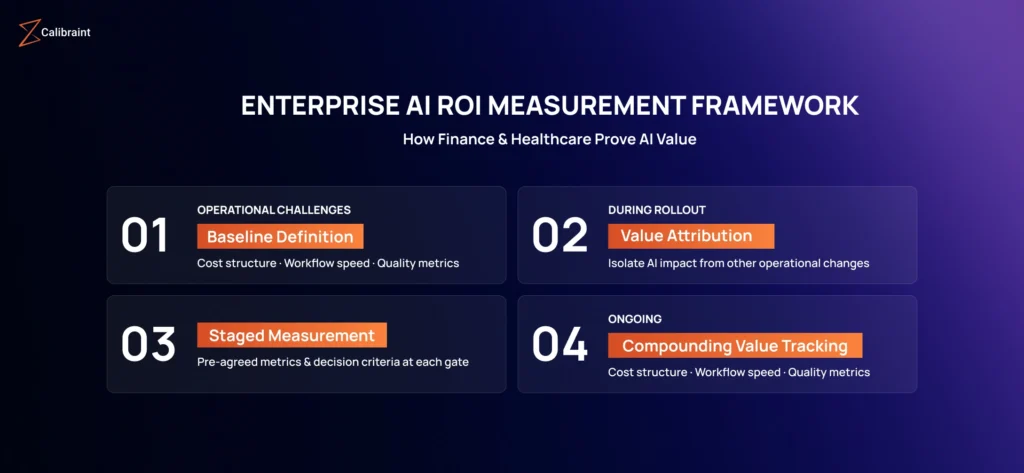
The AI Proof of Value Framework: A Four-Stage Model
The organizations that sustain executive confidence in AI investments share one common characteristic. They define success before deployment, not after. The AI proof of value framework for enterprises that consistently delivers boardroom credibility operates across four stages.
Stage One: Baseline Definition. Before an AI system is deployed, establish a documented, time-stamped baseline for every metric the initiative is expected to influence. This includes not only the primary KPI but the secondary variables that might otherwise be used to challenge the results. Volume, headcount, regulatory environment, and market conditions should all be recorded.
Stage Two: Value Attribution Architecture. Many AI deployments run alongside other process changes, technology upgrades, or workforce shifts. Without a value attribution architecture, AI contributions become impossible to isolate. This stage requires agreement across functions on how value will be carved out, including the use of control groups or counterfactual modelling where parallel operation is not feasible.
Stage Three: Staged Measurement Gates. Enterprise AI ROI in finance and healthcare rarely materializes fully within a standard financial quarter. The measurement framework should include defined gates at 30, 90, and 180 days, each with pre-agreed metrics, tolerances, and decision criteria. This structure prevents the common failure mode where early-stage results are compared against full-deployment benchmarks.
Stage Four: Compounding Value Tracking. As models improve and data volumes grow, initial ROI figures understate long-term value. A rigorous AI proof of value framework for enterprises captures model improvement trajectories, expanding use case coverage, and the increasingly valuable data assets being built as the system operates.
The Measurement Traps That Undermine Enterprise AI ROI Conversations
Across financial services and healthcare, certain patterns consistently erode confidence in enterprise AI ROI numbers, even when the underlying value is real.
Counting pilots as production: A 90-day pilot with curated data and elevated support resources will almost always outperform production deployment. Building an ROI case on pilot metrics sets expectations that full deployment cannot meet. The AI proof of value framework for enterprises must distinguish clearly between proof-of-concept results and production-grade performance.
Ignoring total cost of ownership: Model training, data infrastructure, integration costs, ongoing governance, and the specialized talent required to maintain and improve AI systems all belong in the denominator. Healthcare AI ROI benchmarks that exclude these factors produce impressive-looking returns that collapse under scrutiny at the renewal conversation.
Single-metric optimization: Optimizing for one headline metric, such as automation rate or response time, without monitoring adjacent indicators creates blind spots. Financial services institutions that optimized AI-driven underwriting purely for speed without monitoring approval rate distributions encountered regulatory challenges that significantly increased the actual cost of those deployments.
From Metrics to Strategy: Building Internal Consensus Around AI Value
Measuring return on investment for enterprise AI is ultimately a communication challenge as much as a technical one. The numbers are necessary but not sufficient. Different functions read the same AI results through entirely different lenses.
Finance teams prioritize hard cost reduction and revenue attribution. Clinical leadership in healthcare focuses on workflow impact and patient outcomes. Risk and compliance functions scrutinize model governance and auditability. Technology teams track model performance, latency, and infrastructure efficiency.
A proof framework that speaks only to one audience will not survive the annual budget cycle in a large enterprise. The organizations that build lasting AI programmes are those that translate AI ROI metrics for financial services or healthcare AI ROI benchmarks into the language of each function, without distorting the underlying data.
This requires designating an internal owner of the AI value narrative, often sitting at the intersection of strategy and technology, with the mandate to synthesize cross-functional results into a single, coherent business case. It requires regular reporting cadences that surface both wins and learning moments, because stakeholders who only receive positive updates tend to discount them.
Enterprise AI ROI in finance and healthcare, measured and communicated with this level of rigour, does not just justify past investment. It builds the organizational credibility to fund the next wave.
What the Leading Organizations Are Doing Differently
The gap between organizations that consistently demonstrate enterprise AI ROI in finance and healthcare and those that struggle to build a coherent measurement story is narrowing, but it remains significant.
Leaders in financial services have moved from project-level ROI tracking to portfolio-level AI value management, treating their suite of AI initiatives as a strategic asset with diversified risk and return profiles. They invest in AI observability platforms that provide continuous performance monitoring across model health, business impact, and risk indicators in a single view.
Healthcare systems at the forefront of AI value measurement have embedded AI impact reporting into existing clinical governance structures. Rather than creating parallel measurement frameworks, they integrate AI ROI data into the same committees and reporting channels that already govern technology investment and clinical quality.
Both sectors share one emerging practice: pre-competitive collaboration on benchmarking. Industry consortia in both financial services and healthcare are developing shared AI ROI metrics for financial services and sector-specific healthcare AI ROI benchmarks. allowing organizations to contextualize their own performance against a credible external reference point.
The Business Case That Endures
Enterprise AI in finance and healthcare has moved past the phase where novelty alone justifies investment. Boards and budget holders are asking sharper questions, and the measurement frameworks that organizations bring to those conversations will determine whether AI development programmes continue to scale or stall.
The organizations that will define the next decade of AI deployment are not necessarily those with the most sophisticated models. They are those who can consistently answer the question every stakeholder eventually asks: what did this return, and how do we know?
A rigorous AI proof of value framework for enterprises, combined with the right AI ROI metrics for financial services or healthcare AI ROI benchmarks, transforms that question from a threat into a competitive advantage.
The measurement infrastructure required to answer it confidently is not a back-office function. It is a strategic capability, one that compounds in value just as the AI systems it tracks do.
The organizations that win the next decade will not just deploy AI; they will own the narrative around what it delivers. Calibraint partners with finance and healthcare enterprises to design, build, and measure AI systems that generate returns your board can see, trust, and fund again.
1. How do enterprises measure AI ROI in finance and healthcare?
Enterprises measure AI ROI by establishing a documented pre-deployment baseline and tracking performance across operational cost reduction, revenue impact, risk mitigation, and compliance efficiency. Measurement happens at structured checkpoints of 30, 90, and 180 days, ensuring results reflect production-grade performance rather than pilot conditions.
2. What are the key AI ROI metrics for financial services?
The core metrics include processing time reduction, fraud detection accuracy, false positive rates in AML workflows, credit decisioning speed, and incremental revenue from AI-driven personalization. Beyond efficiency gains, leading institutions also measure avoided cost, covering losses prevented, fines avoided, and capital preserved through smarter risk management.
3. What benchmarks define successful healthcare AI ROI?
Successful healthcare AI ROI spans clinical, operational, and financial dimensions. Key benchmarks include reductions in clinical documentation time, improvements in diagnostic throughput, physician time recovered per day, and claim denial rate reduction. Organizations that track all three dimensions simultaneously build the strongest, most defensible business cases for continued investment.
4. How long does it take to see ROI from enterprise AI implementation?
Most enterprises begin seeing measurable returns between 90 and 180 days post-deployment. Full ROI realization typically occurs within 12 to 18 months as models improve with growing data volumes. Organizations that define success metrics before deployment consistently report higher confidence in their results and faster stakeholder alignment.
5. What is a proof-of-value framework for enterprise AI?
A proof-of-value framework is a structured four-stage model that covers baseline definition, value attribution architecture, staged measurement gates, and compounding value tracking. It connects AI performance directly to business outcomes, isolates AI’s contribution from other operational changes, and gives decision-makers a credible, boardroom-ready narrative for every stage of the investment cycle.
Calibraint
Author
March 9, 2026
Let's Start A Conversation
Manage Consent
To provide the best experiences, we use technologies like cookies to store and/or access device information. Consenting to these technologies will allow us to process data such as browsing behavior or unique IDs on this site. Not consenting or withdrawing consent, may adversely affect certain features and functions.
Functional
Always active
The technical storage or access is strictly necessary for the legitimate purpose of enabling the use of a specific service explicitly requested by the subscriber or user, or for the sole purpose of carrying out the transmission of a communication over an electronic communications network.
Preferences
The technical storage or access is necessary for the legitimate purpose of storing preferences that are not requested by the subscriber or user.
Statistics
The technical storage or access that is used exclusively for statistical purposes.The technical storage or access that is used exclusively for anonymous statistical purposes. Without a subpoena, voluntary compliance on the part of your Internet Service Provider, or additional records from a third party, information stored or retrieved for this purpose alone cannot usually be used to identify you.
Marketing
The technical storage or access is required to create user profiles to send advertising, or to track the user on a website or across several websites for similar marketing purposes.