Enterprise Strategies for Reliable LLM Deployment: Building Accuracy, Scalability, and Organizational Trust
Calibraint
Author
March 17, 2026
Most enterprise AI projects do not fail because of bad models. They fail because of bad infrastructure decisions made too early, poorly defined success metrics, and an absence of governance before things go live. Building a reliable enterprise LLM deployment strategy from the ground up is one of the most consequential decisions a technology leader can make in 2026.
The excitement around generative AI is real. So is the operational debt that follows when teams rush from demo to deployment without a production-grade plan. LLM development at enterprise scale demands a fundamentally different approach than spinning up a prototype on a borrowed API key.
This blog addresses the decisions that actually matter: how to structure reliable LLM deployment for enterprise environments, how to maintain accuracy under real-world load, and how to build the kind of organizational trust.
Why Enterprise LLM Deployment Is a Different Problem Entirely
A consumer-facing chatbot and an enterprise LLM system share almost nothing in common beyond the model architecture.
Enterprise deployments carry compliance requirements, latency expectations, integration depth with legacy systems, and organizational politics that no benchmark paper ever accounts for. The stakes are different. A hallucination in a customer support bot is embarrassing. The same failure in a contract review workflow or a financial reporting assistant creates legal and regulatory exposure.
Scalable AI deployment for enterprise requires teams to think in systems, not just models. That means data pipelines, retrieval layers, fallback logic, audit trails, and human escalation paths, all before the first user touches the interface.
The organizations getting this right share a consistent trait: they approach enterprise LLM deployment strategy not as a launch milestone, but as a continuous engineering discipline that evolves with the business.
The Architecture Decisions That Define Production Quality
Retrieval-Augmented Generation is not optional at scale.
For enterprise use cases where factual precision matters, grounding model outputs in verified, organization-specific data is the foundation of reliable performance. RAG architectures reduce hallucinations by anchoring generation to retrieved documents rather than parametric memory alone.
The quality of that retrieval layer determines everything. Chunking strategy, embedding model selection, re-ranking logic, and context window management all have a direct impact on LLM accuracy and reliability in production, but these effects are hidden until production load reveals them.
Model Choice Defines Business Outcomes
Open-weight models offer control and data privacy. Proprietary API models offer capability and speed-to-market. Hybrid architectures let enterprises route different query types to different models based on sensitivity, cost, and latency requirements.
The mistake most teams make is optimizing for benchmark performance rather than task-specific performance. A model that ranks highly on general reasoning benchmarks may still underperform on domain-specific enterprise tasks where fine-tuning or prompt engineering would close the gap more efficiently.
Latency budgets are non-negotiable.
A production-grade LLM implementation for workflows integrated with CRM systems, ERP platforms, or real-time decision tools cannot tolerate unpredictable response times. Caching strategies, streaming responses, asynchronous processing queues, and infrastructure auto-scaling need to be designed before peak load reveals the gaps.
Enterprise AI Governance Is the Competitive Differentiator
Here is what rarely appears in LLM deployment guides: the organizations that scale AI successfully spend more time on governance than on model selection.
Enterprise AI governance and trust are not a compliance checkbox. It is the operational framework that decides whether an LLM system can be trusted with higher-stakes decisions over time, expanded to new departments, and defended in front of auditors or regulators.
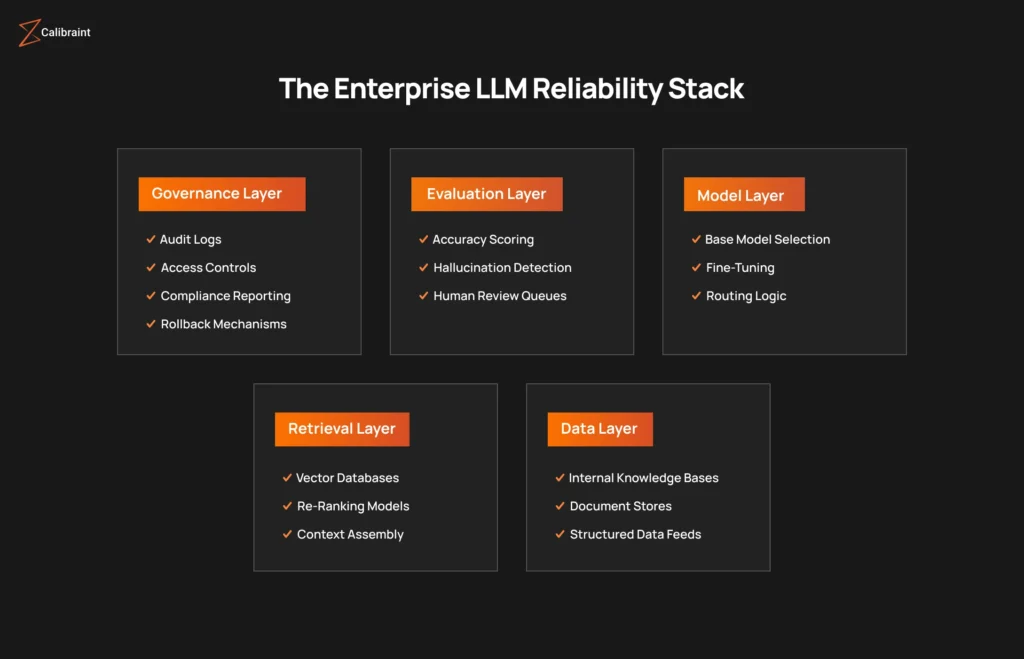
A governance framework for production-grade LLM implementation should address four areas:
Accountability. Who owns model behavior in production? Who reviews outputs flagged by the evaluation layer? Who has the authority to initiate a rollback? These questions need documented answers before deployment.
Transparency. Decision-makers and audit functions need visibility into how outputs are generated, what sources were used, and where confidence thresholds were applied. Black-box AI has a shelf life in regulated industries, and that shelf life is getting shorter.
Consistency. Model behavior should be deterministic within acceptable bounds. Version control for prompts, models, and retrieval indices ensures that changes are tracked and reversible.
Feedback loops. Production data is the most valuable fine-tuning signal available. Enterprises that build structured feedback collection into their deployment architecture continuously improve model performance in ways that static evaluations cannot capture.
The Evaluation Problem Nobody Talks About
LLM evaluation in production is genuinely hard. Accuracy on static benchmarks does not predict real-world performance when queries are ambiguous, context is incomplete, or users probe edge cases that the test set never covered.
Enterprise teams building scalable AI deployment systems need evaluation pipelines that run continuously, not just at launch. Maintaining LLM accuracy and reliability in production means automated scoring on factual accuracy, answer completeness, tone consistency, and citation quality, alongside periodic human review of flagged outputs.
The teams that invest in evaluation infrastructure early discover something consistent: model performance degrades without active monitoring. Retrieval quality drifts as document stores change. Prompts that worked in staging behave differently under production traffic patterns. Catching these shifts early is far cheaper than managing the reputational and operational fallout after they affect users.
This is why a mature enterprise LLM deployment strategy treats evaluation as a first-class engineering concern, rather than an afterthought wired in after launch. Production-grade LLM implementation is, at its core, an ongoing engineering commitment.
What “Organizational Trust” Actually Requires
Beyond the technical architecture, there is a human dimension to enterprise LLM deployment that determines whether a system gets used, expanded, or quietly avoided by the people it was built for.
Organizational trust in AI systems builds through a specific sequence. Users need to understand what the system can and cannot do. They need clear escalation paths for cases where the model output is uncertain or incorrect. They need confidence that their inputs are handled securely and that the system is not a liability risk.
LLM accuracy and reliability in production are only half the equation. Communication design, onboarding, and internal change management are the other half, and they receive a fraction of the engineering attention they deserve in most enterprise rollouts.
The enterprises seeing the strongest adoption are not always running the most sophisticated models. They are running well-scoped systems with clear use cases, honest capability boundaries, and the kind of user experience that makes the tool feel trustworthy rather than impressive.
A Framework for Sustainable Scale
Sustainable, scalable AI deployment for enterprise follows a recognizable pattern. No matter the industry or stack, a well-executed enterprise LLM deployment strategy consistently includes these four principles:
Start narrow and instrument everything. A focused deployment with comprehensive observability generates more actionable data than a broad deployment with minimal monitoring.
Build evaluation before building features. Teams that invest in evaluation infrastructure before expanding capabilities make better decisions at every subsequent stage.
Treat LLM development as a product discipline. The same rigor applied to any production software, versioning, testing, rollback capability, and user feedback loops applies directly to AI systems in production.
Define success in business terms from day one. Accuracy metrics matter. So do time-to-completion rates, error escalation rates, and user adoption curves. Connecting LLM performance to business outcomes is what sustains executive support through the inevitable rough patches.
Enterprise AI is maturing quickly. The organizations that built early proof-of-concept systems on shared API infrastructure are now navigating the considerably more complex work of scaling those systems, securing the data flowing through them, and justifying continued investment with measurable results.
The gap between enterprises that successfully scale AI and those that stall is not a model quality gap. It is an architecture gap, a governance gap, and increasingly an organizational capability gap.
The good news is that these are solvable problems. They require deliberate engineering, experienced guidance, and a deployment philosophy that prioritizes reliability over novelty.
If your organization is moving from experimentation to production, the enterprise LLM deployment strategy decisions you make now will define how far your AI initiatives can scale. The organizations that get this right do not just ship faster; they build systems that compound in value over time.
At Calibraint, we work with enterprises to design and deploy production-grade LLM systems that prioritize accuracy, scalability, and trust from day one.
Explore how we can help you build reliable AI systems.
FAQs
1. What is an enterprise LLM deployment strategy, and why does it matter in 2026?
An enterprise LLM deployment strategy is a structured plan for integrating large language models into business workflows at scale, covering model selection, infrastructure, governance, and evaluation. In 2026, it matters because the gap between a working prototype and a reliable production system has become the defining challenge for AI adoption. Organizations without a clear strategy accumulate technical and operational debt that stalls scale and erodes stakeholder trust.
2. How do enterprises ensure LLM accuracy and reliability in production environments?
Accuracy and reliability in production depend on three pillars: a strong retrieval layer (RAG) that grounds outputs in verified organizational data, continuous evaluation pipelines that monitor factual accuracy, tone, and completeness in real time, and human review queues for flagged edge cases. Static benchmarks are not enough. Production traffic exposes gaps that pre-launch testing never surfaces.
3. What are the biggest challenges to scaling AI deployment across enterprise teams?
The three most common blockers are infrastructure gaps (latency, integration with legacy systems, unpredictable load), governance gaps (unclear ownership, no audit trail, no rollback mechanism), and organizational gaps (poor change management, low user trust, undefined escalation paths). Most enterprises underestimate the second and third categories and over-invest in model selection.
4. How can organizations build trust and governance around enterprise AI systems?
Governance requires four things: clear accountability (who owns model behavior and who can initiate a rollback), transparency (decision-makers can see how outputs were generated and what sources were used), consistency (version control for prompts, models, and retrieval indices), and feedback loops (structured collection of production data to drive continuous improvement). Trust builds when users see that the system has honest boundaries and reliable escalation paths.
5. What does a production-grade LLM implementation look like for a large organization?
A production-grade implementation has five layers working together: a curated data layer, a high-quality retrieval layer with re-ranking logic, a model layer with routing for different query types, an evaluation layer with automated scoring and human review, and a governance layer with audit logs, access controls, and rollback capability. It is treated as a product discipline with versioning, testing, and ongoing monitoring, not a one-time launch.
Calibraint
Author
March 17, 2026
Let's Start A Conversation
Manage Consent
To provide the best experiences, we use technologies like cookies to store and/or access device information. Consenting to these technologies will allow us to process data such as browsing behavior or unique IDs on this site. Not consenting or withdrawing consent, may adversely affect certain features and functions.
Functional
Always active
The technical storage or access is strictly necessary for the legitimate purpose of enabling the use of a specific service explicitly requested by the subscriber or user, or for the sole purpose of carrying out the transmission of a communication over an electronic communications network.
Preferences
The technical storage or access is necessary for the legitimate purpose of storing preferences that are not requested by the subscriber or user.
Statistics
The technical storage or access that is used exclusively for statistical purposes.The technical storage or access that is used exclusively for anonymous statistical purposes. Without a subpoena, voluntary compliance on the part of your Internet Service Provider, or additional records from a third party, information stored or retrieved for this purpose alone cannot usually be used to identify you.
Marketing
The technical storage or access is required to create user profiles to send advertising, or to track the user on a website or across several websites for similar marketing purposes.