Intent Based Blockchain Application Development Services in 2026: Converting Web2 Users to Web3 at Scale
Calibraint
Author
February 27, 2026
We are moving away from systems that require step-by-step commands. Instead of telling software exactly what to do at every stage, people now expect it to understand the desired result and handle the complexity in the background.
No one wants to sign multiple transactions, calculate gas fees, or interpret confusing wallet prompts. They just want results. This approach is at the heart of intent based blockchain development 2026.
Historically, blockchain development provided programmable trust, which is powerful. But it was often complex and not very intuitive. The next phase focuses on making it easier to use. Intent-centric systems combine AI agents, simplified transaction management, and account abstraction to handle complex tasks automatically and deliver straightforward outcomes.
This guide will walk you through what this shift means for your product strategy. Our focus here is purely practical. No hype, no wild guesses about numbers. Just a clear look at the fundamental changes that are shaping the future of our digital world.
The Strategic Shift Toward Intent
Early blockchain systems required users to specify every action. Swap this token. Approve that contract. Bridge assets manually. Every step demanded attention, and every signature added unnecessary complexity to what should have been a simple experience.
Intent based blockchain development changes that entirely. Users declare an outcome, and the system handles the rest. AI agents interpret the goal, apply the right constraints, and orchestrate execution across protocols automatically. Smart contracts settle the final state on-chain. Account abstraction handles authentication in the background. The user simply experiences the result.
This shift mirrors what happened across consumer technology over the last decade. People stopped tolerating complicated interfaces the moment simpler alternatives appeared. Web3 products are reaching that same inflection point, and it is driving intent based blockchain development forward across fintech, supply chain, tokenized assets, and enterprise SaaS.
Why the Market Is Ready
Two developments created the foundation for intent based blockchain development 2026.
First, account abstraction user onboarding matured. Wallet interactions can now abstract gas fees, bundle transactions, and support programmable permissions. This eliminates the rigid, externally owned account model that slowed adoption.
Second, AI agents gained contextual reasoning capabilities. Modern agents can parse objectives, interpret structured constraints, and orchestrate multi-step workflows across protocols.
Together, these advancements enable user intent execution in blockchain systems that feel natural while remaining verifiable.
The result is not cosmetic improvement. It is structural evolution.
Digital asset platforms face three recurring issues:
Fragmented workflows across protocols
Security risks from manual interaction
Low conversion rates during onboarding
Web2 to Web3 onboarding solutions attempt to solve this with simplified interfaces. But interface simplification alone cannot eliminate transactional complexity.
Intent centric Web3 development addresses the root cause. It separates user goals from execution logic. Instead of exposing every contract interaction, it builds an intent layer that interprets objectives and handles execution internally.
This is why intent based blockchain development is gaining attention among product architects who care about retention, efficiency, and risk control.
What Intent Based Blockchain Development 2026 Actually Means
The phrase often gets diluted by marketing. In practice, intent based blockchain development requires five core components:
1. Declarative Transaction Models Blockchain: Instead of describing the procedure, users define what they require. The technology automatically assesses compliance requirements, gas optimization, slippage constraints, and liquidity channels.
2. AI Agent Execution Layer: AI agents translate user objectives into structured instructions. They evaluate risk thresholds and trigger conditional logic.
3. Account Abstraction User Onboarding: Smart accounts remove repetitive signature flows. Gas sponsorship and programmable permissions improve accessibility without compromising security.
5. Monitoring and Governance Controls: Human oversight remains essential. Audit trails, override mechanisms, and policy controls ensure accountability.
The Architecture Behind It All
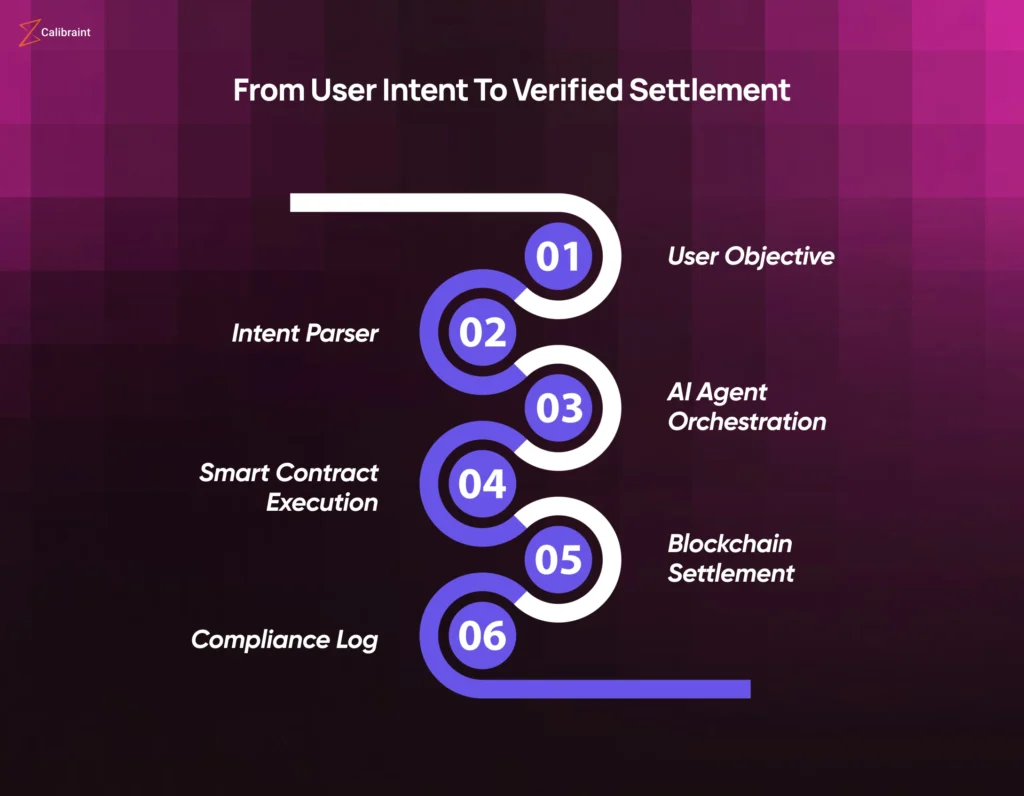
The primary reason intent systems falter isn’t a flawed concept, but rather a lack of inter-layer communication. A well-built system starts at the experience interface, where users express a goal through clean, structured input. No technical jargon, no manual configuration.
That intent travels to a parser that translates human language into machine-readable parameters. From there, an AI orchestration layer evaluates protocol states, market conditions, and policy constraints before handing off to smart contracts for on-chain settlement and state updates. Governance and compliance controls sit across the entire stack, maintaining audit trails and override capabilities where needed.
Intent-centric Web3 development only delivers on its promise when these layers operate as a unified system. When assembled without architectural cohesion, what results is fragmented experimentation rather than a scalable product.
Where the Market Currently Stands
Leading blockchain ecosystems are actively building toward declarative execution. Account abstraction standards continue to mature. DeFi aggregators already apply partial intent routing in token swap flows.
But most of these implementations remain narrow. They handle specific transactions within specific protocols. They do not extend to the complexity of enterprise workflows, structured financial operations, or regulated asset environments.
That gap is where intent based blockchain development 2026 becomes a genuine strategic differentiator. The teams building in this space right now are not just optimizing DeFi UX. They are designing systems capable of handling asset lifecycle management, compliance-aware execution, and multi-protocol orchestration at enterprise scale.
Full-stack development matters here more than it does almost anywhere else. A well-designed backend with no attention to UX will fail at adoption. A polished interface with shallow execution depth will fail at credibility. Both layers must mature together.
The Business Case Is Straightforward
When intent systems are built correctly, three outcomes follow reliably.
Operational workflows tighten. Automated orchestration removes the repetitive, manual handoffs that slow down enterprise teams and create room for error. Risk exposure shrinks. Policy-driven constraints mean execution stays within defined boundaries without depending on human vigilance at every step. And onboarding improves meaningfully, because Web2 to Web3 onboarding solutions built on account abstraction remove the friction that consistently drives drop-off during user activation.
They are the direct result of separating what users want from how the system achieves it.
How a Disciplined Build Actually Works
The strongest implementations of intent based blockchain development follow a structured methodology, not a sprint toward a demo.
It starts with strategic discovery, identifying which workflows genuinely benefit from declarative models rather than applying the pattern universally. Constraint mapping comes next, defining risk parameters, compliance requirements, and execution boundaries before a single line of contract code is written.
When we plan out the system, we think about what we want it to achieve, how our AI will manage everything, and how the smart contracts will be structured. We roll it out carefully, step by step, with built-in checks and audits right from the beginning, instead of just adding them on later. And once it’s live, we constantly watch and tweak how everything performs, learning from real-world use when new or unusual situations pop up.
This is the methodology that separates production-grade systems from proofs of concept that never scale.
There is a common misconception worth addressing directly. AI agents in this context complement smart contract logic.
Agents interpret contextual inputs, evaluate conditions, optimize execution paths, and trigger appropriate contract interactions. Smart contracts then handle deterministic settlement with verifiable outcomes. This is what makes user intent execution on blockchain viable beyond simple token swaps. The agent provides adaptive intelligence. The contract provides integrity.
Neither works as well without the other. That dual structure is the technical foundation that makes intent based blockchain development reliable enough for enterprise adoption.
A Final Thought
The shift happening right now in blockchain isn’t just about making crypto simpler for users. It’s about making complex digital tasks feel as effortless as the everyday products people already rely on. Organizations that move early to design systems around human intent won’t just make things a little smoother.
They will build experiences that are genuinely superior and harder for others to compete with, because the user experience and the underlying capabilities continuously improve for people over time.
If your team is working through what this architecture should look like for your specific product or workflow, the team at Calibraint has built across this stack and would be glad to think through it with you. Reach out at https://www.calibraint.com/contact and start the conversation.
FAQs
1. What is intent based blockchain application development?
It is the design of blockchain systems where users declare desired outcomes rather than specifying every transaction. AI agents, smart contracts, and declarative transaction models automatically interpret and execute these intentions.
2. How does intent based architecture help convert Web2 users to Web3?
Abstracting complex blockchain steps, such as signatures and transaction sequencing, allows users to achieve outcomes with familiar, Web2-like experiences, reducing friction and improving adoption.
3. Are intent based blockchain applications suitable for enterprise use in 2026?
Yes. They provide scalable, compliance-aware automation for multi-step processes, enabling enterprises to execute complex workflows efficiently while maintaining verifiable control.
4. How do gas abstraction and account abstraction technologies enable frictionless Web2 to Web3 migration?
They remove the need for users to manage gas fees or multiple signatures, simplifying onboarding and enabling seamless interaction with blockchain applications.
5. What role do solver networks play in executing intent centric blockchain transactions across multiple chains?
Solver networks coordinate and optimize transaction execution across different blockchains, ensuring user intents are completed efficiently, securely, and in the correct sequence.
Calibraint
Author
February 27, 2026
Let's Start A Conversation
Manage Consent
To provide the best experiences, we use technologies like cookies to store and/or access device information. Consenting to these technologies will allow us to process data such as browsing behavior or unique IDs on this site. Not consenting or withdrawing consent, may adversely affect certain features and functions.
Functional
Always active
The technical storage or access is strictly necessary for the legitimate purpose of enabling the use of a specific service explicitly requested by the subscriber or user, or for the sole purpose of carrying out the transmission of a communication over an electronic communications network.
Preferences
The technical storage or access is necessary for the legitimate purpose of storing preferences that are not requested by the subscriber or user.
Statistics
The technical storage or access that is used exclusively for statistical purposes.The technical storage or access that is used exclusively for anonymous statistical purposes. Without a subpoena, voluntary compliance on the part of your Internet Service Provider, or additional records from a third party, information stored or retrieved for this purpose alone cannot usually be used to identify you.
Marketing
The technical storage or access is required to create user profiles to send advertising, or to track the user on a website or across several websites for similar marketing purposes.