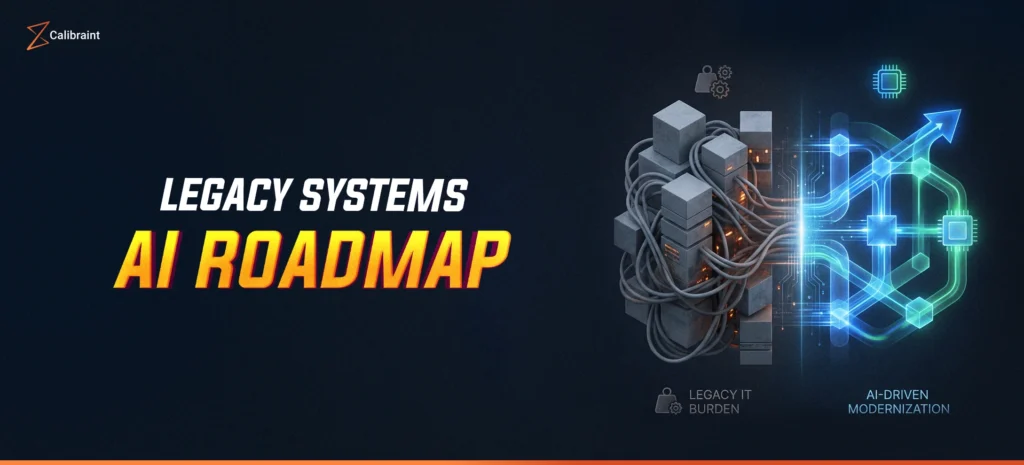
Struggling with Legacy Systems? A Practical AI Driven Digital Transformation Roadmap
Calibraint
Author
April 8, 2026
Legacy systems represent both a financial burden and a strategic liability for modern enterprises. According to Gartner research, companies allocate approximately 40% of their IT budgets to managing technical debt resources that could otherwise fuel innovation and competitive advantage. For organizations struggling with outdated infrastructure, the path forward demands more than incremental improvements. It requires a comprehensive legacy modernization services strategy powered by artificial intelligence.
This blog explores the practical intersection of legacy modernization and AI, delivering actionable insights that help enterprises navigate the complexity of digital transformation without disrupting critical business operations. Whether you’re concerned about rising maintenance costs, security vulnerabilities, or the inability to adopt modern technologies, understanding the principles of legacy system integration and AI-driven legacy transformation can reshape your organizational trajectory.
Why Legacy Modernization Services Matter Now More Than Ever
Legacy systems, including software platforms, databases, and infrastructure built 10, 20, or even 30+ years ago, remain the backbone of enterprise operations across financial services, healthcare, manufacturing, and government sectors. Yet, these systems present escalating challenges that demand immediate attention.
The business case for legacy modernization services has become irrefutable. Organizations maintaining legacy systems face:
Escalating maintenance costs: As legacy system integration becomes increasingly fragile, expenses compound. Some enterprises report spending up to 70% of IT capacity simply keeping legacy systems operational.
Security vulnerabilities: Legacy application modernization addresses the reality that outdated architectures lack modern encryption, multi-factor authentication, and real-time threat detection.
Innovation paralysis: Software modernization services free development teams to pursue emerging technologies such as cloud computing, machine learning, and data analytics, rather than maintaining outdated and fragile systems.
Regulatory compliance gaps: Many legacy systems lack the documentation, controls, and audit trails required for GDPR, HIPAA, PCI-DSS, and emerging regulatory frameworks.
The good news is that strategic legacy modernization services, powered by artificial intelligence and guided by a clear application modernization strategy, can address these challenges simultaneously while minimizing business disruption.
Understanding AI-Driven Legacy Transformation: The Modern Approach
Traditional legacy system integration relied on expensive, time-consuming manual processes. Development teams would spend months analyzing code, rewriting components, testing integrations, and managing risks. An AI-driven legacy transformation changes this equation fundamentally.
AI services platforms now enable intelligent automation across the entire modernization lifecycle:
Code Analysis and Reverse Engineering
AI agents analyze millions of lines of legacy code, automatically identifying dependencies, architectural patterns, and business logic. This reverse engineering process produces comprehensive system documentation, which many organizations lack for systems built before modern documentation standards.
Intelligent Refactoring and Code Transformation
Rather than rewriting entire systems, AI-powered software modernization services intelligently refactor code components, convert legacy frameworks to modern equivalents, and eliminate technical debt. A legacy modernization services platform can identify the optimal transformation path whether replatforming to cloud, migrating to microservices, or adopting API-first architectures.
Automated Testing and Risk Mitigation
AI services solutions automatically generate test cases, validate transformations, and predict integration risks before they occur, dramatically reducing the danger of disruptions during implementation.
The Business Impact: Data-Driven Results from Legacy Modernization
The ROI potential of AI-driven legacy transformation has moved beyond theoretical into measurable reality. Recent industry research demonstrates tangible business outcomes:
Cost Reduction Through Intelligent Modernization
IBM reports that organizations completing AI-assisted legacy modernization services achieve 15-35% yearly savings on infrastructure costs, alongside 74% reductions in hardware, software, and staffing expenses.
McKinsey research indicates that generative AI for legacy application modernization strategy delivers approximately 40% reduction in technical debt-related costs compounding savings year after year.
Multi-agent AI systems for legacy system integration accelerate modernization timelines by 40-50% while cutting direct project costs by 40%.
Accelerated Delivery Without Business Disruption
Traditional legacy system integration projects span 15+ months. AI-driven legacy transformation, guided by a structured application modernization strategy, reduces timelines to 8-10 months, a 47% acceleration.
GitLab’s enterprise telemetry reveals AI-augmented code transformation completes 26% more development tasks in equivalent timeframes compared to manual approaches.
Innovation Capacity Restoration
Global enterprises report that post-modernization, development teams shift from 72% maintenance focus to 70%+ allocation toward innovation, a dramatic recalibration enabling competitive differentiation.
Software modernization services unlock the capacity for emerging technologies: cloud-native architectures, AI/ML integration, real-time analytics, and autonomous systems.
Designing Your AI-Driven Digital Transformation Roadmap
A successful legacy modernization services program begins not with tools, but with strategy. An effective application modernization strategy balances technical feasibility, business impact, and organizational capacity.
Phase 1: Comprehensive Discovery and Assessment
Your application modernization strategy begins by understanding the complete landscape. Conduct a thorough audit of legacy systems, mapping:
Critical business processes dependent on each legacy system integration
Technology stacks, programming languages, and architectural patterns
Current maintenance costs and operational complexity metrics
Data flow dependencies and integration touchpoints
This assessment leverages AI services capabilities to accelerate discovery—AI agents analyze code repositories, identify dead code, map dependencies, and generate architectural documentation automatically.
Phase 2: Prioritization and Path Selection
Not all legacy systems demand equal modernization effort. An effective legacy modernization services approach prioritizes based on:
Business impact: Systems directly influencing revenue, customer experience, or regulatory compliance rank highest
Technical debt burden: Older frameworks with limited vendor support and skill availability
Modernization feasibility: Some systems benefit most from replatforming; others from gradual refactoring or strangler fig patterns
Your AI-driven legacy transformation approach should evaluate multiple modernization pathways: rehost (lift-and-shift to cloud), replatform (leverage cloud-native services), refactor (modernize architecture), re-engineer (complete rebuild), or retire (decommission). Legacy system integration rarely follows a one-size-fits-all approach.
Phase 3: Pilot Project and Knowledge Validation
Before embarking on a comprehensive transformation, select a manageable legacy application modernization candidate, something complex enough to validate your software modernization services approach, yet scoped to contain risk.
The pilot phase accomplishes several objectives:
Validates AI services effectiveness in your specific technical environment
Identifies integration challenges and dependency complexities unique to your architecture
Builds internal expertise and organizational confidence in the AI-driven legacy transformation methodology
Establishes baseline metrics for cost savings, velocity improvements, and business impact
Phase 4: Portfolio-Scale Transformation
Once pilot success validates your legacy system integration and application modernization strategy approaches, scale strategically. Enterprise-wide legacy modernization services programs typically span 18-36 months, with continuous waves of modernization building organizational momentum and compound financial returns.
If you’re looking for a step-by-step approach, explore this detailedAI-driven digital transformation roadmap to understand how enterprises can structure their modernization journey effectively.
Overcoming Common Legacy Modernization Challenges
Legacy system integration presents distinct challenges that demand attention:
Challenge: Business Continuity During Transformation
Legacy systems often process business-critical operations 24/7. An effective legacy modernization services program employs:
Parallel processing strategies where modernized components run alongside legacy systems during transition
Feature flags and gradual traffic migration to minimize cutover risk
AI service orchestration that validates compatibility and predicts failure scenarios before they occur
Challenge: Technical Knowledge Transfer
Legacy systems often lack comprehensive documentation. Original architects have retired. Remaining staff possess tacit knowledge that becomes increasingly fragile. AI-driven legacy transformation generates comprehensive documentation while preserving critical business logic reducing organizational knowledge risk.
Challenge: Cost Control and Predictable Budgeting
Traditional legacy application modernization strategy projects frequently encounter cost overruns when hidden dependencies emerge. AI services assessment identifies these dependencies during planning enabling accurate budget forecasting and risk quantification.
Building Your Legacy Modernization Services Partner Strategy
Successful legacy system integration requires partnerships combining technical depth, industry-specific expertise, and proven methodologies. When evaluating potential legacy modernization services providers, prioritize:
Demonstrated AI service capabilities specifically in legacy modernization (not generic AI assistance)
Proven experience with your specific technology stacks and industries
Human-agent operating models that maintain your team’s autonomy and control
IP protection safeguards and responsible AI governance frameworks
The Path Forward: Your Legacy Modernization Services Opportunity
Legacy systems represent a paradox: they enable critical business operations while simultaneously constraining innovation, consuming disproportionate resources, and creating mounting security exposure. The status quo becomes increasingly untenable.
AI-driven legacy modernization services offer a practical pathway forward. With documented cost reductions of 40-74%, timeline acceleration of 40-50%, and capacity restoration enabling innovation, the business case has become compelling. Organizations that embrace legacy system integration and application modernization strategy now will establish substantial competitive advantages within 24 months. Those that delay will find the burden of technical debt increasingly difficult to overcome.
Your legacy systems don’t need to remain a liability. With strategic planning, AI service leverage, and proven software modernization services methodologies, outdated infrastructure becomes a foundation for competitive differentiation.
The question isn’t whether to modernize. It’s when and with which partner.
Ready to Start Your Transformation?
Schedule a complimentary legacy system assessment with our AI service experts. Discover how legacy modernization services can unlock innovation capacity, reduce costs, and position your organization for sustainable competitive advantage.
Frequently Asked Questions About Legacy Modernization
1. How to modernize legacy systems with AI without disrupting business operations?
The key to zero-disruption legacy system integration lies in strategic implementation patterns. Use strangler fig patterns where new services gradually replace legacy functionality. Employ parallel processing where both systems run simultaneously during transition. Implement comprehensive testing via AI service automation to validate every change before deployment. Maintain detailed rollback procedures. The critical insight: successful legacy modernization services programs treat business continuity as a technical requirement, not an afterthought. With proper planning, your legacy application modernization strategy maintains normal business operations throughout transformation.
2. What is a practical AI roadmap for legacy system modernization and how do I get started?
Start with a comprehensive discovery phase: audit your complete system landscape, identify dependencies, quantify technical debt burden, and understand business criticality. Select a high-impact yet manageable pilot, a legacy application modernization candidate that demonstrates feasibility without overwhelming risk. Execute the pilot with AI service support, validating that your chosen technology and methodology works in your environment. Measure outcomes rigorously: cost reduction, timeline acceleration, quality improvements. Use pilot success to justify portfolio-scale transformation. The typical roadmap spans 3-5 years with continuous modernization waves, each wave building organizational expertise and compound financial returns.
3. How much can AI reduce costs and maintenance in legacy system modernization?
Research demonstrates substantial cost reductions across multiple dimensions. Infrastructure costs decline 15-35% annually post-modernization as hardware and cloud service efficiency improves. Direct maintenance expenses drop 56% or more once outdated systems are retired. Technical debt-related spending falls 40%+ through cleaner, more maintainable code.
Most importantly, your development teams shift from 70%+ maintenance focus to 70%+ innovation capacity multiplying your organization’s ability to create competitive advantage. Total cost of ownership improvements compound year-over-year, making legacy system integration one of the highest-ROI investments an enterprise can make.
4. How long does it take to complete AI-powered legacy system modernization?
Timeline varies significantly based on portfolio complexity and scope. A single legacy application modernization project typically requires 8-12 months with AI service acceleration compared to 15+ months traditionally. Enterprise-wide legacy system integration spanning multiple applications and technology stacks typically spans 24-36 months with staged implementation waves. The key variable: phased approaches maintain business continuity while building organizational capability incrementally. Your AI service partner should provide timeline estimates based on detailed assessment of your specific technical landscape, not generic benchmarks.
5. What are the best benefits and risks of using generative AI for legacy application modernization?
Benefits: Dramatic acceleration of code analysis, refactoring, and testing. Automated documentation generation. Risk prediction before problems occur. Reduced dependency on specialist expertise. Cost and timeline improvements of 40%+. Risks worth managing: AI models occasionally misinterpret complex business logic (human review required). Over-reliance on automation without domain expertise can introduce subtle architectural flaws. Intellectual property concerns require clear governance frameworks. Data security and compliance safeguards demand careful architecture. The reality: generative AI dramatically improves legacy modernization services outcomes when implemented as an augmentation to human expertise, not as a replacement. Successful programs maintain human review and decision authority for all transformation decisions.
Calibraint
Author
April 8, 2026
Let's Start A Conversation
Manage Consent
To provide the best experiences, we use technologies like cookies to store and/or access device information. Consenting to these technologies will allow us to process data such as browsing behavior or unique IDs on this site. Not consenting or withdrawing consent, may adversely affect certain features and functions.
Functional
Always active
The technical storage or access is strictly necessary for the legitimate purpose of enabling the use of a specific service explicitly requested by the subscriber or user, or for the sole purpose of carrying out the transmission of a communication over an electronic communications network.
Preferences
The technical storage or access is necessary for the legitimate purpose of storing preferences that are not requested by the subscriber or user.
Statistics
The technical storage or access that is used exclusively for statistical purposes.The technical storage or access that is used exclusively for anonymous statistical purposes. Without a subpoena, voluntary compliance on the part of your Internet Service Provider, or additional records from a third party, information stored or retrieved for this purpose alone cannot usually be used to identify you.
Marketing
The technical storage or access is required to create user profiles to send advertising, or to track the user on a website or across several websites for similar marketing purposes.