ROI of MEV Aware Blockchain Infrastructure: Preventing Value Leakage in High Throughput Systems
Calibraint
Author
February 17, 2026
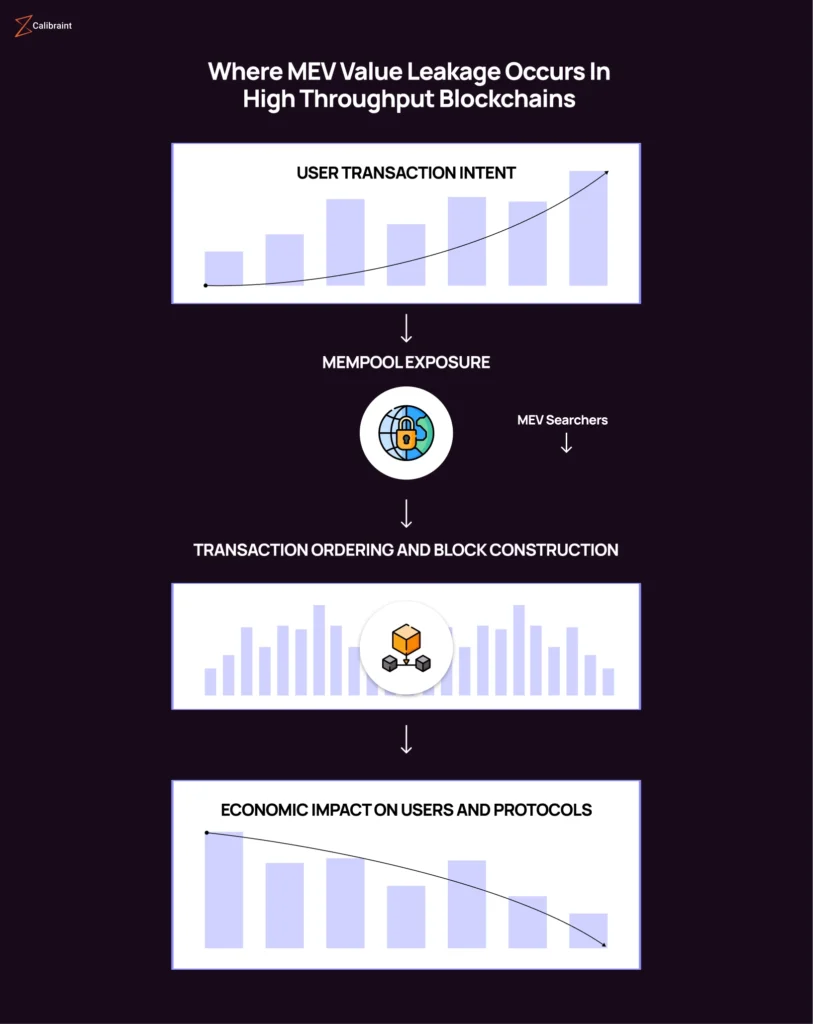
When a DeFi protocol processes thousands of transactions per second, blockchain development decisions made at the infrastructure level quietly determine how much of that economic activity actually reaches its intended destination. Not through hacks. Not through exploits. Through ordering. Transaction ordering attacks are the mechanism. MEV-aware blockchain infrastructure is the discipline that closes that gap, and the teams that understand it early hold a structural edge over those that discover it late.
That is the conversation this article is here to have.
The Business Cost No One Is Booking
MEV (Maximal Extractable Value) is not a flaw in the code. It is an economic side effect of how public blockchains sequence transactions. Validators and block builders, by definition, control the order in which transactions are confirmed. That control has monetary value. And where monetary value exists, rational actors will extract it.
The question for protocol teams, treasury managers, and product leaders is not whether MEV exists. It is whether their platform runs on MEV aware blockchain infrastructure or operates without it.
Transaction ordering attacks quietly erode three things that directly affect a protocol’s financial health. Protocol revenue takes a hit when arbitrageurs extract value that would otherwise have stayed within the system. Liquidity providers earn less than their models predict because their positions are systematically front-run at moments of price movement. User execution quality degrades in ways that are invisible to most dashboards but deeply visible in wallet outcomes. Users rarely diagnose the cause. They simply leave.
Leadership teams often treat MEV as a validator-level concern or a mempool quirk. What is actually happening is continuous value leakage, operating at the infrastructure layer, invisible in most reporting systems, and compounding across every high-volume block. Protocols that operate without MEV aware blockchain infrastructure are absorbing a cost that MEV aware blockchain infrastructure is specifically designed to prevent.
This is not a theoretical concern. The Ethereum research community has documented MEV dynamics extensively since 2019, when Philip Daian et al. published Flash Boys 2.0, the paper that first formally named and quantified miner extractable value. Flashbots was founded specifically to make extraction transparent and reduce its most harmful forms, introducing MEV-Boost and demonstrating that block builder separation from proposers changes the economics of extraction measurably.
Protocol teams across DeFi have disclosed MEV exposure in governance discussions about sandwich attack prevalence and LP analytics showing systematic underperformance against theoretical returns. Encrypted mempool research, private transaction routing pilots, and builder API standards all emerged as direct responses to documented execution quality problems.
The industry signal is clear: committing to MEV aware blockchain infrastructure is how serious protocols separate themselves from those still treating MEV as a background noise problem. Teams that treat MEV prevention strategies as a core infrastructure concern are building with a fundamentally different level of maturity.
What “MEV Aware” Actually Means at the Infrastructure Level
This is where most content on this topic loses precision. MEV aware blockchain infrastructure is not a feature. It is not a toggle or a plugin. It is an infrastructure posture, a set of coordinated design decisions touching transaction privacy, order flow management, validator and builder coordination, and protocol-level incentive alignment.
At the infrastructure level, this approach focuses on protecting transaction intent before it enters a public mempool. Order flow is actively managed rather than indiscriminately broadcast, and the relationship between validators, builders, and sequencers follows rules designed to reduce extractable surface area rather than amplify it.
This is where blockchain development becomes a strategic discipline. Architectural choices made early, including sequencing models, private routing strategies, and builder coordination structures, directly influence how much economic value a protocol retains over time. Treating MEV awareness as infrastructure rather than configuration shifts it from an afterthought into a foundational commitment.
Infrastructure thinking, not feature thinking. That distinction matters enormously for teams scoping a serious build.
Three Attacks, Explained Without the Jargon
Understanding transaction ordering attacks at a conceptual level is essential for any leader making infrastructure decisions. These are the three forms that define the MEV prevention strategies conversation, explained through outcomes rather than mechanics.
A fund manager submits a large token purchase through a DEX. A bot sees the transaction in the public mempool before it confirms. Knowing a large buy will push the price up, the bot submits its own buy first at a higher gas price. The manager’s transaction confirms next at the elevated price. The bot sells immediately. The manager paid more than the market price at the time of submission. The bot kept the difference. That is front-running.
Back-running works differently. When a price oracle update or liquidation event is visible in the mempool, bots position immediately after it to capture the arbitrage the state change creates. The value extracted comes from the protocol’s ecosystem rather than any single user.
The sandwich attack combines both. A user’s trade is spotted, a buy is placed before it, and a sell is immediately after, with the user’s transaction compressed between two bot transactions that extract value from both sides. The user gets a worse price. The bot gets the spread.
All three forms are symptoms of the same root cause: public mempool visibility. MEV aware blockchain infrastructure addresses that root cause rather than each symptom individually.
Why Private Mempools Change the Economics
The public mempool is a broadcast system. Every pending transaction is visible to every observer before it confirms, and that visibility is the single condition MEV extraction depends on. A private mempool removes it. Transaction intent stays confidential until the block is committed, which means the information bots need to front-run simply does not exist at the moment it would need to be acted on.
That is not a complete solution. It is a structural reduction in the attack surface, and the distinction matters.
The trade-offs are real, and leaders should understand them. Routing transactions privately reduces the transparency that public blockchains are built on. If private routing infrastructure is concentrated in the hands of a few operators, those operators gain meaningful power over transaction inclusion, which introduces a different category of censorship risk. These are not reasons to avoid private mempool approaches. There are reasons to implement them with deliberate governance rather than as a quick fix.
Flashbots MEV infrastructure demonstrated at production scale that structured builder relationships, where order flow is managed rather than openly broadcast, produce better execution outcomes across the network. That proof of concept has since shaped how L2 sequencer teams think about mempool design natively, not as an add-on.
Protocol-Level Prevention Is a Design Decision
Some of the most effective MEV prevention strategies happen before the transaction ever reaches the mempool. Choosing between them is one of the defining decisions in building MEV aware blockchain infrastructure, and it is also where MEV protection for DeFi protocols moves from reactive to structural.
Batch auctions collect transactions over a fixed time window and settle them at a single clearing price, eliminating the ordering advantage within the batch. Gnosis Protocol and CoW Protocol have demonstrated this at production scale. Time-based execution windows create deliberate delays that make the informational advantage of front-running time-limited. Fair ordering mechanisms, explored in research frameworks like Themis, enforce transaction ordering based on arrival time rather than gas price.
These are product decisions that shape user trust, institutional participation appetite, and protocol liquidity health. Implementing them reflects operational maturity. Ignoring them is a choice that compounds over time.
The ROI Case for MEV Mitigation Infrastructure
The return on MEV aware blockchain infrastructure is not measured in features shipped. It is measured in value that stops leaving the system.
When bots cannot extract, that value stays, as better LP returns, lower effective trading costs for users, or direct treasury accrual. Liquidity providers who trust that their returns will match their models stay longer and commit deeper. That liquidity improves execution quality, which drives volume, which makes the LP position more attractive. The cycle is self-reinforcing in a way that no marketing effort replicates.
User retention follows the same logic. Execution quality is one of the most sensitive factors in trading platform loyalty, and users who consistently receive worse prices leave without ever explaining why. The cause is invisible to them. The effect is not invisible to the protocol.
Institutional participation is where the ROI of MEV mitigation infrastructure becomes a hard prerequisite. Asset managers apply execution quality standards that are non-negotiable, and a protocol that cannot demonstrate serious infrastructure thinking will not clear their risk assessment. The ROI of MEV mitigation infrastructure, at that level, is simply the price of entry.
A high-throughput DeFi trading protocol was seeing consistent complaints from liquidity providers about underperformance against expected fee returns. Volume was strong. On-chain analytics looked healthy. But LP churn was quietly rising, and institutional interest was not converting to committed liquidity.
An infrastructure review identified transaction ordering attacks as the primary contributor. Bots were systematically extracting value at moments of high price volatility, precisely when LP positions were most exposed. The protocol’s public mempool was broadcasting intent with enough lead time to make extraction trivially easy. The team had never implemented MEV prevention strategies at the infrastructure level.
The team introduced private mempool routing for a defined transaction category, restructured builder relationships to reduce the extractable window, and implemented batch settlement for their most liquidity-sensitive pairs.
What changed was consistency. LP return variance narrowed. Execution quality complaints fell. One institutional participant, previously in extended due diligence around MEV protection for DeFi protocols, committed liquidity within a quarter of the infrastructure changes going live. The protocol did not announce a new product. It demonstrated infrastructure maturity.
High-throughput DeFi systems rarely lose trust through visible failures. More often, execution quality degrades quietly through ordering dynamics that remain unexamined at the infrastructure level. When that happens, value erosion becomes structural rather than episodic.
Let’s Talk About Your Protocol’s Exposure
Teams building serious protocols eventually reach a point where MEV exposure requires architectural scrutiny rather than incremental fixes. That assessment is less about tools and more about understanding how transaction flow, sequencing rules, and validator incentives interact under real volume.
Calibraint supports protocol teams at this stage by helping evaluate execution risk, clarify infrastructure trade-offs, and design systems aligned with the expectations of institutional participants. Our work commences with a detailed assessment, deferring deployment commitments, and emphasizing practical production realities over abstract theories.
FAQs
1. How does MEV aware infrastructure improve ROI in high-throughput blockchain systems?
It improves ROI by reducing hidden value loss from transaction ordering, stabilizing execution quality, and preserving protocol revenue. Over time, this leads to stronger liquidity retention, lower user churn, and higher institutional confidence without relying on speculative upside.
2. What role does proposer builder separation play in preventing MEV value leakage?
Proposer builder separation limits the ability of block proposers to exploit transaction ordering by separating block construction from block proposal. This reduces conflicts of interest, narrows extractable surface area, and supports fairer execution under high transaction volume.
3. Which architectural patterns help design MEV resistant high throughput blockchain networks in 2026?
Key patterns include private or encrypted transaction routing, protocol-level ordering rules, batch execution models, builder and validator incentive alignment, and sequencing mechanisms that minimize exposure of transaction intent before execution.
Calibraint
Author
February 17, 2026
Let's Start A Conversation
Manage Consent
To provide the best experiences, we use technologies like cookies to store and/or access device information. Consenting to these technologies will allow us to process data such as browsing behavior or unique IDs on this site. Not consenting or withdrawing consent, may adversely affect certain features and functions.
Functional
Always active
The technical storage or access is strictly necessary for the legitimate purpose of enabling the use of a specific service explicitly requested by the subscriber or user, or for the sole purpose of carrying out the transmission of a communication over an electronic communications network.
Preferences
The technical storage or access is necessary for the legitimate purpose of storing preferences that are not requested by the subscriber or user.
Statistics
The technical storage or access that is used exclusively for statistical purposes.The technical storage or access that is used exclusively for anonymous statistical purposes. Without a subpoena, voluntary compliance on the part of your Internet Service Provider, or additional records from a third party, information stored or retrieved for this purpose alone cannot usually be used to identify you.
Marketing
The technical storage or access is required to create user profiles to send advertising, or to track the user on a website or across several websites for similar marketing purposes.