Monolithic vs. Modular Blockchains: Which Architecture Will Power Your Enterprise in 2026?
Calibraint
Author
February 10, 2026
You’re likely here because your organization is hitting scalability walls, facing rising transaction costs, or planning a major blockchain initiative that must perform under real enterprise loads. As a CTO, CIO, founder, or blockchain architect, the monolithic vs modular blockchains decision isn’t theoretical, it’s the infrastructure choice that will determine whether your project delivers ROI, stays compliant, and scales without constant rework.
Getting this wrong in 2026 means delayed launches, ballooning OpEx, or security gaps that erode stakeholder confidence. At Calibraint, we help enterprises move from evaluation to confident implementation through proven Blockchain Development strategies. This guide walks you through the monolithic vs modular blockchain comparison so you can decide with clarity and move forward without second-guessing.
What is the Main Difference Between Monolithic and Modular Blockchains?
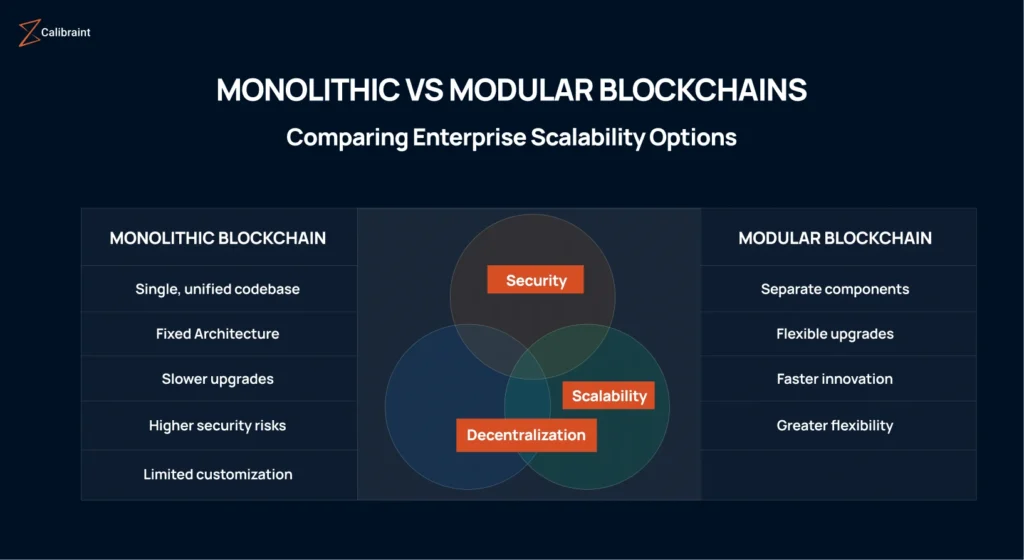
Monolithic blockchains bundle execution, consensus, data availability, and settlement into one tightly coupled layer. Everything runs on the same chain, which simplifies deployment but creates hard limits on throughput and flexibility.
Modular blockchains decouple these functions into independent layers: one optimized for fast execution, another for secure consensus, another for efficient data availability. This separation lets you upgrade or scale individual components without touching the rest.
For enterprise teams, the monolithic vs modular blockchain comparison comes down to control versus specialization. If you’re evaluating now, ask: Do we need predictable, all-in-one reliability or targeted scalability that adapts as business needs evolve?
Monolithic vs Modular Blockchain Comparison: What Actually Matters for Your Business
You’re probably weighing these architectures against real pressures: transaction volume growth, compliance demands, integration with legacy systems, and total cost of ownership.
Scalability
Monolithic chains scale by beefing up the single layer, more powerful nodes, higher fees during peaks. Modular blockchain architecture scales horizontally: parallelize execution, offload data, keep consensus lean. Enterprises facing 10x volume spikes in supply chain or payments see modular delivery sustained performance where monolithic chokes.
Performance & Cost
Unified monolithic designs mean lower initial complexity but higher long-term costs as you over-provision for peaks. Modular blockchain architecture optimizes spend by rightsizing each layer; execution can be cheap and fast, settlement secure and expensive only when needed.
Security & Governance
Monolithic offers a single trust boundary, easier audits, and unified rules. Modular inherits base-layer security but requires careful layer coordination to avoid weak links. For regulated industries, monolithic can feel safer short-term; modular enables granular controls long-term.
Developer & Team Velocity
Monolithic keeps teams in one ecosystem faster onboarding. Modular blockchain architecture allows best-of-breed tools per layer, accelerating innovation but demanding stronger integration expertise.
This monolithic vs modular blockchain comparison isn’t abstract. It’s about which model aligns with your projected load, compliance roadmap, and innovation pace.
For enterprises exploring advanced architectures, especially where AI workloads intersect with decentralized systems, it’s also worth understanding how these layers work together in practice. This becomes clearer when you look at integrating AI with modular blockchains for next-generation dApps and how modular design unlocks intelligent, scalable enterprise applications.
Why Enterprise Blockchain Scalability Is Your 2026 Make-or-Break Factor
Enterprises aren’t building proof-of-concept anymore. You’re deploying production systems that must handle thousands of TPS, integrate with ERP/CRM, and meet audit standards.
Monolithic limitations show up fast: congestion during batch processing, unpredictable gas fees, forced upgrades that disrupt operations. Modular blockchains enterprise adoption solves this by letting you scale the bottleneck independently execution for high throughput, data availability for cheap storage, consensus for finality.
The business outcome? Lower downtime risk, predictable budgeting, faster time-to-market for new features. If your team is modeling 2026–2028 growth, modular blockchain architecture typically delivers 5–20× better enterprise blockchain scalability without proportional cost increases.
When Modular Blockchain Architecture Wins (and When Monolithic Still Makes Sense)
You’re likely asking: “Which is better for enterprises in 2026: Monolithic or Modular Blockchains?”
Choose modular blockchain architecture when:
Volume or complexity will grow significantly (e.g., tokenized assets, cross-border payments, supply-chain provenance).
You need to integrate diverse apps or roll out features rapidly.
Cost efficiency at scale is non-negotiable.
You’re planning hybrid on/off-chain or multi-chain strategies.
Your team has limited blockchain expertise and wants minimal moving parts.
Predictable performance under known loads is the priority.
Most enterprises we advise in 2026 land in the middle: start monolithic for MVP speed, then migrate high-throughput components to modular layers. This hybrid path minimizes risk while preserving optionality.
Real-World Scenarios: How Enterprises Are Deciding Right Now
A logistics provider was maxing out a monolithic chain during peak shipping seasons delays cost millions. They shifted settlement to a modular base layer and execution to a high-throughput rollup. Result: 15× throughput, 40% lower costs, zero missed SLAs.
A financial institution needed ironclad governance for tokenized securities. They stayed monolithic for the core ledger (unified audit trail) but layered modular execution for client-facing apps. Compliance stayed intact; user experience improved.
A healthcare consortium required secure, interoperable data sharing. Modular blockchains enterprise adoption lets them use specialized data availability for large records while keeping consensus decentralized. They avoided the data bloat that plagues monolithic designs.
Run this decision logic on your initiative: forecast volume, list must-have compliance features, estimate team capacity. The monolithic vs modular blockchain comparison becomes clear fast.
What Are the Pros and Cons of Modular Blockchains Compared to Monolithic for Enterprise Adoption?
Modular pros enterprises care about:
Dramatically better enterprise blockchain scalability handles spikes without fees exploding.
Lower long-term TCO through optimized layers.
Faster iteration: upgrade execution without touching consensus.
Future-proofing: easier integration of emerging tech (ZK, AI oracles).
Inter-layer dependencies – mitigated with proven frameworks.
Governance fragmentation – solved via coordinated standards.
Monolithic advantages:
Simpler security model and faster go-live.
Unified governance – easier for audits.
Monolithic drawbacks:
Inevitable bottlenecks as adoption grows.
Expensive vertical scaling.
Limited customization.
For most enterprises pursuing modular blockchains enterprise adoption in 2026, the pros compound over time while cons are manageable with the right partner.
Common Objections We Hear from Enterprise Leaders
“Is modular too complex for our team?”
Not if you phase it: core on monolithic, high-scale components modular. Many start this way.
“Won’t modular introduce more attack surfaces?”
Base layers provide strong security; modular design actually distributes risk better than a single overloaded chain.
“Is the cost premium worth it?”
In pilots, modular blockchain architecture often pays back in 12–18 months via reduced fees and avoided upgrades.
These objections dissolve when you model your exact scenario. The monolithic vs modular blockchain comparison favors modular for growth-oriented enterprises.
Final Recommendation: Which Architecture Fits Your Enterprise Right Now?
In 2026, modular blockchains enterprise adoption is accelerating because it directly solves the scalability ceiling most enterprises are hitting. If your roadmap includes meaningful volume growth, regulatory-grade interoperability, or cost control at scale, modular blockchain architecture is the strategic move.
Monolithic still wins for tightly scoped, security-first use cases with stable loads. But if you’re reading this, you’re likely beyond that stage.
The real question: Are you willing to lock in an architecture that forces rework in 18–24 months?
Make the Decision That Secures Your Future
The monolithic vs modular blockchains choice shapes your enterprise blockchain scalability trajectory, operational resilience, and competitive positioning for years. The right architecture turns infrastructure from a cost center into a growth engine.
Calibraint has guided dozens of enterprises through this exact fork delivering architecture blueprints, migration paths, and production deployments that match business outcomes.
Don’t leave this to chance. Book your confidential consultation today. Our senior architects will analyze your requirements, run the monolithic vs modular blockchain comparison against your data, and deliver a clear recommendation with ROI projections.
What is the main difference between monolithic and modular blockchains?
A monolithic blockchain handles execution, consensus, and data availability in one layer, while a modular blockchain separates these functions into multiple layers for better scalability and flexibility.
What are the pros and cons of modular blockchains compared to monolithic for enterprise adoption?
Modular blockchains offer higher scalability, flexibility, and upgradeability for enterprises but require more complex architecture and integration. Monolithic blockchains are simpler to deploy but scale less efficiently for enterprise use cases.
Which is better for enterprises in 2026: Monolithic or Modular Blockchains?
In 2026, modular blockchains are better for enterprises needing scalability, interoperability, and long-term growth, while monolithic blockchains suit smaller or early-stage enterprise projects.
Calibraint
Author
February 10, 2026
Let's Start A Conversation
Manage Consent
To provide the best experiences, we use technologies like cookies to store and/or access device information. Consenting to these technologies will allow us to process data such as browsing behavior or unique IDs on this site. Not consenting or withdrawing consent, may adversely affect certain features and functions.
Functional
Always active
The technical storage or access is strictly necessary for the legitimate purpose of enabling the use of a specific service explicitly requested by the subscriber or user, or for the sole purpose of carrying out the transmission of a communication over an electronic communications network.
Preferences
The technical storage or access is necessary for the legitimate purpose of storing preferences that are not requested by the subscriber or user.
Statistics
The technical storage or access that is used exclusively for statistical purposes.The technical storage or access that is used exclusively for anonymous statistical purposes. Without a subpoena, voluntary compliance on the part of your Internet Service Provider, or additional records from a third party, information stored or retrieved for this purpose alone cannot usually be used to identify you.
Marketing
The technical storage or access is required to create user profiles to send advertising, or to track the user on a website or across several websites for similar marketing purposes.