How MPC and Account Abstraction Are Making Crypto Wallets More Secure
Calibraint
Author
December 26, 2025
MPC crypto wallet security is the single greatest hurdle preventing institutional capital from flowing freely into decentralized ecosystems in 2026. For years, the industry relied on the “not your keys, not your coins” mantra, which, while ideologically sound, is a practical nightmare for enterprises. A single point of failure in private key management represents a catastrophic risk that no board of directors will approve.
Today, the shift toward a multi-party computation model eliminates this vulnerability by ensuring no single entity ever holds a full private key. This evolution, combined with programmatic flexibility, is transforming how businesses interact with digital assets. As every forward-thinking Cryptocurrency Wallet Development Company now recognizes, MPC-based architectures are no longer optional, they are foundational for enterprise-grade adoption.
By solving the custodial dilemma, MPC crypto wallet security allows enterprises to deploy capital with the same confidence they have in traditional banking, but with the efficiency of blockchain.
Who Should Act on This Now
The window for early-mover advantage in digital asset custody is closing. This transition is critical for:
FinTech Founders: Scaling neo-banks that require secure, non-custodial options for retail users.
CTOs of Hedge Funds: Managing high-frequency on-chain transactions where manual signing is a bottleneck.
Product Heads at Retail Giants: Implementing loyalty programs or tokenized assets that require seamless, “invisible” blockchain interactions.
Enterprise Decision-Makers: In organizations with a market cap exceeding $500 million looking to diversify treasury holdings into digital assets.
If your organization handles more than $10 million in monthly on-chain volume, the legacy approach to security is no longer a viable strategy; it is a liability.
What This Solution Means for Enterprises in 2026?
Cryptocurrency Wallet Development Company services have shifted from building simple storage interfaces to engineering complex financial operating systems. In 2026, the value is not in the “wallet” itself but in the programmable logic that governs it. By integrating MPC crypto wallet security, enterprises can implement multi-level approval workflows that mirror traditional corporate governance. This ensures that even if one fragment of a key is compromised, the asset remains secure.
Furthermore, the integration of Account abstraction wallets allows for the decoupling of the signer from the account. This means businesses can pay for their users’ transaction fees or allow payments in any stablecoin, removing the friction of holding native tokens. When you combine this with MPC crypto wallet security, you create a stack that is both impenetrable and highly functional. This dual-layer approach is the only way to satisfy both the security auditor and the end-user.
Why Enterprises Are Investing in This (Decision Drivers)
ROI via Reduced Insurance Premiums: Traditional custody solutions are expensive. Implementing Off chain key management reduces the risk profile of your digital assets, leading to significantly lower insurance premiums and reduced third-party custodial fees.
Time-to-Market with Gasless & user friendly crypto wallets: Building on-board flows that don’t require users to understand “seed phrases” or “gas” accelerates user acquisition. Companies using Gasless & user friendly crypto wallets report 4x faster onboarding cycles.
Scalability through Account abstraction wallets: Legacy wallets require manual intervention for every transaction. Account abstraction wallets enable batching and automation, allowing your infrastructure to handle thousands of transactions per minute without increasing headcount.
Security and Compliance: Crypto wallet security is no longer just about encryption; it is about compliance. Modern MPC frameworks allow for “policy engines” that prevent transactions to blacklisted addresses at the protocol level.
Operational Efficiency: Utilizing Off chain key management allows for internal administrative changes (like updating authorized signers) without needing to move funds on-chain, saving thousands in transaction costs annually.
Enterprise Use Cases with Business Outcomes
Scenario 1: Institutional Treasury Management
Business Challenge: A multinational corporation needed to manage $50M in USDC across different regions with tiered access.
Solution Approach: Deployed a custom dashboard using MPC crypto wallet security with a 3-of-5 signing threshold.
Quantifiable Result: Eliminated the need for a $150k/year third-party custodian while maintaining 100% uptime and audit compliance.
Scenario 2: Global E-commerce Loyalty Program
Business Challenge: Onboarding 1 million non-crypto users into a Web3 loyalty program without the friction of seed phrases.
Solution Approach: Implementation of Gasless & user friendly crypto wallets where the brand pays the gas fees on behalf of the customer.
Quantifiable Result: 75% increase in user retention compared to traditional Web2 loyalty apps within the first six months.
Scenario 3: High-Volume DeFi Trading Firm
Business Challenge: Executing complex, multi-step arbitrage trades while keeping the primary keys offline.
Solution Approach: Used Account abstraction wallets to create “Session Keys” that allow a trading bot to execute specific trades within a 24-hour window.
Quantifiable Result: Reduced execution latency by 40% and removed the risk of total wallet drain from bot compromise.
Cryptocurrency Wallet Development Company Calibraint follows an architecture-first approach. We do not start with code; we start with a threat model. Our integration strategy focuses on creating a seamless bridge between your existing ERP systems and the blockchain.
We prioritize Off chain key management to ensure that your sensitive signing material never touches an internet-connected environment in its entirety. Our tech stack typically involves Threshold Signature Schemes (TSS) and specialized smart contracts for Account abstraction wallets. This ensures that even in a worst-case scenario, your risk is mitigated through sharded key shares and time-locked recovery mechanisms. This technical rigor is what sets an enterprise-grade MPC crypto wallet security implementation apart from a standard retail setup.
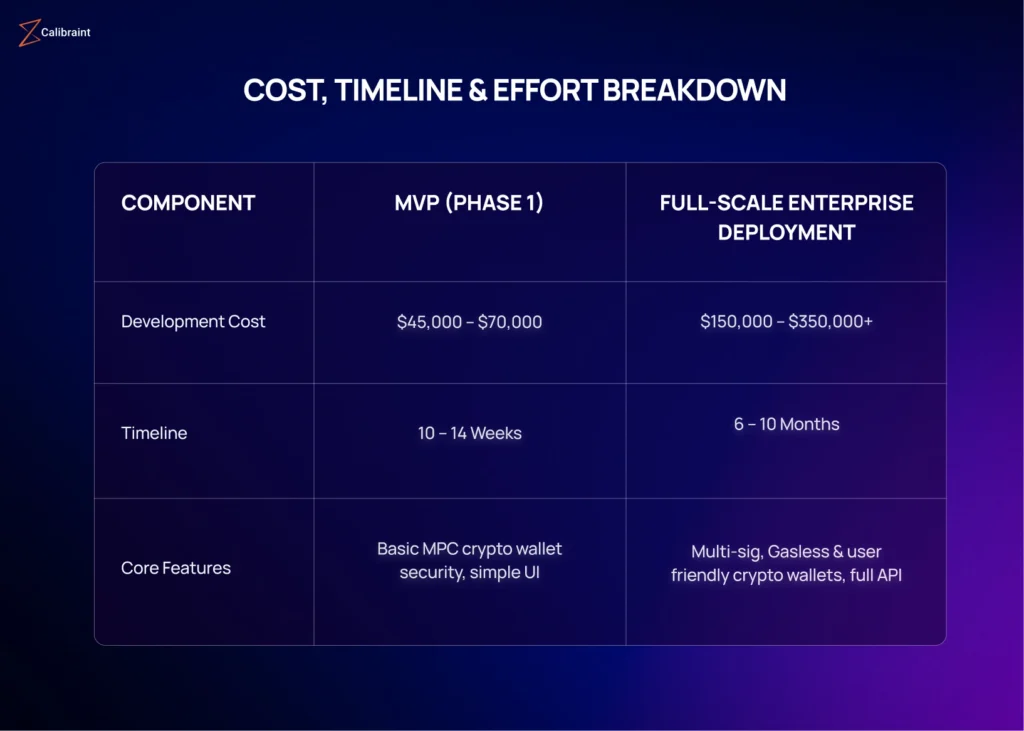
Cost, Timeline & Effort Breakdown
Based on 2025-2026 market benchmarks, the investment for an enterprise-grade wallet solution is segmented as follows:
The variance in cost is driven by the complexity of the policy engine and the number of blockchains supported. A simple Ethereum-based MVP with Gasless & user friendly crypto wallets is on the lower end, while a cross-chain institutional platform requiring rigorous Crypto wallet security audits will occupy the higher tier.
Why Most Enterprises Fail Without the Right Partner
Poor Architecture: Treating Crypto wallet security as a feature rather than the foundation leads to systemic vulnerabilities.
Inaccurate Cost Estimation: Failing to account for the long-term costs of gas, node maintenance, and security patches.
Weak Security Planning: Over-reliance on a single Off chain key management vendor without a disaster recovery plan.
Scalability Issues: Building a system that works for 100 users but crashes under the weight of 100,000 transactions when deploying Gasless & user friendly crypto wallets.
No Long-term Optimization Plan: Failing to update the smart contract logic for Account abstraction wallets as new EIP standards emerge.
Why Calibraint Is the Right Partner
Calibraint is not just a vendor; we are an engineering partner focused on your ROI. Our experience as a leading Cryptocurrency Wallet Development Company means we understand the nuances of enterprise blockchain implementation strategy and the necessity of rigorous testing.
We ensure that your MPC crypto wallet security is not a bottleneck but a facilitator for growth. Our team has successfully navigated the complexities of custom software development roadmap planning for Fortune 500 clients, ensuring that every line of code serves a business objective. By leveraging Off chain key management and the latest in Crypto wallet security protocols, we provide a foundation that is secure enough for a bank but flexible enough for a startup.
Maintaining high-level MPC crypto wallet security requires a partner who understands that the landscape changes weekly. We provide the technical depth needed to implement Account abstraction wallets and Gasless & user friendly crypto wallets that actually convert users and protect assets.
1. What is an MPC wallet and how does it enhance security?
An MPC wallet uses MPC crypto wallet security to split a private key into multiple shares. Since the full key never exists in one place, a hacker would need to breach multiple independent systems simultaneously to steal assets.
2. What is account abstraction and why is it important?
Account abstraction turns a wallet into a smart contract. It’s vital because it enables gasless & user friendly crypto wallets, allowing for features like social recovery, session keys, and automated recurring payments.
3. Can MPC and account abstraction work together in one wallet?
Yes. In 2026, the most secure setups use MPC crypto wallet security for the signing layer (off-chain) and Account Abstraction for the execution logic (on-chain). This combination provides the best of both worlds.
4. Is MPC more expensive than traditional multisig?
Initially, the development cost for MPC crypto wallet security is higher due to its complexity. However, because it signs off-chain, it saves significant money on gas fees in the long run, especially for high-volume enterprises.
5. How does “Off chain key management” impact compliance?
It simplifies it. Because you can have a “compliance share” held by a regulated entity, you can ensure that no transaction is signed unless it meets specific regulatory triggers, making audits significantly easier.
Calibraint
Author
December 26, 2025
Let's Start A Conversation
Manage Consent
To provide the best experiences, we use technologies like cookies to store and/or access device information. Consenting to these technologies will allow us to process data such as browsing behavior or unique IDs on this site. Not consenting or withdrawing consent, may adversely affect certain features and functions.
Functional
Always active
The technical storage or access is strictly necessary for the legitimate purpose of enabling the use of a specific service explicitly requested by the subscriber or user, or for the sole purpose of carrying out the transmission of a communication over an electronic communications network.
Preferences
The technical storage or access is necessary for the legitimate purpose of storing preferences that are not requested by the subscriber or user.
Statistics
The technical storage or access that is used exclusively for statistical purposes.The technical storage or access that is used exclusively for anonymous statistical purposes. Without a subpoena, voluntary compliance on the part of your Internet Service Provider, or additional records from a third party, information stored or retrieved for this purpose alone cannot usually be used to identify you.
Marketing
The technical storage or access is required to create user profiles to send advertising, or to track the user on a website or across several websites for similar marketing purposes.