Multi-Chain DApp Development Guide 2026: Cost Comparison for Ethereum, Solana, Base, and Emerging L2s
Calibraint
Author
January 9, 2026
1. Why Multi-Chain Decisions Fail or Scale in 2026
In 2026, Multi Chain Dapp Development is no longer a technical choice; it is a high-stakes capital allocation strategy. If your team is pitching a multi-chain expansion as a “user growth” play, they are missing the point. At the boardroom level, moving across chains is about risk distribution and capital efficiency. For CTOs and founders evaluating long-term Web3 bets, understanding how execution layers, settlement layers, and infrastructure costs evolve is critical. Many of these shifts are already shaping DApp development trends in 2026, especially as enterprises move away from single-chain dependency models.
Many enterprise Web3 failures are not caused by poor code quality but by accumulated architectural debt. A common mistake is treating a list of supported crypto chains as a strategy, which often leads to vendor lock-in becoming apparent only months later. In the modular blockchain architecture landscape of 2026, the primary risk is not technological failure but the long-term operational cost of dependency. The decision between a primary settlement layer and an execution L2 is fundamentally an asset management choice. When approached as a routine engineering task rather than a strategic business decision, scalability becomes difficult to achieve..
2. The Hidden Cost Curve of Single-Chain vs. Multi-Chain Architectures
Enterprises often fall into the trap of calculating launch costs while ignoring the long-term infrastructure drag. While a single-chain deployment seems cost-effective initially, the “monolithic tax” eventually hits. High congestion on a single network leads to RPC throttling, forced downtime, and significant revenue leakage during peak volatility.
When evaluating ethereum vs solana development costs, the delta isn’t just in gas fees or developer salaries; it’s in the infrastructure overhead. Ethereum offers unparalleled security and a mature ecosystem, but the cost of maintaining high-availability nodes and navigating L1 data availability can be prohibitive for high-frequency applications. Conversely, while Solana offers sub-second finality and lower transaction costs, the complexity of its Sealevel runtime and the specialized hardware requirements for RPC nodes can drive up operational expenditure (OpEx) as you scale.
The opportunity loss from delayed expansion is the silent killer. A multi chain dapp development strategy allows for “liquidity routing” moving high-volume, low-value transactions to cheaper environments while keeping high-value settlements on secure layers. Failing to plan for this multi-layer reality results in a platform that is either too expensive to use or too fragile to trust.
3. Chain Selection Is No Longer About the “Best Chain”
The legacy debate of “Ethereum vs. Solana” is a false dichotomy for the modern enterprise. In 2026, the question is not which chain is best, but which layer2 blockchain comparison aligns with your specific business logic.
We are seeing a massive shift toward base network dapp deployment for consumer-facing applications. Base has moved beyond being just another L2; it has become a strategic entry point for enterprises looking to leverage the Coinbase ecosystem’s institutional rails. Meanwhile, the broader layer2 blockchain comparison now includes specialized ZK-rollups and “AppChains” that offer tailored environments for everything from high-frequency trading to supply chain tracking.
If your architecture relies solely on L1 loyalty, you are missing the efficiency of the modular stack. Strategic multi chain dapp development today involves a “Hub and Spoke” model: Ethereum serves as the ultimate security hub, while networks like Base or Arbitrum act as execution spokes. This allows for a base network dapp deployment that benefits from Ethereum’s security without inheriting its latency.
This architectural shift aligns closely with broader DApp development trends in 2026, where modular execution, ecosystem-native L2s, and cost-aware deployment strategies are becoming standard for enterprise-grade platforms.
4. Infrastructure Reality Check: RPC Is the Silent Bottleneck
Your DApp is only as fast as your slowest RPC provider. In production, public RPC endpoints are a liability, not a resource. For an enterprise-grade multi chain dapp development project, RPC performance defines the user experience (UX). Rate limits and inconsistent head-block synchronization can lead to failed transactions and, ultimately, user churn.
When building for scale, CTOs must compare:
QuickNode supported chains vs. Alchemy RPC: Evaluating which provider offers the lowest latency for your specific geographic user base.
DRPC vs. GRPC for blockchain infrastructure: Moving beyond standard JSON-RPC to more efficient streaming protocols for real-time data.
Fastest RPC provider for production DApps: Identifying who can guarantee SLAs that match your internal uptime requirements.
Infrastructure instability is a direct threat to revenue. A 500ms delay in transaction propagation can be the difference between a successful trade and a reverted execution.
5. Cross-Chain Execution: Where Most Enterprise DApps Break
The most significant risk in multi chain dapp development is not the deployment, but the cross chain smart contract development required to keep the state consistent. When you move assets or data across chains, you are essentially managing a distributed database where every “write” has different finality times and security guarantees.
Enterprises often underestimate the complexity of:
State Consistency Risks: Ensuring that a user’s balance on Base reflects their locked collateral on Ethereum in real-time.
Security Assumptions: Understanding that your DApp is only as secure as the weakest bridge it utilizes.
Governance Complexity: Managing upgrades across multiple smart contracts on disparate chains simultaneously.
Successful cross chain smart contract development requires a “security-first” mindset. It isn’t just about how to create a multi-chain token; it’s about how to ensure that token maintains its value and utility regardless of which chain it currently resides on.
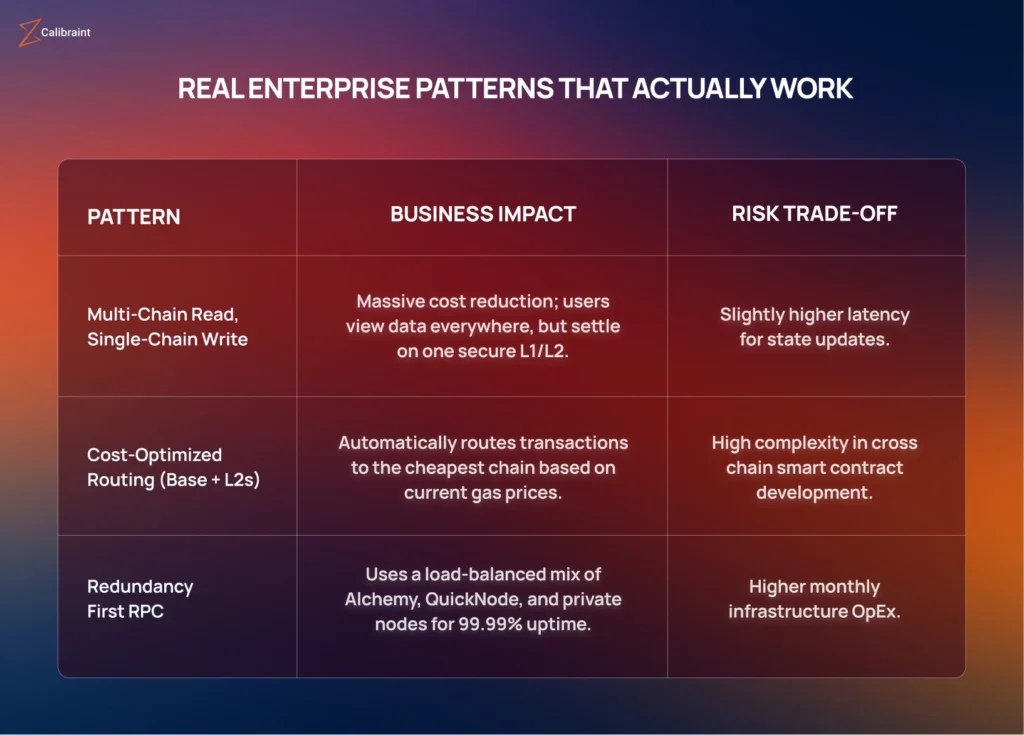
6. Real Enterprise Patterns That Actually Work
At Calibraint, we advocate for proven architectural patterns over experimental “bleeding-edge” hacks. For a robust multi chain dapp development strategy, we typically deploy one of three patterns:
These patterns ensure that your multi chain dapp development effort results in a platform that is resilient to network-specific outages and gas spikes.
7. Where Calibraint Enters the Equation
DApp Development at the enterprise level requires more than just coding proficiency; it requires a deep understanding of the economic and structural trade-offs inherent in Web3. At Calibraint, we don’t just act as a vendor; we act as your Architecture Partner.
Our approach to multi chain dapp development focuses on long-term scale and enterprise governance. We help founders navigate the ethereum vs solana development costs debate by providing data-driven projections that account for both initial build and 3-year maintenance. By focusing on cross chain smart contract development with a rigorous audit-first methodology, we ensure your platform is built on a foundation of risk containment rather than experimentation. From base network dapp deployment to complex L2 migrations, we enable cost-aware execution that aligns with your fiscal goals.
8. Cost, Timeline, and Strategic Trade-Offs
When we discuss multi chain dapp development, we look at decision ranges. An MVP might take 3 months, but a production-grade, multi-chain ecosystem is a 6-to-12-month commitment.
Ethereum vs. Solana Development Costs: Generally, Ethereum-based (EVM) development benefits from a wider talent pool and reusable libraries, often making the initial build faster. Solana requires more specialized Rust engineering, which can increase the initial cost by 20–30%, but offers significantly lower ongoing transaction costs.
L2 Savings vs. Operational Overhead: Deploying on Base or other L2s can reduce gas costs by 95%, but it introduces the need for sophisticated monitoring and cross-chain messaging infrastructure.
Timeline Slippage: In cross-chain builds, timelines usually slip due to “Integration Debt”, the time spent ensuring that different chains’ finality rules don’t break your application logic.
9. Red Flags Enterprises Should Watch Before Committing
Before you sign off on a multi chain dapp development proposal, watch for these “red flags” that indicate a lack of enterprise readiness:
Tool-First Vendors: If a vendor suggests a specific chain before understanding your transaction volume and security needs, they are selling a tool, not a solution.
RPC-Agnostic Claims: Any provider claiming that “RPC doesn’t matter” is ignoring the single biggest cause of production downtime.
Underpriced Proposals: Low-cost bids often ignore the necessity of layer2 blockchain comparison and post-launch optimization, leading to massive “hidden” costs six months after launch.
No Post-Launch Plan: Web3 infrastructure is living. If there is no plan for protocol upgrades or liquidity migration, the DApp is dead on arrival.
10. Final Executive Call to Action
The window for “experimental” Web3 is closed. In 2026, the winners are those who build with architectural foresight and cost-efficiency. Multi chain dapp development is the path to global scale, provided it is executed with a focus on risk management and infrastructure stability.
Enterprises that stay ahead are already aligning their roadmap with emerging DApp development trends in 2026, ensuring their platforms are future-ready rather than retrofitted under pressure.
Are you ready to move from a single-chain bottleneck to a resilient, multi-chain ecosystem?
1. What is the average cost to deploy a DApp on Ethereum vs Solana in 2026?
On Ethereum mainnet, deploying smart contracts can cost from ~$50 to several hundred dollars in gas depending on complexity, and running your dApp incurs variable gas fees often $1–$50+ per transaction without rollups. On Solana, base-layer program deployment and transaction costs are extremely low (often sub-$1 for deploy and <$0.01 per transaction) due to high throughput and cheap gas. Overall, Solana is far cheaper than Ethereum L1 for deployment and user interactions.
2. Which Layer 2 solutions are best for multi-chain DApp development?
Top Layer 2s for multi-chain DApp development include: Arbitrum – Optimistic rollup with strong DeFi adoption. Optimism – Developer-friendly and easy Ethereum integration. Polygon / Polygon zkEVM – Multi-chain ecosystem and EVM-compatible. zkSync and StarkNet – ZK-rollups with very low fees and fast finality. Base – Coinbase-backed L2 with low costs and strong tooling. These rollups reduce Ethereum costs while maintaining security and ease cross-chain expansion
3. How does Base network compare to Ethereum for DApp development costs?
Base is an Ethereum Layer 2 built on Optimistic Rollup tech that offers much lower transaction fees and faster execution than Ethereum’s base layer. It inherits Ethereum security but processes transactions off-chain, cutting costs drastically and making smart contract deployment and testing far more affordable than on Ethereum L1.
Calibraint
Author
January 9, 2026
Let's Start A Conversation
Manage Consent
To provide the best experiences, we use technologies like cookies to store and/or access device information. Consenting to these technologies will allow us to process data such as browsing behavior or unique IDs on this site. Not consenting or withdrawing consent, may adversely affect certain features and functions.
Functional
Always active
The technical storage or access is strictly necessary for the legitimate purpose of enabling the use of a specific service explicitly requested by the subscriber or user, or for the sole purpose of carrying out the transmission of a communication over an electronic communications network.
Preferences
The technical storage or access is necessary for the legitimate purpose of storing preferences that are not requested by the subscriber or user.
Statistics
The technical storage or access that is used exclusively for statistical purposes.The technical storage or access that is used exclusively for anonymous statistical purposes. Without a subpoena, voluntary compliance on the part of your Internet Service Provider, or additional records from a third party, information stored or retrieved for this purpose alone cannot usually be used to identify you.
Marketing
The technical storage or access is required to create user profiles to send advertising, or to track the user on a website or across several websites for similar marketing purposes.