Why Real Estate Tokenization Projects Failed in 2025: 7 Legal Pitfalls to Avoid in 2026
Calibraint
Author
January 5, 2026
Last updated: March 2, 2026
Real estate tokenization legal pitfalls defined the landscape of 2025, transforming what was once seen as a frictionless frontier into a graveyard of stalled platforms and frozen capital. For enterprise leaders, the lessons of the past twelve months are clear: regulatory ambiguity is no longer an excuse for technical oversight. Projects that prioritized speed over structural integrity faced immediate enforcement actions, platform shutdowns, and debilitating investor litigation.
As we enter 2026, the margin for error has vanished. Institutional capital now expects tokenized real estate initiatives to be built on enterprise-gradeRWA development frameworks that embed legal, compliance, and asset governance layers from day one. This shift mirrors the broader evolution of tokenizing real-world assets through secure smart contracts and scalable markets, where legal enforceability is engineered, not assumed, mitigating Real Estate Tokenization Compliance Failures 2025 rather than reacting to them post-launch.
The failures of 2025 were not primarily technical. They were failures of governance and architecture, driven largely by regulatory and governance challenges in real estate tokenization. Enterprises that ignored the complexity of Securities Regulation Tokenized Real Estate found themselves unable to offboard investors or distribute dividends without triggering SEC or ESMA inquiries. This resulted in significant capital lock-in, where assets were technically tokenized but legally untradeable. To protect your ROI and institutional reputation in 2026, your strategy must transition from experimental “pilot” thinking to rigorous, compliance-first execution.
Decision-Maker Filter: Who This Affects
This analysis is specifically designed for stakeholders managing regulated capital or building institutional-grade infrastructure:
CTOs architecting RWA platforms who must ensure code enforces legal logic.
Founders and CEOs seeking to launch RWA products without risking long-term litigation.
Product Heads scaling platforms to accommodate cross-border institutional investors.
Compliance and Risk Leaders tasked with vetting the regulatory viability of blockchain initiatives.
If you manage regulated capital, cross-border investors, or tokenized real estate offerings, the following insights apply directly to your 2026 roadmap.
Solution Snapshot with Enterprise Value
RWA Development at the enterprise level is a discipline that merges high-performance blockchain engineering with a deep understanding of global financial laws. By aligning your technical architecture with existing securities frameworks from day one, you achieve faster regulatory approvals and significantly lower enforcement risk.
Successful real estate tokenization legal pitfalls avoidance starts with a platform that treats compliance as a core feature rather than a secondary plugin. For Calibraint, serving as an execution partner means building systems where institutional trust is hardcoded. This approach ensures that your tokens are recognized as valid legal instruments across jurisdictions, facilitating smoother secondary market liquidity and protecting your business from the catastrophic Real Estate Tokenization Compliance Failures 2025 seen by early movers. As outlined in our deep dive on tokenizing real-world assets using secure smart contracts at scale, compliance-aware token logic is the foundation that connects blockchain execution with enforceable real-world ownership rights.
The 7 Legal Pitfalls That Caused 2025 Failures
1. Misclassification Under Securities Laws
The most common of the real estate tokenization legal pitfalls in 2025 was the attempt to classify tokens as “utility” or “fractional ownership” without acknowledging they are investment contracts. Failing to adhere to Securities Regulation Tokenized Real Estate requirements led to immediate cease-and-desist orders. In 2026, every real estate token must be treated as a security until proven otherwise.
2. Weak Investor Accreditation Checks
Many platforms failed because they allowed non-accredited investors into private placements. This breach of Blockchain Property Investment Legal Risks led to the rescission of offerings, where platforms were legally forced to buy back tokens at the original price, even if the underlying asset value had dropped.
3. Incomplete AML and KYC Enforcement
Real Estate Token AML KYC Requirements are not a one-time check at onboarding. Failed 2025 projects lacked “on-chain” identity verification, allowing tokens to be transferred to unverified wallets in secondary markets. This lack of control triggered massive anti-money laundering investigations.
4. Jurisdictional Conflicts in Cross-Border Offerings
Enterprises often launched tokens accessible globally without considering that a token legal in the UAE might be an unregistered security in the US or Germany. These Real Estate Tokenization Compliance Failures 2025 resulted in fragmented liquidity and locked assets as platforms scrambled to block specific IP addresses post-launch.
5. Improper Custody and Transfer Restrictions
Blockchain Property Investment Legal Risks often materialize during the transfer of ownership. If the smart contract does not reflect the physical deed’s legal restrictions, the “digital twin” becomes a legal fiction. Failed projects lacked the “forced transfer” and “burn” capabilities required for court-ordered asset seizures or death-of-holder scenarios.
6. Reliance on Off-Chain Legal Wrappers
Many 2025 failures stemmed from a “broken link” between the digital token and the legal SPV (Special Purpose Vehicle). If the smart contract doesn’t programmatically enforce the rights described in the legal prospectus, the token holds no real-world value, leading to investor lawsuits.
7. Neglecting Continuous Disclosure Requirements
Securities Regulation Tokenized Real Estate requires ongoing reporting. Platforms that failed to build automated reporting tools into their dashboard were unable to meet the transparency standards required by regulators, leading to the suspension of trading licenses.
Enterprise Impact Scenarios & Outcomes
Scenario A: The Multi-Jurisdictional Liquidity Freeze
An asset manager tokenized a commercial portfolio across Europe and Asia. However, the architecture failed to account for varying Real Estate Token AML KYC Requirements between regions. When an investor in Singapore tried to sell to a buyer in France, the transaction triggered a regulatory red flag. Impact: The entire secondary market for the asset was frozen for nine months, leading to a 40% exit of institutional partners.
Scenario B: The SEC Registration Trap
A fintech startup ignored Securities Regulation Tokenized Real Estate norms, labeling their token a “co-op membership.” The SEC disagreed, labeling it an unregistered security. Impact: The company was fined $2.5 million and forced to refund all investors, effectively bankrupting the platform despite the underlying real estate performing well.
Scenario C: Data Privacy vs. Transparency Conflict
A platform published investor KYC data partially on a public ledger to prove compliance. This violated GDPR and other Blockchain Property Investment Legal Risks related to consumer privacy. Impact: Massive class-action litigation from investors and a total platform shutdown by EU regulators.
Scenario D: The “Zombie” Token
An enterprise failed to address real estate tokenization legal pitfalls regarding the legal transfer of the physical deed. The tokens were sold, but the local land registry did not recognize the blockchain as a source of truth. Impact: Token holders discovered they had no legal claim to the building, leading to total loss of investor trust and a permanent stain on the enterprise’s reputation.
Implementation Approach That Prevents Failure
RWA Development at Calibraint is governed by a “Regulation-First” methodology. We do not write a single line of code until the legal logic is mapped. This involves:
Embedded AML and KYC Enforcement: We integrate decentralized identity (DID) and reusable KYC into the smart contract level to ensure Real Estate Token AML KYC Requirements are met for every single peer-to-peer transfer.
Jurisdiction-Aware Token Logic: Our architecture allows for “programmable compliance,” where transfer rules can be updated in real-time as global laws evolve.
Audit-Ready Workflows: Every transaction and compliance check is logged in a tamper-proof manner, making regulatory audits a matter of hours, not months.
Alignment with Global Frameworks: We build with an eye on MiCA (EU), the SEC (US), and VARA (Dubai) to ensure your asset remains liquid and legal across borders.
This strategic rigor effectively eliminates the Real Estate Tokenization Compliance Failures 2025 that decimated less prepared organizations.
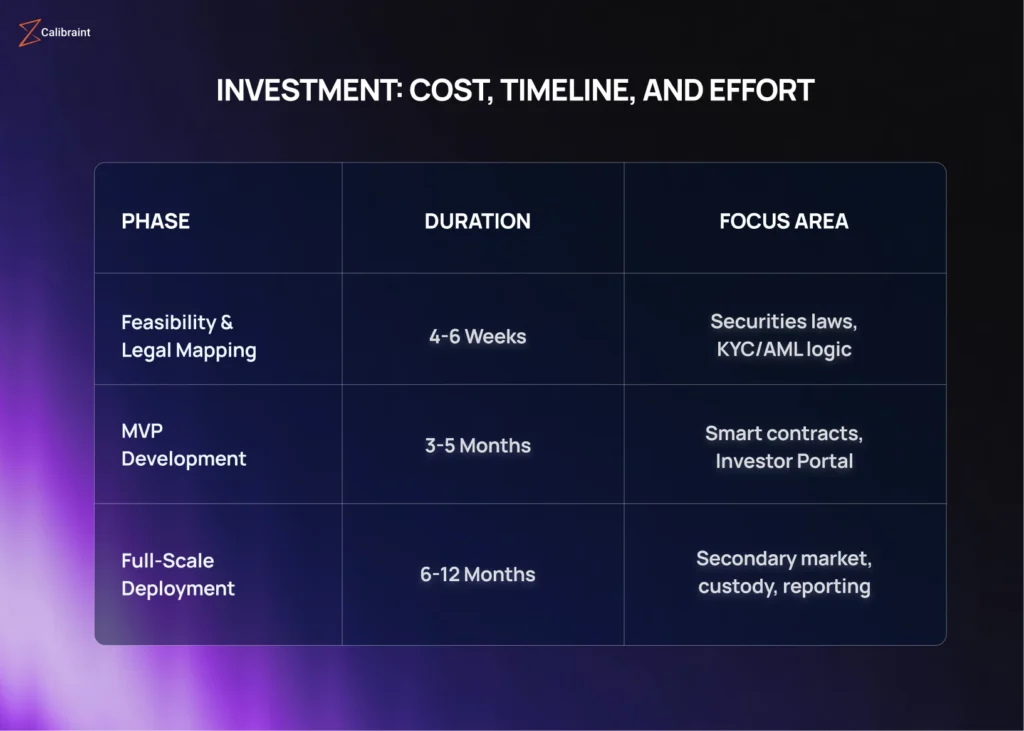
Cost, Timeline, and Compliance Effort
Navigating real estate tokenization legal pitfalls requires a realistic investment in both time and capital.
The compliance effort typically accounts for 30% of the total project timeline. Cutting corners here is what led to the Real Estate Tokenization Compliance Failures 2025; investing in it now is the only way to ensure 2026 success.
What Goes Wrong Without the Right Partner
Working with a generalist blockchain vendor rather than an RWA specialist leads to five critical enterprise mistakes:
Legal assumptions instead of validation: Builders guess at regulatory needs rather than following a legal-technical blueprint.
Token models built before compliance mapping: The code is finished before the lawyers have even seen the transfer logic.
Weak audit and reporting readiness: The system cannot produce the data regulators demand during an inquiry.
Inflexible jurisdiction handling: The platform is locked into one region, killing global scalability.
No long-term regulatory adaptation plan: The software is static and becomes illegal the moment a new law is passed.
Why Calibraint
At Calibraint, we specialize in Enterprise Blockchain Implementation that prioritizes the bottom line and regulatory safety. Our history in RWA and tokenization is built on helping firms navigate the Blockchain Property Investment Legal Risks that sink others. We don’t just build technology; we build institutional-grade financial infrastructure.
For more insights on how we approach complex builds, read our latest analysis on The Future of RWA Tokenization or explore our guide to Institutional Digital Asset Custody.
Take the Next Step
The era of “moving fast and breaking things” in real estate tokenization is over. Success in 2026 requires a partner who understands that the code is the contract, but the law is the judge. Enterprises that want to scale confidently must align legal structure, smart contract logic, and asset governance into a single execution model. If you are evaluating your next move, our perspective on tokenizing real-world assets with secure smart contracts and scalable institutional markets provides a practical blueprint for building compliant, regulator-ready RWA platforms.
1. Why did real estate tokenization projects fail in 2025?
Most failures were caused by real estate tokenization legal pitfalls, specifically the misclassification of tokens as utility assets rather than securities. Many platforms collapsed due to Real Estate Tokenization Compliance Failures 2025, where weak on-chain KYC/AML enforcement and a lack of legal “wrappers” (like SPVs) left investors with tokens that held no enforceable claim to the physical property.
2. What are the main legal requirements for launching a compliant real estate tokenization platform in 2026?
A compliant platform must adhere to Securities Regulation Tokenized Real Estate standards, including mandatory registration or exemptions (e.g., Regulation D or MiCA). Key requirements include automated Real Estate Token AML KYC Requirements, verified investor accreditation, and a robust legal structure that links digital tokens to beneficial ownership in a regulated entity or trust.
3. How can real estate tokenization projects avoid securities law violations in 2026?
To mitigate Blockchain Property Investment Legal Risks, projects should implement a “regulation-first” architecture. This involves embedding transfer restrictions directly into the smart contract to ensure tokens only move between verified, eligible wallets. Partnering with an expert in RWA Development ensures your technical roadmap aligns with local securities laws and disclosure mandates from day one.
Calibraint
Author
January 5, 2026
Last updated: March 2, 2026
Let's Start A Conversation
Manage Consent
To provide the best experiences, we use technologies like cookies to store and/or access device information. Consenting to these technologies will allow us to process data such as browsing behavior or unique IDs on this site. Not consenting or withdrawing consent, may adversely affect certain features and functions.
Functional
Always active
The technical storage or access is strictly necessary for the legitimate purpose of enabling the use of a specific service explicitly requested by the subscriber or user, or for the sole purpose of carrying out the transmission of a communication over an electronic communications network.
Preferences
The technical storage or access is necessary for the legitimate purpose of storing preferences that are not requested by the subscriber or user.
Statistics
The technical storage or access that is used exclusively for statistical purposes.The technical storage or access that is used exclusively for anonymous statistical purposes. Without a subpoena, voluntary compliance on the part of your Internet Service Provider, or additional records from a third party, information stored or retrieved for this purpose alone cannot usually be used to identify you.
Marketing
The technical storage or access is required to create user profiles to send advertising, or to track the user on a website or across several websites for similar marketing purposes.