REITS vs Fractional Real Estate Liquidity: Navigating Enterprise Secondary Markets in 2026
Calibraint
Author
December 31, 2025
REITs vs Fractional Real Estate Liquidity remains the pivotal debate for institutional leaders managing large-scale property portfolios in 2026. As market volatility persists, the traditional liquidity premiums associated with Real Estate Investment Trusts are being challenged by the rapid maturation of fractionalized assets. This shift is being accelerated by enterprise-grade RWA development, where real-world assets are tokenized to unlock programmable liquidity, faster settlement cycles, and compliant secondary trading.
What increasingly differentiates winning platforms is not yield optimization but exit engineering. As outlined in this fractional real estate liquidity exit guide, institutional-grade liquidity depends on how redemption flows, secondary pricing, and settlement logic are architected under stress. For enterprise-level investment platforms and asset management firms, the choice between these models is no longer about asset preference; it is about mitigating systematic fractional real estate redemption risk while maintaining the agility required for secondary market dominance. Institutional investors are shifting focus from simple yield to the mechanics of exit, where the spread between net asset value and secondary market price can make or break a fiscal year.
If you manage multi-asset portfolios, oversee complex institutional real estate investments, or are responsible for enterprise-scale capital allocation, the quantitative differences in REITs vs Fractional Real Estate Liquidity detailed below will directly impact your 2026–2030 roadmap.
RWA Development: A Catalyst for Enterprise Liquidity
RWA Development is the technical cornerstone for firms looking to solve the liquidity gap. Rather than relying on the fragmented and often opaque secondary markets of the past, enterprise-grade development of Real-World Assets allows for the programmatic enforcement of liquidity rules. When comparing REITS vs Fractional Real Estate Liquidity, the integration of automated market makers and high-throughput ledgers ensures that fractional owners are not left stranded during periods of high redemption demand. This approach directly mitigates fractional property ownership liquidity risk by creating a structured, transparent environment for asset exchange. For the enterprise, this translates to improved ROI through lower liquidity discounts and a more robust buffer against market-wide shocks.
For a deeper breakdown of exit mechanics and secondary market design, this fractional real estate liquidity and exit strategy guide outlines how enterprises can structure predictable exits without sacrificing compliance.
This approach directly mitigates fractional property ownership liquidity risk by creating a structured, transparent environment for asset exchange. For the enterprise, this translates to improved ROI through lower liquidity discounts and a more robust buffer against market-wide shocks.
Key Decision Drivers for Institutional Portfolios
When evaluating your strategy for REITS vs Fractional Real Estate Liquidity, five business-focused drivers must guide your technical and financial architecture:
ROI and Revenue Predictability: While REITs secondary market liquidity 2026 is often higher due to public exchange listing, the management fees and market correlations can erode net returns. Fractional models, when executed correctly, allow for higher precision in asset selection and direct revenue pass-through.
Time-to-Market for Secondary Strategies: Building a proprietary secondary market for fractional assets requires a sophisticated tech stack. However, the ability to control the “exit” experience for your investors is a significant competitive advantage.
Scalability Across Portfolios: Large enterprises must ensure that their liquidity solutions can handle thousands of concurrent transactions without slippage.
Compliance and Audit-Readiness: Both models face scrutiny, but fractional real estate redemption risk requires a more rigorous automated compliance framework to satisfy institutional auditors.
Operational Efficiency: Eliminating manual reconciliation in the redemption process is non-negotiable for 500+ employee firms.
Enterprise Use Cases & Outcomes
Scenario A: The Institutional Asset Manager
An institutional firm managing $2B in commercial assets faced significant fractional property ownership liquidity risk due to a lack of a secondary trading venue. By shifting to a private, high-speed exchange model, they achieved a 40% reduction in redemption wait times. The quantitative shift in REITS vs Fractional Real Estate Liquidity allowed them to offer “liquid-plus” products that outperformed traditional REITs in a down market.
Scenario B: The Fintech PropTech Scale-up
A fintech leader sought to capture the REITs secondary market liquidity 2026 trend by launching a hybrid fund. The challenge was balancing immediate liquidity with the underlying illiquidity of the properties. Through a custom secondary market engine, they successfully managed $500M in volume with less than 1% price impact.
Scenario C: Real Estate Investment Platform
A global platform needed to address fractional real estate redemption risk across multiple jurisdictions. By implementing a standardized settlement protocol, they reduced cross-border transaction costs by 25% and stabilized their liquidity pool during a period of rising interest rates.
Implementation Approach: Engineering for Certainty
At Calibraint, our execution model for REITS vs Fractional Real Estate Liquidity infrastructure is architecture-first. We recognize that for an enterprise with 500+ employees, a “plug-and-play” solution is rarely sufficient. Our strategy focuses on:
Modular Architecture: Ensuring your liquidity engine can interface with existing ERP and core banking systems.
Risk Mitigation Layers: Building automated circuit breakers to manage fractional property ownership liquidity risk during black-swan events.
Integration Strategy: Seamlessly connecting your platform to the REITs secondary market liquidity 2026 ecosystem or independent liquidity providers.
RWA Development must be treated as a mission-critical financial system. Our implementation roadmap ensures that as you scale, your secondary market remains a source of strength rather than a liability. We focus on the tech stack that supports high-frequency valuation updates, which is essential to maintaining the balance in REITS vs Fractional Real Estate Liquidity.
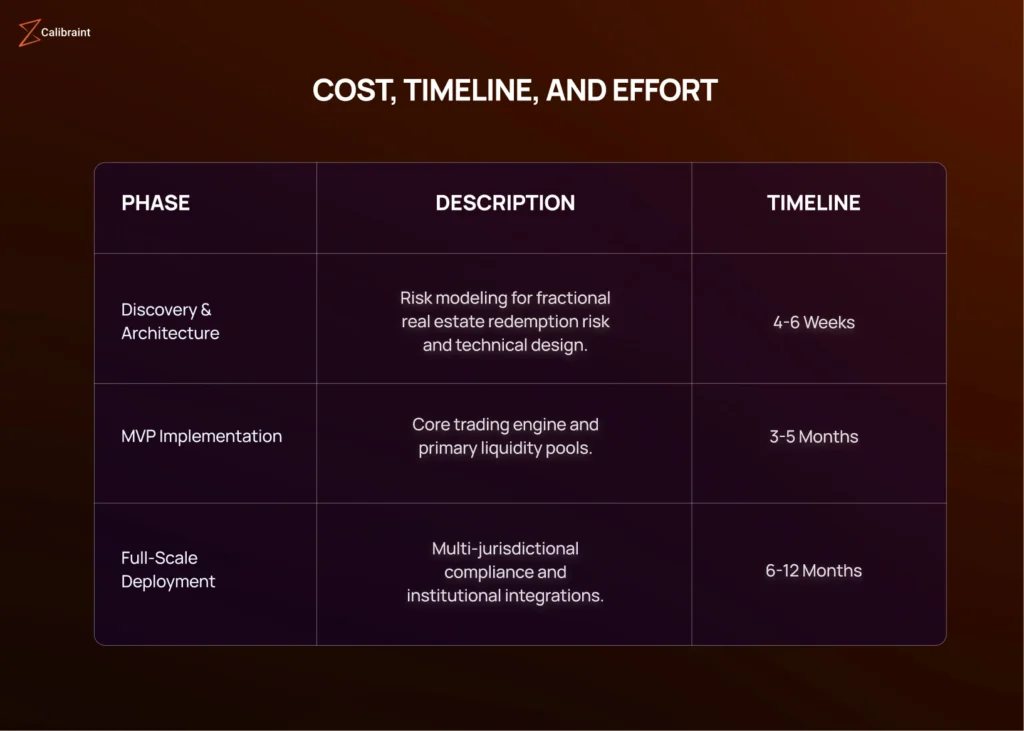
Cost, Timeline, and Effort
Transitioning to or building a high-liquidity real estate platform requires a clear understanding of the investment involved.
Managing the nuances of REITS vs Fractional Real Estate Liquidity at scale is an iterative process. REITs secondary market liquidity 2026 benchmarks suggest that systems must be capable of sub-second execution to remain competitive.
Common Enterprise Pitfalls Without the Right Partner
Even the most sophisticated teams can stumble when bridging the gap between REITS vs Fractional Real Estate Liquidity. Common failures include:
Poor Architecture: Failing to account for the spike in fractional property ownership liquidity risk during market downturns.
Inaccurate Cost Estimation: Underestimating the long-term maintenance of a secondary market.
Weak Security Planning: Leaving institutional assets vulnerable to smart contract or API exploits.
Scalability Issues: Systems that crash when transaction volume exceeds 1,000 TPS.
No Long-Term Optimization Plan: Failing to evolve with the changing landscape of REITs secondary market liquidity 2026.
Why Calibraint for Your Liquidity Strategy?
Calibraint operates where institutional finance meets production-grade engineering. We design and deploy enterprise liquidity infrastructure, not experimental platforms. Our proven expertise in RWA development enables your organization to operationalize REITs vs Fractional Real Estate Liquidity decisions with measurable confidence, regulatory alignment, and long-term scalability.
For CTOs and Product Heads, success means building systems that disappear into reliability. Platforms that settle faster, scale without friction, and manage fractional real estate redemption risk algorithmically rather than operationally. Through enterprise blockchain implementations and precision-driven software roadmaps, we help transform secondary market liquidity from a structural risk into a controllable advantage.
The question is no longer whether REITs or fractional real estate will dominate liquidity strategies. The real question is whether your infrastructure is engineered to earn institutional trust at scale. Calibraint builds that foundation.
FAQ
1. How does liquidity of fractional real estate compare to publicly traded REITs in 2026?
Publicly traded REITs offer superior liquidity because they are listed on major stock exchanges, allowing for near-instant execution during trading hours. In contrast, REITS vs Fractional Real Estate Liquidity data shows that fractional ownership is maturing but remains less liquid. While 2026 has seen the rise of secondary marketplaces and SM REIT regulations that improve exit options, fractional assets still typically require a multi-day or multi-week window to match buyers and sellers.
2. What are the main redemption risks when investing in fractional property ownership vs REITs?
The primary fractional real estate redemption risk is “market thinness”, the possibility that there are no active buyers on a platform’s secondary market when you need to exit, potentially forcing a sale at a steep discount. REITs, while highly liquid, face “market volatility risk,” where their share price can decouple from the underlying property value due to broader stock market sentiment. Fractional ownership also carries a higher “lock-up risk,” as many SPV structures have defined holding periods of 5–10 years.
3. Are REITs or fractional real estate better for investors who may need to exit quickly?
REITs are the clear choice for investors prioritizing an immediate exit. Because they trade like equities, you can liquidate a position in seconds. Fractional real estate is designed as a long-term yield play; even with RWA Development improving secondary market speed, the process is not yet instantaneous. If your capital allocation strategy requires the ability to pivot within a single fiscal quarter, the REITs secondary market liquidity 2026 infrastructure provides the necessary agility that fractional models currently lack.
4. What is the impact of high-interest rates on REITs secondary market liquidity 2026 compared to fractional assets?
High-interest rates generally increase REITs secondary market liquidity 2026 volatility, as institutional investors often rotate out of REITs and into bonds when yields rise, leading to sudden price drops. Fractional real estate, however, is more insulated from daily interest rate sentiment because it does not trade on public exchanges. While higher rates may increase the fractional real estate redemption risk by cooling the overall property market, the private nature of these assets prevents the “panic selling” often seen in REITs, making them a more stable though less liquid alternative during inflationary cycles.
Calibraint
Author
December 31, 2025
Let's Start A Conversation
Manage Consent
To provide the best experiences, we use technologies like cookies to store and/or access device information. Consenting to these technologies will allow us to process data such as browsing behavior or unique IDs on this site. Not consenting or withdrawing consent, may adversely affect certain features and functions.
Functional
Always active
The technical storage or access is strictly necessary for the legitimate purpose of enabling the use of a specific service explicitly requested by the subscriber or user, or for the sole purpose of carrying out the transmission of a communication over an electronic communications network.
Preferences
The technical storage or access is necessary for the legitimate purpose of storing preferences that are not requested by the subscriber or user.
Statistics
The technical storage or access that is used exclusively for statistical purposes.The technical storage or access that is used exclusively for anonymous statistical purposes. Without a subpoena, voluntary compliance on the part of your Internet Service Provider, or additional records from a third party, information stored or retrieved for this purpose alone cannot usually be used to identify you.
Marketing
The technical storage or access is required to create user profiles to send advertising, or to track the user on a website or across several websites for similar marketing purposes.