Web3 Investment Strategies 2026: How to Allocate to Tokenized Real Estate and DePIN Infrastructure for Risk-Adjusted Returns
Calibraint
Author
February 13, 2026
Last updated: March 2, 2026
You’ve built a solid portfolio over the years. Maybe it’s heavy in Bitcoin and Ethereum, with a dash of altcoins that once promised the world. But as we step into 2026, you’re asking the right questions: Where does real, sustainable value come from in Web3? How do I protect against the wild swings while capturing upside from actual infrastructure?
This is where the conversation shifts. 2026 marks a turning point in web3 investment strategies 2026, one where speculative tokens give way to assets backed by tangible cash flows and real-world utility. Two categories stand out for serious capital allocation: tokenized real estate and DePIN networks. These aren’t just trends; they’re infrastructure plays that deliver risk-adjusted returns through yield, diversification, and maturity.
In this guide, we’ll walk through why traditional crypto portfolios often underdeliver on a risk-adjusted basis. We’ll explore how tokenized real estate investment and DePIN infrastructure solve those gaps. And we’ll map out practical allocation strategies tailored for Web3 founders, crypto-native VCs, HNIs, and enterprise leaders like you.
The Shortcomings of Traditional Crypto Portfolios
If you’ve been in this space long enough, you know the pattern. A bull run lifts everything, but when the tide goes out, volatility exposes the lack of fundamentals. Most portfolios are 70-80% correlated to Bitcoin’s price action. That’s fine for alpha chasers, but for risk-adjusted returns? It leaves a lot to be desired.
Data from the past cycles shows it clearly. Pure crypto allocations delivered strong nominal returns but with Sharpe ratios often below 0.8 far from the 1.2+ you’d expect from balanced traditional portfolios. The issue? No underlying yield. No cash flow stability. Just narrative-driven price discovery.
That’s changing. In 2026, the smartest allocators are carving out 15-25% of their Web3 exposure for assets that generate real income and serve real demand. Tokenized real estate investment and DePIN infrastructure are leading that charge.
Why Tokenized Real Estate and DePIN Deserve Your Attention in 2026
The maturation of blockchain infrastructure has unlocked something powerful: the ability to bring illiquid, high-value real-world assets on-chain while maintaining compliance and efficiency.
Tokenized real estate investment turns physical property into divisible, tradable digital assets. You can own a slice of a commercial building in Dubai or a rental portfolio in Singapore starting from as little as $1,000 without the headaches of direct ownership.
DePIN, or Decentralized Physical Infrastructure Networks, does the same for tech infrastructure. Think wireless networks, data storage, and compute power powered by thousands of individual nodes instead of centralized giants.
Together, they address the core weaknesses of legacy crypto: volatility, lack of utility, and disconnection from the real economy.
Web3 investment strategies 2026 now prioritize these categories because they offer something rare in digital assets: predictable yields backed by physical demand.
What Makes Tokenized Real Estate Attractive for Long-Term Investors in 2026?
You’re probably wondering: Why now? What’s different in 2026?
The answer lies in three converging forces: regulatory clarity, technological readiness, and institutional inflows.
First, platforms have solved the fractional ownership puzzle. Through RWA tokenized real estate, a single luxury apartment can be divided into 10,000 tokens, each representing verifiable ownership rights, rental income, and governance. Smart contracts automate dividend distributions often daily or weekly directly to your wallet.
Second, liquidity has improved dramatically. Secondary markets now handle billions in monthly volume, with settlement times measured in seconds rather than months. This isn’t theoretical; projects like those inspired by Red Swan and Kin Capital have tokenized over $2 billion in commercial real estate, delivering yields of 8-15% in stablecoins.
Third, the risk profile has matured. In 2026, tokenized assets benefited from hybrid legal structures SPVs in jurisdictions like Luxembourg and Singapore that align on-chain ownership with off-chain rights. An EY survey from late 2025 showed 56% of institutions planning real estate allocations within tokenized formats, citing lower transaction costs and global access as key drivers.
For long-term investors, this means portfolio stability. Tokenized real estate investment correlates more with global property cycles than crypto sentiment, providing a natural hedge.
How Does DePIN Infrastructure Generate Real-World Value?
DePIN takes the same tokenization logic and applies it to physical networks. Instead of relying on AWS or Verizon, these projects crowdsource hardware from individuals and enterprises.
Take wireless connectivity. Networks like Helium have deployed millions of hotspots worldwide, earning revenue from IoT data transmission. In 2026, DePIN revenue hit record highs over $150 million in January alone driven by AI compute demand and enterprise adoption.
DePin crypto Projects in storage (Filecoin), rendering (Render), and mapping (Hivemapper) are no longer experiments. They deliver measurable utility: cheaper bandwidth, decentralized AI training, and resilient infrastructure in emerging markets.
The value creation is straightforward. Participants earn tokens for contributing hardware and bandwidth. Demand from real users, telcos, AI firms, and logistics companies pays the bills. This creates sustainable token economics, unlike pure utility tokens that rely on speculation.
DePin investment 2026 is about backing networks that solve trillion-dollar problems in connectivity and compute. The sector’s market cap crossed $30 billion in 2025, with projections pointing to $3.5 trillion in addressable infrastructure by 2028.
Addressing the Concerns: Liquidity, Regulation, and Sustainability
No serious investor ignores risks. Let’s tackle the big ones head-on.
Liquidity: Traditional real estate is notoriously illiquid. Tokenized versions flip the script. You can exit positions on decentralized exchanges or compliant platforms within minutes. DePIN tokens trade on major venues with growing depth, supported by real usage metrics.
Regulation: 2026 brings clearer frameworks. The EU’s MiCA, U.S. policy shifts, and Asia’s sandboxes have reduced uncertainty. RWA tokenized real estate platforms now integrate KYC and AML natively, making them suitable for institutional mandates.
Infrastructure risk: Smart contract audits and multi-chain designs have minimized exploits. Yield sustainability comes from underlying demand rents for real estate, data fees for DePIN.
DePin investment 2026 still carries execution risk, but the shift to revenue-positive models has de-risked the category significantly.
Are Tokenized RWAs Safer Than Traditional Crypto Assets?
Yes, in many ways, when structured properly.
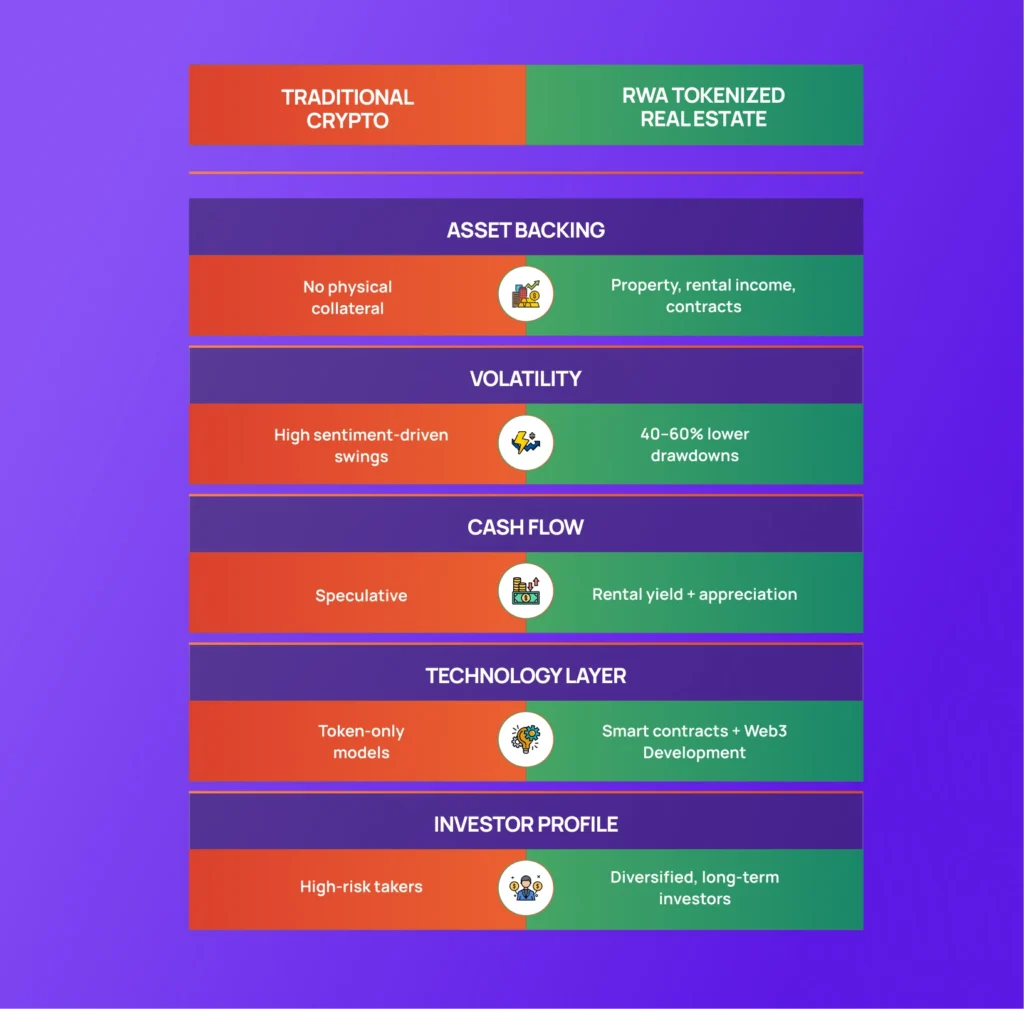
RWA tokenized real estate benefits from underlying collateral: bricks, mortar, and rental contracts. This creates a floor that pure crypto rarely has. Volatility is lower because price discovery ties to real-world appraisals and cash flows.
Traditional crypto assets, by contrast, often trade on sentiment alone. RWAs built using mature web3 development practices have shown 40–60% lower drawdowns in stressed market conditions.
That said, they’re not risk-free. Platform risk and regulatory shifts exist. But for diversified portfolios, they enhance safety through correlation benefits.
How Do Institutional Investors View DePIN and RWA Investments?
Institutions are all in. BlackRock, Franklin Templeton, and pension funds have tokenized funds exceeding $10 billion in AUM. They see DePin crypto Projects as the backbone for Web3’s next phase providing the compute and connectivity that AI demands.
For RWAs, the appeal is yield plus appreciation. Surveys show 7-9% of portfolios shifting to tokenized real estate by 2027. The view? These are “crypto with training wheels”, digital access to proven asset classes.
Web3 investment strategies 2026 from family offices now routinely include 10-20% in these categories for their inflation-hedging and income properties.
What Role Does Blockchain Infrastructure Play in Web3 Portfolio Diversification?
Blockchain infrastructure is the quiet enabler. It’s what makes fractional ownership possible, automates compliance, and ensures transparency.
In Web3 Development, we see platforms evolving to handle complex RWAs and DePIN coordination. This layer reduces counterparty risk and unlocks composability, your tokenized property can collateralize DeFi loans, for instance.
For diversification, blockchain infrastructure lowers the barrier to global exposure. You’re no longer limited to local markets. A single allocation can span continents, asset types, and yield profiles.
DePin investment 2026 amplifies this by tying digital returns to physical expansion. It’s diversification at its most fundamental.
Building Your 2026 Allocation Framework
Here’s a practical model for risk-adjusted returns:
Core (60-70%): Bitcoin and blue-chip Layer 1s for growth.
Yield Layer (15-20%): Tokenized real estate investment via compliant platforms (target 8-12% yields).
Infrastructure (10-15%): DePIN networks focused on revenue-generating verticals like compute and wireless.
Tactical (5-10%): Early-stage DePin crypto Projects with strong fundamentals.
Rebalance quarterly based on utilization metrics and macro signals. Stress-test for 30% crypto drawdowns, your RWA and DePIN holdings should buffer that.
RWA tokenized real estate shines in downturns, while DePIN scales with AI adoption.
At this stage, many investors realize they need expert guidance to implement these strategies. Calibraint specializes in Web3 Development for tokenized platforms and DePIN networks. If you’re ready to move from theory to execution, let’s discuss building or investing in these assets.
FAQ: Your Questions on Tokenized Real Estate and DePIN in 2026
What are the main risks of investing in tokenized real estate and DePIN in 2026?
The primary risks include smart contract vulnerabilities (mitigated by audits), regulatory changes (addressed through jurisdictional alignment), and adoption lag (countered by focusing on revenue-positive projects). For tokenized real estate investment, valuation disputes can arise, but oracles and third-party appraisers help. In DePIN, hardware costs and competition exist, but real demand from enterprises reduces this. Overall, these are lower than pure crypto risks due to tangible backing.
Is DePIN a good investment in 2026 and what are the top projects?
Yes, for investors seeking utility and growth. DePin investment 2026 rewards networks with proven traction. Top DePin crypto Projects include Render (GPU compute for AI), Helium (wireless coverage), Filecoin (decentralized storage), and Grass (decentralized data scraping). Look for projects with high device counts, enterprise partnerships, and sustainable tokenomics. Allocate based on revenue multiples, not hype.
How to allocate a portfolio to tokenized real estate and DePIN for risk-adjusted returns in 2026?
Start with 10-15% in RWA tokenized real estate for income stability and 8-12% in DePIN for growth. Use platforms with strong governance. Diversify across geographies and verticals. Monitor key metrics: rental occupancy for real estate, active nodes and revenue for DePIN. Rebalance to maintain your target Sharpe ratio above 1.0. Consult specialists in Blockchain Development for custom structures.
Why These Assets Complement Each Other in Mature Portfolios
Tokenized real estate investment provides the ballast, stable yields from proven assets. DePIN supplies the growth engine, expanding infrastructure that powers the digital economy.
In web3 investment strategies 2026, they form a powerful duo: one anchors returns during volatility, the other captures upside from technological shifts. Together, they reduce overall portfolio beta while boosting income.
You’ve seen enough cycles to know that timing matters, but preparation matters more. The infrastructure is here. The adoption is accelerating. The question is whether your allocation reflects that reality.
At Calibraint, we don’t just advise on these opportunities, we help build the platforms that make them possible. Whether you’re a founder launching a tokenized asset vehicle, a VC structuring DePIN investments, or an enterprise exploring RWA tokenized real estate, our expertise in Web3 Development ensures compliant, scalable execution.
Let’s connect to explore how these strategies can strengthen your portfolio. The next phase of Web3 belongs to those who allocate with purpose.
Calibraint
Author
February 13, 2026
Last updated: March 2, 2026
Let's Start A Conversation
Manage Consent
To provide the best experiences, we use technologies like cookies to store and/or access device information. Consenting to these technologies will allow us to process data such as browsing behavior or unique IDs on this site. Not consenting or withdrawing consent, may adversely affect certain features and functions.
Functional
Always active
The technical storage or access is strictly necessary for the legitimate purpose of enabling the use of a specific service explicitly requested by the subscriber or user, or for the sole purpose of carrying out the transmission of a communication over an electronic communications network.
Preferences
The technical storage or access is necessary for the legitimate purpose of storing preferences that are not requested by the subscriber or user.
Statistics
The technical storage or access that is used exclusively for statistical purposes.The technical storage or access that is used exclusively for anonymous statistical purposes. Without a subpoena, voluntary compliance on the part of your Internet Service Provider, or additional records from a third party, information stored or retrieved for this purpose alone cannot usually be used to identify you.
Marketing
The technical storage or access is required to create user profiles to send advertising, or to track the user on a website or across several websites for similar marketing purposes.