User Acquisition Economics in Web3: Why Traditional SaaS Metrics Fail and What to Measure Instead
Calibraint
Author
November 17, 2025
The digital landscape is undergoing a major shift. As businesses transition from centralized Web2 systems to decentralized Web3 ecosystems, the rules of growth are being rewritten. For top leaders, product heads, and strategists, this isn’t just another wave of innovation, it’s a fundamental change in how value is created, captured, and measured.
At the center of this shift lies User Acquisition Economics in Web3.
The Web3 Blind Spot: Why SaaS Metrics Miscalculate Decentralized Value
In the predictable world of SaaS, metrics like CAC (Customer Acquisition Cost) and LTV (Lifetime Value) were simple, designed for a model where a user is just a paying customer.
But Web3 doesn’t operate on that simple logic. In a decentralized environment, a user is complex; they are:
A customer (generating fees)
A contributor (adding liquidity)
A governor (voting on proposals)
An owner (holding tokens)
This reality completely changes how you measure success and, more importantly, how you allocate your acquisition budget.
To understand how top companies adapt to this shift, explore this guide on theTop Web3 Development Company 2025 for insights on enterprise-level Web3 adoption.
When Traditional Funnels Stop Making Sense
If you manage growth for a DApp, you’ve likely felt this friction firsthand:
You know how to scale a Web2 product, optimize the funnel from click to subscription. But when you apply that same thinking to Web3, your numbers look wrong:
Your Cost Per Wallet seems too high.
Most users drop off after the first interaction.
Long-term value becomes impossible to define.
This confusion is common because the core monetization mechanism has changed: Web2 made money from access; Web3 development makes money from participation.
In Web3, real value comes from: network activity, liquidity added, governance participation, and ecosystem growth. No SaaS metric can accurately quantify these decentralized behaviors.
To emphasize the risk: Approximately 65% of Web3 users drop off immediately after connecting their wallet.
A wallet connection is not an engaged user. If you optimize for this shallow metric, you end up wasting large chunks of your budget on “tourists” who never contribute to the network. This undermines your User Acquisition Economics in Web3.
The Core Problem: Spending on Tourists Instead of Owners
The biggest mistake Web3 development companies make is trying to spend like a Web2 marketer while expecting Web3-level participation.
The Misleading Metric: Cost Per Wallet (CPW)
Companies often judge campaigns by how cheaply they can get a wallet connection. But in Web3, a wallet connection is nothing more than a potential entry point; it’s the doorbell ring, not the dinner party. What truly matters is the on-chain action that follows.
The Gap in Web3 User Acquisition Cost Analysis
Imagine a DeFi platform spends $100 to acquire a new user. That user then deposits $100,000 in the protocol. If you only look at the small trading fees, the LTV looks tiny.
But that same user may also:
Lock liquidity for months.
Stake tokens to secure the network.
Vote in governance.
This activity dramatically increases the TVL, enhances protocol security, and boosts decentralization, all critical for long-term health. Traditional LTV, and a standard Web3 user acquisition cost analysis, ignores this foundational value.
Simple Insight: Shifting from Customer to Co-Owner with Token Rewards
The biggest unlock for sustainable User Acquisition Economics in Web3 is understanding how token incentive user economics reshape user behavior.
The relationship model changes completely:
Web2 (SaaS)
Web3 (Protocols)
You pay money.
Users are rewarded for using the protocol.
You get a product.
They earn ownership (tokens).
Relationship ends.
The relationship deepens over time.
This profound shift means your primary metric must move from CAC to CNC (Cost of Network Capitalization). You aren’t simply buying customers anymore; you’re funding the network’s foundation: liquidity, governance, and security.
Real Story: How Token Incentives Transformed a DeFi Platform
A large institutional-grade DeFi project (we’ll call it Atlas) was facing an early growth problem that stalled its Web3 user acquisition cost analysis efforts. They spent $500 per liquidity provider, resulting in high wallet connections but a dismal Day-7 Retention Rate of 15%. They were optimizing for signups instead of sustained participation.
The Strategic Pivot: Token Incentive User Economics
We advised Atlas to redesign their acquisition strategy to focus on deep, on-chain value:
Staged Rewards: Instead of rewarding a simple wallet connection, they rewarded meaningful Core Value Actions (CVAs), such as providing liquidity for 30 days and holding vested tokens. This immediately filtered out the “tourists.”
Community Activation: Users unlocked additional rewards after their first governance vote, successfully converting passive users into active stakeholders.
The Results
The initial Cost Per Wallet increased slightly from $500 to $550. However, the Day-30 Retention Rate for activated users jumped to 62%, and the average Total Value Locked (TVL) per user quadrupled.
This change is the secret to mastering User Acquisition Economics in Web3, it’s about investing in a long-term co-owner, not renting a customer.
The New Framework: Activated Wallet Lifecycle Value (AWLV)
To bring the clarity and structure leaders need, we introduce the Activated Wallet Lifecycle Value (AWLV) Framework, a Web3-native measurement system that provides superior DApp growth metrics vs SaaS.
1. Cost Per Activated Wallet (CPAW)
This is your real CAC. It measures your total cost against users who complete a Core Value Action (CVA) like the first deposit, first trade, or first governance vote. It filters out empty signups.
2. Activated Wallet Retention Rate (AWRR)
This tracks how many users who achieved CPAW return to perform any on-chain action after 30 days. It is the key measure of product stickiness.
3. Network Capitalization Value (NCV)
This is your Web3 LTV. It measures the deeper value contributed by a user, including: Total Value Locked (TVL), staking/delegating, and governance participation.
Quantifying ROI: The Real Business Impact of Web3 Growth Metrics
Adopting the AWLV framework delivers powerful, measurable business impact and ROI:
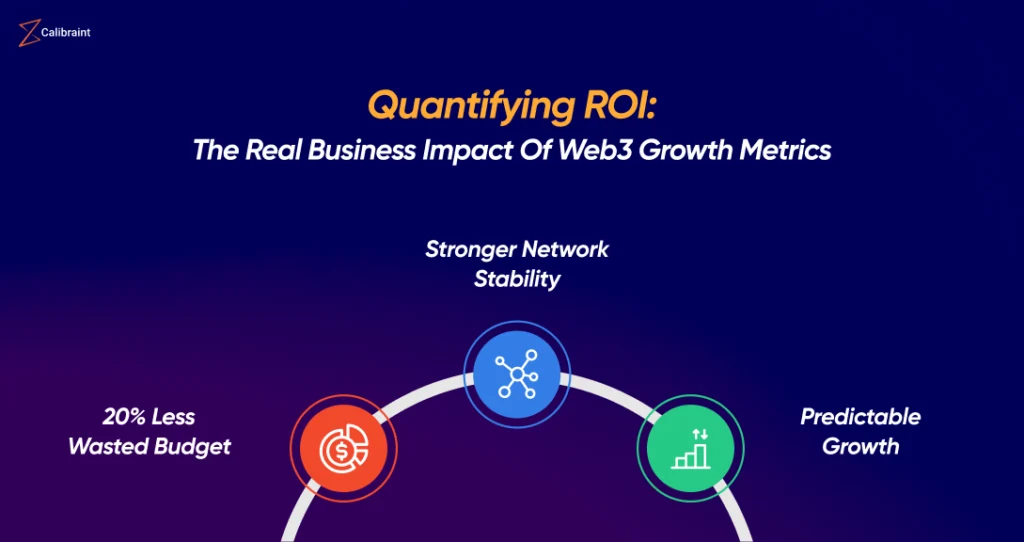
20% Less Wasted Budget: Focusing on CPAW instead of shallow clicks means you stop paying for users who never transact. This precision saves marketing budget.
Stronger Network Stability:Token incentive user economics turn users into contributors who actively secure liquidity and governance, creating a major competitive advantage that traditional companies cannot replicate.
Predictable Growth: Combining Fees + NCV gives you far more accurate long-term forecasting power, a factor institutional investors prioritize.
This is how modern Web3 enterprises build resilient, self-sustaining ecosystems.
Next Steps: Partnering for Sustainable User Acquisition Economics in Web3
The decentralized world rewards teams who treat users not as customers, but as partners.
The question for your enterprise is: Are your current metrics capturing the true value your users bring?
Sustainable token economies and reward models that drive real utility.
Onboarding flows that dramatically increase activation.
Web3-native growth frameworks like AWLV.
We don’t just build DApps; we engineer high-performing digital economies.
Ready to move past outdated thinking and define a winning strategy for your Web3 project?
Connect with our senior consulting team today for a tailored assessment of your Web3 user acquisition cost analysis and explore how our expertise in token incentive user economics can dramatically improve your network’s health and value.
FAQ:
1. What is the main problem with Cost Per Wallet (CPW)?
CPW is misleading. It counts “tourists” (users who drop off after connecting) rather than engaged contributors, wasting up to 65% of the acquisition budget.
2. What is a Core Value Action (CVA) in Web3?
A CVA is the first meaningful, on-chain step a user takes, such as a first deposit, a trade, or a governance vote. It signifies true activation.
3. How do token incentives improve Web3 user acquisition?
Incentives turn customers into co-owners by rewarding valuable participation (liquidity, staking) with tokens, deepening the relationship and ensuring long-term retention.
Calibraint
Author
November 17, 2025
Let's Start A Conversation
Manage Consent
To provide the best experiences, we use technologies like cookies to store and/or access device information. Consenting to these technologies will allow us to process data such as browsing behavior or unique IDs on this site. Not consenting or withdrawing consent, may adversely affect certain features and functions.
Functional
Always active
The technical storage or access is strictly necessary for the legitimate purpose of enabling the use of a specific service explicitly requested by the subscriber or user, or for the sole purpose of carrying out the transmission of a communication over an electronic communications network.
Preferences
The technical storage or access is necessary for the legitimate purpose of storing preferences that are not requested by the subscriber or user.
Statistics
The technical storage or access that is used exclusively for statistical purposes.The technical storage or access that is used exclusively for anonymous statistical purposes. Without a subpoena, voluntary compliance on the part of your Internet Service Provider, or additional records from a third party, information stored or retrieved for this purpose alone cannot usually be used to identify you.
Marketing
The technical storage or access is required to create user profiles to send advertising, or to track the user on a website or across several websites for similar marketing purposes.