AI Systems: Designing Autonomous AI Agents for Enterprise Workflows
Calibraint
Author
February 19, 2026
Enterprise workflows are under quiet strain. Not because systems failed, but because decision velocity collapsed. Leaders sit on layered tools, approvals stretch across departments, and insights stall before action. Many organizations invested heavily in analytics and automation, yet teams still wait on human handoffs to move work forward. This is the gap where AI development matured from isolated tools into systems that think, decide, and act with intent.
Most enterprises did not fail to automate. They automated the wrong layer. Rules executed faster, but judgment stayed fragmented. Approvals stacked. Exceptions multiplied. AI pilots surfaced patterns but stopped at dashboards. The result was operational drag hidden behind modern interfaces.
This is where autonomous AI agents for enterprise workflowsenter the conversation as a structural shift. These systems address how decisions move through organizations, not how tasks get completed. They sit between insight and execution, turning intent into coordinated action across systems while respecting accountability.
This article examines how autonomous AI agents for enterprise workflows are designed, governed, and operationalized inside real enterprises.
The Enterprise Problems Leaders Rarely Say Out Loud
There is a category of operational dysfunction that never appears in quarterly reports. It sits between systems, in the time between a decision being needed and a decision being made, and in the informal knowledge required to move work from one stage to the next.
Fragmented ownership quietly slows large organizations. When a procurement decision requires sign-off from finance, legal, and operations, the delay is not a people issue. It is structural. No single team owns the outcome, so no single team has complete visibility or authority to resolve it quickly.
This is precisely where autonomous AI agents for enterprise workflows create structural relief. They do not replace decision makers. They coordinate context across systems, evaluate policy boundaries, and move work forward when defined conditions are met. When confidence drops, they escalate with clarity rather than stall in silence.
There is also a quieter frustration. Many enterprises pilot advanced AI models that generate accurate forecasts or risk signals. The model performs well. The insight looks promising. Yet the output arrives as a report, a dashboard, or a file that waits for review. Days pass before action follows. By then, market conditions or internal priorities have shifted. The system did not fail because the prediction was wrong. It failed because insight was disconnected from execution.
Well-designed agentic AI workflows close that gap. They connect reasoning to action through defined thresholds and approval logic. Instead of sending information downstream, they assess what should happen next and either trigger the appropriate step or route the decision to the right human owner.
Through Adaptive AI workflow automation, the system adjusts as conditions change. It reevaluates inventory exposure, compliance constraints, or financial limits in real time. It does not rely on static sequences. It adapts within the boundaries leaders define.
What Agentic AI Systems Actually Change
The shift from task automation to outcome ownership is the most important conceptual change enterprise leaders need to internalize. A traditional workflow system asks: What is the next step? An agentic system asks: what is the right outcome, and what path gets there?
This reframing has significant operational implications. Autonomous AI agents for enterprise workflows do not wait to be triggered. They monitor conditions, evaluate context, and initiate action when defined thresholds are met. They adapt when circumstances shift. They track outcomes and revise behavior accordingly.
The gap between automation and agentic AI is not measured in speed or scale. It is measured in judgment. Automation executes what it was designed for. Agentic AI handles what it was not.
Context-aware autonomous decisioning is the engine of this capability. Rather than applying a static rule set to incoming data, the agent assembles a contextual picture from multiple data sources, evaluates that picture against its operational objectives, and selects the highest-confidence action path. This is not intuition. It is structured reasoning at machine speed.
For operations leaders, this means workflows that do not stall at decision points. For finance teams, this means approvals that are completed based on verified conditions rather than email chains. For supply chain heads, this means responses to demand signals that happen in minutes rather than days.
Autonomous AI agents for enterprise workflows do not eliminate human judgment. They reserve it for the decisions that genuinely require it.
Inside an Agentic AI Workflow: Six Layers That Drive Decisions
Understanding how autonomous AI agents for enterprise workflows operate mechanically is essential before any organization commits to designing one. The architecture is not exotic. It is disciplined.
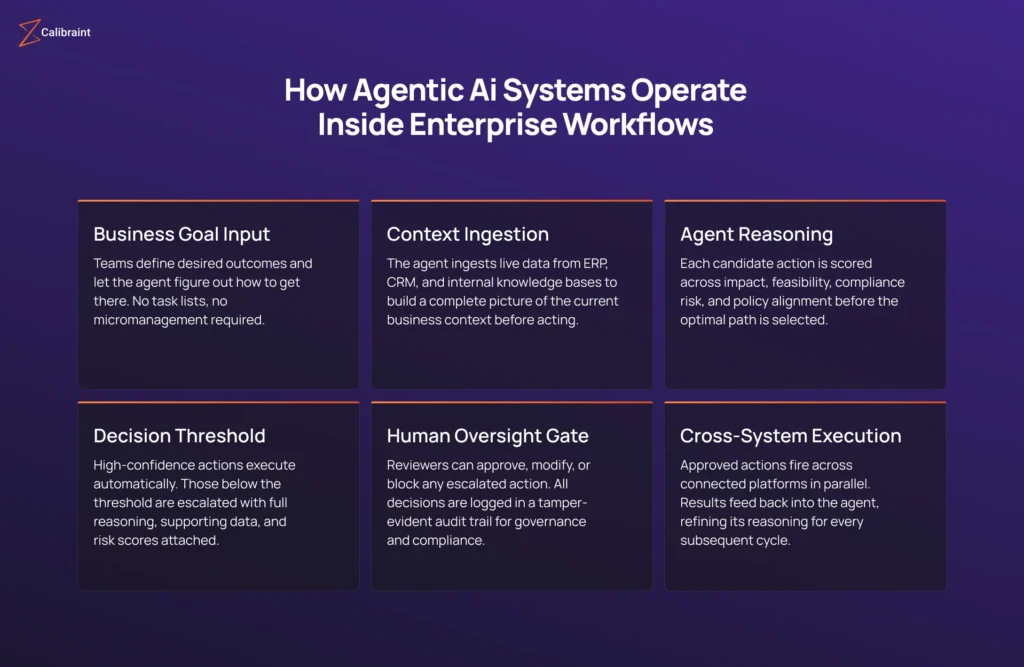
The process begins with business goal input. Leaders define high-level outcomes rather than task sequences. Reduce procurement cycle time by a target percentage. Maintain inventory levels within defined parameters. The agent receives objectives, not instructions.
The Context Ingestion Layer pulls data from every relevant system simultaneously. ERP transaction history, CRM interaction records, real-time market data, and internal policy documents. This data assembly happens continuously, not at scheduled intervals. The agent always has a current picture.
The Agent Reasoning Engine maps available actions against the defined goal. It evaluates each option across feasibility, compliance risk, cost implications, and downstream consequences. It assigns a confidence score to each path.
That confidence score drives the decision confidence threshold, the architectural gate that separates autonomous execution from human escalation. Well-designed agentic systems do not aim for maximum autonomy. They aim for appropriate autonomy. High-confidence, low-risk decisions execute automatically. Complex, novel, or high-stakes decisions route immediately to human review with full supporting context attached.
Human in the loop agent governance sits at the center of this architecture, not at the edges. And the final layer, cross-system execution and feedback, closes the loop. Decisions that execute update the systems of record, trigger downstream processes, and return outcome data to the reasoning engine. The agent learns from what worked.
Human-in-the-Loop Governance: The Architecture of Trust
The organizations that fail with agentic AI do so for a predictable reason. They treat autonomy as the goal rather than the outcome. They deploy agents with minimal oversight infrastructure, encounter an unexpected exception, and spend months rebuilding trust internally.
Human in the loop agent governance is not a constraint on agentic capability. It is what makes agentic capability deployable at enterprise scale.
Every agent decision boundary must be defined before deployment. What can the agent execute without approval? What triggers an escalation? Who receives the escalation? What context does that person need to decide quickly? These are not technical questions. They are governance questions, and they require input from compliance, legal, operations, and risk leadership.
Escalation thresholds should be calibrated based on decision category, financial exposure, regulatory risk, and operational reversibility. An agent managing routine invoice matching operates with broad autonomy. An agent involved in supplier contract modifications operates with narrow autonomy and frequent human checkpoints.
Audit trails are non-negotiable. Every decision the agent makes, whether autonomous or escalated, must be logged with the full reasoning context that produced it. Regulators, auditors, and internal risk teams all require this. Organizations that treat auditability as an afterthought build systems they cannot defend.
Autonomous AI agents for enterprise workflows designed with rigorous governance protocols are not slower or more constrained. They are faster to deploy, faster to earn organizational trust, and faster to scale beyond a single business unit.
Enterprise technology environments are complex by design. A large organization may operate a dozen distinct platforms: ERP for financial operations, CRM for customer relationships, dedicated systems for supply chain, HR, compliance, and risk management. Each holds critical data. Most do not communicate well with each other.
Cross system autonomous API integrations are the connective tissue of an agentic architecture. The goal is not to build point-to-point connections between systems. The goal is to create an orchestration layer that allows an agent to read context from any system, write decisions to any system, and trigger workflows across systems in a coordinated sequence.
This is materially different from traditional API integration. Traditional integrations move data on a schedule or in response to a specific trigger. Agentic orchestration moves data in response to reasoning. The agent determines what information it needs, retrieves it in real time, evaluates it, and acts, all within a single decision cycle.
For a procurement team, this means an agent that checks inventory levels in the ERP, confirms budget availability in the finance system, validates supplier terms in the contract repository, and issues a purchase order, all without a human touching the keyboard.
For a customer operations team, cross-system autonomous API integrations allow an agent to pull account history from CRM, check billing status in the finance platform, consult the knowledge base for resolution precedents, and execute a service action, all while the customer is still on the call.
Autonomous AI agents for enterprise workflows that operate across systems are not integrations. They are operational intelligence layers.
Enterprise technology environments are complex by design. Large organizations operate across ERP platforms for finance, CRM systems for customer engagement, and dedicated tools for supply chain, HR, compliance, and risk management. Each system holds critical context. Few were designed to reason together.
Cross system autonomous API integrations form the connective tissue of an agentic architecture. The objective is not to create brittle point-to-point links. It is to establish an orchestration layer where an agent can read context from multiple systems, apply policy and risk logic, and coordinate actions across platforms as a single decision flow.
This differs fundamentally from traditional integration. Conventional APIs move data on schedules or fixed triggers. Agentic orchestration moves in response to reasoning. The agent determines what information it needs, retrieves it in real time, evaluates tradeoffs, and acts within a single decision cycle.
In procurement, this means an agent that reviews inventory positions in the ERP, validates budget availability in finance, checks supplier terms in the contract repository, and prepares a purchase action without waiting for manual coordination. Human review occurs only when confidence thresholds or policy limits are exceeded.
For customer operations, cross-system autonomous API integrations allow an agent to assemble account history from CRM, confirm billing status, consult resolution precedents, and initiate service actions while the customer interaction is still active. The experience feels continuous because the reasoning is continuous.
Autonomous AI agents for enterprise workflows operating across systems do more than connect applications. They function as orchestration layers that align data, decisions, and execution, turning fragmented enterprise environments into coordinated operational intelligence.
Where Agentic AI Is Heading: From Tools to Infrastructure
Organizations investing in agentic AI systems are moving beyond treating them as mere productivity tools. They are designing them as operational infrastructure, systems that the business will eventually rely on as deeply as ERP platforms or cloud environments.
This shift carries strategic consequences. Enterprises that mature with autonomous AI agents for enterprise workflows gain decision velocity as a capability. They respond faster, adapt more consistently, and reserve human judgment for decisions that truly require experience and accountability. Organizations still relying on layered approvals will see the performance gap widen over time.
Agent maturity unfolds in stages. Early implementations are tightly scoped and closely supervised. As confidence builds, decision boundaries expand. Agents operate across multiple systems, manage richer context, and reason through more complex tradeoffs. This progression rewards discipline over speed.
Success comes from deliberate design. Governance is established first, context architecture follows, and autonomy is introduced only when both are in place. This sequence ensures scalable, trustworthy systems.
Assess Where Agentic AI Fits in Your Workflows
Every enterprise has workflows where delays create friction, such as procurement approvals, customer escalations, or inventory decisions lagging behind demand. These structural bottlenecks are often the first areas where autonomous AI agents for enterprise workflows deliver clear value.
As Calibraint highlights, mapping these workflows with governance in mind ensures safe and effective adoption. Evaluate your key workflows today to discover where agentic AI can accelerate decisions and improve operational efficiency.
FAQs
1. What Are Autonomous AI Agents?
Autonomous AI agents are AI systems that can perform tasks, make decisions, and act independently within defined boundaries. They continuously learn from context to improve performance over time.
2. What are autonomous AI agents in enterprise workflows?
In enterprise workflows, they handle routine or complex tasks across multiple systems, accelerating processes while maintaining accuracy and compliance. This allows teams to focus on strategic work instead of repetitive operations.
3. How do agentic AI systems improve business productivity?
They reduce decision latency, automate repetitive work, and provide actionable insights, freeing humans to focus on high-value tasks. Over time, they help organizations scale processes efficiently without sacrificing quality.
4. Why are enterprises adopting autonomous AI agents in 2026?
Enterprises adopt them to increase operational speed, scale decision-making, and maintain a competitive edge in fast-moving markets. Early adopters gain measurable efficiency and faster response to business challenges.
Calibraint
Author
February 19, 2026
Let's Start A Conversation
Manage Consent
To provide the best experiences, we use technologies like cookies to store and/or access device information. Consenting to these technologies will allow us to process data such as browsing behavior or unique IDs on this site. Not consenting or withdrawing consent, may adversely affect certain features and functions.
Functional
Always active
The technical storage or access is strictly necessary for the legitimate purpose of enabling the use of a specific service explicitly requested by the subscriber or user, or for the sole purpose of carrying out the transmission of a communication over an electronic communications network.
Preferences
The technical storage or access is necessary for the legitimate purpose of storing preferences that are not requested by the subscriber or user.
Statistics
The technical storage or access that is used exclusively for statistical purposes.The technical storage or access that is used exclusively for anonymous statistical purposes. Without a subpoena, voluntary compliance on the part of your Internet Service Provider, or additional records from a third party, information stored or retrieved for this purpose alone cannot usually be used to identify you.
Marketing
The technical storage or access is required to create user profiles to send advertising, or to track the user on a website or across several websites for similar marketing purposes.