AI Development Services in 2026 for Secure Inference Using Encrypted and Isolated Runtime Environments
Calibraint
Author
January 6, 2026
In the current landscape of hyper-integrated digital ecosystems, AI Development Services in 2026 have shifted focus from model accuracy to model integrity. As we navigate the complexities of 2026, the board-level conversation has evolved. It is no longer enough to have a functional LLM or a predictive engine; the question is where that data lives during the millisecond of calculation. AI security is now the primary bottleneck for enterprise scaling, particularly for those integrating AI chatbot app development services into their customer-facing workflows.
The inference phase the moment your proprietary data meets a trained model has become the preeminent attack surface for modern enterprises. In 2026, traditional perimeter security is insufficient because it does not protect data “in use.” Without runtime encryption for AI, sensitive inputs are exposed in plain text within system memory, creating a catastrophic vulnerability. A single breach at the inference layer now triggers massive regulatory penalties under evolved global data acts and, more critically, results in the permanent loss of intellectual property and market trust. To stay competitive, organizations must view secure inference and the broader scope of AI data security not as a technical checkbox, but as a fundamental pillar of corporate risk management.
Who Should Treat Secure AI Execution as a Strategic Priority
This architecture is not for every hobbyist or experimental startup. It is specifically designed for CTOs, Founders, and Heads of Product who handle “high-stakes” data. If your organization operates within fintech, healthcare, defense, or legal tech, the transition to confidential AI in 2026 is mandatory.
Specifically, if your AI roadmap involves processing personally identifiable information (PII), proprietary financial algorithms, or sensitive health records, you cannot afford to proceed with standard cloud deployments. Conversely, if your AI use cases are limited to public data summarization or non-sensitive creative brainstorming, the rigor of isolated AI execution environments may exceed your current needs. However, for the enterprise-scale player, ignoring hardware based AI confidentiality in 2026 is a direct invitation to litigation and operational paralysis.
What Secure AI Execution Changes for Enterprise Economics
AI services provided by Calibraint are engineered to transform security from a cost center into a competitive moat. By implementing AI Development Services in 2026, enterprises can drastically reduce the “risk premium” associated with deploying large-scale models. When your data is protected by runtime encryption for AI, the cost of compliance audits drops significantly because the data is mathematically shielded from the infrastructure provider itself.
Furthermore, confidential AI in 2026 enables a “zero-trust” relationship with cloud vendors. This allows your organization to negotiate better infrastructure rates without being locked into a single provider’s proprietary security stack. By utilizing isolated AI execution environments, you protect your most valuable asset, your IP ensuring that your custom-tuned models cannot be reverse-engineered or leaked during execution. This protection is the ultimate enabler of scale, allowing you to deploy globally without fearing the jurisdictional data-residency traps that stall most AI initiatives.
The Five Enterprise Metrics That Determine Secure AI Readiness
To determine if your organization is prepared for the next generation of AI Development Services in 2026, we evaluate your posture against these five critical metrics:
Inference-Time Data Exposure: What percentage of your data is unencrypted while being processed? Reducing this to zero using runtime encryption for AI is the gold standard for AI chatbot app development services.
Auditability and Compliance Posture: Can you provide a cryptographic proof that no human including your cloud admin accessed the data during inference? This is the core of AI security.
Deployment Flexibility: Is your AI security stack portable, or are you tethered to a specific region? Isolated AI execution environments provide the mobility needed for global operations.
Performance Overhead Tolerance: How much latency can your business logic sustain for the sake of hardware based AI confidentiality in 2026? Modern TEEs (Trusted Execution Environments) have reduced this overhead to negligible levels.
Long-term AI Governance: Do you have a roadmap for confidential AI in 2026 that accounts for post-quantum cryptographic threats?
How Leading Enterprises Are Deploying Confidential AI Today
The following scenarios illustrate how AI Development Services in 2026 are being leveraged to solve complex business challenges:
Financial AI Risk Engines
Risk Before Deployment: Exposure of real-time trade signals to the cloud provider’s memory space.
Secure Execution Approach: Utilizing isolated AI execution environments to run high-frequency risk models.
Business Result: 40% increase in institutional capital allocation due to verified data privacy and hardened AI security.
Investor Analytics Platforms
Risk Before Deployment: Potential leakage of private equity valuations during multi-party data synthesis.
Secure Execution Approach: Implementing runtime encryption for AI to ensure that data from different limited partners remains siloed even during joint analysis.
Business Result: Secured “Preferred Tech” status with Tier-1 banks by meeting 2026’s strictest confidentiality benchmarks.
Institutional Decision-Support Systems
Risk Before Deployment: Unauthorized access to executive-level strategic simulations.
Secure Execution Approach: Deployment of hardware based AI confidentiality in 2026 via secure enclaves.
Business Result: 100% elimination of internal data leakage incidents during the 2025-2026 fiscal cycle.
Execution Blueprint: From Architecture to Production
At Calibraint, our delivery model for AI Development Services in 2026 is built on the principle of “Verifiable Trust.” We don’t ask you to trust our code; we ask you to trust the math. Our architecture centers on creating isolated AI execution environments that act as “black boxes” where even the OS kernel cannot see the processing logic.
We focus on establishing strict trust boundaries. By leveraging hardware based AI confidentiality in 2026, we ensure that the decryption keys never leave the secure enclave. This operational resilience ensures that even if the host environment is compromised, your AI model and its data remain encrypted and inaccessible. This is the hallmark of professional AI security in the modern era.
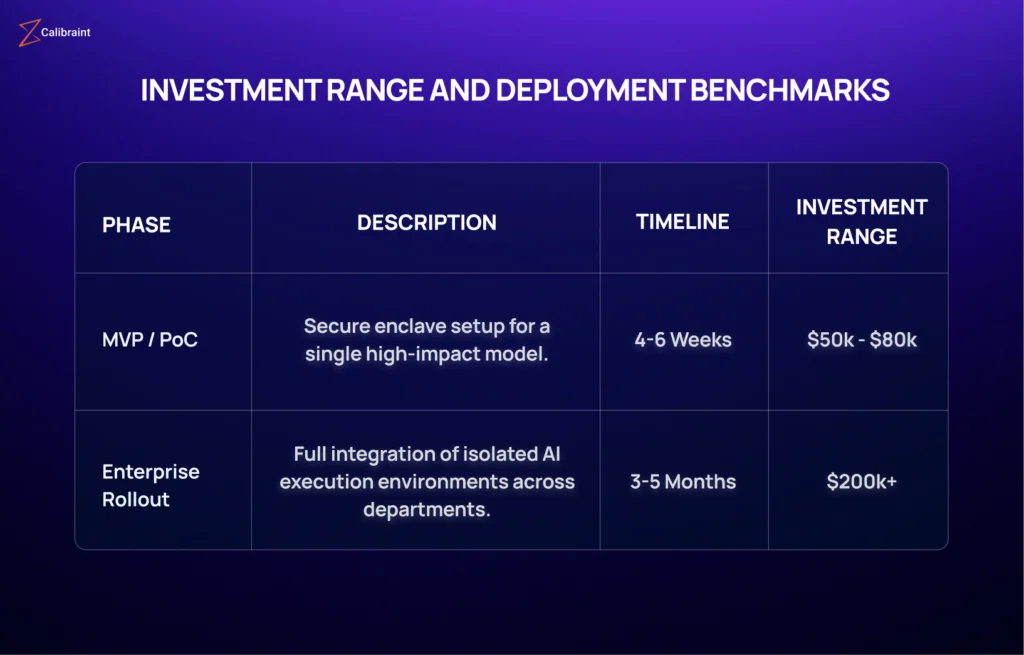
Investment Range and Deployment Benchmarks
Transitioning to confidential AI in 2026 requires a strategic investment. While costs vary based on model complexity, a typical enterprise rollout follows this trajectory:
The internal effort required from your team is minimal; Calibraint’s AI Development Services in 2026 handle the heavy lifting of cryptographic integration, allowing your data scientists to focus on model performance while we handle the runtime encryption for AI.
Where Enterprises Fail When Implementing Secure AI Alone
Many organizations attempt to bootstrap AI security and fail due to common pitfalls:
Treating Security as a Cloud Feature: Assuming your cloud provider’s default settings provide confidential AI in 2026.
Ignoring Inference-Time Risks: Protecting data at rest but leaving it “naked” during the inference call.
Overengineering without Governance: Building complex isolated AI execution environments that don’t align with actual regulatory requirements.
Underestimating Compliance: Failing to realize that AI Development Services in 2026 require specific cryptographic logging for audit trails.
Why Enterprises Choose Calibraint for Secure AI Execution
AI services from Calibraint are backed by years of experience in regulated industries. We understand that in 2026, a breach isn’t just a technical failure; it’s a threat to your company’s existence. By integrating hardware based AI confidentiality in 2026 into the core of your product, we provide the peace of mind necessary to innovate at speed.
We invite you to explore our deep-dive resources on confidential AI architectures and how we implement runtime encryption for AI for our global partners. Our outcome-driven delivery ensures that your AI Development Services in 2026 are not just secure, but also performant and scalable, outperforming standard AI chatbot app development services that lack runtime protection.
Your Next Step Toward Production-Ready Confidential AI
The window for gaining a “security-first” advantage is closing. As AI security becomes the standard, the early adopters of AI Development Services in 2026 will be the ones who capture the most sensitive and lucrative market segments.
Secure AI inference is the process of running a trained model on live data while ensuring that neither the input data nor the model’s internal logic is exposed to unauthorized parties. In 2026, it specifically refers to protecting data “in-use” during the millisecond of calculation, preventing leaks in system memory that traditional encryption at-rest or in-transit cannot stop.
2. How do encrypted runtime environments protect AI models in 2026?
These environments use runtime encryption for AI to keep data encrypted even while being processed by the CPU or GPU. By creating a cryptographically shielded workspace, they ensure that sensitive proprietary algorithms and user data remain invisible to the underlying operating system, cloud provider, or any malicious actor with physical access to the server.
3. What is confidential computing for AI?
Confidential computing for AI is a hardware-based security technology that isolates AI workloads in a “Trusted Execution Environment” (TEE). It provides a verifiable “black box” where execution is protected from the rest of the system. This allows enterprises to deploy confidential AI in 2026 on public cloud infrastructure with the guarantee that their most sensitive IP remains entirely private and tamper-proof.
Calibraint
Author
January 6, 2026
Let's Start A Conversation
Manage Consent
To provide the best experiences, we use technologies like cookies to store and/or access device information. Consenting to these technologies will allow us to process data such as browsing behavior or unique IDs on this site. Not consenting or withdrawing consent, may adversely affect certain features and functions.
Functional
Always active
The technical storage or access is strictly necessary for the legitimate purpose of enabling the use of a specific service explicitly requested by the subscriber or user, or for the sole purpose of carrying out the transmission of a communication over an electronic communications network.
Preferences
The technical storage or access is necessary for the legitimate purpose of storing preferences that are not requested by the subscriber or user.
Statistics
The technical storage or access that is used exclusively for statistical purposes.The technical storage or access that is used exclusively for anonymous statistical purposes. Without a subpoena, voluntary compliance on the part of your Internet Service Provider, or additional records from a third party, information stored or retrieved for this purpose alone cannot usually be used to identify you.
Marketing
The technical storage or access is required to create user profiles to send advertising, or to track the user on a website or across several websites for similar marketing purposes.