Why 95% of Enterprise AI Pilots Fails to Scale and Deliver ROI Pratical RoadMaps for Production-Ready Impact
Calibraint
Author
March 3, 2026
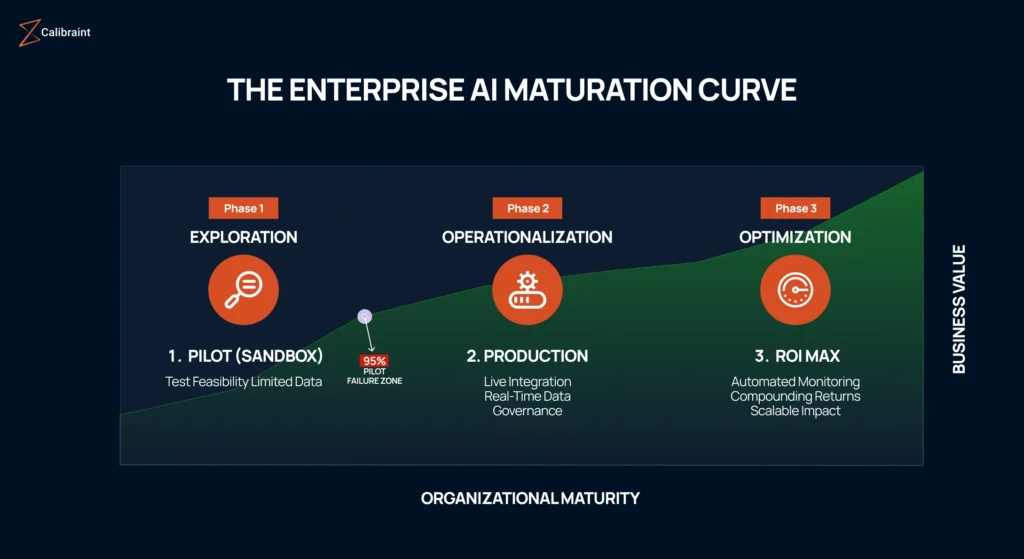
The corporate world currently finds itself in a cycle of expensive experimentation. The corporate world currently finds itself in a cycle of expensive experimentation. Industry research from leading consulting firms suggests that most enterprise AI initiatives struggle to transition from pilot to scaled production, despite increasing investment and executive attention. The reason is rarely the technology itself. Most organizations possess the computational power and the data scientists required to build a functional model. The breakdown occurs at the intersection of operational reality and strategic scaling.
In the current market, AI development requires a departure from the traditional software lifecycle. When a project remains siloed within a laboratory setting, it lacks the biological necessity to adapt to real-world friction. Most organizations treat their first foray into machine learning as a science project rather than a core business asset. To survive the transition, leadership must adopt a rigorous enterprise AI pilot to production roadmap that prioritizes operational integration over mere algorithmic accuracy.
This guide dissects the structural barriers to growth and provides the architectural requirements for a production-ready ecosystem.
The Structural Paradox of the Pilot Phase
The pilot phase exists to validate feasibility. It reduces scope, simplifies data, and isolates risk. That focus serves a purpose. However, the same conditions that enable a proof of concept often conceal the barriers that emerge in production.
This is the fundamental distinction between an AI proof of concept vs production.
A proof of concept answers whether a model can generate accurate outputs under curated conditions. Production demands reliability, security, scalability, and financial accountability across the full enterprise ecosystem.
When leadership treats early technical success as operational readiness, scaling becomes fragile. A mature enterprise AI pilot to production roadmap recognizes that the transition from pilot to production is not an extension of experimentation. It is a redesign of architecture, governance, and cost structure.
Organizations that fail to distinguish between AI proof of concept and production expectations often allocate budgets incorrectly and misjudge timeline requirements. The result is prolonged stagnation.
Data Integrity and the Drift Problem
During the pilot phase, teams frequently rely on static datasets. In production, data flows continuously across business units, regions, and regulatory boundaries. Statistical properties shift. User behavior evolves. Market conditions change.
If AI development does not include real-time monitoring and retraining protocols, model performance declines silently. This phenomenon remains one of the most persistent enterprise AI scaling challenges facing leadership teams.
A production-ready enterprise AI pilot to production roadmap dedicates significant attention to data engineering, validation pipelines, and drift detection systems. Infrastructure maturity becomes as critical as model accuracy.
Organizations that underestimate this requirement often discover that a high-performing pilot deteriorates rapidly once exposed to real operational variability.
Measuring What Matters: Financial Accountability
Technical metrics rarely persuade executive leadership. Accuracy percentages, precision scores, and recall rates provide engineering insight but limited financial clarity.
Understanding how to measure ROI of enterprise AI requires translating technical outcomes into economic value.
A rigorous enterprise AI pilot to production roadmap defines financial baselines before implementation begins. Without a clearly documented pre-deployment state, post-deployment improvements remain anecdotal.
Direct Economic Impact
Automation initiatives typically generate measurable cost displacement. Examples include reduced manual processing hours or lower operational error rates. These impacts should tie directly to expense line items.
Indirect Strategic Impact
Predictive analytics systems often deliver resilience rather than immediate cost savings. Supply chain forecasting, fraud detection, and risk modeling reduce exposure to future losses. Although indirect, these gains hold substantial enterprise value.
To effectively determine how to measure ROI of enterprise AI, organizations must categorize expected outcomes before scaling decisions. Clarity in value attribution strengthens executive confidence and funding continuity.
Technical Debt and the Economics of Scale
Scaling requires more than increasing user access. It requires re-engineering of underlying systems.
One overlooked enterprise AI scaling challenges involves technical debt accumulated during experimentation. Pilot projects frequently rely on manual scripts, provisional cloud environments, and unoptimized compute resources. These shortcuts accelerate testing but become unsustainable at scale.
Inference cost becomes central at production levels. A model that performs well but requires excessive computational resources can erode margins. A disciplined enterprise AI pilot to production roadmap includes optimization for cost efficiency alongside performance evaluation.
This stage differentiates AI proof of concept vs production maturity. Production systems must operate within predictable financial parameters.
Security obligations expand significantly once systems move beyond experimentation. Production environments handle sensitive customer data, financial transactions, and operational records.
Governance frameworks must define ownership of model outputs, monitoring thresholds, and escalation procedures. Questions surrounding accountability require clear answers before enterprise-wide deployment.
Strong AI development integrates security reviews, compliance checks, and audit documentation into early phases of the enterprise AI pilot to production roadmap. Retrofitting governance after deployment increases risk and delays scale.
Organizations that treat governance as an afterthought frequently encounter regulatory friction that disrupts momentum.
A Framework for Sustainable Scaling
Sustainable success requires a repeatable methodology. The following framework supports a disciplined enterprise AI pilot to production roadmap built for long-term impact.
Step 1: Value-First Audit
Begin with business-critical pain points. Identify operational bottlenecks that materially affect cost, risk, or revenue. Align executive sponsorship with clearly defined economic outcomes.
If the initiative does not address a measurable business priority, it will struggle to justify expansion.
Step 2: Integration-Centered Design
Adoption drives impact. Systems that require separate workflows or manual data uploads rarely sustain engagement.
Successful AI development embeds intelligence within existing operational tools. Integration reduces friction and addresses one of the most difficult enterprise AI scaling challenges: behavioral resistance.
Step 3: Continuous Feedback Architecture
Production systems require structured feedback loops. Subject matter experts must validate outputs and correct errors. These corrections refine future model performance.
This evolutionary capability distinguishes AI proof of concept vs production systems. A proof of concept demonstrates static performance. A production system improves over time.
A mature enterprise AI pilot to production roadmap institutionalizes feedback rather than treating it as optional.
Cultural Architecture and Organizational Trust
Technology alone does not determine success. Organizational behavior plays a decisive role.
Resistance often emerges when teams perceive automation as displacement. Transparent communication clarifies that artificial intelligence augments rather than replaces strategic judgment.
Cross-functional literacy further strengthens scaling efforts. Finance teams should understand technical cost drivers. Engineering teams should understand revenue structures and margin expectations. This shared understanding clarifies how to measure ROI of enterprise AI and reduces friction during budgeting cycles.
Cultural readiness often defines whether enterprise AI scaling challenges become manageable or obstructive.
The boundary between conventional software and intelligent systems continues to narrow. Enterprises increasingly treat artificial intelligence as infrastructure rather than experimentation.
In this context, an enterprise AI pilot to production roadmap becomes an operational blueprint rather than a project plan. It governs capital allocation, compliance alignment, data governance, and performance management.
Organizations that institutionalize this approach convert early experimentation into a durable advantage. Those who do not remain in perpetual pilot mode.
Conclusion: The Mandate for Scale
The journey from a promising pilot to a production-ready AI system is complex, but the potential rewards are transformational. Organizations that implement a disciplined enterprise AI pilot to production roadmap can convert early experimentation into measurable business outcomes, achieving operational efficiency, risk reduction, and revenue impact.
Success requires clear, structured actions:
Standardize AI development processes to ensure consistency across teams and business units.
Define how to measure ROI of enterprise AI using business-centric KPIs that align with financial and strategic objectives.
Proactively address enterprise AI scaling challenges, including data drift, infrastructure gaps, and cultural resistance.
Maintain a clear distinction between AI proof of concept vs production, ensuring that pilots evolve into sustainable systems rather than permanent prototypes.
At Calibraint, we have guided complex enterprises through the design and execution of production-ready AI roadmaps. Our approach focuses on creating high-performance, secure, and ROI-driven AI development ecosystems that thrive beyond the lab, delivering real business impact across operations.
Let’s explore your specific use case and build a roadmap that leads to measurable impact.
FAQs
1. Why do most enterprise AI pilots fail to scale?
Most enterprise AI pilots fail to scale because organizations treat them as technical experiments rather than operational transformations. Common enterprise AI scaling challenges include poor data integration, lack of governance planning, unclear ownership, and failure to define how to measure ROI of enterprise AI before deployment. Without a structured enterprise AI pilot to production roadmap, early success rarely translates into sustainable enterprise impact.
2. What is the difference between an AI pilot and production-ready enterprise AI?
The difference between AI proof of concept vs production lies in scope and accountability. An AI pilot validates feasibility in a controlled environment with limited data and users. Production-ready enterprise AI operates across integrated systems, includes governance and security frameworks, supports real-time monitoring, and delivers measurable business outcomes through a defined enterprise AI pilot to production roadmap.
3. How can enterprises successfully scale AI from pilot to production?
Enterprises scale AI successfully by formalizing a disciplined enterprise AI pilot to production roadmap. This includes aligning initiatives with clear business objectives, addressing enterprise AI scaling challenges early, embedding governance and monitoring systems, and establishing financial benchmarks to measure ROI of enterprise AI. Scaling succeeds when AI moves from isolated experimentation to structured operational capability.
Calibraint
Author
March 3, 2026
Let's Start A Conversation
Manage Consent
To provide the best experiences, we use technologies like cookies to store and/or access device information. Consenting to these technologies will allow us to process data such as browsing behavior or unique IDs on this site. Not consenting or withdrawing consent, may adversely affect certain features and functions.
Functional
Always active
The technical storage or access is strictly necessary for the legitimate purpose of enabling the use of a specific service explicitly requested by the subscriber or user, or for the sole purpose of carrying out the transmission of a communication over an electronic communications network.
Preferences
The technical storage or access is necessary for the legitimate purpose of storing preferences that are not requested by the subscriber or user.
Statistics
The technical storage or access that is used exclusively for statistical purposes.The technical storage or access that is used exclusively for anonymous statistical purposes. Without a subpoena, voluntary compliance on the part of your Internet Service Provider, or additional records from a third party, information stored or retrieved for this purpose alone cannot usually be used to identify you.
Marketing
The technical storage or access is required to create user profiles to send advertising, or to track the user on a website or across several websites for similar marketing purposes.